Category Archives: Uncategorized

Composition And Method For The Repair And Regeneration Of Cartilage And Other Tissues

Me: There is two patents I found that has the proposed ideas on how we can possibly inject dna mutated chondrocytes into the epiphysis of the femur and tibia to stimulate mesenchymal stem cells to differentiate into chondrocytes correctly.

Analysis:

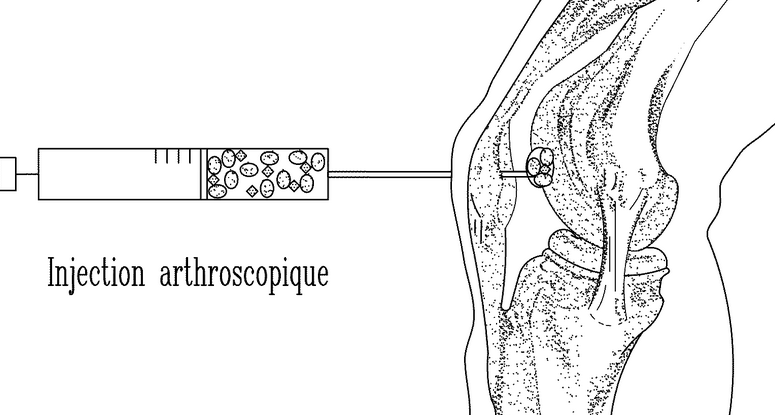
For Patent 1 – Only a picture of the idea below was used. The idea as always to combine a type of gel system with growth factors in it and have extracted and regrown chondrocytes implanted in it. Then the entire piece is then implanted into a bone defect or fracture or cartilage to heal it.

For Patent 2 – we have a mixture to heal articular cartilage defects comprising of these components through implantation. There are two main pieces. In essence, it is a proliferating chondrocyte cell structure having phenotypic capability embedded in a vehicle or gel.

The first peice is the extracted and cultured chondrocytes of a certain packing density. This is bone marrow derived chondrocytes or osteoblasts of autologous or homologous origin, or homologous committed chondrocytes, or autologous or homologous muscle fibroblast derived chondrocytes or any other progenital cells from mesenchymal origin

The second part is a a biodegradable, biocompatible, biological resorbable immobilization vehicle (BRIV) adhesive glue. This is made of the following compounds

  • fibrinogen (100-150 mg/ml)
  • thrombin (60-90 units/ml)
  • CaCl₂ (an excess of 60 mM CaCl₂.)
  • protease inhibitor (selected from the group consisting of polysaccharide inhibitors, plasma protease inhibitors, and synthetic and natural non-plasma protease inhibitors)
  • about 10-30% serum (selected from fetal calf serum or umbilical cord serum from the second trimester or horse serum or any combination of such serums. may optionally contain growth factors such as IGFI, IGFII, TGFB, PDGF, or any other growth factors that will be found to facilitate the proliferation of the cells)

The chondrocyte population is embedded in the biological glue at a concentration of between from 100,000 to 500,000 cells per milliliter of glue.
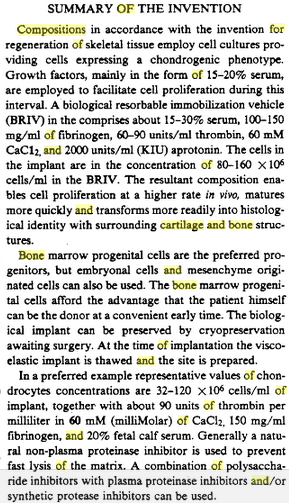
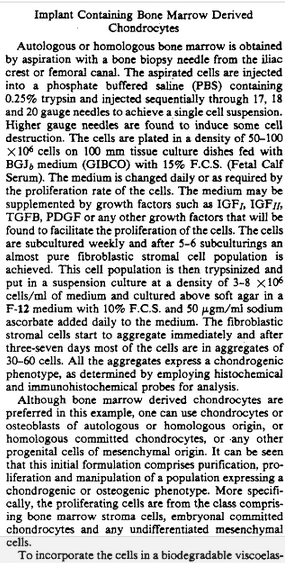
For Patent 3 – Patent #3 was written by the same guy who wrote up patent #2 and he wrote it because it turns out patent #2 had a few limitations that was later found out from experiments. It was believed that for the greatest ability in chondrocyte proliferation the best type was embryonic. However this meant the right type of cells was hard to get and there was also the problem with immune system reactions. It would turn out that the concentration limits for the chondrocyte density in gel, the thrombin, and the fibrinogen were not good in actual experimental testing. The compositions and procedures were changed. I have decided just to slip the sections of the patent to the right and left. We can see that overall, the Patent #3 is an improved version to Patent #2 where this has been shown to be more experimentally feasible in causing more chondrocyte proliferation.

Implications: These patents show what exactly would have to go into a gel/resin and cultured cell pellet combination to make any idea of implanted chondrocytes to work out. The way to administer it would be relatively non-invasive through a small syringe with the loaded material going through the knee


Patent #1: Composition and method for the repair and regeneration of cartilage and other tissues (US8258117 B2) (Patent #1 link)

Patent Information:

Issue No. US8258117B2
Application Number 12/901, 293
Public date September 4, 2012
Filing Date October 8, 2010
Inventor
Michael D. Buschmann

2 more »

Applicants
Piramal Healthcare (Canada) Ltd

5 more »

United States Patent and Trademark Office patent classification 514/54

Patent #2: Composition for repair of cartilage and bone and method for their preparation as skeletal tissue implant (EP0339607 B1) (Patent #2 link)

A composition for the regeneration of articular cartilage and bones by implantation comprising bone marrow derived chondrocytes or osteoblasts of autologous or homologous origin, or homologous committed chondrocytes, or autologous or homologous muscle fibroblast derived chondrocytes or any other progenital cells from mesenchymal origin and a biodegradable, biocompatible, biological resorbable immobilization vehicle (BRIV) adhesive glue consisiting of fibrinogen, thrombin, CaCl₂, protease inhibitor, and about 10-30% serum, characterized in that said composition contains from 80-160 x 10⁶ cells/ml of BRIV. (From Patent)

Me: Also from the same Inventor Dr. Sam Itay…

Patent #3: Compositions for repair of cartilage and bone (Patent #3 link) [Note: I have already talked about this invention in a previous post]

A defect is provided in cartilage or bone, or both, to excize damaged or pathological tissue, and it is filled with an implant having capability for complete regeneration of the skeletal tissue as a chondrogenic or osteogenic phenotype. The implant comprises cells expressing a chondrocyte phenotype (80.times.10.sup.6 cells/ml) embedded in a biocompatible matrix having about 20% serum, which provides a permissive environment for maturation and transformation of the implant to a fully integrated state with the surrounding tissue. A portion of the implant may comprise a bone segment or a bone substitute.

This is a picture of the patent idea from patent #1.
Growth Hormones Exert A Direct Stimulatory Effect On Epiphyseal Cartilage And Stimulates Longitudinal Bone Growth Directly

Me: I think it is time to put the questioning of whether the hGH in the human body directly stimulated the epiphyseal plate for longitudinal growth to be answered conclusively. It does.

From article 1…

We see that chondrocytes from the tested rat’s epiphyseal plates are removed and cultured using calf serum. The thing to note is that to make the condrocyte colonies one needs the serum. There is also a strong correlation in terms that the number of colonies formed is directly proportional to the concentration of the calf serum. Overall we see that we need all three factors of

  1. Number of initial seeded chondrocytes
  2. Have enough 10-15% newborn calf serum
  3. Having around 10-40 ng/ml of hGH
They will allow for the best formation of chondrocyte colonies. The researchers conclude that “These results show that GH potentiates colony formation in chondrocytes of the epiphyseal growth plate, providing further support for the contention that GH exert a direct stimulatory effect on epiphyseal cartilage and thus stimulates longitudinal bone growth directly.” also…”The finding that GH preferentially potentiated the formation of large size colonies suggests that GH promoted the differentiation of early proliferative chondrocytes or stem cell chondrocytes with an inherent high capacity to proliferate.” This seems to suggest that the GH also has two really big functions to progenitor cells and proliferative chondrocytes, first in differentiating the progenitor cells into chondrocytes and then in helping lead to to chondrocyte proliferation.

From article 2…

We see that both hGH and IGF-1 both lead to increased cloning efficiency. What is even more interesting is that IGF-1 when used after the pretreatment of the chondrocytes by GH lead to a far greater effect of cloning efficiency. The researchers concluded that …” The results of the present study show that pretreatment of hypophysectomized rats with GH, but not with IGF-I, promotes the formation of chondrocyte colonies and make the chondrocytes susceptible to IGF-I in vitro. The results suggest that GH induces colony formation by IGF-I-independent mechanisms and that IGF-I is a second effector in GH action as previously shown

From article 3…

This study was designed to investigate whether growth hormone (GH) influences the expression of its own receptor in chondrocytes. To investigate this possibility GH-receptor mRNA was measured in cultured rat epiphyseal chondrocytes in the absence or presence of GH under various experimental conditions. The researchers concluded that “GH specifically regulates mRNA levels for its own receptor in rat epiphyseal chondrocytes by interacting with somatogenic binding sites. These findings also suggest a transcription-dependent regulatory system between the GH-receptor and the GH-receptor gene.”

Implications: It seems that GH can be used to cause cell colony formation and is the first hormone that is usually used to stimulate epiphyseal plate chondrocytes. THe IFG-1 pathway is independent of it’s pathway. It seems that the GH causes it’s own receptors to form by turning it’s own receptor genes on.

From PubMed article 1 link HERE


Endocrinology. 1986 May;118(5):1843-8.

Growth hormone potentiates colony formation of epiphyseal chondrocytes in suspension culture.

Lindahl A, Isgaard J, Nilsson A, Isaksson OG.

Abstract

The effect of human GH (hGH) on colony formation of rat epiphyseal plate chondrocytes was studied in suspension culture. Chondrocytes were isolated enzymatically from epiphyseal plates of the proximal tibia of 28-day-old normal male rats, and were cultured in a suspension stabilized with 0.5% agarose. After approximately 7 days of culture in the presence of 10% newborn calf serum (NCS), chondrocyte colonies developed consisting of varying numbers of cells in matrix. No colonies developed in the absence of NCS, and the number of formed colonies was proportional to the concentration of NCS (5-20%) in the medium. hGH potentiated the formation of large size colonies (diameter greater than 90 microns) after a culture period of 10 or 14 days. The lowest effective concentration of hGH was 10 ng/ml, while 40 ng/ml hGH gave a maximal stimulatory effect (40-50%). Higher concentrations of hGH (80 and 160 ng/ml) showed reduced potentiation of colony formation. The stimulatory effect of hGH was expressed at 10-15% of NCS at 14 days of culture. There was a linear relation between the number of seeded cells and the number of colonies formed, both in the absence and presence of hGH. These results show that GH potentiates colony formation in chondrocytes of the epiphyseal growth plate, providing further support for the contention that GH exert a direct stimulatory effect on epiphyseal cartilage and thus stimulates longitudinal bone growth directly. The finding that GH preferentially potentiated the formation of large size colonies suggests that GH promoted the differentiation of early proliferative chondrocytes or stem cell chondrocytes with an inherent high capacity to proliferate.

PMID: 3698898     [PubMed – indexed for MEDLINE]

From PubMed article 2 link HERE


Endocrinology. 1987 Sep;121(3):1070-5.

Growth hormone in vivo potentiates the stimulatory effect of insulin-like growth factor-1 in vitro on colony formation of epiphyseal chondrocytes isolated from hypophysectomized rats.

Lindahl A, Isgaard J, Isaksson OG.

Abstract

The effect of GH pretreatment in vivo on the colony formation of epiphyseal chondrocytes from hypophysectomized rats and the subsequent responsiveness to insulin-like growth factor (IGF-I) was studied in vitro. Chondrocytes from epiphyseal growth plates of the proximal tibia of 36-day-old hypophysectomized rats were enzymatically isolated and cultured in suspension, stabilized with agarose (0.5%) in Ham’s F-12 medium and serum supplement. After 14 days the cultures were terminated and screened for cloning efficiency (number of colonies with a diameter greater than 56 microns/1000 seeded cells) and for distribution of cloning efficiency as a function of colony size. Pretreatment with human GH in vivo for 24 h (10 micrograms X 3) increased the cloning efficiency during the subsequent culture period (control, 1.5 +/- 0.1; human GH, 4.4 +/- 0.3). Addition of IGF-I to the chondrocyte cultures from control rats caused a slight increase in cloning efficiency (control, 1.5 +/- 0.1; IGF-I, 2.2 +/- 0.3) but caused a marked increase in chondrocyte cultures from GH-pretreated rats (control, 4.4 +/- 0.4; IGF-I, 8.2 +/- 0.9). The cloning efficiency was increased 12 and 24 h, but not 4 h, after start of GH-treatment in vivo. The increased responsiveness to IGF-I in vivo showed a similar time course after GH pretreatment. The distribution of cloning efficiency was altered in cultures of chondrocytes isolated from the GH-pretreated rats; large colonies were overrepresented in the GH-treated group. Colonies with a diameter exceeding 180 microns were only seen in cultures of chondrocytes isolated from the GH-pretreated animals. Addition of IGF-I in vitro did not alter the distribution of cloning efficiency, but increased the mean colony size of all colonies. Pretreatment of the rats with two different doses of IGF-I in vivo for 24 h (5 micrograms X 3 or 50 micrograms X 3) had a slight stimulatory effect on subsequent colony formation, but no potentiation of IGF-I in vitro was demonstrated. The results of the present study show that pretreatment of hypophysectomized rats with GH, but not with IGF-I, promotes the formation of chondrocyte colonies and make the chondrocytes susceptible to IGF-I in vitro. The results suggest that GH induces colony formation by IGF-I-independent mechanisms and that IGF-I is a second effector in GH action as previously shown for cultured 3T3-preadipose cells.(ABSTRACT TRUNCATED AT 400 WORDS)

PMID: 3622376    [PubMed – indexed for MEDLINE]
From PubMed article 3 link HERE

Mol Cell Endocrinol. 1990 May 7;70(3):237-46.

Growth hormone regulation of the growth hormone receptor mRNA in cultured rat epiphyseal chondrocytes.

Nilsson A, Carlsson B, Mathews L, Isaksson OG.

Source

Department of Physiology, University of Göteborg, Sweden.

Abstract

This study was designed to investigate whether growth hormone (GH) influences the expression of its own receptor in chondrocytes. To investigate this possibility GH-receptor mRNA was measured in cultured rat epiphyseal chondrocytes in the absence or presence of GH under various experimental conditions. Chondrocytes were isolated enzymatically from epiphyseal growth plates of the proximal tibia of 20-day-old male rats and cultured in monolayer in Ham’s F-12 medium supplemented with 10% calf serum and 1% of a serum substitute. The cells were seeded at various densities (100,000-1,000,000 cells per flask) and cultured for 14 days. Subsequently, the calf serum-containing medium and the cells cultured for various periods of time (0-24 h) before total nucleic acid preparation. GH-receptor mRNA was measured with a solution hybridization technique using [35S]UTP-labeled RNA growth hormone receptor cloned from rat liver cDNA. Human GH (hGH; 50 ng/ml) increased GH-receptor mRNA after 3 h and maximal levels were seen 12 h after GH addition. This effect of hGH was time and dose dependent with a significant effect of hGH at a concentration of 0.5 ng/ml and a maximal effect at 50 ng/ml. The hGH-stimulated increase of GH-receptor mRNA was completely blocked by actinomycin-C1 (1.0-0.1 micrograms/ml), while cycloheximide (10 micrograms/ml) only slightly counteracted the hGH effect. Rat and human GH were equally potent, and ovine prolactin was effective at 500 ng/ml but not 5 and 50 ng/ml. A high dose of insulin-like growth factor-I (IGF-I; 1 microgram/ml) caused a small stimulatory effect and addition of 10% calf serum caused a marked increase in GH-receptor mRNA. The level of GH receptor mRNA after 14 days of culture was inversely proportional to the cell density at the start of culture. These results show that GH specifically regulates mRNA levels for its own receptor in rat epiphyseal chondrocytes by interacting with somatogenic binding sites. These findings also suggest a transcription-dependent regulatory system between the GH-receptor and the GH-receptor gene.

PMID: 1694505    [PubMed – indexed for MEDLINE]

Epiphyseal Plate Transplantation Through Vascularization (Breakthrough!)

Me: This is one of those posts that puts ideas into one’s head on what is possible biomedically. The study shows that one can transplant epiphyseal plates into host bodies as long as it is kept vascularized. The term vascularized just means that it has blood vessels going in and out of it keeping it feed with incoming nutrients and has a way to remove the waste. One big question I have had since reading Dr. Brighton’s detailed description of the plates was exactly how the blood vessels are distributed along the layers of the plate. We know that the resting zone is the most critical since it is where everything starts and is also the true determining area for how much longitudinal growth is possible. It also has at least 2 growth factors which determine the chondrocytes to start stacking in columns when they get to the proliferative zone.

There was 4 ways the researchers were testing to see the longitudinal growth.

  1. Serial roentgenograms – a time distribution of photographs made with x-rays
  2. Histological examination – using microscope to analyze the cells
  3. Fluorescent bone-labeling – sounds just like what it is
  4. Microangiography – Radiography of the minute blood vessels of an organ obtained by injection of a contrast medium and enlargement of the resulting radiograph

Implications: This study has proved that growth plate transplantation is completely possible, as long as you keep the chondrocytes fed through vascularization.

From PubMed study link HERE… (For a copy of the Full Text PDF click HERE)


J Bone Joint Surg Am. 1984 Dec;66(9):1421-30.

Free microvascular epiphyseal-plate transplantation. An experimental study in dogs.

Nettelblad H, Randolph MA, Weiland AJ.

Abstract

To evaluate the feasibility of transplanting vascularized epiphyseal plates while maintaining normal growth in the recipient site, twenty-two puppies from known, large breeds were divided into one control and three experimental groups of four animals each and one long-term group of six animals. The control group underwent insertion of a radiopaque marker in the fibular metaphysis bilaterally, and, in addition, a fibular osteotomy was performed on one side. In the experimental groups, a fibular switch was carried out, selecting one fibula as a vascularized graft and the other as a non-vascularized graft. Both the controls and the experimental groups were evaluated using serial roentgenograms, histological examination, fluorescent bone-labeling, and microangiography. One week, six weeks, three months, and seven months postoperatively, animals from each group were killed. Continuous growth was observed in the vascularized epiphyseal transplants and in the controls, with no statistical difference noted, whereas the non-vascularized transplants exhibited considerably less or no growth. Vascularized transplants demonstrated an average 21.2-millimeter increase in length while non-vascularized transplants showed a 6.6-millimeter increase. Histological examination, fluorochrome bone-labeling, and microangiography confirmed the continued viability of the vascularized epiphyseal transplants in contrast to the non-vascularized transplants.

PMID: 6501338    [PubMed – indexed for MEDLINE]

Former Tallest Women In The World Yao Defen Died

I was not aware of this news until a few minutes ago. I am a frequent visitor to the site TheTallestMan.com and I found out from visiting the forum that the tallest female in the world had died about a week ago at the age of 41 from some “acute ailment” as the posters claimed (source HERE).

I got the news from this story article HERE. I can’t read Chinese but the people at the Tallest Man website confirmed her passing.

This for me is really, really sad news because I really felt her pain from seeing how her life was going in recent years being subjected to brain surgery. I was able to look past her face and I realized that if you can look past the Acromegaly enhanced face features, she was a very beautiful women. The pictures of her when she was younger showed that she was very pretty.

It just goes to show you that sometimes being tall is not a good thing but can lead to great misery and pain. If we going to chase this dream for increased height, I hope we are chasing for this dream for the right reasons.

As for who can claim the title of “World’s Tallest Women” now we see that Margo Dydek passed away in recent years. So the title goes to either Maria Feliciana dos Santos or Sun Fang. I’d think Maria is probably 1 inch taller from the listings on the website.

Natural Height Growth Podcast, Episode 1: My Personal Story And Research

Finally, Finally, I have managed to get the 1st podcast up. It should only get easier from here since they always say that for almost everything, the first time is always the hardest, when it comes to learning any new skill or activity. For me this process of putting up a podcast series for this website has been a huge learning experience dealing with all types of challenges including learning about new hardware considerations, software issues, buying new services, and many other things.

For the last 2 weeks I have been putting a few hours in every other day to figure out how to get the first podcast episode up. Now it has been done! Woo hoo!!

Episode #1: My Personal Story And Research

For the first one, it is where I introduce myself and explain my story, where I come from, why I am doing this project. I then explain the few areas of research which seems the most promising.

Forgive me for my lags in the beginning a little. I got a little nervous putting this episode up and I felt my voice tonality change a little and I often stopped to think about what to say next sometimes but I finished it and got it done. And execution is what matters most. It will only get better from this point on.

Note: I am still having difficulty putting this episode on itunes because of a .jpg issue. That will be done within a few days though once I get that figured out.

Click Here to Subscribe via iTunes and/or leave a review for the podcast!

Length of time: 16 mins

Listen Here – (to download, right click and click ‘save’)

Mind Hack XVII: Decode Patterns Of Success With Cal Newport At Study Hacks

Something that I have been getting more interested in recent years is in the possible ways to increase one’s cognitive abilities. For this mind hacks edition, I present to the readers the writings and thinking of Cal Newport.

I was originally informed of Cal’s blog and books by Ramit Sethi on a webinar interview he did with Tim Ferris. Cal’s blog is Study Hacks – Decoding Patterns of Success. His website is at calnewport.com .

As he states on his “about” section….

What is Study Hacks?

Study Hacks was launched in the summer 2007 by me (aka., Cal Newport). At the time I was a computer science PhD candidate at MIT. Now I’m an assistant professor at Georgetown University.

I’m interested in why some people end up leading successful, enjoyable, meaningful lives, while so many others do not. Being a geek, I’m not satisfied with simplistic slogans (e.g., “follow your passion!”) or conventional wisdom (e.g., student success requires stress). Instead, I dive deeper, looking to decode underlying patterns of success.

When I started this project, I was a student. Therefore, much of my early writing concerns the patterns of success followed by remarkable students. I reject the idea that doing well in school requires stressful overwork, and instead promote a philosophy of simplicity: do less, but do what you do much better.

During this period I also wrote three books on my student philosophy: How to Be a High School Superstar (Random House, 2010), How to Become a Straight-A Student (Random House, 2006) and How to Win at College (Random House, 2005).

Over 125,000 copies of these books are currently in print, so people must be finding them useful.

Recently, as I’ve moved beyond my student years, I’ve turned more of my attention toward decoding patterns of success in the working world.  In September 2012, my new book on this topic, So Good They Can’t Ignore You (Hachette/Grand Central), was published. It lays out my case for why “follow your passion” is a dangerous suggestion and then chronicles my quest to figure out what works instead.


Me: What makes him a little more different in thinking than most self help, mind enhancing, blogs out there is his training. He went to MIT to study Computer Science, he is an assistant professor at Georgetown University. He tries to breakdown the process of “success” to figure out why some people become successful and how other people can learn from these already successful people and emulate their results. As he states very clearly in his profile section “…Instead, I dive deeper, looking to decode underlying patterns of success, in all their nuanced glory.

So far he has written three books, one of which I have bought.

The book I bought main thesis is that the commonly quoted phrase “Follow your passion” is horrible advice to give to people and for people to take. They should instead focus on what they are good at and try to hone their skills for competence. So far, the book is on my iphone4s as an audio book for about $24. Since I live a mobile lifestyle I try to have minimal things and be “light” so I carry few actual real books to read. The audio book saves in terms of energy lugging that book around, paper thus saving the trees, and effort since the transmission and consumption of the information is convenient. I highly recommend to most people that they try to get audio books since it saves on so many forms of resources. As always, those links above are Amazon Associate Links so the site will be getting a commision if you guy anything from the Amazon using the link.
I may no longer be in a formal school listening to lecturers teach but I know that I will definitely buy his other two books when I go back to graduate school. It will help make me more productive and effectives in my work quality and quantity.
For a sample of his writings, one the most read posts entitled “Beyond Passion: The Science of Loving What You Do“. His main point is this “I argued that mastering a rare and valuable skill is the key to generating a remarkable life — much more important than following your “passions” or matching your career (or academic major) to your personality.