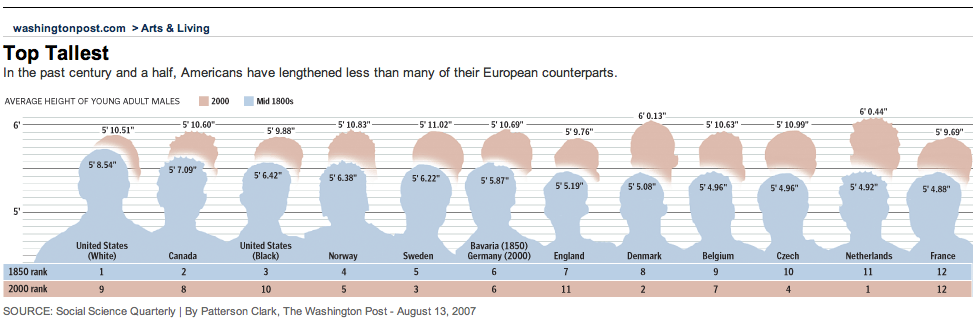
I somehow found this graph of the average height of males of the US heights compared to the average male heights of the Europeans looking at the height differences of the last 150 years that have passed. The link/ resource I found this very illustrative graph from is HERE.
Category Archives: Uncategorized
Brooke Greenberg Is The Girl Who Does Not Age, What Is Her Genetic Secret?
Just today while I was doing research on the fact that at least two types of animal species have been found to be biologically immortal, meaning they don’t older, I stumbled upon the story about Brooke Greenberg, who at this time is a 19 year old female but appears to have not grown older through the years. Her anthropomorphic measurements are just about 30 inches (76 cm) tall, weighs about 16 pounds (7.3 kg) which is about the usual size of a 1 year old. Her physical and mental maturity seems to not have progressed at all.
Her story was really big a few years ago when ABC News did a story on her.
From the Wikipedia article on her HERE….
Brooke Greenberg (born January 8, 1993), is an American from Reisterstown, Maryland, who has remained physically and cognitively similar to a toddler, despite her increasing age. She is about 30 inches (76 cm) tall, weighs about 16 pounds (7.3 kg), and has an estimated mental age of nine months to one year. Brooke’s doctors have termed her condition Syndrome X.
Brooke was born on January 8, 1993 at Sinai Hospital in Baltimore, Maryland, one month prior to her due date, weighing just four pounds (1.8 kg). She was born with anterior hip dislocation, a condition which caused her legs to be swiveled upwards toward her shoulders; this was corrected surgically. Otherwise, Brooke appeared to be a normal infant.
Birth and early life
In her first six years, Brooke Greenberg went through a series of unexplained medical emergencies from which she recovered. She had seven perforated stomach ulcers. She also suffered a seizure. This was followed by what was later diagnosed as a stroke; weeks later, no damage was detected. At age five, Brooke had a mass in her brain that caused her to sleep for 14 days. The doctors diagnosed the mass as a brain tumor. However, Brooke later awoke, and physicians found no tumor present. Brooke’s pediatrician, Dr. Lawrence Pakula, states that the source of her sudden illness remains a mystery.
To keep food from getting into her lungs, Brooke is fed through a permanent stomach tube. Feeding her through the tube takes ten hours a day.
Unexplained condition
Over the past several years, the Greenbergs visited many specialists, looking for an explanation for their daughter’s strange condition, yet there has been no diagnosis of any known genetic syndrome or chromosomal abnormality. In 2001, when Dateline documented Brooke, she was still the size of a six-month-old infant, weighing just 13 lb (5.9 kg) at 27 inches (69 cm) tall. The family still had no explanation. Brooke Greenberg’s mother Melanie said, “They [the specialists] just said she’ll catch up. Then we went to the nutritionist, the endocrinologist. We tried the growth hormone…”. The growth hormone treatment had no effect. Howard, Brooke’s father, said: “I mean she did not put on an ounce or she did not grow an inch … That’s when I knew there was a problem.” After the growth hormone administration failed, the doctors, unable to diagnose a known condition, named her condition Syndrome X.
The Greenbergs made many visits to nearby Johns Hopkins Children’s Center, and even took Brooke to New York’s Mount Sinai Hospital, searching for information about their daughter’s condition. When geneticists sequenced Greenberg’s DNA, they found that the genes associated with the premature aging diseases were normal, unlike the mutated versions in patients with Werner syndrome and progeria.
Medical studies
In 2006, Richard Walker, PhD in endocrine physiology of the University of South Florida College of Medicine, said that Brooke’s body is not developing as a coordinated unit, but as independent parts that are out of sync. She has never been diagnosed with any known genetic disorder or chromosomal abnormality that would help explain why. Her telomeres seem to be shortening at the normal rate.
In 2009, Walker said: “There’ve been very minimal changes in Brooke’s brain … Various parts of her body, rather than all being at the same stage, seem to be disconnected.” Walker noted that Greenberg’s brain, for example, is not much more mature than that of a newborn infant. He estimates her mental age at around nine months to a year old. Brooke can make gestures and recognize sounds, but cannot speak. Her bones are like those of a ten-year-old, and she still has her baby teeth, which have an estimated developmental age of about eight years. Said Walker, “We think that Brooke’s condition presents us with a unique opportunity to understand the process of aging.” “Different parts of her body are developing at different rates, as if they were not a unit but parts of separate organisms,” Walker explains.
Dr. Walker believes that the condition resulted from a failure of central control genes. He has identified two more people with similar developmental issues: Gabrielle Williams of Montana (born 2004) and Nicky Freeman of Australia (born 1970), a forty-year-old man who looks like a boy. Others, such as British biologist Aubrey de Grey, believe that aging and development are not related.
Me: What is fascinating about this story is that even the geneticists are perplexed by wha they are seeing. this girl is not suffering from the ordinary genetic issues like Werner syndrome or progeria. It states that “She has never been diagnosed with any known genetic disorder or chromosomal abnormality that would help explain why. Her telomeres seem to be shortening at the normal rate.” It would appear that she is growing and gaining weight and may be going through the process but the rate at which she is aging and changing is extremely slow. The incident where she developed a brain tumor that went away after a few weeks is ridiculous. At the end of the wikipedia article, I noted the statement that “aging and development are not related”. That is definitely a challenged to what most people would think is so self evident that is common sense but from a scientific point of view makes sense. Aging and development don’t always have to go together, it may just appear from the outside in a phenotypical way to be the same thing. Maybe there are people like Brooke which do age, but don’t develop. They even did a documentary on her entitled ‘Girl Frozen In Time” that aired on TLC.
As for any height increase related news, the doctors did try to put her on a growth hormone therapy but she didn’t gain any height or even weight. Now that is ridiculous. They stated that her body is not developing at the same rate, but separately.
From ABC News 20/20 website HERE…
Doctors Baffled, Intrigued by Girl Who Doesn’t Age
By BOB BROWN
June 23, 2009
Brooke Greenberg is the size of an infant, with the mental capacity of a toddler.
She turned 16 in January.
“Why doesn’t she age?” Howard Greenberg, 52, asked of his daughter. “Is she the fountain of youth?”
Such questions are why scientists are fascinated by Brooke. Among the many documented instances of children who fail to grow or develop in some way, Brooke’s case may be unique, according to her doctor, Johns Hopkins School of Medicine pediatrician Lawrence Pakula, in Baltimore.
“Many of the best-known names in medicine, in their experience … had not seen anyone who matched up to Brooke,” Pakula said. “She is always a surprise.”
Brooke hasn’t aged in the conventional sense. Dr. Richard Walker of the University of South Florida College of Medicine, in Tampa, says Brooke’s body is not developing as a coordinated unit, but as independent parts that are out of sync. She has never been diagnosed with any known genetic syndrome or chromosomal abnormality that would help explain why.
In a recent paper for the journal “Mechanisms of Ageing and Development,” Walker and his co-authors, who include Pakula and All Children’s Hospital (St. Petersburg, Fla.) geneticist Maxine Sutcliffe chronicled a baffling range of inconsistencies in Brooke’s aging process. She still has baby teeth at 16, for instance. And her bone age is estimated to be more like 10 years old.
“There’ve been very minimal changes in Brooke’s brain,” Walker said. “Various parts of her body, rather than all being at the same stage, seem to be disconnected.”
Brooke’s mother, Melanie Greenberg, 48, sees a different picture. “She loves to shop,” Greenberg said. “Just like a woman.”
Brooke rides in a stroller while her mom shops for clothes in the infant sections of department stores near their home in a Baltimore suburb. That Brooke is in her mid-teens is so mind-boggling that if another mother with a toddler asks Greenberg how old Brooke is, she usually doesn’t try to explain.
“My system always has been to turn years into months,” Greenberg said. “So, if someone asked today, I might say, she’s 16 months old.”
The Toddler Who Rebels Like a Teen
Brooke weighs 16 pounds and is 30 inches tall. She doesn’t speak, but she laughs when she is happy, and she clearly recognizes the people around her. She has three sisters: Emily, 22; Caitlin, 19; and Carly, 13. All three are bright, active and of normal size and development. They say that Brooke has ways of expressing herself like the teenager she is.
“She looks like a 6-month-old, but she kind of has a personality of a 16-year-old,” Caitlin said. “Sometimes we joke about how she rebels.”
Brooke will resist and refuse activities that don’t appeal to her by vocalizing her displeasure, not with words, but with sounds typical of an infant. “She makes it known what she likes and what she doesn’t like,” sister Emily said.
Carly said it no longer seems strange to have an older sister who is still essentially an infant. “As I got older, she was just like another little sister to me,” she said.
In her first six years, Brooke went through a series of medical emergencies from which she recovered, often without explanation. She survived surgery for seven perforated stomach ulcers. She suffered a brain seizure followed by what was diagnosed as a stroke that weeks later left no apparent damage.
Page 2 of 3
June 23, 2009
At 4, she fell into a lethargy that caused her to sleep for 14 days. Then, doctors diagnosed a brain tumor, and the Greenbergs bought a casket for her.
“We were preparing for our child to die,” Howard Greenberg said. “We were saying goodbye. And, then, we got a call that there was some change; that Brooke had opened her eyes and she was fine. There was no tumor. She overcomes every obstacle that is thrown her way.”
Brooke’s doctor said the source of her sudden illnesses remains a mystery.
“We often did not have a good explanation for why she became ill as quickly and intensely as she did,” Pakula said. “There were many times in which there were real doubts about her ability to survive.”
As she rocks back and forth in a baby swing, Brooke is fed through a tube inserted into her stomach, because her esophagus is so small that swallowed food could back up into her lungs and cause pneumonia.
Doctors recommended growth hormone therapy early in Brooke’s life, but the treatment produced no results.
Howard Greenberg recalled the follow-up visit to the endocrinologist. “We took her back in six months, and the doctor looked at us and said, ‘Why didn’t you give Brooke the growth hormones?’ And I said, ‘We gave Brooke the growth hormones. We gave her everything you told us to do.’ And Brooke didn’t put on a pound, an ounce; she didn’t grow an inch.”
Part of the Family
Brooke’s hair and her nails are the only two things that grow, Howard said. “She has pajamas and outfits that are 10 or 12 years old,” he said.
One of the things she loves most is movement. As Brooke lies on her stomach, Carly often steers her through the house on an ottoman. Brooke also likes to push against open kitchen drawers until they slam shut.
In her crib, “she’s very content,” Howard said. “She has very little conception of time.”
The family has placed a small television near the crib so she can watch whenever she pleases. Her father gets up in the middle of each night to check on her.
Brooke has a caretaker during daytime hours, but the family’s schedule revolves around her, year after year. The Greenbergs take no vacations, have few nights out and involve Brooke in as many family activities as possible.
“To go to a swimming pool for the summer, or belong to a summer club … we tried all those things, and it’s lacking something,” her mother said. “Brooke’s not there. We’re not a family without Brooke.”
Brooke goes to a Baltimore County public school, Ridge Ruxton, dedicated to special education. Based on her age, she would be a junior in high school. Jewel Adiele, one of Brooke’s teachers, said she wonders sometimes what Brooke is thinking or perceiving.
“People who have worked with her in the past or who briefly see her say … there’s no change,” Adiele said. “But I think, in her heart, she changes. I think from day to day, there are changes. They’re not just as visible as you see in a lot of teens.”
To try to determine why Brooke’s aging process has been so irregular — and what it means to the understanding of our genetic makeup — Walker and Sutcliffe have studied samples of Brooke’s cells and DNA to look for what they think may be a genetic mutation never seen before that has affected the way she ages.
Walker, of the University of South Florida, believes that if the gene can be isolated, it may provide clues to questions about why we age and die.
Page 3 of 3
June 23, 2009
“Without being sensational, I’d say this is an opportunity for us to answer the question, why we’re mortal, or at least to test it,” Walker said. “And if we’re wrong, we can discard it. But if we’re right, we’ve got the golden ring.”
A Key to Understanding How We Age?
If the gene — or complex of genes — is identified, Walker plans to test laboratory animals to determine whether the gene can be switched off and, if so, whether it will cause the animal’s aging to slow.
In the long term, the idea that the aging process might somehow be manipulated raises serious questions about what human beings might do with that knowledge.
“Clearly, that’s the science fiction aspect of it,” said Walker, describing the social and ethical dilemmas that would arise. “We can’t have continued reproduction and people who don’t age.”
One possible reason to slow the aging process, Walker suggested, would be to allow astronauts to travel in space for long periods of time. “But right now, it’s only conjecture,” he said.
Neither Walker nor Pakula, her doctor, can speculate how long Brooke’s life might be. “That’s more of a crystal ball question,” Pakula said. “I think there’s no way of knowing. ”
The visual evidence of that unpredictable future is always there in the family pictures — photographs in which everyone but Brooke is aging.
The Greenbergs are fascinated by the promise that a scientific breakthrough may stem from Brooke, whose own life is governed by the most basic elements: food and shelter; a family’s love; and their ability to see in her far more than meets the eye, having come to terms with the prospect that she will never grow up.
“We love her just the way she is,” Melanie Greenberg said. “We don’t want to change her.”
Added Howard Greenberg, “Brooke is the nucleus of our family. What if Brooke holds the secret to aging? We’d like to find out. We’d like to help people. Everybody’s here for a reason. Maybe this is why Brooke is here.”
For more of Brooke’s story, watch the documentary, “Child Frozen In Time,” Sunday, Aug. 9 at 10 p.m. on TLC.
Increase Height And Grow Taller Using Letrozole And Anastrozole
Something I have read about in the Giant Scientific forum and the Impartial Height Board discussion was the talk of using other types of steroid to possibly inhibit the aromitization factor of estrogen just like previously looked at compounds like anavar. I know at least one person who decided to incorporate these compounds into their routine as a type of multivitamin supplement to possibly increase the GH release rate or slow down the rate of growth plate senescence.
this next part was taking from the Anabolic Minds forums located HERE, on the same post where people talked about the possibility of using GHenerate and I-GH-1 in possibly increasing height.
rms80
Running with the Big BoysBoard Sponsor
Originally Posted by BeastModeIm 18, will HGH make me any taller? I heard that it will. Is this fact or fiction?

Thought you guys might find this interesting- a little food for thought:
in Endocrinol (Oxf). 2006 May;64(5):510-3. Treatment with the aromatase inhibitor letrozole during adolescence increases near-final height in boys with constitutional delay of puberty.
Hero M, Wickman S, Dunkel L.
SourceHospital for Children and Adolescents, Helsinki University Central Hospital, Helsinki, Finland.
Abstract
OBJECTIVE:
We investigated whether inhibition of oestrogen biosynthesis with the aromatase inhibitor, letrozole, during adolescence improves near-final height in boys with constitutional delay of puberty.
PATIENTS AND METHODS:
Seventeen boys with constitutional delay of puberty were randomized to receive testosterone (T) enanthate (1 mg/kg i.m.) every 4 weeks for 6 months in combination with placebo (Pl, n = 8), or the aromatase inhibitor letrozole (Lz, 2.5 mg/day orally) (n = 9), for 12 months. After treatment, patients were followed up until near-final height. Height discrepancy was calculated as near-final height minus mid-parental target height.
MEASUREMENTS:
The primary end point was the difference in near-final height between the groups treated either with T + Pl or T + Lz. Secondarily, height discrepancy and gain in height standard deviation score (SDS) were analysed in both groups.
RESULTS:
Boys treated with T + Lz reached a higher mean near-final height than did boys on T + Pl (175.8 vs. 169.1 cm, respectively, P = 0.04). In T + Lz-treated boys, mean near-final height did not differ from their mid-parental target height (175.8 vs. 177.1 cm, P = 0.38), whereas in T + Pl-treated boys, mean near-final height was lower than mid-parental target height (169.1 vs. 173.9 cm, P = 0.007). T + Lz-treated boys had a greater increment in height SDS over the pretreatment height SDS than T + Pl-treated boys (+1.4 SDS vs.+0.8 SDS, P = 0.03).
CONCLUSIONS:Our findings indicate that in adolescent boys an increase in adult height can be attained by use of aromatase inhibitors.
J Clin Endocrinol Metab. 2005 Dec;90(12):6396-402. Epub 2005 Sep 27.
Inhibition of estrogen biosynthesis with a potent aromatase inhibitor increases predicted adult height in boys with idiopathic short stature: a randomized controlled trial.Hero M, Norjavaara E, Dunkel L.
Source
Hospital for Children and Adolescents, University of Helsinki, Finland.
Abstract
CONTEXT:
In males as well as in females, estrogen is an essential regulator of bone maturation, growth plate fusion, and cessation of longitudinal growth. Therefore, an increase in predicted adult height (PAH) may be achieved in short boys by blocking estrogen biosynthesis.
OBJECTIVE:
We tested the hypothesis that a decrease in the rate of bone maturation and an increase in PAH can be achieved in boys with idiopathic short stature (ISS) by the method of blocking estrogen biosynthesis with an aromatase inhibitor. Secondarily, we investigated the effects of aromatase inhibition on bone mineralization.
DESIGN:This was a prospective, double-blind, randomized, placebo (Pl)-controlled clinical study.
SETTING:The study was performed at a university hospital out-patient clinic.
PATIENTS:Thirty-one boys, aged 9.0-14.5 yr, with ISS were studied.
INTERVENTION:The boys were treated with the aromatase inhibitor letrozole (Lz; 2.5 mg/d) or Pl for 2 yr.
MAIN OUTCOME MEASURE:The main outcome measure was the change in PAH after 24 months of treatment.
RESULTS:PAH increased by 5.9 cm (P < 0.0001), and height SD score for bone age increased by 0.7 SD score (P < 0.0001) in the Lz-treated boys, whereas no changes occurred in the respective measures in Pl-treated boys. Areal bone mineral density of the lumbar spine and femoral neck, assessed by dual-energy x-ray absorptiometry, increased in a similar fashion in both groups during the treatment, whereas bone mineral apparent density increased only in those taking Lz (median increase, 4.3%; P = 0.009).
CONCLUSIONS:Treatment with the aromatase inhibitor Lz delays bone maturation and improves PAH in boys with ISS. No adverse effects on bone mineralization were evident after 2 yr of treatment.
J Clin Endocrinol Metab. 2008 Mar;93(3):823-31. Epub 2007 Dec 28.
Anastrozole increases predicted adult height of short adolescent males treated with growth hormone: a randomized, placebo-controlled, multicenter trial for one to three years.
Mauras N, Gonzalez de Pijem L, Hsiang HY, Desrosiers P, Rapaport R, Schwartz ID, Klein KO, Singh RJ, Miyamoto A,Bishop K.
SourceNemours Children’s Clinic, Division of Endocrinology, 807 Children’s Way, Jacksonville, Florida 32207, USA.nmauras@nemours.org
Abstract
CONTEXT:
The process of epiphyseal fusion during puberty is regulated by estrogen, even in males.
OBJECTIVE:Our objective was to investigate whether anastrozole, a potent aromatase inhibitor, could delay bone age acceleration and increase predicted adult height in adolescent boys with GH deficiency.
METHODS:Fifty-two adolescent males with GH deficiency treated with GH were randomized to cotreatment with anastrozole or placebo daily for up to 36 months.
RESULTS:Fifty subjects completed 12 months, 41 completed 24 months, and 28 completed 36 months. Linear growth was comparable between groups; however, there was a significantly slower increase in bone age advancement from baseline in the anastrozole group vs. placebo group after 2 yr (+1.8+/-0.1 vs. +2.7+/-0.1 yr, P<0.0001) and after 3 yr (+2.5+/-0.2 vs. +4.1+/-0.1 yr, P<0.0001). This resulted in a net increase in predicted adult height of +4.5+/-1.2 cm in the anastrozole group at 24 months and +6.7+/-1.4 cm at 36 months as compared with a 1-cm gain at both time points in the placebo group. Estradiol and estrone concentrations increased less in the anastrozole group compared with placebo group. All boys on the aromatase inhibitor had normal tempo of virilization. Safety data, including glucose, and plasma lipid concentrations were comparable between groups.
CONCLUSIONS:
Anastrozole increases adult height potential of adolescent boys on GH therapy while maintaining normal pubertal progression after 2-3 yr. This treatment offers an alternative in promoting growth in GH-deficient boys in puberty. Long-term follow up is needed to elucidate fully the safety and efficacy of this approach.
Dirk Tanis, BA, MSci
Chief Operating Officer, Applied NutriceuticalsConclusion: It really does appear that any type of steroids that like the aromatase inhibitor letrozole and Anastrozole during used during adolescence will work in increasing the final height of the still growing individuals. They somehow slow down the age of puberty and full bone maturation.
Thesis related to LSJL
APPLICATION OF QUANTITATIVE ANALYSIS IN TREATMENT OF OSTEOPOROSIS AND OSTEOARTHRITIS
“The math model of osteoporosis reveals a quick response to salubrinal and a delayed
but substantial response to knee loading”<-knee loading=LSJL
“the epiphyses of the proximal tibia and the distal femur are loaded, increasing intramedullary pressure in the adjacent bones. This pressure leads to interstitial fluid flow, which has been
shown to induce bone formation”<-interesting that the intramedullary pressure leads to the fluid flow and dismissing possible effects of the pressure itself.
Osteoperosis study:
C57BL/6 female mice (8 weeks old) were housed four to five mice per cage at the
Indiana University Animal Care Facility and fed with mouse chow and water ad
libitum.
“Loads were applied in the lateral-medial direction for 3 minutes/day at 15Hz, with peak-topeak
force of 0.5 N.”
“knee loading and salubrinal application elevated BMD via sclerostin and phosphorylated eIF2❛ (p-eIF2❛), respectively”
“Under 4-week salubrinal application, the BMD of ovariectomized mice decreased only 13%, with osteoblast activity increasing 136% while osteoclast activity decreased by 48%. After 4 weeks of knee loading, the BMD of ovariectomized mice decreased only 12%, with osteoblast
activity increasing 136% osteoclast decreasing 34%”
” loading’s suppression of p-eIF2❛ did not propagate to ATF4 and NFATc1.”
“ATF4 was modeled to increase the differentiation rate of osteoblast precursors to active osteoblasts, while NFATc1 was modeled to increase the production of osteoclast precursors.”
” Loading was found to be more effective when applied earlier, as its effects are long term. Salubrinal seems to have a more immediate effect, thus being more advantageous when applied closer to the data collection time.”
Review Of Orthopaedic Surgeon Dr. Dror Paley
1. Dror Paley, MD, FRCSC, Medical Director at Paley Advanced Limb Lengthening Institute, Advanced Orthopedic Institute at St. Mary’s Medical Center
Description: Board-certified, fellowship-trained orthopedic surgeon and is nationally and internationally recognized for his expertise in deformity correction and limb lengthening. (Note: I highly recommend Dr. Paley for his credentials, exposure, and experience.)
901 45th Street – Kimmel Building
West Palm Beach, FL 33407
877-765-4637 (Toll Free)
Office – (561) 844-5255 Fax – (561) 844-5245
Email address: dpaley@lengthening.us
Website: Paley Institute
Wikipedia Article About Dr. Paley
My Review: There is not doubt and question that Dr. Paley is a world expert at his chosen field of Practice. He has developed some revolutionary surgical techniques for limb deformity treatment and if you were to desire to gain extra height, Dr. Paley is the person to do it. However, it seems that he is a little bit inattentive, hard to reach, and doesn’t focus much of his time on connecting to the patient. That is understandable given his schedule and his work. Some things that were brought up in the reviews is that it seems Paley may be involved in some immoral medical practices in getting cheaper rates for external fixators. I don’t know anything about this claim.
From Vitals.com
Dr. Dror Paley, MD is a male with 29 years of medical experience and practices in Orthopaedic Surgery.
Saint Mary’s Medical Center
901 45th St
West Palm Beach, FL
West Palm Beach, FL
See all of Dr. Paley’s practice locations

Hospital affiliation
Patient Ratings & Comments
The Overall Average Patient Rating of Dr. Dror Paley, MD when asked is Good.
Dr. Paley has been reviewed by 17 patients. The rating is 3.0 out of 4 stars. Read Reviews
Dr. Paley has been reviewed by 17 patients. The rating is 3.0 out of 4 stars. Read Reviews
Insurance
Dr. Paley accepts the following insurance plans:
- 17 United Healthcare Plans
- 6 Cigna Plans
- 1 ODS Health Plan
- 1 USA H & W Network Plan
- 6 CareFirst Plans
- 1 United Health Group, Inc. – Americhoice Plan
- 2 Priority Partners Plans
See additional insurance networks and plans that are accepted.
Need health insurance? It’s more affordable than you think! Get an INSTANT quote!
Education Summary
Dr. Paley graduated from University Of Toronto Faculty Of Medicine.
Learn more about Dr. Paley’s medical training.
Learn more about Dr. Paley’s medical training.
Hospital Affiliation
See all hospital affiliations.
Publications
Review specific publication excerpts.
Awards & Distinctions
America’s Leading Experts recognizes the top 15% of physicians who are proficient publishers on a specific disease, disorder or medical condition. Dr. Paley of West Palm Beach, FL recognition highlights his research proficiency in Orthopaedic Surgery.
Castle Connolly Top Doctors™ are specialists and primary care physicians who are highly recommended by their peers and other healthcare professionals. This recognition identifies the top physicians who possess a high level of medical skill and expertise. Dr. Paley of West Palm Beach, FL has been recognized in 2012, 2011, 2010, 2009.
Read more about other awards, appointments and associations.
Board Certification, Specialty and Expertise
Dr. Dror Paley, MD has obtained board certification from the member board for Orthopaedic Surgery.
In addition to the specialty of Orthopaedic Surgery, Dr. Dror Paley, MD has expertise in 21 areas. This includes Pediatric Orthopaedic Surgery, Acquired Joint Deformities, Broken Bones Bone Fractures plus others.
View ABMS Certification
Licenses
A medical license is required for a doctor to receive a NPI number and practice in any given state. Requirements vary by state but most require, at a minimum, post-graduate training in the doctor’s specific specialty. Dr. Dror Paley is confirmed to have a license in FL and MD.
Where does Dr. Dror Frcsc Paley practice?
Dr. Dror Paley practices Orthopaedic Surgery near West Palm Beach, FL.
Additional practice locations include: Baltimore, MD
See other West Palm Beach Surgeons and West Palm Beach Orthopedic Surgeons.
Dr. Dror Paley practices Orthopaedic Surgery near West Palm Beach, FL.
Additional practice locations include: Baltimore, MD
See other West Palm Beach Surgeons and West Palm Beach Orthopedic Surgeons.
Overall Patient Rating 
Based on 17 ratings (see all) Overall Rating The Overall Average Patient Rating of Dr. Dror Paley, MD is Good. Dr. Paley has been reviewed by 17 patients. The rating is 3.0 out of 4 stars.
Wait Time Patient Ratings Ease of Appointment — 3.1
Courteous Staff — 2.6 Accurate Diagnosis — 2.9 Bedside Manner — 2.5 Spends Time with Me — 2.5 Follow Up — 2.5 Dr. Paley is rated “FAIR” in the following areas: Promptness — 1.8
|
From RateMDs.com
Dr. Dror Paley
Doctor
Doctor
- Location:
-
WEST PALM BEACH, FL
- Gender:
- M
- Specialty:
- Orthopedic Surgeon
- Webpage:
- lifebridgehealth.or…

- Practice:
- Hospital:
-
Sinai Hospital Of Baltimore
- Answers Email:
- N
- Online Appt. Scheduling:
- N
- Accepting New Patients:
- Y
- Phone:
- 410-601-4200
- Med. School:
- Grad. Year:
- 1979
Rating: 3.9 out of 5, based on 6 reviews.
Dr. Paley has a good overall rating, based on 6 helpfulness and knowledge ratings of this doctor.
Dr. Paley has a good overall rating, based on 6 helpfulness and knowledge ratings of this doctor.
| Date |  |
 |
 |
 |
Comments | ||
|---|---|---|---|---|---|---|---|
  |
12/1/11 | 1 | 1 | 1 | 1 | Does anyone realize Dr. Paley, was dismissed from his hospital that he was practicing in while in Maryland. He was fee splitting money from the representive who was supplying the frames he uses at the hospital. Plus, the representive was his girlfriend. Needless to say, he was dismissed from the hospital he was at. |  |
 |
8/9/11 | 5 | 2 | 5 | 5 | Although you may have to wait for Dr. Paley for hours, it is well worth it. He doesn’t send anyone home without seeing you and has been in the office as late as 10:30 pm to ensure that everyone is seen. My son broke his leg last week and his PA sent him the xrays via email on his Iphone and Dr. Paley responded within minutes all the way from Sicily. How many doctors would do that? Dr. Paley is the best surgeon and is the only surgeon I would trust to operate on my son’s deformities (TAR Syndrome). I can’t say enough great things about him and his entire staff. Insurance: Aetna |
 |
|
|
6/22/10 | 5 | 3 | 5 | 5 | Dr. Paley is unquestionably the most competent orthopedic surgeon in the US, and possibly the world in the field of leg lenghtening and handling complex orthopedic cases, particularly pediatric. My 14 year old son has had 16 surgeries, 3 with Dr. Paley, and is nw walking with a kneed that bends after 4 prior surgeons recommended amputation or fusion. To be treated by the best surgeon to receive the gift of mobility and limb functionality is worth every hour of waiting time. Insurance: Blue Cross / Blue Shield |
|
|
|
4/30/10 | 1 | 1 | 2 | 5 | Dr. Paley made me feel like I did not matter. At all. I never saw him post-op, and whenever I had problems with my fixator (such as a strut popping off!) I could not reach him for several days. To me, even if this was a matter of personality conflict, it was extremely unprofessional and really cost me in terms of fighting spirit. After all, if the doctor isn’t behind you, who is? In my case, everyone else, I guess. I wouldn’t go back to the office. | |
|
|
9/14/06 | 2 | 5 | 5 | He may be overbooked and time delayed, but he is the most incredible doctor I have ever known. He is the #1 doctor in the nation and internationally for limb deformity. He saved my leg when 3 other orthopaedic doctors wanted to amputate. I walk today unassisted,on my own two feet. The time I have had to wait was a small price to pay to have both of my legs and feet. As for bedside manner, he is honest, caring, and to the point. You may have to wait to see him, but the rewards are priceless. He never has short changed me on time, or attention to my medical needs when I am in his office. He gives everyone the time necessary to treat, answer questions, and provide what is needed for each patient. | |
|
|
|
8/26/06 | 1 | 3 | 5 | Dr. Paley is technically the best in his field. I trust hom completely in terms of medical decisions. Unfortunatley he is so busy that you must often wait hours – 3-5 hours – to see him past your scheduled appointment. His bedside manner is also rather lacking. Unless you have a specific questions ready to ask him he will be in and out of the room in a matter of minutes. |
Review Of Orthopaedic Surgeon Dr. Amar Sarin
2. Dr. Amar Sarin, Orthopaedic Consultant and Restorative Surgeon
Description: Dr. Sarin has worked at Institute for Invalids & Reconstructive Surgeries Ukraine Region, Vinnitssa Medical Institute Hospital Vinnitssa U.S.S.R. for Reconstructive Surgeries, Rehabilitative Surgeries and Illizarov Technique of Bone remodeling. In 20 years he has performed more than 3000 Ilizarov surgeries.
Website: Dr. Amar Sarin, Orthopaedic Consultant and Restorative Surgeon
Address: Clinic Address: A-136, Super Mart 1 , DLF Phase 4, Gurgaon, India
Practice Location: B L Kapur Mqemorial Hospital, Action Cancer Institute, Nova Surgical Center
My Review: There is a major problem in reviewing Dr. Sarin and it is because he is based in New Delhi, India. If he was based in the US there would be at least 4-5 medical database resources where previous patients have been able to give their opinions and reviews on him. However his New Delhi clinic seems to mean that few of his patients have been able to post their reviews online. From his profile on his website, I would say that he is credible and if you could only get surgery in India without leaving the country, then Dr. Sarin would be an appropriate choice. I had expected that he would be located in the USA with many reviews but there seems to be none at all, at least that I have found.
There is one post on the Make Me Taller forums HERE which criticizes the Dr. but most people on the forums trust the doctor in his abilities.
There is one main review of Dr. Sarin from the Grow Taller forums HERE and the person who met him seems to have mostly a positive experience with him. I would recommend Dr. Sarin but any patient should still always do their research to make sure that the person who is about to operate on them has the skills and credibility. From the forums, the cost was approximately this for about 8 cm of height increase through tibia lengthening.
|
From his website HERE.
Surgeon’s Profile of :
Dr. Amar Sarin joined as senior consultant at B L Kapur Hospital a Super Specialty Hospital 2 years back. Prior to this Dr. Sarin was associated with Action Medical Institute and was instrumental in creating the department of Illizarov surgery at Jaipur Golden Hospital served a period of seven years with the institute, steering it to newer milestones.
Dr. Sarin has a vast experience of doing advanced Illizarov procedures. He has performed advanced Illizarov over more than 3000 patients in the past 20 years.
He has also trained surgeons from other countries in basic and advance Illizarov and Ortho-oncology surgeries.
Previous Appointment:
Jaipur Golden Hospital, New Delhi
Action Medical Institute, Paschim Vihar New Delhi
Educational Training:
Medical School
M S Ramaiah Medical college Bangalore
Vinitssa Medical Institute Ukraine U.S.S.R.
Basic Illizarov Training
Vinnitssa Medical Institute, Ukraine
Advanced Ilizarov Training
Institute for Invalids & Reconstructive Surgeries
Ukraine Region, Vinnitssa USSR
Memberships and Fellowships:
Indian Orthopaedic Association
Special Interests:
Revision Illizarov Surgeries
Designing custom made prosthesis
Height Gain Surgeries
Hobbies:
Off-road driving