Category Archives: Uncategorized

Review On The Grow Taller Dynamics, Growing Taller Faster Program

There is an old Grow Taller Program which I have not gotten to until now which I wanted to only briefly talk about in a short interview post. This product is called Grow Taller Dynamics, a Grow Taller Faster Program from the website www.growtallerdynamics.com.

It would be very easy to dismiss this program as another grow taller scam but I have tried to be reasonable and open to all ideas. The thing I am looking for is scientific evidence that their ideas would work.


Grow Taller DynamicsFrom the home page of the website, we learn that the creator of this system is a Dr. Philip Miller….“I’m Dr. Philip Miller, a health researcher, natural remedies expert and a doctor by profession with a specialization in neurosurgery.”

Me: I am not sure if this guy is real or not, or that picture of this guy is a standard template pic used in all these grow taller internet scams.

“It’s a scientific fact that the spine accounts for about 35% of our current height. This means that, fixing postural or spinal problems can result to a substantial increase in your height from 2 to 6 inches.

I have read that astronauts in space wil have their vertebrate disks decompressed leading to an increase of 3% of their original body height. That is around 2 inches for most people between the height of 5 and 6 feet tall. His claim of anything more than 2 inches will be impossible for anyone else who is less than 8 feet tall since 3% of 8 feet tall (96 inches) will still be slightly less than 3 inches. 2 inches is the maximum that is really possible for normal vertebrate disk decompression in most people.

Further on…

Grow Taller Dynamics will teach you like I taught my daughter the step-by-step procedure of correcting excessive curvatures of the spine that are genetically inherited or occur to daily habits, thus increasing your height.”

This type of procedure if done with extreme dedication and effort might result in at maximum 1 inch or slight more after many months of work. 2 inches is impossible for most people (without severe spinal curvature like scoliosis) to achieve. And also, we know that the stretching which will most likely give the person a few millimeters of increase will be lost if the exercise routines are not done without stopping.

Other claims that is made by this guy is that his daughter who supposedly stopped growing grew 4 inches within the first 6 weeks of implementing this program and grew another 2 inches later.

The entire Grow Taller Dynamics Program is around $37 dollars. It is supposed to have been reduced from the original price of $97. There is supposed to be a 60 day Risk Free 100% Money Back Guarantee. If you buy this program, they might answer your questions on the contact page with an order number but I highly doubt these people will ever talk to a buyer ever again. The entire program seems to be another PDF file. So another E-Product. The entire thing is just 1 long sales page. I can only find a 2nd product ordering page.

Analysis: 

What this Dr. Miller is saying is only partially true. Spinal curvature and vertebrate curvature can cause some reasonable amount of height reduction. There are already any ways using ordinary stretching and yoga positions to decrease the spinal curvature and regain some height reduction.


More Evidence Showing That Colostrum Is Similar To Growth Hormones Which Can Make People Taller

I recently have found more evidence that a very old post I did may have more validity than I thought back then when I wrote about it. That old post is “The Connection Between Colostrum, Growth, and Height”. it seemed that Tyler would also immediately write about the possibility that Colostrum would work when he posted something similar “Increase longitudinal bone growth with Colostrum?”

Now there is this article I found written in 2009 entitled “Colostrum Functions Like Human Growth Hormone to Reverse the Aging Process”. The article is probably written for the page to gain traffic and get ad clicks but it is still rather informative. I wrote the old article about colostrum and its potential to help people grow taller when the website was still rather new but now I am a little better informed on what is going on. 

Tyler mentioned back in that post that we should figure out what type of cytokines are in the colostrum and whether the growth factor that get ingested make it to the blood stream or does the stomach just break down growth factors and they never manage to get to the areas where growth happens.

From the article above…

Research has shown that colostrum is the one supplement that can bring help to everyone that uses it, largely because of its ability to perform many of the functions of human growth hormone (HGH) in the body.

The colostrum also has some anti-inflammatory effects on intestiinal epithelial cells.

While human mothers produce a small amount of colostrum, cows produce approximately nine gallons during the first thirty-six hours after giving birth. Colostrum is produced by almost all mammals, and is not species specific…

This means that supplementing with colostrum provides many of the benefits of HGH without the high cost or need for daily injections. It is IGF-1 that is responsible for many of the benefits provided by colostrum. Studies indicating that bovine colostrum supplementation can increase levels of IGF-1 in the body date back to 1998.

Growth factors from colostrum:

IGF-1 is a truncated form of IGF that is 10 times more potent than IGF-2 in stimulating hypertrophy and cell regeneration. It is present in bovine colostrum. (International Journal of Cellular Biology, 1996)

Fibroblast growth factor, IGF-1 and epithelial growth factor are all important mitogens for healing the skin. They are all found in bovine colostrum. (Journal of Surgery Research, 1995)

Analysis & Interpretation:

It is not a good idea to believe everything you read from the internet but this article seems to have been written by someone who knew what they were talking about. If the facts are real, then we can say that colostrum seem to have very similar properties and effects as human growth hormon, HGH. IGF-1 is also found inside colostrum.

That initial bit of cream that mammal mothers produce after they give birth to babies seem to be colostrum and this has many anti-bacterial, anti-viral properties making sure the baby is well fed and protected when it is first born. This compound seem to be extremely good for humans and for protection from pathogens and illness which stunt growth for developing children.

If I was to suggest maybe a supplement to take for people who are still growing, getting real colostrum supplements is something that I would consider to use.

Growth Plates In Elephants Never Close Or Close Extremely Late Suggesting They Experience Indeterminate Growth (Important)

Something that I found today while I was reading over an old PDF I had downloaded and put in a big folder was lecture notes from a Upper Class (or even Graduate School) university Biology course from a California State University.

The Lecture notes were entitled “Chapter 10: Postnatal Growth of Fins and Limbs through Endochondral ossification Cornelia E. Farnum Review by Susan Lujan”

The link for the website if you check the URL seems to be from a Biology 680 course (and lecture #4) by a Dr. Stuart S. Sumida from the Laboratory for Vertebrate Paleontology at California State University, San Bernardino (CSUSB)

In the lecture notes, in the section that talks about growth strategies, there is a small part where notes on indeterminate is talked about. Now, I have looked at the idea of indeterminate growth before in previous posts and noted that some animal families or orders have this property where they never stop growing in size, in length, height, weight, and size. These included the usual suspects like fish, reptiles, amphibians, etc. However there was a part where I did not expect which is where the notes seem to suggest that the cartilage in elephants may not completely go away suggesting that elephants may experience a form of indeterminate growth…

Indeterminate growth

  • Never ceases, may slow
  • Epiphysis remains cartilaginous
  • No bony union between epiphysis and diaphysis
  • In fish, amphibians, reptiles, the epiphysis may not develop a secondary center of ossification, articular surface is not separated from bone

Elephant

  • Epiphyses open, growth throughout life – Dr. Sumida’s note: paedomorphy? 

To figure out why is it that some types of animals can continue to grow without stop, the thing about fish, amphibians, and reptiles is that in the long bones that are going through endochondral ossification, there is no secondary center of ossification. I wanted to remind the reader that for the growth plates to even exist, there has to be two types of ossification centers. There is the primary center of ossification that starts in the middle of the long bone, the diaphysis, and there is the secondary center of ossification that starts at the ends of the long bone, the epiphysis. The cartilage that is between the secondary and primary ossification centers are the growth plates, which over time shrink in thickness as the centers continue to grow outward in a way that is similar to the way the periosteum near the outer surface of the cortical bone layer grows outward appositionally. This means, that if the amphibian/fish/reptile is missing the 2nd part (the secondary ossification center) that creates the growth plate, it might be that the concept of “growth plates” don’t exist in these animal creatures.

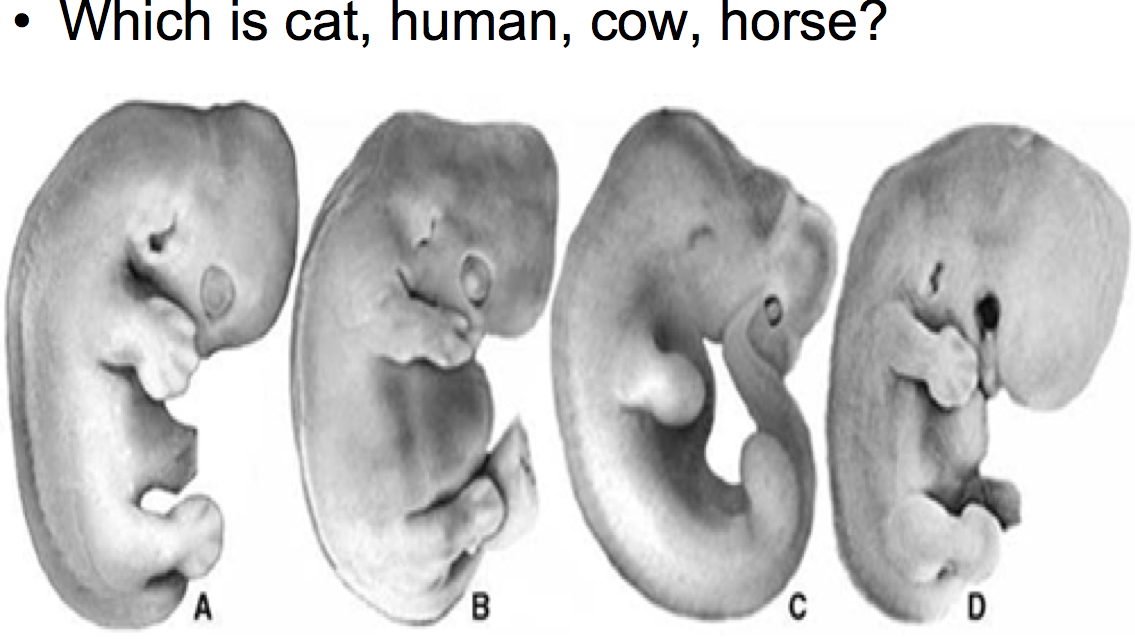
different types of animal fetusesSince nearly all animals when in the very early fetus stage look almost exactly alike which is determined by genes that act as directions on how the limbs will be structured, we realize that even the reptile has the same early stages of growth before birth as the human.

It seems that humans before birth develop the structures that will eventually become the bones through some type of cell aggregation known as chondrocyte condensation.

So if the humans at fetuses have cartilage as bone precursors, then the reptiles’ long bones should be similar in composition at least. If they are then missing the secondary ossification centers then there is a tip in the long bones that are never pushed by a 2nd part making the layer of cartilage thinner, as what happens in humans. Like the same type of physiological process we saw in how animal antlers are formed, there is a layer of cartilage or mesenchyme on the ends of the bones that never go away, that is not surrounded by bones clamping down on them, and that means that the bones of these types of animals get longer and longer, which we as humans/mammales don’t have.

(remember that there is a difference between animal horns and animal)

From the PubMed study “Cartilaginous Epiphyses in Extant Archosaurs and Their Implications for Reconstructing Limb Function in Dinosaurs”

Among extant animals, epiphyseal cartilage has been the focus of anatomical descriptions, proposed mechanical and evolutionary models, phylogenetic interpretations, and numerous biomedical studies. Different clades of amniotes vary in the extent to which they retain or ossify their epiphyses. During early limb development in amphibians, turtles, crocodylians, birds, and hypothetically non-avian dinosaurs, a cartilage cone develops within the metaphysis that is connected to the epiphyseal cartilage. Endochondral ossification continues just deep to the epiphyseal region, eventually engulfing and obliterating the cartilage cone, leaving the terminal cartilaginous cap that comprises the epiphysis. In birds, ossification proceeds much as in crocodylians and turtles, but differs in that most of the epiphysis is eventually assimilated into endochondral bone, leaving just the relatively thin hyaline cartilage of the articular surface. Secondary centers of ossification (i.e., bony epiphyses) are absent in turtles, crocodylians, and birds. On the other hand, in mammals and most lizards, secondary centers of ossification develop, leaving only a relatively thin layer of hyaline articular cartilage on the terminal ends of the element. Endochondral ossification continues as chondrocytes hypertrophy, proliferate, and form a growth plate between the metaphyseal bone and epiphyseal cartilage. This scaffold of cartilage cells forms a thin lamina of calcified cartilage that persists as an evenly curved surface on the end of the bone. Despite our understanding of skeletal tissue biology, few studies have attempted to quantify how much of an epiphyseal cartilaginous cap is present, particularly in reptiles.

However, this post is about elephants and how they seem to be growing indefinitely and they are the heaviest land animals in the world. How do their cartilage manage to survive for so long?

I wanted to do more research to see whether this claim that the growth plates of elephants never close true or not. So I googled the term “elephant epiphyses” to see what would appear.

Source #1: From the article “How Elephants Grow: Heterochrony and the Calibration of Developmental Stages in Some Living and Fossil Species” – V. Louise Roth Journal of Vertebrate Paleontology -Vol. 4, No. 1 (Sep., 1984), pp. 126-145 – Published by: The Society of Vertebrate Paleontology

  • It states that “In elephants, ontogeny is prolonged and the period of growth is lengthy.”
  • Also, in the abstract, limb bones that complete epiphyseal fusion late in ontogeny also grow more in absolute terms”

Source #2: From a PDF by a person named Gary Haynes in the Anthropology Department in the University of Nevada, Reno entitled “One way to understand mammoths: lessons from actualistic studies of modern elephants”

  • Bottom left part of Page 83: Most fractures were created by elephants trampling on elements partly buried in the surface sediments or lying atop the ground. In a few cases, spotted hyenas had first gnawed off an epiphysis, especially common with bones from elephants whose epiphyses had not fused to the shafts at the time of their death.

Source #3: From the book “Mammoths, Mastodonts, and Elephants: Biology, Behavior and the Fossil Record” (Low-ball): Gary Haynes” : Page 350:

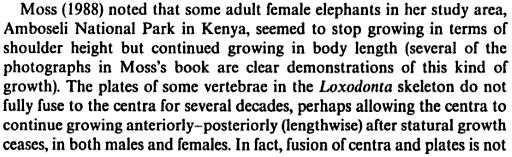
elephant growth 1elephant growth 2


elephant growth 3


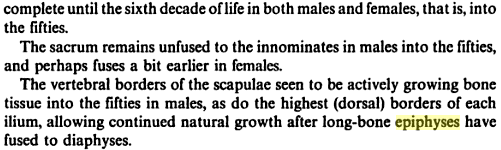
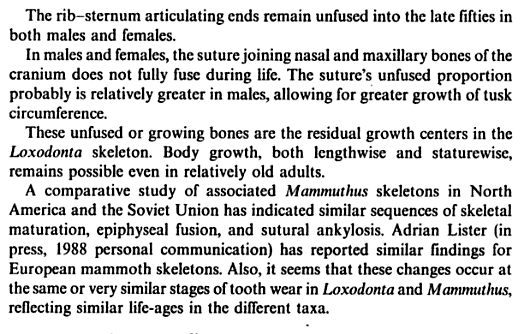
These sources show that maybe the reason elephants get so big is because they have epiphyseal cartilage that don’t fused together even at advanged age.


From a 4th source, “The Wild Elephant and the Method of Capturing and Taming it in Ceylon”

(Low-ball): Sir James Emerson Tennent – Sketches of the Natural History of Ceylon The epiphyses were still distinct Page 125 of 295

  • The researcher seems to find mammoths that at the age of around 30 years old still had distinct, and rather well kept growth plates. This made the researcher suspect that the ancient mammoths could live to be up to 150 years or even more (300 years old).

“The only attempt which I know of to establish a period historically or physiologically is that of FLEURENS, who has advanced an ingenious theory on the subject in his treatise “_De la Longevite Humaine_.” He assumes the sum total of life in all animals to be equivalent to five times the number of years requisite to perfect their growth and development;–and he adopts as evidence of the period at which growth ceases, the final consolidation of the bones with their _epiphyses_; which in the young consist of cartilages; but in the adult become uniformly osseous and solid. So long as the epiphyses are distinct from the bones, the growth of the animal is proceeding, but it ceases so soon as the consolidation is complete. In man, according to FLEURENS, this consummation takes place at 20 years of age, in the horse at 5, in the dog at 2; so that conformably to this theory the respective normal age for each would be 100 years for man, 25 for the horse, and 10 for a dog. As a datum for his conclusion, FLEURENS cites the instance of one young elephant in which, at 26 years old, the epiphyses were still distinct, whereas in another, which died at 31, they were firm and adherent. Hence he draws the inference that the period of completed solidification is thirty years, and consequently that the normal age of the elephant is _one hundred and fifty_.[3]”

Implications For Height Increase:

There is some evidence like these stories and scientific article which suggest that even though the elephant is the biggest, heaviest animal on land, it still somehow manages to keep the growth plates in its legs around for decades.

Not only that, it seems that there ie vertebrate growth plates which don’t fuse until the 5th or 6th decade of the elephants life meaning that while their shoulder height might have stopped growing keeping their “height” stable, they are still growing anterior and posteriorly into a longer animal.

The evidence for mammoths, compared to the elephants of today is even more astonishing. Some paleontologists are stating from the resources that maybe the mammoths that are found may never stop growing since their bones don’t fuse in the growth plate area.

The evidence shows many times over that the elephants may still be able to grow their bones in terms of volume even into advanced age.

What we see here is something which I didn’t think was possible, especially with such a large in weight land mammal like an elephant. However it makes sense that elephants should have unfused growth plates for so long since they do end up growing to become almost the tallest animals on land.

I had previously believed that the tissue of cartilage would not be strong enough to be able to withstand even the compressive load from the weight of a 200 lb adult human male. The cartilage would not be thick enough or strong enough to hold up that much weight without it being compressed and squeezed to the point where it disappears. This felt like common sense.

The example with the elephant, which is probably the heaviest land animal on earth really makes me rethink about what the cartilage tissue is capable of handling. The biggest elephant ever shot was around 26,000 lbs and 14 feet tall. The mammoths from the ice ages were even bigger.

I guess maybe it might be important to rethink about just strong and durable growth plates really are from the example of how long elephants manage to keep growing.

What is inside the elephant’s DNA that allows them to grow in the vertebrate even in the 6th decade of their life? That is something that the height increase researcher would be interested in knowing.

Increase Height And Grow Taller By Using Principles Of Reverse Ossification (Important)

Recently I got a message or comment to the website where someone would link to a study that Tyler from HeightQuest.com had written about in the post “Reverse Ossification”

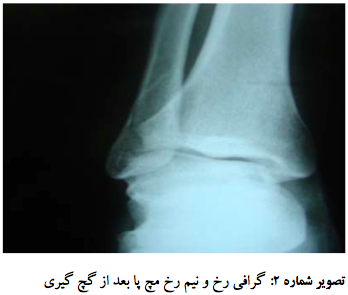
The study or article was entitled “Growth Plate Reappearance after Closure in Ankle Radiography for Trauma

Article abstract:

Bone growth plates or physis are present at the end of long bones and are responsible for longitudinal growth. These plates consist of 4 layers and are lucent in radiography as a line perpendicular to the longitudinal axis, Because of cartilage layer x-ray absorption is less than calcified bone. Gradually increases with age and bone maturity these line will be narrower and as longitudinal bone growth stops, the line disappears. This phenomenon occurs at different ages in different bones of the skeleton but with complete maturity at the age of 19, all growth plates are closed and sclerosed. Re-appearing after closing is uncommon. We introduce two young patients in this study due to trauma have been treated for an ankle cast and the growth plates of tibia and fibula in their control X-ray was re-appeared. Subchondrel Bone Resorbtion is a known phenomenon that will occur after 6 to 8 weeks immobility in any bone. The lucent line caused by imbalance in osteoblast and osteoclast activity and bone absorption. Re-appearing of growth plates can be caused by reversed ossification and bone absorption.

Analysis

Months ago Tyler had brought the article to my attention when he asked for my help in finding some way to translate the article written in Persian/Farsi since the article was written by medical researchers based in Iran. I tried using Google Translate and Yahoo’s Babel Fish technology without success.

After getting some extra time to looking back at the study and really think over what is really going on, I wanted to make some observations about what is going on. The first thing I see is that the doctors say that “Re-appearing after closing is uncommon”

The way they word the phrase makes a person who is really intent on finding a way to reverse the ossification think that maybe the reappearance of growth plates happen a lot more often then say “NEVER”.

Are these researchers saying that they have seen growth plate reappearance before in other cases? Because I have not in any studies, medical textbooks, or journals.

Here is what I guess is really going on. The cartilage is indeed there. The X-rays they see show that the absorption rate is lower. If we look at how X-rays turn out, we remember that the calcified bones will absorb more so the color on the X-rays is much lighter, or transparent. The less absorption on X-rays turn out darker and less transparent.

growth plate regenerationWhat you see in the article which Tyler copied to the Post is a series of X-rays but I would say even after looking at long bone X-rays before that I can’t really see what the growth plate is supposed to have regenerated.

The picture to the right is the only X-rays where I am noticing any type of mark or fracture in the bones. If we look at the way the dark line is on the bone, I would say that the line is very straight, and not curved and crooked like how the cartilage appears in young pig ankles, which I showed in one of the website’s YouTube video HERE

At this point, I would say that the darker shade of line on the tibia area is not the hyaline growth plate cartilage coming back but something else.

That something else I am proposing is actually fibrocartilage. Fibrocartilage is what would be formed if you managed to puncture or lacerate the bone deep enough to get below the subchondrel layer of the cortical bone.

When I was doing research on the subject of microfracture surgery I wrote a post about the possibility of using microfracture surgery to grow taller entitled “Increase Height And Grow Taller Using Microfracture Surgery, Part I”

From the Wikipedia article….

Through use of an awl, the surgeon creates tiny fractures in the subchondral bone plate.[9] Blood and bone marrow (which contains stem cells) seep out of the fractures, creating a blood clot that releases cartilage-building cells

Analysis

The principle of microfracture surgery results in the fact that the cells in the bone marrow will seep out and the progenitor adult stem cells will first differentiate into the chondrogenic lineage, at least at first.

All the physicians are in agreement that when the surgeon uses the awl to drill a hole into articular cartilage, the cartilage that is formed is fibrocartilage, not hyaline cartilage. In the procedure section on how microfracture surgery is done, the awl is a drill tool that goes pass the hard cortical bone layer and reaches to the spongy, more porous cancellous bone area where the marrow and adult progenitor cells are.

And this is what I think is really showing up in the X-rays of this document that Tyler and the other person found. That straight dark line that slices horizontally across the X-ray I am saying is more likely a bone fracture that is mostly likely filled with progenitor cells which wil turn it into fibrocartilage, not the hyaline type of cartilage the Iranian researchers claim them to be.

I wrote about a proposed idea on how we could theoretically use the fibrocartilage that is formed to increase our height at “A Proposed Height Increase Method Using Microfracture Surgery Techniques With Fibrocartilage Formation”

Perhaps there might be a possibility to combine the propose method from the post above with trauma injury type os incidents which lead to X-rays showing fibrocartilage formation. I said in the recent post that to do reverse ossification properly, we would have to have at least two major stages that not only happen at the same time, but also happen sequentially. they are…

1. One step would be to somehow remove the hard inorganic, nonliving tissue between the bone cells (osteocytes) and lacunae in the extracellular matrix of the bones. 

2. The second step would be to be able to cause only chondrogenesis (to create cartilage) to occur in the area which lost the inorganic nonliving tissue. 

Remember that ossification is where either the chondrocytes turns into osteocytes and osteoblasts or they die leaving the spaces for the osteocytes to take up later in development.

This is like how life goes. You can either turn into something else through evolution or a transformation or you die out to be replaced by something else. If you want that process to go in reverse, you would either have to figure out how to do transdiferrentiation, which the immortal hydra had figured out how to do, or you have to figure out how to reverse in the aging process, which the immortal hydra also figured out.

Since we are not talking about the entire body as an organism, but also a section of our body to regenerate back the cartilage we lost from the natural growth process, it would be much easier to first remove the dead, non-organic, hard calcium miineral deposits first. After the deposits are removed, then you replace over the now empty space with cartilage forming chondrocytes with some type of injection or growth factor mixture.


I would conclude with two things.

  1. The X-rays is not showing growth plate hyaline cartilage re-appearance, but actually some type of fracture that was made by the injury. The bone is cracked and maybe some other body tissue has gotten into the bone cracked region.
  1. If the X-rays is not a fracture, but actually cartilage, then it is not the hyaline cartilage we are looking for, but actually fibrocartilage that has seeped out of the cavity and the trabecular bone from the inside.

Let’s look at what is stated in the beginning of the young kids who are getting their X-rays looked at.

How Does Recent News About Stem Cell Production From Cloning Human Embryos Apply To Our Height Increase Research?

In recent news for the last week, there was reports coming out about the fact that a team of researchers in Oregon (Oregon Health & Science University) managed to be able to produce stem cells from cloning human embryos for the first time.

NBC News: Cloning technique produces human stem cells for the first time

What I wanted to talk about in this post is just how this type of news, about the fascinating new branch of biomedical research, will possibly effect the height increase endeavor for the coming years and even decades.

First, what is the endeavor of even doing stem cells research in the first place, at least for this group of researchers?

Answer: “…use cloning technology to make human embryos and grow stem cells from them in the hopes of making perfectly matched grow-your-own tissue transplants.”

The article writer goes into a very superficial description of what the researchers did with….

“They used a human egg cell and parts of a human skin cell to grow a very early human embryo, then transformed cells from this ball of cells into beating heart cells and skin cells. The process may eventually help treat a range of diseases, from Parkinson’s to rare inherited conditions, they reported Wednesday…”

The scientific abstract they referenced to from the journal Cell was “Human Embryonic Stem Cells Derived by Somatic Cell Nuclear Transfer”

Cell, 15 May 2013
Copyright © 2013 Elsevier Inc. All rights reserved.
10.1016/j.cell.2013.05.006

Authors

Masahito Tachibana,Paula Amato,Michelle Sparman, et. al.

    Summary

    Reprogramming somatic cells into pluripotent embryonic stem cells (ESCs) by somatic cell nuclear transfer (SCNT) has been envisioned as an approach for generating patient-matched nuclear transfer (NT)-ESCs for studies of disease mechanisms and for developing specific therapies. Past attempts to produce human NT-ESCs have failed secondary to early embryonic arrest of SCNT embryos. Here, we identified premature exit from meiosis in human oocytes and suboptimal activation as key factors that are responsible for these outcomes. Optimized SCNT approaches designed to circumvent these limitations allowed derivation of human NT-ESCs. When applied to premium quality human oocytes, NT-ESC lines were derived from as few as two oocytes. NT-ESCs displayed normal diploid karyotypes and inherited their nuclear genome exclusively from parental somatic cells. Gene expression and differentiation profiles in human NT-ESCs were similar to embryo-derived ESCs, suggesting efficient reprogramming of somatic cells to a pluripotent state.

    Analysis #1: On a first take at looking at what is written by the journalist aka non-geneticist, they do a reasonable job in explaining the idea of stem cells to the non biologist. It is well known from high school biology that to make the initial human baby, we need two copies of human dna that would be encased in a specific type of cell. For humans, there is the male and female sex cells. The biological name for human sex cells is gametes. The female gamete is the ovum (or egg) and the male gamete is the sperm. It required the sperm which is much smaller than the egg to borrow itself into the female egg and then inject its DNA within the egg’s nucleus to the egg’s DNA to start the initial spark of the human organism’s creation.

    The combined result is known as the zygote. from the Wikipedia article on the Zygote…

    “…In multicellular organisms, it is the earliest developmental stage of the embryo. In single-celled organisms, the zygote divides to produce offspring, usually through meiosis. Meiosis is the formation of gametes. Mitosis is the process of cell division….”

    and

    “All mammals go through the zygote stage of life. Mammalian zygotes eventually develop into a blastocyst, after which they are more generally termed an embryo, and then a fetus.

    A human zygote exists as a single cell before undergoing cleavage, forming blastomeres,[5] and becomes a blastocyst on the fifth day.”

    This shows that for the human, a mammal, the way we can visualize it can be like….

    Sperm + Egg (Ovum) = Zygote (undergoing cleavage) —> Blastomeres —> Blastocyst —> Embryo —> Fetus —> Baby (prenatal) —> actual birth —> Baby (neonatal).

    What I had found out from doing gene therapy research was that apparently one can do genetic engineering not just on one cell (ie a single zygote) at a time but that genetic engineering can be done on multiple cells at the same time, at least when the multicellular organism is still ni the infancy of its development which would be when it is still making the blastomeres or in the blastocyst stage.

    What the University researchers did was to combine the human egg and then one skin cell from explanted adult human skin tissue. The DNA in the skin cell was taken and injected deep into the nucleus of the egg so that the normal fertilization process would start. The very early embryo the author is talking about is probably the blastocyst that develops after a few days from the initial combination.

    Note what the article quotes next….
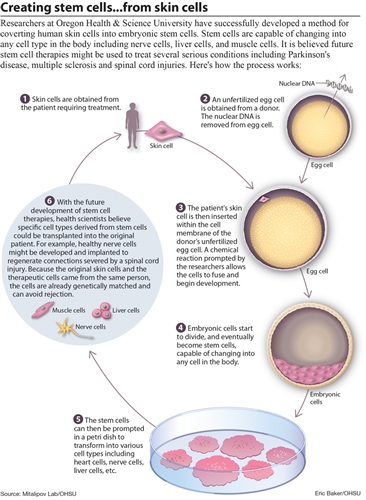
    Stem cell Oregon Health Science University“These stem cells are kind of very early unprogrammed cells but they have the capacity to become any other cell type,” says Shoukhrat Mitalipov, who led the research.

    These cells are very different from so-called adult stem cells, like those taken from bone marrow. Adult stem cells cannot give rise to cells of other tissue types — blood cells cannot be used to make brain cells, for instance.

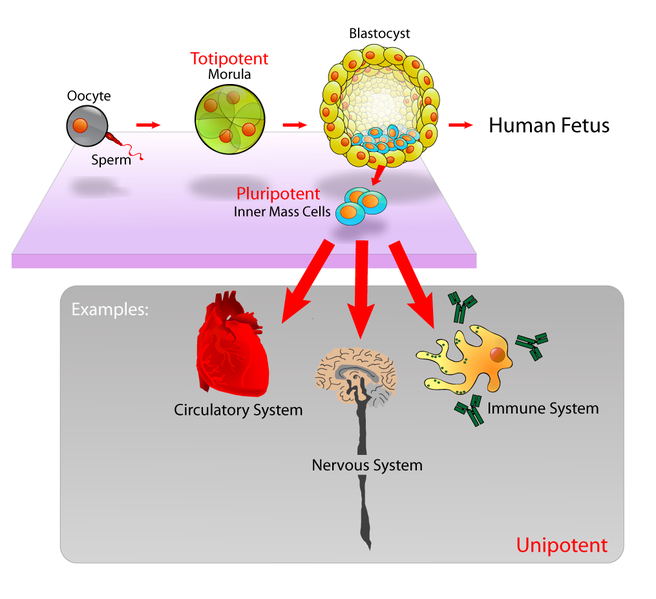
    This shows another important point about stem cells. There are different types of stem cells. We have mostly talked about mesenchymal stem cells that can differentiate into the chondrocytes and then the cartilage tissue we want. However the stem cells are still not as powerful as the stem cells one can find in embryos, which are termed pluripotent. pluripotent stem cells can differentiate into any type of cell found in the human body. The stem cells of the human bone marrow have a limited range of cells that they turn into. For our endeavor, maybe we have to find the more powerful types of stem cells needed since maybe the mesenchymal stem cells in our intermedullary cavities are already too old or “differentiated” to far to be effective. The article does quote one of the researchers on the team…

    “These stem cells are kind of very early unprogrammed cells but they have the capacity to become any other cell type,” says Shoukhrat Mitalipov, who led the research.”

    The reason these guys chose to use very early stage cells was to have more power/ability for the cells.

    From looking at the diagram picture above by the people who wrote the article (all credit goes to them) it seems that my initial analysis was wrong about what they did. They seem to extract the nucleus from the skin cell, not the DNA as I said. That actually makes more sense because one can’t extract the entire chromosome set very easily, much less the DNA strands. It makes more sense to remove the nucleus. So the nucleus is removed from the skin cell.

    The Ovum/Egg has its own nucleus removed. Maybe there was some very small, very sharp, and accurate pliers or tongs to remove it. After the nucleus in the egg is removed, the nucleus from the skin is implanted. The technique that the researchers used was known as “somatic cell nuclear transfer”. The thing about why this technique seems to succeed where cloning of humans didn’t work before was because the donated human egg provides fresh & rejuvenating DNA.

    It seems that groups of researchers have tried before to clone humans or at least make stem cells that they can use to make organs and tissues that can be implanted in humans who suffer debilitating injuries. There have been groups of researchers who have tried to use the “leftover” stem cells in fertility clinics. There have been other researchers who try to “trick” ordinary skin cells into remodelling themselves into different tissues.

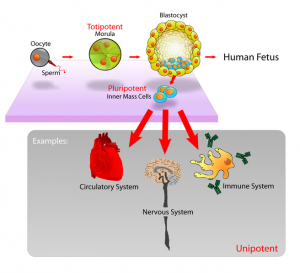
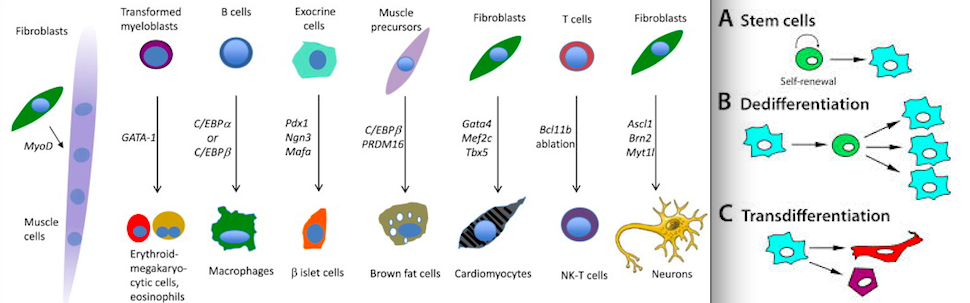
    I will use a diagram I took from the Wikipedia article on Stem Cell Potency

    Stem Cell Potency Diagram

    What we are seeing is that

    Something to note here is the term “Oocyte”. From the Wikipedia article on oocytes

    An oocyteoöcyteovocyte, or rarely ocyte, is a female gametocyte or germ cell involved in reproduction. In other words, it is animmature ovum, or egg cell. An oocyte is produced in the ovary during female gametogenesis. The female germ cells produce a primordial germ cell (PGC) which undergoes mitosis to form an oogonium. During oogenesis the oogonium becomes a primary oocyte.

    Analysis #2:

    Let’s go back to the scientific article that was cited, Human Embryonic Stem Cells Derived by Somatic Cell Nuclear Transfer

    Summary
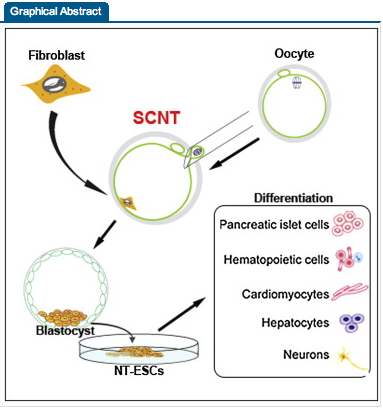
    Somatic Nuclear TransferReprogramming somatic cells into pluripotent embryonic stem cells (ESCs) by somatic cell nuclear transfer (SCNT) has been envisioned as an approach for generating patient-matched nuclear transfer (NT)-ESCs for studies of disease mechanisms and for developing specific therapies. Past attempts to produce human NT-ESCs have failed secondary to early embryonic arrest of SCNT embryos. Here, we identified premature exit from meiosis in human oocytes and suboptimal activation as key factors that are responsible for these outcomes. Optimized SCNT approaches designed to circumvent these limitations allowed derivation of human NT-ESCs. When applied to premium quality human oocytes, NT-ESC lines were derived from as few as two oocytes. NT-ESCs displayed normal diploid karyotypes and inherited their nuclear genome exclusively from parental somatic cells. Gene expression and differentiation profiles in human NT-ESCs were similar to embryo-derived ESCs, suggesting efficient reprogramming of somatic cells to a pluripotent state.

    Interpretation

    What we see is that this experimental study somehow managed to figure out around the decade old problem on how to create stable human nuclear transfer-embryonic stem cells (NT-ESCs)

    As states in the introduction of the article…

    In humans, SCNT was envisioned as a means of generating personalized embryonic stem cells from patients’ somatic cells, which could be used to study disease mechanisms and ultimately for cell-based therapies (Lanza et al., 1999; Yang et al., 2007). However, the derivation of human nuclear transfer-embryonic stem cells (NT-ESCs) has not been achieved despite numerous attempts during the past decade. The roadblock responsible for failure is early embryonic arrest of human SCNT embryos precluding derivation of stable NT-ESCs. Typically, SCNT embryos fail to progress beyond the eight-cell stage, presumably due to an inability to activate critical embryonic genes from the somatic donor cell nucleus (Egli et al., 2011;Noggle et al., 2011)

    After noticing in lab rhesus monkeys that their fibroblast skin cells could be reprogrammed into the NT-ESCs they were looking for so they state “…Therefore, we reasoned that, similar to other mammals, human MII oocytes must contain reprogramming activity.”

    This is where they got the idea of using the very early stage of the ovum right before fertilization and removing the nucleus for its reprogramming activity.

    For the researchers who are going to use the stem cells that make tissue for medical reasons , I agree with the general idea that the best option for people is to become their own donors since it seems that it is much harder for some people to find that perfect donor for them.

    As stated in the article….

    “…using a patient’s own cells offers potentially huge advantages. “A lot of patients don’t have an optimal donor,” he said. So bone marrow transplants are done only for the patients in the most dire need.

    “If we could make every patient their own donor … we would bypass the transplant barrier,” he said. “Everyone could be a donor for themselves.””

    Implications For Height Increase Research:

    We found that from our bone marrow, which is what is inside the long bone intermedullary cavity, some types of stem cells which have limited differentiating ability. They can differentiate into chondrocytes if we really focused on just finding the right growth factors to induce them into the chondrogenic lineage, although it seems that most growth factors are both osteogenic and chondrogenic. If we can get the stem cells ,in say the epiphysis or diaphysis, to turn chondrogenic, there is still not enough time for them to form the cartilage tissue needed to expand and push the bones longitudinally before turning into the osteblasts and osteocytes. The recent news about this group of university researchers in oregon makes me think about the possibility of injecting the newly created stem cells using somatic cell nuclear transfer into human bone for to form cartilage tissue or growing the blastocytes derived into epiphyseal hyaline cartilage. This approach may be the easiest way to make real growth plates in the lab using non-controversial methods like taking the pluripotent stem cells from embryos.  
    Japanese Olympic Medalist Figure Skater Daisuke Takahashi Expresses Desire To Become Taller And Have Longer Limbs

    Sometimes it really surprises even me just how common the desire to become taller is, even among the best, most talented, most accomplished, and most beautiful humans on earth. I had written about the fact that the immensely popular, international Korean singer Boa had expressed constantly her regret in not drinking enough milk when she was younger and desiring to be taller in the post “Korean Singer Boa Is Dissatisfied Over Her Height”. I was reading the news on CNN and the story of this olympic medalist japanese figure skater named Daisuke Takahashi appeared which got me interested. It seems that for this Japanese young male, he really cares about how he looks and seems to have some type of insecurity over how he looks compared to other people, even after all he has accomplished.

    I will be only taking a small section of the full article to show where he talks about his desire to become taller.

    CNN Article: Daisuke Takahashi: Japan’s golden boy on the importance of being ‘gorgeous’


    Despite his success — he also won silver at last year’s worlds — the 27-year-old admits he still looks up to his rivals.

    “I never thought I have anything special. I’ve always thought about what I don’t have compared to other skaters,” he says.

    “I tend to think like other skaters get more applause than I do. I constantly think about ways I can level up, and I’m often jealous of other skaters,” he adds, laughing. “When I see someone’s cool performance, it makes me want to be like them, and that’s what motivates me.”

    A big part of figure skating is the outfits — often elaborate lycra creations that might otherwise seem more at home in a musical stage show.

    “I don’t have long legs and arms, and I am … short,” quips Takahashi. “So I want something that makes me look taller and with longer legs and arms.

    “I want something will make me a bit bigger, and so something with flaps that give my arms a little flow.”


    I guess the thing to really understand is that maybe this desire to become taller is something that people wish for because they are constantly comparing themselves to other people and go through cycles of feeling inadequate, unattractive, jealousy, and competitiveness.

    This innate desire to always be comparing ourselves to other humans to see who is better off, in terms of all the measurable (and non measurable) qualities that make life better may be something that can not be turned off. Insecurity runs in almost everyone expect the most secure people with the highest levels of self esteem. Maybe the reason why we all seem to want to be taller is because we can’t fully accept ourselves with who we are and when we look at our naked bodies in the mirror, we feel only disappoint.

    However, would being taller solve all of our self esteem issues? If we did find an alternative solution to become taller than through limb lengthening surgery, and we had the procedure done to us to make us into the height we desired, would that stop our madness to want to improve ourselves and keep growing (figuratively)?

    I don’t know what Daisuke Takahashi is thinking in his head, and can only guess at the possible reasons on why he wishes for his limbs to be longer. He says that with having longer limbs he would be better looking. All I wanted to say is that this young man who is loved by his nation and admired throughout the world still wishes to become better looking by being taller.

    I guess height is something that will always be valued and strived for.