Category Archives: Uncategorized

Increase Long Bone Length And Increase Height By Inhibiting Complete Ossification Of The Epiphysis Through Ischemia (Big Breakthrough)

While I was doing research on how the alignement of a double growth plate would lead to potential unlimited lengthening of the long bones, I took a deeper look at how the ossification centers and realized something which I was surprised I had missed before.

In one of the most important posts written for the website where I had analyzed how the antlers in some deer fall off and regrow in length each and every year, I had noted that to be able to get the type of lengthening you need to have a tip area which has mesenchyme, and that it must be covered by a type of tissue that is either perichondrium, or has the elastic and impermeable nature of perichondrium.

The posts were

  1. The Connection Between Regenerating Deer Antlers and The PTHrP, PTH And IHH pathway for Cartilage Regulation, PTHrP Seems To Be The Answer (Big Breakthrough!)
  2. Increase Height And Grow Taller From Deer Antler Regeneration Principles
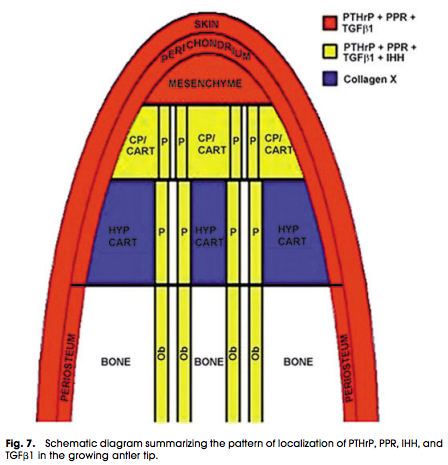
deer-antlerSee the diagram on how tissue would have to align for any type of tissue expansion to happen.

You see that the bone has to be at the bottom, while at the edge or tip, it has to have the progenitor cells/mesenchyme ready to differentiate into the chondrogenic lineage which is will what be the tissue that can really expand the structure volumetrically.

Now, Let’s look at the tip or ends of a long bone to see the difference. The long bones are growing longer or longitudinally because the growth plates are pushing the bony secondary ossification center outwards away from the primary ossification layer.
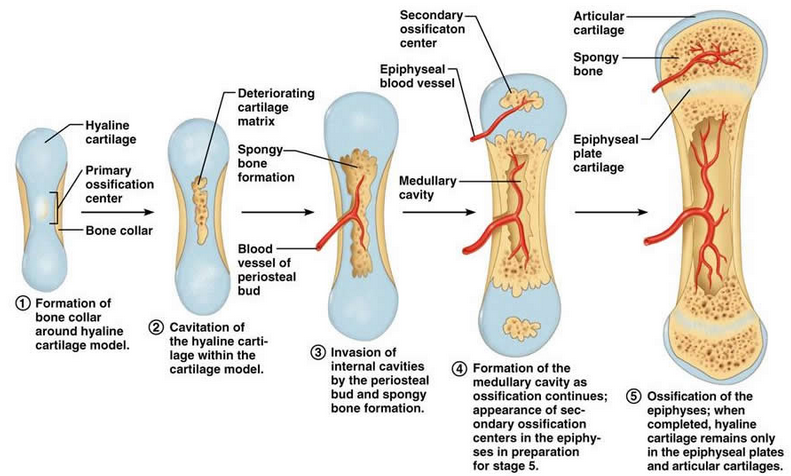
primary secondary ossification centers


The ends or tip of the bones, which are known as the epiphysis have a core of ossified cartilage (aka bone tissue) and that grows out until it envelops all of the tissue of the structure at the knobby ends of the long bone except for the articular cartilage.

However the thing that I noticed in this picture which may not be shown in other anatomical diagrams of bone tissue is that there are blood vessel that are going into the epiphysis and the diaphysis. I had forgotten about a very important point which I had researched months ago as well as also forget one of the most basic points of the cartilage-bone tissue relationship.

The first thing I forgot was that there was a study that showed that if you take an awl, and put the awl in a hole that was made from a drilling into the diaphysis of the long bone, and then turn the awl around, basically cutting the blood vessels thus restricting the blood vessels and nutrients from reaching the various regions of the long bone, you notice that the longitudinal growth of the long bone seem to increase slightly.

The 2nd thing that I forgot was that for cartilage to ever turn into bone, it has to go through a process where it’s protective covering, the perichondrium has to start to fail in its strength, the cartilage get invaded by blood vessels that gets inside, and over time, the vascularization leads to the introduction of calcium minerals, leading to then mineralization and calcification, and thus ossification.

Proposed Method For Height Increase

We can get the long bones to ‘grow’ or lengthen by making sure that the ends keep on pushing away from it. As long as the end of a bone structure is filled with material that is not bone, or at least not completely made form bone tissue, just as the case with the tip of the antlers in deer structure. The bone was the tissue at the base but at the tip was only mesenchyme that would turn into cartilage. Somehow the mesenchyme never turned into bones themselves until the mesenchyme was completely used up.
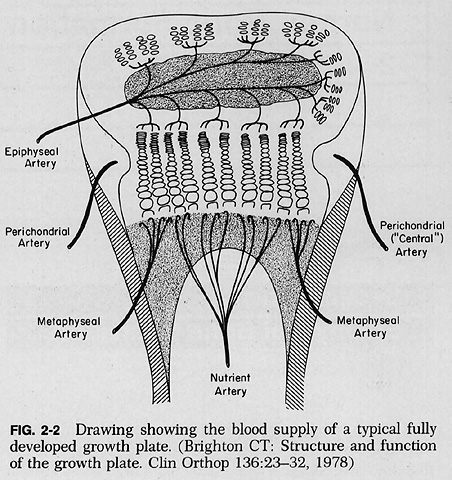
growth plate blood vesselWe see from many anatomical diagrams that there is at least one major blood vessel going through the epiphysis of the long bones to supply it with the proteins and nutrients to continue to make organic living cells like the mesenchymal stem cells that are in the epiphysis. However that blood vessel is also the main cause of the epiphysis/ ends of the bones turning into bones through ossification in the first place. There is one famous study that shows that if you disrupt the blood vessels going into the metaphysis (or the diaphysis) of the long bone, the longitudinal growth of the overall bone is increased. This shows the possibility that if you disrupt the blood vessels that are doing the vascularization of one of the sides of the growth plate, the bone is supposed to get longer.

The proposed idea is to drill a small hole into the epiphysis and disrupt the blood vessels going into the epiphysis, to keep the tissue in the epiphysis in a relatively large percentage of cartilage tissue. My proposal is that as long as the ends of the long bones are not completely infiltrated by blood vessels, they will stay in a state more like a the tip of the antlers of deer, which has the possibility of turning into chondrocytes and this means that the lengthening of the ends of long bones becomes a possibility.

So there are two parts.

1. Drill a hole into the epiphysis and disrupt the vascularization of the ends of the long bones. This would help keep the entire region from turning into bone tissue. 

2. Inject through syringe around 50 ng of BMP-7/OP-1 per gram of tissue into the hole. I have stated recently that out of all the BMPs, the BMP-7 seem to have the most chondrogenic benefits. This would help in turning any mesenchyme/ progenitor cells that did not get destroyed to convert into chondrocytes and possibly then cartilage.

The result is the epiphysis/ends of the long bones becoming softer, more elastic, and more like the tips of deer antlers which can push out and lengthen the ends of the long bones.

The post that really got the core idea started isStudying Changes In The Growth Plate By Restricting The Blood Vessel Supply, Ischaemiawhere I referenced a very old study done by a surgeon named Albert B. Ferguson namedSURGICAL STIMULATION OF BONE GROWTH BY A NEW PROCEDURE – PRELIMINARY REPORT. Ferguson was also the man who showed to me one of the most crucial ideas on how to possibly increase height using a very practical idea which can be easily done at the comfort of one’s home, which I had coined the Chisel and Hammer method, which I would show in the YouTube VideoChisel and Hammer Method Explained“. The basic idea behind the Chisel and Hammer Method is to break apart the periosteum layer so that the growth plate tissue would be less restrictive in their ability to expand.


How Sox 5, 6, and 9 drive chondrogenesis

The transcription factors SOX9 and SOX5/SOX6 cooperate genome-wide through super-enhancers to drive chondrogenesis.

“SOX9 is a transcriptional activator required for chondrogenesis, and SOX5 and SOX6 are closely related DNA-binding proteins that critically enhance its function. We use here genome-wide approaches to gain novel insights into the full spectrum of the target genes and modes of action of this chondrogenic trio. Using the RCS cell line as a faithful model for proliferating/early prehypertrophic growth plate chondrocytes, we uncover that SOX6 and SOX9 bind thousands of genomic sites, frequently and most efficiently near each other. SOX9 recognizes pairs of inverted SOX motifs, whereas SOX6 favors pairs of tandem SOX motifs. The SOX proteins primarily target enhancers. While binding to a small fraction of typical enhancers, they bind multiple sites on almost all super-enhancers (SEs) present in RCS cells. These SEs are predominantly linked to cartilage-specific genes. The SOX proteins effectively work together to activate these SEs and are required for in vivo expression of their associated genes. These genes encode key regulatory factors, including the SOX trio proteins, and all essential cartilage extracellular matrix components. Chst11, Fgfr3, Runx2 and Runx3 are among many other newly identified SOX trio targets. SOX9 and SOX5/SOX6 thus cooperate genome-wide, primarily through SEs, to implement the growth plate chondrocyte differentiation program.”

“Once settled in skeletogenic sites, progenitor cells coalesce into precartilaginous condensations and activate the chondrocyte differentiation program. Early-stage chondrocytes proliferate and build an abundant, cartilage-specific extracellular matrix. They express such genes as Col2a1 (encoding collagen type II) and Acan (proteoglycan aggrecan). Elongation of cartilage anlagen occurs in growth plates, structures in which chondrocytes proceed through terminal maturation steps in a precise spatial and temporal manner. They proliferate and produce cartilage matrix while aligning into longitudinal columns. They then cease proliferation, become prehypertrophic and express novel markers, such as Ihh (Indian hedgehog). As they become hypertrophic, they turn off most early markers and activate unique ones, including Col10a1 (collagen type X). They eventually die or switch to the osteoblast fate to participate in endochondral ossification. Chondrocytes forming permanent cartilage never proceed through these growth plate maturation steps. They keep expressing pancartilaginous early-chondrocyte markers and also express tissue-specific markers. For instance, superficial articular chondrocytes distinctively express Prg4 (lubricin).”

“Expression of the three SOX genes culminates in growth plate proliferating and prehypertrophic chondrocytes, and is abruptly turned off when chondrocytes undergo hypertrophy. SOX9 is required for chondrogenesis.”

“SOX9 is required to turn on and maintain chondrocyte-specific genes and that SOX5/6 strikingly augment SOX9’s transcriptional activity by securing SOX9 binding to DNA”

“The phenotype of RCS[rat chondrosarcoma] cells thus faithfully matches that of growth plate chondrocytes at the proliferating/early prehypertrophic stage. “<-For more on this read the study.

“RCS cells are bona fide growth plate proliferating/prehypertrophic chondrocytes “<-Since chondrosarcoma can occur in older individuals this is a very promising statement for the creation of neo-growth plates.

Bone Replacement Implant To Lengthen Limbs Without Surgery

I was going through the forum Make Me Taller when a certain thread did increase my curiosity JTS Implant for height increase?. The forum members were rather excited about this technology and the science is indeed there backing up what is claimed.

It seems that there is a way for at least young kids to lengthen their legs using a type of device that does not involve surgery. There is actually a YouTube video referenced entitled “What Is The Lengthening Procedure Like?”

On the website Implants For Children there is a section that talks about what exactly is the JTS implant at “What Is JTS?

The Science Behind This Limb Lengthening Method Without Surgery

Due to some type of illness or disorder which will cause the bone tissue in a limb/leg to be useless and can not be saved by surgeons, there is a type of metal implant that is surgically implanted in the place where bone tissue used to be.

This implant is mechanical in nature. There is a small but powerful gearbox in the implant. The gearbox is strong enough to release an output force which is high enough to pull legs apart using a special gear mechanism.

To lengthen the leg, the gear is put in an external drive unit. The drive unit is turned on causing electrical current to run through the electrical coil in the drive unit. This causes a magnetic force to be created rotating at 3000 rpm.

From the webpage…

“This rotation is captured by the magnet within the implant and is passed through the gearbox to extend the device. The implant will grow at 1mm every 4 minutes, thereby slowly stretching the soft tissues”

The benefits of this type of leg lengthening is that is is very precise, it is noninvasive for the stretching, does not require sedation, low chance for infection, is almost pain free, and the patient can go home the exact same day.

Implication For Height Increase Seekers

While the forum members got slightly excited about this prospective new method, they quickly become disenchanted when they found out that this method would involve where there would have to be a metal implant permanently placed in their body as well as having a major portion of their leg bone removed for the metal implant to be go in.

The device is only allowed for kids who have suffered from some type of disorder which caused major parts of the bone tissue in their leg to be damaged beyond repair and the child also has to be young enough where they would most likely still have growth plates meaning that they are supposed to be still growing taller. The implant is almost always done for one leg only so that the implant can increase in length at the same rate as the other leg which is not infected so that when the child is finished growing taller and the growth plates in the limbs fuse, the implant is finally set in its final length and no longer increased any more.

The technology is really incredible, but I would suspect that most people who want to grow taller would have no desire to go through a very invasive surgery in the beginning and have an extendible metal implant permanently placed in their body. It probably makes more sense for people to go through with the limb lengthening surgery with the external fixator or internal rods to increase the length of their legs instead because at least after 2 years at most (usually 1-15 year), a 2nd major surgery is done where the internal rods or the external fixator is finally removed.

This method for potential height increase is viable, but there probably is not that many people who would be willing to go through with it. In Addition, of the few locations around the world which does this type of metal implant and external drive lengthening, none of them currently would allow any healthy person with good legs to go through with this type of surgery for a cosmetic reason for only increasing their height.

Taller Height Seems To Correlate To Increased Higher Education Attainment

In this series which shows how growth and overal adult height is correlated with other areas of one’s life, I move towards the connection between educational attainment and self reported height of men at the age of 18.

Study #1: Height at age 18 years is a strong predictor of attained education later in life: cohort study of over 950,000 Swedish men.

RESULTS:

The odds ratio (OR) for attaining higher education 7-27 years after baseline was 1.10 [95% confidence interval (95% CI) 1.09-1.10] in fully adjusted models per 5 cm increase in height. Men taller than 194 cm were two to three times more likely to obtain a higher education as compared with men shorter than 165 cm. The association remained within brother-pairs, OR 1.08 (95% CI 1.07-1.10), suggesting that non-familial factors contribute to the association between height and education attainment. A significant interaction (P < 0.0001) was found between year of birth, height, and attained education, showing slightly weaker associations among later birth cohorts.

CONCLUSIONS:

The strong positive association between height and educational achievement remaining after adjustment for year of birth, parental socioeconomic position, other shared family factors, and cognitive ability may reflect educational discrimination based on height although residual confounding cannot be ruled out.

Analysis:

Educational AttainmentSo this almost 1 million large in size of Swedish men back in the 1970s had their height noted when they were 18 and then it seems that at the age of 27 (or 7-27 after the height was reported) they were found by the researchers and asked about the level of education they did achieve at the end. The researchers were testing to see what were the socioeconomic effects of height.

The most striking thing that was stated was probably “Men taller than 194 cm were two to three times more likely to obtain a higher education as compared with men shorter than 165 cm.

This translates to mean that men who were taller than 6′ 4″ were 2-3 X more likely to get a college degree than men who were shorter than 5′ 5″. So can we blame it on genetics, saying that taller men are just smarter than shorter men? Or is it the result of upbringing, where the human tendency to discriminate against shorter men resulted in shorter men having less confidence in their own cognitive abilities and thus give up on attaining as much higher education as their taller counterparts?

The statement “suggesting that non-familial factors contribute to the association between height and education attainment” might shed a little light on this issue.

This shows that when the study was done on brothers who obviously had slight height differences, the same educational difference was also noticed. Brothers (like sisters being siblings) probably are as close in genetic material as possible. The biggest difference that can be seen between one brother and another brother from a phenotypical point of view would be height. On average, the brothers should be around the same level of intelligent although it would be clear that on an individual sibling comparison one side would on average be smarter than the other.

This means that genetics may not be as important towards educational attainment as say the social feedback one receives from one’s teachers and professors for being of a certain stature.

There is also a correlation with the fact that for people who are born in later order compared to their siblings, the correlation between height and educational attainment is decreased.

The researchers concluded at the end that the difference in educational attainment from height difference was of “cognitive ability may reflect educational discrimination based on height“. This means that because a person might be taller than average, they more likely got positive feedback on their cognitive abilities which lead to them developing the confidence to go through with higher levels of education.

Note that the following factors were all considered and factor out to standardize the results as much as possible…

  • year of birth
  • parental socioeconomic position
  • other shared family factors
  • cognitive ability

Smoking During Pregnancy Seem To Result In Children Who Develop Shorter Adult Height

While I personally have not done enough research yet on the effects of how acquiring the habit of smoking in one’s prepubescent years will affect one’s growth and eventual adult height, this study I found does show a correlation between the effects of how one will turn out in terms of final adult height with the amount of smoking one’s mother did while they were still pregnant with us.

The results from previous/past studies looking at how the high levels of smoking the pregnant mother will effect the adult height of the unborn baby show that any stunted growth is minimal. There was a fraction of an inch of decrease in height but that was explained away from researchers stating that there were so many variables to consider and that the slight difference could be just as well explained to be from lower social classes, less ability to get to resources like nutritious food to eat, etc.

In fact, for girls there seems to be no height change at all for girls where their mothers smoked or didn’t smoke. The researchers for this study went back and tried to prove conclusively that if the mother did have a habit of smoking extensively, the baby would ultimately result in some noticeable amount of decreased height.

Study #1: Smoking in pregnancy and development into early adulthood.

Abstract

Follow up analyses of data on the 1958 cohort from the national child development study have shown that the association of smoking in pregnancy with physical and intellectual development diverges between the sexes at age 16, no longer being significantly associated with height in girls. These studies, however, have emphasised that the differences in outcome are small and may be explained by other factors. The analyses have taken account of birth weight and have therefore examined the effects of smoking on subsequent development in addition to this variable. To assess the importance of smoking on development in early adult life and whether the effect is independent of birth weight data from the 1958 cohort at age 23 were analysed. Only weak evidence for a relation between smoking in pregnancy and self reported height of the offspring was apparent once social class, size of family, mothers’ height, and birth weight for gestational age were taken into account. After omission of birth weight from the analyses, however, the average difference in height between subjects whose mothers smoked 20 cigarettes a day or more during the second half of pregnancy and those whose mothers did not was 0.93 cm in men and 1.83 cm in women. A strong association was also evident with the highest qualification achieved by subjects at this age, suggesting a long term relation between smoking in pregnancy and the intellectual development of the offspring.

Analysis 

The thing to notice is this “Only weak evidence for a relation between smoking in pregnancy and self reported height of the offspring was apparent once social class, size of family, mothers’ height, and birth weight for gestational age were taken into account”. So there was a different but the difference seems to be small.

It seems that for the almost 1 cm in height difference in men and 1.8 cms of height difference in women, the mother would have to had a smoking habit that involved where they smoked 20 cigarettes a day or more. I personally don’t know anyone who has a nicotine or smoking addiction that requires that they smoke 20 cigarettes a day. I don’t remember how many cigarettes are in a pack but it might be possible that every single pack has 20 in each one. If that is the case, then there might be quite a few people who do smoke 20 cigarettes a day who claim something like “I used to smoke a pack a day”.

For the researchers to give these numbers, they had to take many other factors into account to rule out their association. Other factors that was considered and taken into account were…

  • Social class
  • Size of family
  • Mothers’ height
  • Birth weight for gestational age

I would guess that this study should be a good starting point for anyone to use as a reference if they needed to argue/debate with someone to show that the mother’s smoking habits would have a clear affect on the child’s physical development resulting in on average decreased height.

However the emphasize focused in the last sentence is on the fact that smoking has a very dramatic effect on the cognitive and mental abilities of the child when it is growing up. So instead of worrying that smoking is going to make your child shorter, it is probably more useful and relevant to worry that one’s child will end up stupider from one’s smoking habit.

The main thing of course is to stop smoking and give one’s child a better chance at a better life by giving them the best resources and opportunities

The Height Differences Between Siblings Due To Birth Order

This study I recently found sort of actually contradicts an old idea that have been going on.

Study #1: The association between height and birth order: evidence from 652 518 Swedish men.

Results:

Unadjusted analyses showed no differences between the first two birth orders but in the fixed effects regression, birth orders 2, 3 and 4 were associated with 0.4, 0.7 and 0.8 cm (p<0.001 for each) shorter height than birth order 1, respectively. The associations were similar in large and small and high-SEP and low-SEP families, but were attenuated in recent cohorts. Birth characteristics did not explain these associations.

CONCLUSIONS:

Birth order is an important determinant of height. The height difference between birth orders 3 and 1 is larger than the population-level height increase achieved over 10 years. The attenuation of the effect over cohorts may reflect improvements in living standards. Decreases in family size may explain some of the secular-height increases in countries with decreasing fertility.

Analysis

Now this is just one study but the study seems to be done on over half a million Swedish men where the measurement of height was taken when they were just 18 years old, which is believed to be the average age when the vertical growth in males should have stopped.

siblings_constantThe old idea that was stated by other scientific studies was that the siblings and kids who are born later like child #3 or child #4 would end up to be taller on average. The rational for that was that the uterus for the mother during the first pregnancy (and maybe also the 2nd pregnancy) would have been smaller than the subsequent pregnancies. The size of the fetus or baby before birth is said to have been determined by the size of the the uterus or womb it was carried in. Maybe to the average person without anytype of obstetric training, it might be ‘common sense’ to think that once the baby before birth pushed the womb up to a certain size, the uterus will start to go through the contraction signifying that birth is supposed to occur.

There are already some studies that show that larger females in terms of taller mothers and mothers with wider hips do give birth to heavier and taller babies. In some old posts I had used the logic that the size of how big a person will become may be mainly determined by how large they are at the moment that they are born. My logic back then which seems to be proven false from this study is the idea that the larger the uterus and womb was from the start the larger the baby will be before it actually comes out.

I would have guessed that children born later in order should be bigger. However this study says that the earlier children, the 1st and 2nd child of a couple seem to become taller. Why?

What is noted is that there might be a social-economic correlation between decreased family size and increased children sizes. This might mean that the size of a child can be partly determined by the amounf of resources (ie food, time, energy) the parents of the child can give to it on an individual basis. Perhaps as the first and second born, the child gets more attention and energy from the parents than if they were the last of a ‘litter’ and the decrease in resources due to resource sharing alone from having so many siblings is all that is required to end up just slightly shorter than one’s older siblings.