Category Archives: Uncategorized

Alana Renaud Height Progression Due To Pituitary Hyperplasia Leading To Gigantism From Delay Of Onset Of Puberty (Breakthrough!)

I think for us height increase researchers this news might be slightly exciting to realize. This insight on how gigantism caused by pituitary hyperplasia results in something else, which might be the real answer on why height was able to be increased.

I spent some time doing a little bit of reading/research on one of the tallest females in the USA named Alana Renaud, who is listed at either 6′ 10″ – 6′ 11″. I checked out her profile on the website TheTallestMan.com and there was a story written about Alana Renaud in some popular magazine which revealed something sort of interesting.

The backstory on Alana is rather normal and uneventful, suggesting nothing out of the ordinary for an American raised female. Alana is a lovely, beautiful women who just happened to be a few standard deviations above in the height distribution bell curve. She is an almost 7 feet tall woman after going to the chiropractor so she is going to get a lot of stares no matter where she goes. She friend laments that she could be naked next to Alana and men would still probably be more focused and interested in Alan due to how tall and big she is.

However, I want to mainly focus on the interesting scientific facts about Alana from what appears to be an American Apparel magazine article entitled “Above It All” written by Audra Melton

Correction: Alana seems to have gone to the University of West Georgia, NOT Western Georgia University to play as a student-athlete for the university volleyball team.

Alana Renaud Height/Growth Progression (All this information is taken from the article)

Father’s side of the family had many tall women

  • Birth: Weight – 7 lbs, 2 oz.  & Height/Length: 19.5 inches
  • Age 9-10 (5th grade): grew 4 inches to 5′ 5″
  • Age 10-11: grew 1 inch to 5′ 6″
  • Age 12: grew 2 inches in 3 months to 5′ 8″
  • Age 13: grew from 6′ 0″ to 6′ 2″
  • Age 14: grew to 6′ 4″
  • Freshman Year of High School: 6′ 5″
  • Sophomore Year of High School: had to duck under the standard height doorway which is 6′ 8″
  • Fall of Senior Year of High School: 6′ 10″

So it could be that Alana just happened to be one of those girls who had the extreme height gene being idiopathically tall like Marvadene Anderson however her extreme stature was from something else.

It says that Alan did not start menstruating even when she was 17. A trip to the gynecologist, and then to an endocrinologist lead to her pituitary diagnosis. Like so many other people who has gigantism due to pituitary hyperplasia which I have studied, her tumor was also benign but still quite active. She suffered from a hyperactive pituitary gland.

The symptoms of Gigantism, and then adult onset acromegaly are that the facial features start to protrude and bulge out as the bone tissue which can still expand will expand. The brow ridge gets bigger. Their nose and jaw can also be wider and protrude out. Their voices pitch get much lower as the voicebox which is made out of cartilage tissue become wider and wider due to the chondrocytes in the voicebox pushing the cartilage tissue apart expanding it. The results is a deepened voice. Alana is said to have a broadening noce and chin in her senior high school portrait.

Alana would later have a surgeon go through the nasal cavity to cut out the tumor on the pituitary. There was some serious complications in the surgery where there was a lot of bleeding. It would take 3 surgeries to remove the tumor tissue adequately well so that there would be a change where the tumor could never regrow back. The most interesting thing that was said was that after the surgery with the radiation, Alana’s nose and jaw slenderized back to normal.

The only other thing that was slightly unusual was that Alan supposedly found a nodule in her thyroid on a routine annual checkup with the endocrinologist.

So why is Alana Renaud’s story important for us as researchers looking for a way to help children and adults grow taller?

It is from the connection between the late onset of her menarche and her gigantism condition.

Note: Before I continue any further, I completely understand that correlation does not imply causation, but for Anala’s situation, I am willing to show that the two events are not coincidence, but that the two things are related. 

From reading over hundreds of PubMed studies and looking over the literature on how gigantism develops in young kids with open growth plates, I will make a claim.

Thesis: People who have gigantism which is due to pituitary hyperplasia (from a tumor) get to the extreme height ranges from some endocrine and biomolecular mechanism resulting from the pituitary. The actual mechanism manages to slow down bone maturity significantly and slows down growth plate senescence.

The thing is that from reading multiple articles of studies done by researchers who used growth hormone therapy in children to improve the children’s adult final height, it seems that GH treatment might not even do anything to make the child taller. It only works for children suffering from GH deficiency disorder. The GH therapy may not be able to make the child taller than what their intended height was supposed to be if they didn’t have the disorder causing short stature.

There is even suggestions that excess GH usage in testing subject children caused their bone maturity to be accelerated, which is the exact opposite thing we would want to increase final adult height.

So the obvious question then is, if synthetic recombinant GH injected into kids don’t make them super tall, why does pituitary gland hyperplasia due to benign (rarely malignant) tumor causes some people to become extremely tall?

At this time, I don’t know the exact cause but I do suggest that the pituitary gland controls human vertical growth in more than 1 way. Using an alternative endocrine or signaling pathway, the pituitary gland tumor can cause the body to decrease the rate of bone maturity, NOT accelerate it.

Main Point: This shows that the way people become really tall, and achieve extreme heights in the long tail of the height distribution is more likely from slowly down bone maturity instead of increased GH release into the system. There is at least two mechanisms going on. On the one hand, the natural GH made by the pituitary gland can release the GH to accelerate bone maturity, but there is some other unknown process which it does to slow down bone maturity.

The thing is that Alana stopped growing at an age reasonable for most males, 17-18. Most females stop growing around 14-15. I can say from talking with my sisters that the taller one at 5′ 7″ started menarche when she was around 12 and she stopped growing taller when she was 13-14. It took just 1 year approximately from the time that my sister experience menarche and when she stopped growing. This shows that menarche is a very good sign in a girl that she is probably going to stop growing any taller very soon.

Menarche is the scientific term for when a female gets her first period. This is the sign within many cultures that a females has gone from a girl into a full woman who finally has developed the sign that she can give birth to children. Menarche defined by scientists also signify that her body can theoretically have children (not that she should). Alana’s extremely late menarche reveals that somehow the gonadotropins could not be released form her ovaries, showing that there was some process in her body keeping her from starting gonadarche. This phenomena can be validated slight by the fact that african american women in the USA is about 1 inch shorter than their caucasian american female counterparts. The scientific reason that is given is that the african american women start puberty about 1 years earlier than the caucasian females. So puberty is the signal that a person is going to start to reach the process where they are going to stop growing anymore, at least vertically.

We see this in Sultan Kosen, who grew 2 inches when he was 27. We see this in Lee Lazelle who grew even when he was 30 years old. We see this in Tanya Tngus, who supposedly grew even when she was 27-29. I had written posts about all of these giants at one point saying that the fact that they were still growing even in their late 20s signify that their growth had to be from somewhere else besides the growth plates, which should have closed for them since they were in their late 20s. Now I cam saying that I was probably very wrong about my assessment from the past posts. It seems that the pituitary gland that was affecting them had someway to slow down growth plate senescence, so that they could extend the amount of time for them to continue to grow a little taller.

However, it seems that the only way for the child to achieve really tall height is not through GH therapy, since it doesn’t seem to be able to make them tall, but only correct for height deficiencies. The reason that the pituitary gland tumor works to turn them into giants is because it uses a currently unknown mechanism to slow down the growth plate senescence and bone maturity so that they have a few more years to continue to grow further. This is done in females at least by keeping them from going through certain puberty stages.  If Renaud did not have the pituitary hyperplasia, her growth would have ended when she was around 13-14 since her puberty would have been triggered much earlier causing the ovaries to release estrodial which would have definitely hatled her height dramatically, which would have made her height reduced by about 12 inches, if we remove the extra four years she had to grow and the 2 years of actual growth in puberty also diminished. She would have ended up tall still, probably around 5′ 10 – 6′ 0″ due to the fact that her father’s side of the family had some very tall females, but not as tall as she is today.

So in conclusion, I seemed to have been wrong about an important scientific point but now I realized that I am wrong. Tyler suggested this idea when I brought up this point and I considered it but never found any studies or evidence to validate his point. However this article seems to show that he was right.

Side Note: It seems that there are even modeling agencies that are focused on photographing only  people or females who are of extremely tall stature like Alana. She is said in the article to have done some modeling for the website Kaikura.Net. I am a member of the website TheTallestMan.com but I am not really an admirer of tall people or giants. I am more interested in seeing if we can maybe all become tall and giants one day. 

Did Lee Lazelle Continue Growing Taller After 30?

Someone today left a comment on the website linking to a guy named Lee Lazelle from the UK who had a DailyMail UK article entitled I Can’t Stop Growing written about him back in 2001 saying that even at the age of 30 he was still growing at a rate of 1 inch per year.

Now he would be  42 years old. Someone did ask what happened to this guy (source) who was said to have some type of incurable condition which makes him not have the ability to stop growing. If he kept up that rate of 1 inch per year, and after 12 year later, since 2001 to the current 2013, he would be 8 feet 3 inches now, a serious contender for the world’s tallest man.

This guy is clearly visible from being so tall, and if he did grow to anywhere close to the tallest man in the UK record, which stands at 7′ 7″ – 7′ 8″ right now, he would have been noticed buy anyone who saw him and the Guinness Records people would have found him, or at least a few new channels would have done at least another story about this guy.

I think the overall conclusion is that Lazelle did actually stop growing and if I was to guess, he ended up with a height around 7′ 4″- 7′ 5″. There is no more information on this British guy that I found anywhere else from doing a quick google search on his name.

Young Yao MingThe reason why I give this guy another 1-2 inches of his reported height back in 2001 is actually based on the height/ growth pattern seen in Yao Ming, another giant. China’s past record on falsifying their Olympic athletes’ ages aside, lets assume that Yao Ming’s real age reported when he was drafted as #1 to the Houston Rockets back in 2002 was true. Currently Yao is 32 years old. He was born in Sep of 1980. Back in June of 2002 when he was drafted, he would have been almost 22 years old. Yao’s growth pattern shows that over the span of the last 2-3 years of his growth, he averaged about 1 inch of extra growth each year. In the 2000 Olympics Yao was first noticed and his height looked to be around 7′ 4″ – 7′ 5″.

Most males stop growing taller around the age of 18-20. Yao’s genetics meant that he probably had another couple of extra years of open growth plates. He was listed at 7′ 5″ when he came into the league but his height was elevated another 1 inch around the end of his NBA career to 7′ 6″. There is only anecdotal stories and evidence that Yao grew taller by 0.5 inch from the age of 21 when he got drafted to maybe 22-23 when he supposedly stopped growing taller.

I am going to try to take the growth progress of Yao and transpose it to the growth of this british guy and this is why I say that he grew at most 2 inches. The other thing to recognize is that this guy had severe bone pain in his body. It seemed that he was suffering from arthritis, which is a symptom in mainly people who are much older. If I was to guess at his condition, it seems that he went through an accelerated rate of growth earlier in life. My guess is that this guy suffers from a similar condition like that of Zech Devits. I wrote a post about the connection between Zech Devits, Matt McGrory, and Siah Khan in the post The Connection Between Matt McGrory, Siah Khan, Zech Devits, And The Tallest Filipino Leads To Proteus Syndrome And Much More (Important!)

The bone pains is NOT from growing longitudinally in the bones. This is what most people would think is the pain but it is not. People who experience growing pains usually are the type who grow 8-10 inches a year, not the type of person who grows only 1 inch a year. His pain is coming from a result where he is said to not even be able to hold onto a cup from hand cramping. Hand cramps can come from either from muscle problems or joint problems. It could be that he could not send the electrical signal to tell the muscle in his hands to close down on a cup. I would guess the better reason is that the joints in his hands could not move in the right way without pain. The joints became locked and stiff. This signals the onset of rheumatoid arthritis, where he is lossing articular cartilage in the synovial joints of his hands. This is the same things as what happened to Zech Devits. Devits also had extreme problems with bone pain and advanced aging of his bones.

So why do I think that Lazelle stopped growing?

I refer to the PubMed article Fundamental limits on longitudinal bone growth: growth plate senescence and epiphyseal fusionThe study/ article shows that at least one of the primary reasons why humans stop growing is due to simple physics and mathematical principles. Over time, the number of cells/chondrocytes that are possible to be used for hypertrophy slowly drops and there is only 1 inevitable ending, where all the cells are used up.

There is one other possibility on how it is possible that this Lee Lazelle guy could have grown. This is if he had a serious problem where the chondrocytes in his growth plates did not have the estrogen receptors, either alpha or beta. There have been three studies written and posted in the PubMed database which show this type of medical disorder where it really is possible for the person who has it to still be growing. It is due to the fact that the cartilage in the long bones have not been able to go through the chondro-osteogenic process yet.

I wrote a post The 3 Men Who Lacked Estrogen Receptors Who Did Not Stop Growing to show that it is possible.

However for the 2 cases of men who were around 6′ 8″ around the 30 years old range and still had open growth plates, the main negativity that resulted from their disorder was that they were sterile and could not have children. However the article on Lee Lazelle showed that he had a 12 year old daughter back in 2001. If this guy had a daughter when he was 18 years old (he was 30 years old when the article was written) then he clearly did not have any problems with child bearing, so he was not sterile like the medically documented cases.

The thing about having the estrogen receptors being inactive or gone in the other cases showed that it would have been close to impossible to have children. This shows that Lee Lazelle did NOT have the problem where he was suffering from the same condition, where his growth plates could not close due to him lacking the receptors or the receptors not functioning.

He was a normal guy going through the normal endochondral ossification process. He just happened to have growth plates that stayed around a lot longer than average, just like Kosen and Angus. So why did his growth plates stay around even at the age of 30?

It was due to another endocrine system mechanism which I do not know of right now, although I suspect that it happens to a lot of people who have pituitary adenoma. Kosen was said to be around when he grew again another 2 inches. Angus grew until she was around 29 years old, when the weight on her body caused the vertebrate to curve, reducing overall height and removing any phenotypical evidence that excess GH in her body resulted in adult stage height increase, even if it did happen.

So did this Lazelle continue to grow taller even after being in his 30s? No, he stopped growing.

However, the most interesting thing for us researchers is to find out what mechanism or endocrine process could have caused his body to be able to prevent full growth plate closure until he was in his 30s. That would be a very helpful thing to know.

Is Being 7 Feet Tall The Fastest Way To Get Rich In America?

This is a article I found from Forbes.com entitled “NBA Draft: Is Being 7 Feet Tall The Fastest Way To Get Rich In America?” written by a Dan Diamond and posted in 6/27/2013.

Interpretation: This type of article that is posted for the website of one of the most foremost magazines on fortune, business, and the professional life does make me and the other people who come to this website take a step back from our endeavor to see just how even the extreme high end of height is good for you, even if there are inconveniences like increased likelihood of heading one’s head and airplane seats not having enough leg room.

The Issue Over Winning the Genetic Lottery…

Sometimes I get frustrated with people who feel somehow bad that they were so lucky to win the genetic lottery and feel like they don’t deserve what they have and did not work hard for. There are billions of people who would kill to be in the position they are in, however they were unlucky. The most famous speech ever made by a person is probably Cameron Rusell who got a disproportionately large applause to her rather weak speech on TED.tv.

In a rather famous YouTube video where the writer Neil Strauss tries to develop rapport with Jessica Alba in the Jimmy Kimmel Show (HERE) he states to the rather oblivious Jessica “In LA everyone’s beautiful. If you are beautiful you come to LA to try to make it, right? ….So you are beautiful, so what? so you got lucky in the gene pool, so what?…

This technique is he doing is to make Alba start to qualify herself to him and reverses the values of each other’s roles. A rather classic pick up artist strategy where the NLP technique of reframing the situation is done.

I think Jessica misses the main point. If we remove the idea of of a omnipotent god who used intention and had a specific reason to create us, humans, and don’t believe in anything that is associated with the idea of intelligent design, then the factor that would be the biggest determinant in detemining the quality of the life of existence is randomness and PURE DUMB LUCK. The fact is that while Strauss may try to use words to negate the major factor, which is that Jessica Alba got lucky on the genetic lottery, if we look at the situation completely objectively we can see that being physically attractive is going to get most girls very far in life, even if they lack a substantial amount in the other areas of life like intelligence, personality, etc. If Alba was born as a girl in some remote tribe in the Amazon, she will not have the type of fame and money she has now. If Alba was born in some village in Bangladesh she probably would have been a mother at 15 and be forced into a life of being a farmer. If she was born with osteogenesis imperfecta she will never get the main role in a romantic comedy movie, no matter how great her personality was.

My main point is, the cold hard fact is that winning the genetic lottery is probably the only thing that matters in any of our lives.  If you got lucky and won, then your life is set. If you are unlucky and go the short end of the straw, there is really very little you can do to change anything, even if you work your ass off. That is how life is. Life is very unfair.

Here is the article he wrote below…

Every year, I watch the NBA Draft and its parade of young men who appear to have won the genetic lottery, or at least a sweepstakes for overactive pituitaries. And every year, I come away with the same conclusion: Thanks to pro basketball, being 7 feet tall is the world’s shortest path to becoming a millionaire.

These newest, lankiest pro players have worked hard to develop elite basketball skills, of course. But they’ve also benefited from a years-long, worldwide search to identify and maximize talent unlike any other industry.

And as a result, a disproportionate number of the planet’s tallest men already work in the NBA, with players like Nerlens Noel, Alex Len, and Cody Zeller poised to join them tonight.

The extraordinary advantage of being 7 feet tall

Drawing on Centers for Disease Control data, Sports Illustrated‘s Pablo Torre estimated that no more than 70 American men are between the ages of 20 and 40 and at least 7 feet tall. “While the probability of, say, an American between 6’6″ and 6’8″ being an NBA player today stands at a mere 0.07%, it’s a staggering 17% for someone 7 feet or taller,” Torre writes.

(While that claim might seem like a tall tale, more than 42 U.S.-born players listed at 7 feet did debut in NBA games between 1993 and 2013. Even accounting for the typical 1-inch inflation in players’ listed heights would still mean that 15 “true” 7-footers made it to the NBA, out of Torre’s hypothetical pool of about 70 men.)

Many 7 footers also profit by getting into basketball relatively early. While scouts canvas the globe for super-sized warm bodies – “I’ll check up on anyone over 7 feet that’s breathing,” NBA scouting director Ryan Blake told Torre in 2011 – they usually haven’t slipped through the cracks. In a nation like China or Germany, a 10-year-old who shows extreme growth potential will be recruited into a national basketball academy; in the United States, clumsy young giants are often funneled into the sport thanks to some variation on the following conversation: “Do you play basketball? If not, you should.”

There’s a clear reason why extreme height is so prized in basketball: At worst, it’s still an unteachable asset. Even a relatively unskilled 7 footer can simply stand near a basket and alter an opponent’s shots just by his presence.

And given the market need for players who can protect the rim, there are extra rewards for this extra height. The league’s median player last season was 6 feet 7 inches tall, and paid about $2.5 million for his service. But consider the rarified air of the 7-footer-and-up club. The average salary of those 35 NBA players: $6.1 million.

(How much does one more inch matter? The 39 players listed at 6 feet 11 inches were paid an average of $4.9 million, or about 20% less than the 7 footers.)

And once a 7 footer has made it to the league, his height offers tremendous job security — the basketball equivalent of tenure. A tattered reputation didn’t stop Eddy Curry (more than $70 million in career earnings) or Jerome James ($44 million) from getting huge, multi-year contracts. A lack of skill didn’t stop Ryan Hollins ($10 million in career earnings) or Keith Closs ($6.2 million) from carving out a lucrative niche as backups.

Extreme height also induces teams to take flyers on marginal players who would otherwise never warrant a second look. Back in the 1990s, 7 foot 1 Matt Wenstrom, who averaged 1.6 points per game in his college career at North Carolina, somehow played two seasons in the NBA – which was two seasons more than Donald Williams, who was Wenstrom’s college teammate and the most outstanding player of the 1993 NCAA Final Four.

Even though NBA teams are starting to get a little smaller, with the rise of non-traditional lineups often used by the Miami Heat and Oklahoma City Thunder, the NBA Draft is paradoxically expected to grow a bit bigger this year. At least seven players who are listed at 7 feet or taller are projected as first round selections on Thursday night, which would break a five-year-old record.

Whether or not this draft is historically huge, the annual parade of young giants like Noel, Len, and Zeller will be a powerful visual reminder: While being incredibly skinny doesn’t make you a model, and being unusually short or fat doesn’t get you much at all, being tall – like, off-the-growth-charts tall – can make you very rich while very young.

The Origin And Validity Of The Story Of How Hypnotherapist Milton Erickson Made A 20 Year Old Man 12 Inches Taller

Most people who have done any type of research on the possibility of trying to grow taller from using hypnosis, neuro linguistic programming and anything related would have heard of the legendary story of how the late great hypnotherapist Milton H. Erickson managed to get a supposed 20 year old man to grow 12 inches taller in one year from using a specific type of visualization technique.

I have written about and referenced at least two post about this unique case. The original post was  “Milton Erickson’s Legend of 12 Inch Height Increase“. The subsequent posts like about praying, wishing, NLP, hypnosis, and hypnotherapy, this specific case was referenced multiple times to show that maybe there is something to hypnosis.

I remembered back to this specific case and wanted to do some research to find out whether this story was true or not and find the exact origin of where this story came from.

The first clue I got was from the article I had originally published about Milton Erickson. There was the title of a certain book which I didn’t even realized I had copy and pasted in the 1st post. It was entitled “Ericksonian Approaches“. I checked Amazon.com and found that the title referred to a specific reference manual on Erickson’s methods. It is “Ericksonian Approaches: A Comprehensive Manual”. The cost of it was 26 British Pounds.

I searched for a free PDF copy of the book looking on Google and found none so I spent $35 of my own money to buy the Kindle Version of the book. I set up a Kindle Reader for my Mac OSX and Apple computer and started to search through the entire book trying to find the exact passage of the original. It would turn out the passage does exist.

Exceptional Growth

Erickson recognized the importance of healthy body imagery. He used hypnosis to help at least two young women allow their breasts to grow in response to their own hormones. They had previously inhibited such interaction, considering themselves unfeminine and unattractive (Erickson and Rossi, 1980b, p. 183–5).

In 1960, he told me about a 20-year-old man who grew 12 inches in height in the span of one year. In hypnosis, at the start of therapy, this stunted young man looked out on his world as though unwilling to grow, a modern-day Peter Pan. For example, he described a room as though he were standing beneath a table. Similarly, a cow on his farm was visualized as though it were ten feet tall; his eyes were on a level with cow’s udder. Growth began to take place when Erickson encouraged the man to hallucinate his world as though he were standing part way up a staircase. I said, “Why have you kept this report out of the literature?” Erickson smiled and said, “No respectable editor of a scientific journal would publish such an impossible thing.” “Dr. Erickson,” I answered, “You are the editor of a respectable journal.” He smiled again and said, “I would like to keep my job.” (Cheek, 1982, p. 282.)

Erickson did some things that bordered on the unbelievable!

I. Posthypnotic Behavior

Me: I am not sure which page it is on but the passage is there. What is most important is the fact that the exact passage is referenced and it points at another book on Erickson’s Methods. The reference is…

Cheek, D.B. (1982). Some of Erickson’s contributions to medicine. In J.K. Zeig (ed.), Ericksonian approaches to hypnosis and psychotherapy. New York: Brunner/Mazel.

  • Study/Article Author: Cheek, D.B.
  • Article Title: Some of Erickson’s contributions to medicine
  • Year the article was published: 1982
  • Book Name: Ericksonian approaches to hypnosis and psychotherapy
  • Book’s Author/ Editor: J. K. Zeig

Currently I am outside the USA and the place I live in does not get any type of packages. Even if I buy the book, I will never be able to receive it. I would like to request one of the readers of this website to kindly pay the $6 to get it from Amazon and tell me what exactly is on page 282?

The link below is an Amazon Associates link so if you buy from the link, I do get a small commission fee of roughly 25 cents. That’s right, I am get a nice quarter for all of my work on this research.

Click HERE! –> Ericksonian Approaches to Hypnosis and Psychotherapy – Editor: Jeffrey K. Zeig – Cost: $6

Conclusion:

I can not continue any further with the research because I can not get any copy of the book entitled “Ericksonian Approaches to Hypnosis and Psychotherapy“. It seems that Google Scholar and Google Books does not have a copy of this body in electronic or PDF form yet. Can Anyone help in seeing just how valid is the idea of increasing height from using hypnosis really is? The story have been validated to be true since it is in a professional manual written. Traced back a little further, it seems that the real origin of the book is from another Ericksonian Techniques Manual or Guide.


When Is The True Last Age That A Natural Growth Spurt Is Possible?

I get emails from people asking me whether they can still grow anywhere from 1 inch to 9-11 inches all the time and for some of them, I answer it is possible and for others I don’t even reply.

Like I said multiple times before, the growth plates are the main thing that the average person needs to consider if they want to know if they are going to grow taller or not. Now I am not talking about growth spurts, but only a slight increase.

I actually think it is very unreasonable to believe that one would be able to get 9 inches of extra height in a few months from any type of technique or method, although there have been some cases where people have grown at this rate, although I think it is extremely strange.

So when is the true last age that a natural growth spurt can still happen?

I want to move the reader away from the idea that they are going to be lucky enough to get a 7 inch growth spurt in a few months just because they want to be taller since that doesn’t happen. If it does happen, that is wonderful and this website is something that one should not need to refer to. I write this website for the people who are the majority, the people who are slightly older and never get the type of height boost that they want, but are concerned that maybe it is already too late for them.

The question should be changed from “When is the true last age that a natural growth spurt is possible?” into “Is it possible that I can still get a growth spurt?” to the real question that can be answered. “Can I still grow?”

Technically growth spurts are just the phenomena where the vertical increase in height is slightly higher than what is predicted to be average by an pediatrician or endocrinologist during a short period of time.

Growth spurts turn out to occur very rapidly and happen usually in a range of just a few short months. They usually happen during the summer time where a person can grow around 4-5 inches over a 2-3 month time range. It happened to me and it happened to other people. For some people, they never get the increased vertical growth but increase in height at a very steady rate, at around 2-3 inches every year, until they are finished. If that is the case, then we can say that this person never technically had a growth spurt, but that their growth rate was constant.

So the better question, and the question I can answer would be “What is the true last age which a person can possibly grow?” which can be rewritten in the more personal way “I am a certain age, can I still grow?”

To answer this question, click on the post…

“Hi, I’m ENTER YOUR AGE years old. Am I Still Growing? Can I Still Grow Taller?”

In Related News… 

In a recent interview the actor Armie Hammer (played the Winklevoss twins in The Social Network) with Conan O’Brien said that during the summer between the 9th and 10th grade, probably when he was either 15 or 16 he increased his height by 9 inches within the span of a few short months, or as he says it, 1 summer. Whether that meant he grew in 2 or 3 months do make a difference. Armie talks about all the growing pains he would feel in his legs at night as his bones were being stretched out. In 9th grade he was shorter with a small gut, and looked pudgy.

Conan states in the video below that he was sort of a short kid in high school and that he grew overnight and that somewhere in the late sophomore year, within the period of 2 months, he grew like the Hulk. The same thing happened to Armie Hammer in terms of the growth, and it seems that the exact same thing happened to both of them, where it happened over night.

The bad part of this insane growth period is the amount of pain they went through. They talk about the leg cramps. Armie stated that his hips even popped out of their socket, which is even more interesting. From just ordinary walking, the hips would just pop out.


Increase Height And Grow Taller Through Cartilage Regeneration Through Stainless Steel Strength Osteogenic Tissue

In what I would call one of the most seminal posts I have ever written for this website which is Why Growing Taller With Closed Growth Plates Is So Difficult To Figure Out And Impossible To Almost All PeopleI had proposed that there is really two possible ways that we can achieve the ultimate goal of height increase if the people are truly extremely adamant on the fact that we must always be searching for a non-invasive/ minimal invasive solution or approach, which I personally don’t agree with.

The two possibilities are to either…

  1. Turn a band of the bone tissue in a long bone like the femur into cartilage tissue, and then manipulate that cartilage into the right type of cartilage we want, then add the chondrocytes into the cartilage, get them to align in columns like the way natural growth plates work.
  2. Somehow get the bone cells like osteoblasts to be able to expand out through hypertrophy and push against the organic & inorganic formed bone extracellular matrix and pull them apart. 

At this point, I have stated that it takes a tremendous amount of force, around 25,000-30,000 Lbs to pull the average adult human male femur steadily apart to the point where it has a chance of plastically deforming instead of snapping back in its original length due to the extremely high Young’s Modulus value.

Personally, I can’t figure out any idea or way to get the bone cells to be able to expand/ hypertrophize with enough force per area to push the matrix of the bone to a point where the entire bone structure would stretch out. I wonder just how strong in terms of the Surface Tension is the outer membrance of the osteoblasts. Can the surface of the osteoblasts, osteoclasts, and osteocytes have a high enough surface tension to be able to actually pull apart the ionic bonds that form between the calcium phophates minerals aka hydroxyapatite so that the entire matrix, environment around them is expanded out ward?

I can’t see how, and that is why I would say that at least right now, and not any time in the foreseeable can I see any type of scientific or biomedical idea or theory which can accomplish this task.

What is left is that idea of whether we can turn the bone tissue into cartilage tissue. This turns out to be the hardest step.

Like I said in the previous post, we would be going in reverse against the natural differentiation path of cells in the human body.

Natural way: Cartilage Cells Differentiate into Bone Tissue Cells or die from apoptosis leading to hollow cavities filled by bone tissue cells.

What we are trying to do: Turn Bone tissue cells into cartilage cells

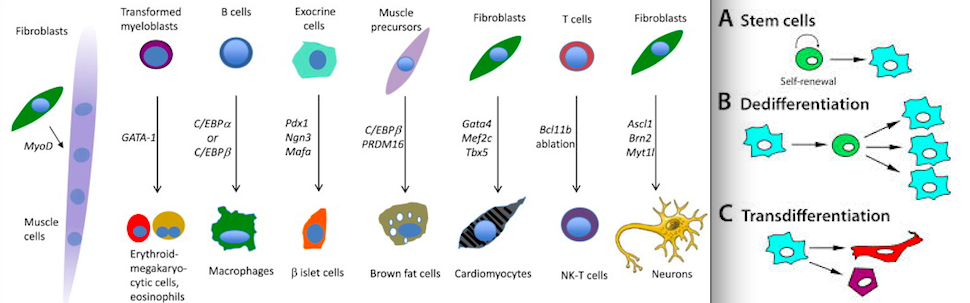
The best way to figure it out would be to see how to do the process known as transdifferentiation, where one type of fully differentiated cell turns into  another type of fully differentiated cell without going through the middle path which is to de-differentiate and revert into a progenitor form of  stem cells, and then redifferentiate into the type of tissue cell we are looking for.

The fact is that researchers can already turn the cells in urine into stem cells for teeth. (source) So the technology for focusing one type of stem cell into differentiate into a fully differentiated cell like neurons, adipocytes, etc. is available already. The step on how to de-differentiate backwards into the progenitor cells has also been very well studied and there are some options.

It is just that scientists have not been able to figure out how to do transdifferentiation of fully differentiated human cells yet. If we understood at the genetic or nano level on how some animals like the Immortal Jellyfish does this process, which mRNA or microRNA is activated to turn on the expression of which gene, then we would be able to figure out how to turn the bone cells in a certain area of the body into cartilage cells. If we can keep the chondrogenic phenotype long enough through some type of minimal approach like Ultrasound, Extracorporeal Shockwaves, etc., then it would start releasing the right type of extracellular proteins and compounds like Collagen Type 2, proteoglycans, Glycoaminoglycans, Type IX, and Alkaline phosphatase, which would slowly turn the region of bone from a hard, brittle matrix into a elastic one which would eventually become hyaline cartilage.

The title of this post is “Increase Height And Grow Taller Through Cartilage Regeneration Through Stainless Steel Strength Osteogenic Tissue”

What the title of the post really means is that instead of trying to stretch out bone, which has the resistive and material strength at the same magnitude as stainless steel (source), we should try to regenerate (or actually generate) the cartilage tissue which can get in between the osteogenic tissue/bone and slowly replace the bone into something that is much less strong which we can work with.

So we can try to either get small fragments of cartilage tissue embedded in between the large much harder and stronger bone, and then figure out how to dissolve/ filter out the bone tissue over time, or we try to turn a segment of the bone into cartilage tissue, using maybe de-mineralization techniques, increasing of PTHrP levels, acid-base titration reactions, or activating some type of microRNA signals which will start the transdifferentiation process.