Author Archives: Senior Researcher

Controlling a Stem Cell’s Form Can Determine Its Fate

From Science Daily

Shaping Up: Controlling a Stem Cell’s Form Can Determine Its Fate

ScienceDaily (Sep. 20, 2011) — “Form follows function!” was the credo of early 20th century architects making design choices based on the intended use of the structure. Cell biologists may be turning that on its head. New research by a team working at the National Institute of Standards and Technology (NIST) reinforces the idea that stem cells can be induced to develop into specific types of cells solely by controlling their shape. The results may be important to the design of materials to induce the regeneration of lost or damaged tissues in the body.

Tissue engineering seeks to repair or re-grow damaged body tissues, often using some form of stem cells. Stem cells are basic repair units in the body that have the ability to develop into any of several different forms. The NIST experiments looked at primary human bone marrow stromal cells, adult stem cells that can be isolated from bone marrow and can “differentiate” into bone, fat or cartilage cells, depending.

“Depending on what?” is one of the key questions in tissue engineering. How do you ensure that the stem cells turn into the type you need? Chemical cues have been known to work in cases where researchers have identified the proper additives — a hormone in the case of bone cells. Other research has suggested that cell differentiation on flat surfaces can be controlled by patterning the surface to restrict the locations where growing cells can attach themselves.

The experiments at NIST are believed to be the first head-to-head comparison of five popular tissue scaffold designs to examine the effect of architecture alone on bone marrow cells without adding any biochemical supplements other than cell growth medium. The scaffolds, made of a biocompatible polymer, are meant to provide a temporary implant that gives cells a firm structure on which to grow and ultimately rebuild tissue. The experiment included structures made by leaching and foaming processes (resulting in microscopic structures looking like clumps of insect-eaten lettuce), freeform fabrication (like microscopic rods stacked in a crisscross pattern) and electrospun nanofibers (a random nest of thin fibers). Bone marrow stromal cells were cultured on each, then analyzed to see which were most effective at creating deposits of calcium — a telltale of bone cell activity. Microarray analysis also was used to determine patterns of gene expression for the cultured cells.

The results show that the stem cells will differentiate quite efficiently on the nanofiber scaffolds — even without any hormone additives — but not so on the other architectures. The distinction, says NIST biologist Carl Simon, Jr., seems to be shape. Mature bone cells are characteristically long and stringy with several extended branches. Of the five different scaffolds, only the nanofiber one, in effect, forces the cells to a similar shape, long and branched, as they try to find anchor points. Being in the shape of a bone cell seems to induce the cells to activate the genes that ultimately produce bone tissue.

“This suggests that a good strategy to design future scaffolds would be to take into account what shape you want to put the cells in,” says Simon, adding, “That’s kind of a tall order though, you’d have to understand a lot of stuff: how cell morphology influences cell behavior, and then how the three-dimensional structure can be used to control it.” Despite the research still to be done on this method, the ability to physically direct cell differentiation by shape alone potentially would be simpler, cheaper and possibly safer than using biochemical supplements, he says.

The work was supported in part by the National Institute of Dental and Craniofacial Research, National Institutes of Health.

Me: So apparently you can get the right type of stem cell differentiation by using scaffolds of certain designs. You manage to control the form it goes into, you can control the type the stem cells turns into.

CartiHeal And Agili-CTM, a Single Stage Arthroscopic Cartilage Regeneration Implant

I found this article post that says that the company CartiHeal from Israel has gotten funding to continue their need in developing an innovative cell-free technology for regenerating hyaline cartilage. Found HERE

I do realize that the technology is mainly going to be used for the articular cartilage at the end of long bones, but I don’t see how this type of technology can’t be used as a form of implant since it is suppose to regenerate hyaline cartilage, .


CartiHeal Receives Additional Funding to Prepare for Market Launch of Agili-CTM, a Single Stage Arthroscopic Cartilage Regeneration Implant

TEL AVIV, Israel–(BUSINESS WIRE)–CartiHeal (2009) Ltd, a privately held medical device company developing an innovative cell-free technology for regenerating hyaline cartilage, raised up to $10 million, including $5 million in cash and $5 million in options. Half of the sum was raised from new investor, Elron, and the remainder from previous investors, Accelmed and Access Medical Ventures. The financing will be used to accelerate the development of CartiHeal’s technology portfolio, including its leading product, the Agili-CTM, as well as support ongoing clinical studies.

“In our post-marketing studies, initial clinical outcomes are very promising. Biopsies and MRIs show the regeneration of hyaline cartilage as early as 6-12 months following implantation. This is nothing short of a technological breakthrough”

CartiHeal’s Agili-CTM is a single step arthroscopically-placed implant, indicated for repairing cartilage and osteochondral defects. Agili-CTM has demonstrated, in both animal and human studies, an unprecedented ability to regenerate true hyaline cartilage—confirmed by the presence of Type II collagen—without the use of growth factors, stem cells or cell expansion techniques. These results have been confirmed by histological analysis performed by NAMSA, an independent research laboratory. The Agili-CTM is CE marked and CartiHeal is currently conducting post-approval clinical studies at leading centers in Europe.

Research has shown that injuries to the articular cartilage, if left untreated, lead to progressive joint changes and early onset of osteoarthritis. The most common treatments for articular cartilage injuries (e.g. microfracture and osteochondral grafting) fall short, since they do not result in regeneration of hyaline cartilage. Agili-CTM offers the 1.2 million patients undergoing cartilage repair annually worldwide, the potential for healing the defect with hyaline rather than “hyaline-like” fibrocartilage, possibly preventing the need for future joint replacement surgery in these patients.

“In our post-marketing studies, initial clinical outcomes are very promising. Biopsies and MRIs show the regeneration of hyaline cartilage as early as 6-12 months following implantation. This is nothing short of a technological breakthrough,” reports Nir Altschuler, Founder and CEO of CartiHeal. “We welcome our new investor and believe Elron’s extensive experience will assist us to become a leading player in the field of cartilage regeneration.”

Ari Bronshtein, CEO of Elron, commented, “The investment in CartiHeal attests to our commitment to continue investing in medical device companies based on revolutionary technology with significant potential. Elron’s know-how and experience in the biomed field, together with existing investors Accelmed and Access Medical and the Company’s management as well as its scientific advisory board, will contribute to CartiHeal’s advancement and help it achieve its goals.

About CartiHeal

Founded in 2009, CartiHeal is a privately held medical device company that develops proprietary implants for the regeneration of cartilage and bone disorders following sports injuries, trauma or degenerative joint changes. CartiHeal is a spin-out of the Department of Biotechnology Engineering at Ben-Gurion University, Israel.

About Elron

Elron is a leading holding company dedicated to building technology companies, primarily in the field of medical devices. Investments in med-tech companies during the last five years totaled over $150 million.

Elron’s portfolio companies include: Given Imaging, a world leader in developing and marketing diagnostic products for visualizing and detecting disorders of the GI tract; Pocared Diagnostics, which is developing a real-time and automated system for infectious diseases diagnosis using optical technology; BrainsGate, which is developing a system for treating ischemic stroke; Kyma, which is developing a remote patient monitoring system for chronic heart failure patients, and; SmartWave, which is developing a fully automatic implantable atrial defibrillator.

Contacts

CartiHeal
Nir Altschuler, CEO, +972-3-9085000
info@cartiheal.com


Comparing Pilates, Alexander Technique, And Chiropractor. Which Method Gives The Most Height Increase?

I found this article from the Daily Mail UK about a woman who had decided to take the three paths of pilates, alexander technique, and chiropractor and see which one could give her the most extra height.

It is from HERE. Again, I highlighted the most interesting parts . Hope you like it.


Can you grow an inch in a week?

by ALICE ROBINSON, Daily Mail

Modern life is making us lose height. This is the disturbing conclusion of health experts who have the unenviable task of righting the damage we do to our backs in the course of our everyday lives. ‘We spend far too much time slumped over computers, wearing high heels and idling around on sofas watching TV,’ says Sue Wakefield, executive director of the British Chiropractic Association. As a direct result, most of us may well be standing up to 2in shorter than we need to be.

Back problems are costing British firms 10 million working days a year and making us an unhappy and short nation in constant pain. Having woken every morning for two years with an aching neck and feeling permanently irritable, Alice Robinson, 5ft 4in, set out to find a cure. She tried three methods of realignment to see if she could gain a healthy spine – and extra inches. Her results may surprise you.

Pilates

Developed last century by Joseph H. Pilates – a German fitness enthusiast – and now fashionable among celebrities such as Sharon Stone, Madonna and Julia Roberts, Pilates was originally used to help injured dancers and athletes.

It is used to rectify poor posture by means of exercises that strengthen the spine, and stretch the vertebrae, which increases height, improves the circulation and opens up the joints.

This was initially only practised in studios, using beds to which pupils were loosely strapped, so that specific areas could be isolated and manipulated without moving other parts of the body.

However, ex-dancer and Pilates tutor Glenda Taylor has developed exercises that can be done for 10 to 15 minutes a day at home.

According to Taylor, Pilates is, in addition, like ironing out the spine, and a marvellous way of improving the way you look.

‘If your body is concertina-ed down, you necessarily look fatter. When you stand correctly, because you are standing taller, you are stretching your fat over a larger surface area – which gives the impression of being slimmer.’

Glenda agreed to give me three lessons to see how much difference we could make to my height.

During our first session, we concentrated on stretching out the spine while facing upwards. As I followed her instructions, trying to co-ordinate my arms and legs, I realised just how little control I have over virtually every part of my body.

We began by sitting in a yoga-like position, gradually dipping my head further and further towards my legs. Then Glenda took me through a variety of exercises such as sitting with one leg tucked up to my bottom and one stretched out, then curving my arms towards my toes to elongate the spine.

During the second session, Glenda taught me exercises that concentrated on lying on my stomach and arching the spine. The third session was devoted to stretching and limbering up to give suppleness, using household objects to perform the exercises.

Verdict: 1/2 inches (so that is 0.5 inches with 3 sessions)

After just three sessions, I had grown half an inch, and also found it easier to pull in my stomach muscles – an added bonus. However, with Pilates and the Alexander Technique, the effects can only be maintained with regular practice.

Alexander Technique

The Alexander Techinque has 800 practitioners in Britain, and the numbers are growing.

It was developed by Frederick Matthias Alexander, a 19th century actor, who lost full use of his voice through chronic laryngitis. He realised that muscular tension was causing this problem and developed a method of releasing it and allowing the spine to lengthen.

Practitioners claim some people grow as much as 2in through the technique. I put their claims to the test at Noel Kingsley’s London practice, with three sessions over the course of a week.

‘We all become accustomed to standing incorrectly,’ explains Noel. ‘Children are born with naturally perfect posture, but as we get older, we develop unconscious movement habits – such as slouching, or carrying heavy bags.

‘These affect our sense of wellbeing as well as causing physical problems, and the Alexander Technique is a way of releasing unwanted muscular tension that has accumulated over years of stressful living.

I was thrown by Noel’s first comment. He explained that when you stand correctly the head will feel as if it is tipped slightly forward with your chin pointing down, so you are not resting the weight of your head on the spine.

I then had to relax and Noel gently pushed down my shoulders and ran his hands up my neck. As I forced myself to stop resisting the action it is incredibly difficult to relinquish total control of your limbs to someone else – I could feel the muscles stretching and elongating.

The release of blood and oxygen made my whole body tingle, and after the first session I almost floated down Oxford Street and wafted onto the Tube.

Having been shown how to balance my head in the right way, I found it easy not to slip back into my former rigid stance. Over the next two sessions Noel showed me how I should stand (balanced), sitting (straight) and walking (in a much more relaxed fashion).

Having analysed my movement pattern, he used touch to guide me into the right positions, using his hands to gently push my shoulders down, my bottom in and my head forward. Ideally, the technique is taught to you over a series of lessons – Noel recommends 15.

The verdict: one inch   (wow, 3 sessions lead to 1.0 extra inch!!)

After my third and final session, I measured myself and was astounded to discover that I had grown an inch and could gaze down at the world from the lofty height of 5ft 5in. Not quite Kate Moss, but almost.

Chiropractor

Chiropractic involves diagnosing and treating disorders of the joints, muscles and bones. Minor displacements of the spinal bones can cause stress to the whole body as it compensates for misalignments.

One of the main treatments used is manipulation – where the joints are mobilised or stretched using a gentle motion to improve or restore normal function.

Although I gained just over a quarter of an inch from my sessions with Antoni Jakobowski – a chiropractor for more than ten years who sorts out the back problems of the U.S.

Having never contemplated whether my spine was in good condition, during my initial consultation I realised that I had spent two years with a constant nagging pain in my neck and right shoulder.

Bones and discs need motion to keep them healthy, otherwise calcium deposits form on the joints, making them harder to move.

The muscles surrounding the joints start to tense in order to try to stabilise the weak joint, and you start to feel pain.

Jakobowski explains that how much height you gain depends on where the problem is. ‘If you need work on your lower back, you will gain more height because the curve of your spine changes.’ When a bone is out of position the body leans forward to compensate.

Having worked out where the problem areas might be, he uses a nervoscope – a heat sensitive thermometer that identifies areas of inflammation.

Because blood is rushing to these areas, they are hotter. Running the nervoscope up and down my spine, it transpired that I had two vertebrae functioning improperly in my neck – from clutching the phone between my neck and shoulder.

Jakobowski placed his hands on my chin and neck and twisted it quickly to realign my neck vertebrae. There was a disconcerting popping sound, caused apparently by trapped gas being emitted from the joint, and the pain in my neck and shoulder disappeared instantly.

The verdict: one-quarter of an inch    (so 1 session with a chiropractor leads to 0.25 inches)

Not only was I standing a quarter of an inch taller, but I felt much more energetic and even-tempered. I wouldn’t hesitate to visit a chiropractor again. Depending on factors such as weight and age, the effect should be longer lasting.

Me: It looks like from the three methods, The alexander method lead to the most change of 1 inch (2.54 cms). However, I would be willing to bet that if the women kept on doing the pilates exercises or the chiropractor sessions, her height gain could have been more than just a fraction of an inch. Overall, they all seem to work in fixing standing and posture issues. 

increasing Torso Height via Controlled Introvertebral Fibrocartilage Hypertrophy and/or Hyperplasia By Ultrasound-Guided Injections while Inverted

As I had stated in my last post, the discussion on the Make Me Taller boards seemed to have lead to me finding another rather revolutionary way to possibly increase a person’s height.

The original Discussion was started HERE but after a few extra clicks of linkes, I found myself on this discussion where one of the profiles started to talk about an idea that was very foreign to me, and seemed also very hopeful located HERE.


…..The spine is a very delicate and dynamic aspect of our body. The Call To Torsos is for a compilation of research that may help discover or advance methods for minimally-invasive or non-invasive methods for increasing Sitting Height via lengthening the Introvertebral Discs.

The major challenge is, to increase the spine length you would need a minimally-invasive or non-invasive method for increasing the height of the Vertebrae (Bone – not at all ideal) or of the Introvertebral Discs (Fibrocartilage – very ideal).

You do not want to increase the bone length because this is likely to be more difficult and there will be increased load on the Introvertebral Discs. The Introvertebral Discs provide critical cushioning and mobility between the Vertebrae and they degenerate with age. If you could increase the height of the Introvertebral Discs, you would be combating the degenerative effects of age which lead to spinal injury, you would have a healthier spine less prone to injury and you would increase height.

The optimistic aspect is 1: science has approached a period where it is trying to master growing Bone and Fibrocartilage among many other biological tissues and 2: 24 Vertebrae are not fused and thus 25 Discs have reasonable potential to be manipulated http://www.giantscientific.com/height_gain_exercise.html , which means that only a very small increase in height needs to be applied to each disc (e.g. 0.5cm or half of the width of your pinky nail Multiplied By 25 = 12.5cm = about 5 inches or 4.92 inches to be exact).

While some research is being applied to methods for manipulating the body in completely non-invasive ways such as systemic oral consumption or even approaches similar to magnetics or radio waves etc, my theory is that in order to specifically increase height of the discs in a practical manner which will not have negative side effects on the rest of the body one will likely need minimally-invasive injections directly to the disc. 

I imagine a solution such as Ultrasound-Guided Injections of some sort of growth agent, probably best administered while inverting on a specially designed Inversion Table. This also needs to be done in a manner where the disc does actually grow the correct amount in the correct direction and in a uniform/proportional manner so that there is no bulging and interference with the nerves.

Nothing would likely be permanent, since the discs degenerate with age or the agent that may be found to do this may simply “inflate” the disc rather than actually grow it. However, there could be varying degrees of maintenance depending on application. It would be Controlled Introvertebral Fibrocartilage Hypertrophy and/or Hyperplasia or something technically close to that – not a permanent implant or anything incredibly invasive.

While this may seem too extreme at first though, the reality is Leg Lengthening is accepted here and it is a violent breaking of the largest bones in the body followed by lengthening with a lot of tearing/stretching of soft tissues, consolidating and soft tissue healing and rehab for months and years; whereas this is simply injections that could be done in a single day and actually improve the quality/safety/mobility/health of your spine and possibly provide about 5 inches in height. This could be similar to women getting botox injections to inflate their lips or actors/models getting botox to compensate for indented scars etc. You could even observe which discs would benefit best from an increase via the Ultrasound and make sure to take care of them first.

Me: On the GrownGrowth’s next post, he goes even further to explain the method/ technique to increase torso height

So, let’s talk about the anatomy and method again in order to address this perspective of yours. 

Method:

Controlled Introvertebral Fibrocartilage Hypertrophy and/or Hyperplasia, which I theorize is to be done by Ultrasound-Guided Injections while inverted.

Methodological application on anatomy:

Introvertebral Fibrocartilage Hypertrophy and/or Hyperplasia means…

Controlled lengthening of the cartilage (type: Fibrocartilage), commonly referred to as Spinal Discs, in between the vertebrae (Introvertebral) by causing the Discs to grow in a controlled manner.

Essentially, we recognize that growth plates that help bones grow are also made of cartilage (type: Hyaline) before they become bone; and that the Spinal Discs could greatly benefit from reasonable addition in size for health and anti-degeneration while also increasing height (old people partly get shorter from Spinal Disc Degeneration, the Discs provide flexibility and shock absorbing …etc).

Real example of the direct dynamic effect of the method on anatomy:

24 Vertebrae are not fused and thus 25 Discs have reasonable potential to be manipulated http://www.giantscientific.com/height_gain_exercise.html , which means that only a very small increase in height needs to be applied to each disc (e.g. 0.5cm or half of the width of your pinky nail Multiplied By 25 = 12.5cm = about 5 inches or 4.92 inches to be exact).

*If you pay attention to the Sitting Height : Leg Height : Total Height Ratios, you’ll realize that 5 inches is going to be towards the rare extreme of maximum lengthening … much like only about 2 people on this forum have lengthened their legs 6 inches while most are thinking about 2-3 inches.

Real example put into perspective of the systemic or indirect effect on the anatomy:

With leg lengthening, there is usually 1 lateral cut in the bone per segment (rarely 2). This means that all of the lengthening is occurring at one “pressure point” or “load point” so to speak. So to compare LL of bones to the lengthening of the spine, like you were trying to do, this would be as if you only enlarged 1 of the 25 discs by 5 inches, whereas I am talking about enlarging each of the 25 discs a very small amount (again, even 5 inches is only 0.5cm lengthening per disc or the width of half of your pinky nail – think of how incredibly small that is for 5 inches of effect). While the overall increase is large, the “load dispersion” spread proportionally by only 0.5cm makes this very practical for 1: how much each disc can grow, 2: how much this effects surrounding anatomy because there is no large gap created in any one area rather the effect itself is so proportional that it is “almost systemic”.

(Common sense, plus see my skin experiment and rope analogy below!)

More importantly, is the very elaborate understanding of how each of those organs are secured to the body and/or secured to each other. 

So, let’s try to put the effect on the organs in perspective with all of this:

First, we’ll eliminate what we should:

Quote
the anus, from which fecal wastes are excreted. Finally, the pelvic region houses both the male and female reproductive organs.

These organs are in the fused section of the spine, and thus the only load that is going to be applied here is approximately 0.5cm for the 1 and only disc directly connected at the top and a similarly small load at the point where the intestine connects etc. It will not be the collective load, but the load in the specific area of connection.

Quote
In the upper chest, the heart and lungs are protected by the rib cage

So, we know for sure that the rib cage is firmly attached to the spine. We need to be incredibly concerned that when lengthening the spine the heart and lungs are still going to be as protected as they should be. What I do not understand, nor know how to certainly find out without dissecting a cadaver or talking with an experienced surgeon, is exactly how the heart and lungs are secured and thus how they would move in relation to the spine and ribs moving.

What is good to know is, a healthy body is already quite flexible. For example, when somebody performs a reverse arch type of pose:

….the spine is effectively lengthening in some respect by the angle it bends even though there isn’t a height increase – maybe 1-3+ inches total – because of the flexibility of the Introvertebral Discs – and the ribs are moving greatly, yet the lungs and heart are also moving with the ribs and they are still protected even though there is a better angle for a spear to enter the heart.

Now, it is important to remember that even though a total height increase in my example of 5inches, the “load dispersion” means that the ribs themselves are not elevated by 5 inches! The bottom rib will elevate approximately 0.5cm and the ribs gaps will be stretched approximately 0.5cm per rib as they are connected to each vertebrae and they still have connective tissue in the gaps for protection!

Regardless, as long as the heart and lungs are attached well enough – which I think/hope they are – they will simply move with the ribs (not need to grow or stretch at all) and be protected the same.

Quote
the abdomen contains the majority of organs responsible for digestion: the stomach, where food is broken down; the pancreas and liver, which respectively produce enzymes and bile necessary for digestion; the kidneys, which filter wastes from blood before excretion as urine; the large and small intestines, which extract nutrients from food;

Again, I do not know how all of these are connected, but they are going to have a very small load of 0.5cm put on them very proportionately.

I’m quite sure this is not going to matter at all for the intestines. I bet it would make you a bit more regular because it would stretch them out a bit (don’t you notice how well your digest and dump after abdomen stretching?)! The small intestine is about 23 feet long  and the large intestine is about 5 feet long (plenty of room the lengthen 0.5cm proportionally along their surface area against the spine)!
Likewise, the rest of the organs could very possibly handle the proportional load covered only for their surface area in relation to the spine. 

So, what essentially remains is the skin and the muscles of the back and abdomen and their connective fascia/tissues. This, combined with gravity, should be the biggest resistance how I currently imagine. However, Hyperplasia and/or Hypertrophy can very logically potentially overcome this!

Now, to try to give an example of how easy the skin will surely adapt, do this:

Pinch the skin on your bicep between your thumb and index finger, grip it and pull it as far out from the arm as possible. You’ll probably get an inch of stretch easily. This is because the “load” is dispersed proportionally throughout the already-flexible skin.

However, let go. Now, think of only the small area of skin that your pinched for a grip and try to spread that small area of skin out the same inch or so that the skin collectively extended from you arm. You can’t because there is too much “load” on too small of an area, thus you have to tear the skin and cause it to grow new skin to stretch the same inch or so as the first experiment! However, you can stretch that small area about 0.5cm before the skin would have to tear, which helps make the point that each Introvertebral Disc could likely be manipulated by about 0.5cm!

In theory, the muscle and all connective tissue itself may adapt the same!

One other example by analogy is, imagine an old rope. Quality rope is usually made by 3 core strands interwoven, and each core strand has many micro strands of thread. An old rope loosens over time, with the core strands unweaving and the micro strands unweaving. The longer the rope is, the more the length difference. A very long and loosened rope, when pulled from each end, may increase in length by 5 inches; however, that is only because each micro strand and core strand is tightening proportionally throughout it’s entire length and no smaller segment of the rope could be lengthened 5 inches without cutting the rope.

I don’t think I am completely wrong. I may be completely correct. At worst I am partly correct. There certainly isn’t enough reason to be deterred based on this premise alone.

Quote from: Soho on October 01, 2008, 09:16:13 PM
And for me it’s clearly not with today technology that we will make it.

No, it is very possible with current technology. If we don’t already have all the pieces of the puzzle, we are very close. You still think stem cell progress is science fiction and you’re way off. HGH, IGF, MGF, BGH and Adult and Embryonic stem cells and more are all very well understood – though maybe not perfectly – and we are growing all sorts of tissues in vitro and directly on some animals and body builders are growing tissues on themselves etc.

Gene Database

I finally can get to editing and adding upon this section for the Gene Database after I found the GIANT collaborative project that was published back in one of the October editions in Nature magazine in 2010. This is the most comprehensive collection of gene that have at “significance” in height.

First, lets get through some terminology…

GIANT (Genetic Investigation of ANthropometric Traits consortium): is an international collaboration that seeks to identify genetic loci that modulate human body size and shape, including height and measures of obesity. The GIANT consortium is a collaboration between investigators from many different groups, institutions, countries, and studies, and the results represent their combined efforts. The primary approach has been meta-analysis of genome-wide association data and other large-scale genetic data sets. Anthropometric traits that have been studied by GIANT include body mass index (BMI), height, and traits related to waist circumference (such as waist-hip ratio adjusted for BMI, or WHRadjBMI). Thus far, the GIANT consortium has identified common genetic variants at hundreds of loci that are associated with anthropometric traits. (from Broad Institute website HERE)

SNP (Single Nucleotide Polymorphism): is a DNA sequence variation occurring when a single nucleotide — A, T, C or G — in the genome (or other shared sequence) differs between members of a biological species or paired chromosomes in an individual. (ie, two sequenced DNA fragments from different individuals, AAGCCTA to AAGCTTA, contain a difference in a single nucleotide. In this case we say that there are two alleles: C and T). Almost all common SNPs have only two alleles (from wikipedia article on SNP here)

GWAs (Genomic-Wide Association studies): In genetic epidemiology, a genome-wide association study (GWA study, or GWAS), also known as whole genome association study (WGA study, or WGAS), is an examination of many common genetic variants in different individuals to see if any variant is associated with a trait. GWAS typically focus on associations between single-nucleotide polymorphisms (SNPs) and traits like major diseases. These studies normally compare the DNA of two groups of participants: people with the disease (cases) and similar people without (controls). Each person gives a sample of DNA, from which millions of genetic variants are read using SNP arrays. If one type of the variant (one allele) is more frequent in people with the disease, the SNP is said to be “associated” with the disease. The associated SNPs are then considered to mark a region of the human genome which influences the risk of disease. (from wikipedia article on GWAs here)

Nucleotide: molecules that, when joined, make up the individual structural units of the nucleic acids RNA and DNA.

Gene variation: variation in alleles of genes, occurs both within and among populations. Genetic variation is important because it provides the “raw material” for natural selection. Genetic variation is brought about by mutation, which is a change in the chemical structure of a gene. (from wiki)

Allele: one of two or more forms of a gene or a genetic locus (generally a group of genes). Sometimes, different alleles can result in different observable phenotypic traits, such as different pigmentation. However, many variations at the genetic level result in little or no observable variation. Most multicellular organisms have two sets of chromosomes, that is, they are diploid. These chromosomes are referred to as homologous chromosomes. Diploid organisms have one copy of each gene (and therefore one allele) on each chromosome. If both alleles are the same, they are homozygotes. If the alleles are different, they are heterozygotes. A population or species of organisms typically includes multiple alleles at each locus among various individuals. Allelic variation at a locus is measurable as the number of alleles (polymorphism) present, or the proportion of heterozygotes in the population.  In many cases, genotypic interactions between the two alleles at a locus can be described as dominant or recessive, according to which of the two homozygous genotypes the phenotype of the heterozygote most resembles. Where the heterozygote is indistinguishable from one of the homozygotes, the allele involved is said to be dominant to the other, which is said to be recessive to the former. The degree and pattern of dominance varies among loci. For a further discussion see Dominance (genetics). This type of interaction was first formally described by Gregor Mendel. However, many traits defy this simple categorization and the phenotypes are modeled by polygenic inheritance. The term “wild type” allele is sometimes used to describe an allele that is thought to contribute to the typical phenotypic character as seen in “wild” populations of organisms…Such a “wild type” allele was historically regarded as dominant, common, and “normal”, in contrast to “mutant” alleles regarded as recessive, rare, and frequently deleterious. It was commonly thought that most individuals were homozygous for the “wild type” allele at most gene loci, and that any alternative ‘mutant’ allele was found in homozygous form in a small minority of “affected” individuals, often as genetic diseases, and more frequently in heterozygous form in “carriers” for the mutant allele. It is now appreciated that most or all gene loci are highly polymorphic, with multiple alleles, whose frequencies vary from population to population, and that a great deal of genetic variation is hidden in the form of alleles that do not produce obvious phenotypic differences. (from wikipedia article on allele HERE)

Loci (singular is Locus): is the specific location of a gene or DNA sequence on a chromosome. A variant of the DNA sequence at a given locus is called an allele. The ordered list of loci known for a particular genome is called a genetic map. Gene mapping is the procession of determining the locus for a particular biological trait. Diploid and polyploid cells whose chromosomes have the same allele of a given gene at some locus are called homozygous with respect to that gene, while those that have different alleles of a given gene at a locus, are called heterozygous with respect to that gene. (from wikipedia article on gene loci HERE)

Gene: is a molecular unit of heredity of a living organism. It is a name given to some stretches of DNA and RNA that code for a polypeptide or for an RNA chain that has a function in the organism. A modern working definition of a gene is “a locatable region of genomic sequence, corresponding to a unit of inheritance, which is associated with regulatory regions, transcribed regions, and or other functional sequence regions “. Colloquial usage of the term gene (e.g. “good genes”, “hair color gene”) may actually refer to an allele: a gene is the basic instruction—a sequence of nucleic acids (DNA or, in the case of certain viruses RNA), while anallele is one variant of that gene. Referring to having a gene for a trait is no longer the scientifically accepted usage. In most cases, all people would have a gene for the trait in question, but certain people will have a specific allele of that gene, which results in the trait variant. Further, genes code for proteins, which might result in identifiable traits, but it is the gene, not the trait, which is inherited. (from the wikipedia article on gene HERE)

Minor Allele Frequency (MAF): refers to the frequency at which the less common allele occurs in a given population. MAF is widely employed in Genome Wide Association studies for complex traits. (from wikipedia article on MAF HERE)

Now let’s get through how gene locus nomenclature is done… 


(the segment/pic clip posted below is taken from the wikipedia article on genetics loci above HERE)

Also Understand the Results And Measurements (specifically the P-value)…

What is P-value? – In statistical hypothesis testing, the p-value is the probability of obtaining a test statistic at least as extreme as the one that was actually observed, assuming that the null hypothesis is true. One often “rejects the null hypothesis” when the p-value is less than the significance level α (Greek alpha), which is often 0.05 or 0.01. When the null hypothesis is rejected, the result is said to be statistically significant. (from wikipedia)

Note: For a far better and more detailed explanation of what exactly is the P-value please refer to the notes from a University of Alberta Stats class located HERE.

What does it mean to be “statistically signifi cant”?

It has become scienti fic convention to say that p-values exceeding 0.05 (one in twenty) just aren’t strong enough to be the sole evidence that two treatments
being studied really di ffer in their e ffect. When the term statistically signi cant is used to describe the results from a clinical trial, it means that the p-value is less than this conventional reference point. It is possible to have very strong evidence to show that even a very small e ffect is nonetheless a real one. Consequently, it is possible to have a small p-value even though the size of the e ffect is not worth bothering with from the 5clinical standpoint. Thus, statistical signi cance and clinical importance must be completely separate assessments.

Even when one treatment is superior to another in clinically important ways, it is possible for the study not to end in statistical signi cance. The study may have been too small to detect any but the largest of di erences. And of coursechance can work against a treatment as easily as work in its favor. Consequently, not achieving statistical signi cance must not be interpreted as having shown that the treatments studied are equally e ffective. (from University of Chicago Document HERE)

List Of Genes

[Note: This list of genes that have a “significant” influence on height variation was all taken from the Supplementary Material from the GIANT project.]

Analysis 1 (from GIANT article)


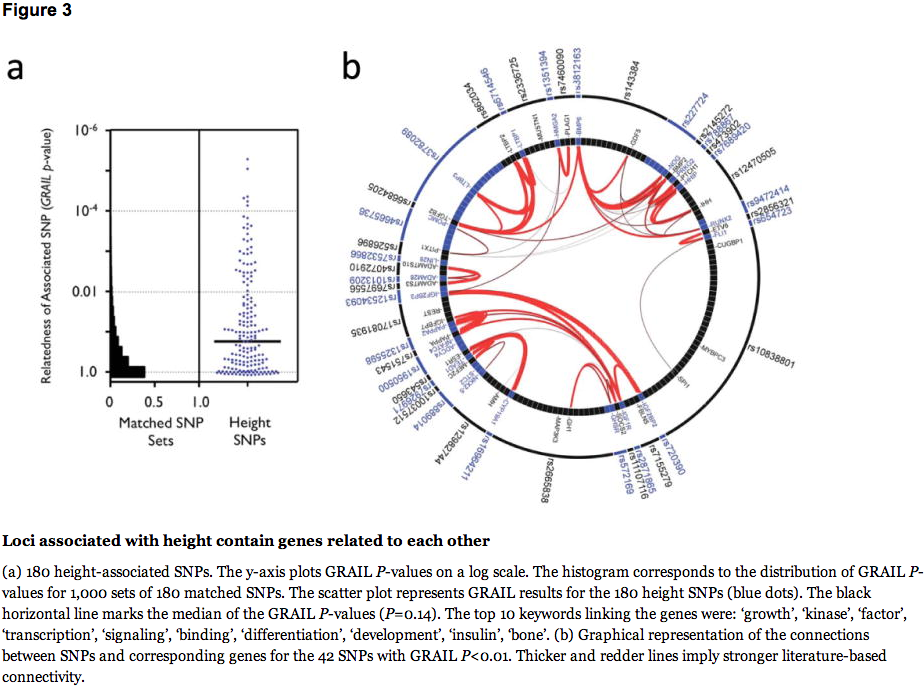
If you can see close enough, you can see that there was 42 single nucleotide polymorphisms associated in the circular diagram above. As stated in the original article found HERE

“This analysis revealed 17 different biological pathways and 14 molecular functions nominally enriched (P<0.05) for associated genes, many of which lie within the validated height loci. These gene-sets include previously reported (e.g. Hedgehog signaling) and novel (e.g. TGF-beta signaling, histones, and growth and development-related) pathways and molecular functions (Supplementary Table 12). Several SNPs near genes in these pathways narrowly missed genome-wide significance, suggesting that these pathways likely contain additional associated variants.”

also

“Of 32 genes with highly correlated (r2>0.8) nsSNPs, several are newly identified strong candidates for playing a role in human growth. Some are in pathways enriched in our study (such as ECM2, implicated in extracellular matrix), while others have similar functions to known growth-related genes, including FGFR4 (FGFR3 underlies several classic skeletal dysplasias23) and STAT2 (STAT5B mutations cause growth defects in humans24). Interestingly, Fgfr4-/- Fgfr3-/- mice show severe growth retardation not seen in either single mutant25, suggesting that the FGFR4 variant might modify FGFR3-mediated skeletal dysplasias. Other genes at associated loci, such as NPPC and NPR3 (encoding the C-type natriuretic peptide and its receptor), influence skeletal growth in mice and will likely also influence human growth17. Many of the remaining 180 loci have no genes with obvious connections to growth biology, but at some our data provide modest supporting evidence for particular genes…”

COMPLETE LISTING – 180 gene loci at present 

[Note: All the tables, graphs, and charts are edited and taken from the Supplementary Document for the GIANT article located HERE.]

Supplementary Table 1. Association results for Stage 1 (discovery GWAS), Stage 2 (in-silico replication), Stage 1+2 combined, and Stage 1+2 sex-specific meta-analyses, for the 180 independent signals that reached genome-wide significance (P<5×10⁻⁸) in the combined Stage 1+2 analysis. I2 represents the % heterogeneity of effect size between Stage 1 studies. Phet is the heterogeneity P-value.

SNP a Chr Position (bp) Nearest/OMIM height gene b Effect / other allele c Frequency (effect allele) Beta P-value d Phet (MvsF)
rs425277 1 2059032 PRKCZ T/C 0.28 0.024 1.70E-006 0.15
rs2284746 1 17179262 MFAP2 C/G 0.48 -0.035 5.60E-015 0.76
rs1738475 1 23409478 HTR1D C/G 0.59 0.022 1.90E-006 0.25
rs4601530 1 24916698 CLIC4 T/C 0.26 -0.024 2.00E-006 0.47
rs7532866 1 26614131 LIN28 A/G 0.67 0.022 3.30E-006 0.23
rs2154319 1 41518357 SCMH1 T/C 0.75 -0.034 4.30E-010 0.13
rs17391694 1 78396214 GIPC2 T/C 0.12 0.04 5.90E-007 0.95
rs6699417 1 88896031 PKN2 T/C 0.61 0.022 1.70E-006 0.99
rs10874746 1 93096559 RPL5 T/C 0.37 -0.022 1.70E-006 0.78
rs9428104 1 118657110 SPAG17 A/G 0.24 -0.038 8.90E-013 0.55
rs11205277 1 148159496 SF3B4 A/G 0.58 -0.045 1.20E-018 0.36
rs17346452 1 170319910 DNM3 T/C 0.73 -0.038 3.30E-014 0.56
rs1325598 1 175058872 PAPPA2 A/G 0.43 -0.026 1.60E-008 0.52
rs1046934 1 182290152 TSEN15 A/C 0.64 -0.046 6.40E-022 0.94
rs10863936 1 210304421 DTL A/G 0.53 -0.022 6.20E-007 0.06
rs6684205 1 216676325 TGFB2 A/G 0.71 -0.033 2.00E-011 0.41
rs11118346 1 217810342 LYPLAL1 T/C 0.47 -0.026 2.20E-009 0.05
rs10799445 1 225978506 JMJD4 A/C 0.77 0.031 1.20E-008 0.21
rs4665736 2 25041103 DNAJC27 T/C 0.54 0.034 1.40E-013 0.08
rs6714546 2 33214929 LTBP1 A/G 0.28 -0.025 2.20E-006 0.19
rs17511102 2 37814117 CDC42EP3 A/T 0.91 -0.06 1.30E-012 0.9
rs2341459 2 44621706 C2orf34 T/C 0.27 0.028 3.60E-008 0.14
rs12474201 2 46774789 SOCS5 A/G 0.35 0.023 1.00E-006 0.78
rs3791675 2 55964813 EFEMP1 T/C 0.23 -0.05 2.40E-020 0.71
rs11684404 2 88705737 EIF2AK3 T/C 0.67 -0.027 6.40E-009 0.46
rs7567288 2 134151294 NCKAP5 T/C 0.8 -0.031 6.70E-008 0.6
rs7567851 2 178392966 PDE11A C/G 0.08 0.041 7.50E-007 0.7
rs1351164 2 217980143 TNS1 T/C 0.79 0.028 3.70E-007 0.83
rs12470505 2 219616613 CCDC108/IHH T/G 0.9 0.048 1.30E-010 0.01
rs2629046 2 224755988 SERPINE2 T/C 0.55 0.025 2.20E-008 0.2
rs2580816 2 232506210 NPPC T/C 0.19 -0.041 1.80E-012 0.23
rs12694997 2 241911659 SEPT2 A/G 0.24 -0.027 1.80E-007 0.61
rs2597513 3 13530836 HDAC11 T/C 0.9 -0.039 1.10E-007 0.83
rs13088462 3 51046753 DOCK3 T/C 0.94 -0.054 3.10E-007 0.56
rs2336725 3 53093779 RTF1 T/C 0.55 -0.026 3.50E-008 0.85
rs9835332 3 56642722 C3orf63 C/G 0.46 -0.022 8.70E-007 0.91
rs17806888 3 67499012 SUCLG2 T/C 0.88 0.04 1.10E-007 0.93
rs9863706 3 72520103 RYBP T/C 0.22 -0.03 1.50E-008 0.6
rs6439167 3 130533446 C3orf47 T/C 0.21 -0.034 7.20E-010 0.09
rs9844666 3 137456906 PCCB A/G 0.25 -0.028 3.10E-008 0.09
rs724016 3 142588260 ZBTB38 A/G 0.56 -0.067 4.50E-052 0.42
rs572169 3 173648421 GHSR T/C 0.31 0.036 9.90E-014 0.4
rs720390 3 187031377 IGF2BP2 A/G 0.39 0.031 1.60E-010 0.14
rs2247341 4 1671115 SLBP/FGFR3 A/G 0.36 0.025 6.80E-008 0.67
rs6449353 4 17642586 LCORL T/C 0.85 0.071 1.30E-027 0.88
rs17081935 4 57518233 POLR2B T/C 0.2 0.031 4.80E-008 0.09
rs7697556 4 73734177 ADAMTS3 T/C 0.47 0.022 1.30E-006 0.56
rs788867 4 82369030 PRKG2/BMP3 T/G 0.68 -0.039 1.80E-015 0.95
rs10010325 4 106325802 TET2 A/C 0.49 0.021 2.30E-006 0.64
rs7689420 4 145787802 HHIP T/C 0.16 -0.069 1.40E-029 0.61
rs955748 4 184452669 WWC2 A/G 0.24 -0.024 2.20E-006 0.29
rs1173727 5 32866278 NPR3 T/C 0.4 0.036 4.00E-015 0.27
rs11958779 5 55037656 SLC38A9 A/G 0.7 -0.028 8.00E-009 0.8
rs10037512 5 88390431 MEF2C T/C 0.56 0.027 3.80E-009 0.3
rs13177718 5 108141243 FER T/C 0.07 -0.041 4.10E-006 0.16
rs1582931 5 122685098 CEP120 A/G 0.47 -0.025 2.10E-008 0.31
rs274546 5 131727766 SLC22A5 A/G 0.4 -0.028 8.50E-010 0.13
rs526896 5 134384604 PITX1 T/G 0.73 0.032 1.90E-009 0.15
rs4282339 5 168188818 SLIT3 A/G 0.2 -0.035 3.40E-010 0.69
rs12153391 5 171136043 FBXW11 A/C 0.25 -0.033 8.70E-010 0.57
rs889014 5 172916720 BOD1 T/C 0.36 -0.029 4.50E-010 0.51
rs422421 5 176449932 FGFR4/NSD1 T/C 0.22 -0.033 1.40E-009 0.64
rs6879260 5 179663620 GFPT2 T/C 0.39 -0.028 5.60E-010 0.41
rs3812163 6 7670759 BMP6 A/T 0.54 -0.037 6.70E-016 0.36
rs1047014 6 19949472 ID4 T/C 0.75 -0.029 1.10E-007 0.9
rs806794 6 26308656 Histone cluster A/G 0.7 0.053 5.50E-026 0.12
rs3129109 6 29192211 OR2J3 T/C 0.39 -0.026 3.30E-008 0.64
rs2256183 6 31488508 MICA A/G 0.45 0.035 2.70E-014 0.43
rs6457620 6 32771977 HLA locus C/G 0.51 -0.024 3.60E-008 0.81
rs2780226 6 34307070 HMGA1 T/C 0.92 -0.079 1.00E-018 0.96
rs6457821 6 35510783 PPARD/FANCE A/C 0.02 -0.121 1.80E-011 0.29
rs9472414 6 45054484 SUPT3H/RUNX2 A/T 0.22 -0.031 2.40E-008 0.66
rs9360921 6 76322362 SENP6 T/G 0.89 -0.048 4.60E-011 0.62
rs310405 6 81857081 FAM46A A/G 0.52 0.03 3.60E-011 0.25
rs7759938 6 105485647 LIN28B T/C 0.68 -0.042 8.70E-018 0.26
rs1046943 6 109890634 ZBTB24 A/G 0.58 0.022 8.60E-007 0.46
rs961764 6 117628849 VGLL2 C/G 0.42 -0.023 2.40E-007 0.79
rs1490384 6 126892853 C6orf173 T/C 0.5 0.037 3.20E-016 0.55
rs6569648 6 130390812 L3MBTL3 T/C 0.76 -0.036 8.90E-012 0.14
rs7763064 6 142838982 GPR126 A/G 0.29 -0.045 6.40E-019 0.29
rs543650 6 152152636 ESR1 T/G 0.4 -0.032 1.40E-009 0.36
rs9456307 6 158849430 TULP4 A/T 0.06 -0.05 4.60E-007 0.38
rs798489 7 2768329 GNA12 T/C 0.3 -0.052 8.50E-025 0.53
rs4470914 7 19583047 TWISTNB T/C 0.18 0.033 3.80E-008 0.93
rs12534093 7 23469499 IGF2BP3 A/T 0.22 -0.03 5.60E-008 0.84
rs1708299 7 28156471 JAZF1 A/G 0.3 0.042 1.50E-017 0.25
rs6959212 7 38094851 STARD3NL T/C 0.32 -0.023 2.80E-006 0.66
rs42235 7 92086012 CDK6 T/C 0.31 0.055 7.30E-028 0.01
rs822552 7 148281567 PDIA4 C/G 0.74 -0.03 1.30E-007 0.24
rs2110001 7 150147955 TMEM176A C/G 0.69 -0.033 9.80E-010 0.71
rs1013209 8 24172249 ADAM28 T/C 0.25 -0.029 4.50E-008 0.95
rs7460090 8 57356717 SDR16C5 T/C 0.87 0.055 9.60E-016 0.16
rs6473015 8 78341040 PEX2 A/C 0.72 -0.032 1.70E-010 0.84
rs6470764 8 130794847 GSDMC T/C 0.2 -0.047 5.90E-017 0.95
rs12680655 8 135706519 ZFAT C/G 0.6 0.03 4.80E-011 0.45
rs7864648 9 16358732 BNC2 T/G 0.32 0.025 4.90E-007 0.23
rs11144688 9 77732106 PCSK5 A/G 0.11 -0.055 1.50E-009 0.28
rs7853377 9 85742025 C9orf64 A/G 0.77 -0.026 3.10E-006 0.26
rs8181166 9 88306448 ZCCHC6 C/G 0.53 0.025 1.10E-007 0.07
rs2778031 9 90025546 SPIN1 T/C 0.24 0.027 3.60E-007 0.78
rs9969804 9 94468941 IPPK A/C 0.44 0.028 5.60E-010 0.92
rs1257763 9 95933766 PTPDC1 A/G 0.04 0.069 2.50E-006 0.55
rs473902 9 97296056 PTCH1/FANCC T/G 0.92 0.074 1.70E-014 0.62
rs7027110 9 108638867 ZNF462 A/G 0.23 0.034 1.30E-010 0.72
rs1468758 9 112846903 LPAR1 T/C 0.25 -0.026 1.50E-006 0.24
rs751543 9 118162163 PAPPA T/C 0.72 0.029 4.50E-008 0.89
rs7466269 9 132453905 FUBP3 A/G 0.64 0.036 1.20E-014 0.92
rs7849585 9 138251691 QSOX2 T/G 0.33 0.032 3.40E-011 0.69
rs7909670 10 12958770 CCDC3 T/C 0.44 -0.022 1.30E-006 0.06
rs2145998 10 80791702 PPIF A/T 0.49 -0.025 2.70E-008 0.68
rs11599750 10 101795432 CPN1 T/C 0.38 -0.023 7.60E-007 0.32
rs2237886 11 2767307 KCNQ1 T/C 0.11 0.043 3.10E-008 0.25
rs7926971 11 12654616 TEAD1 A/G 0.55 -0.024 7.30E-008 0.4
rs1330 11 17272605 NUCB2 T/C 0.35 0.024 4.40E-007 0.56
rs10838801 11 48054856 PTPRJ/SLC39A13 A/G 0.69 -0.031 1.80E-010 0.27
rs1814175 11 49515748 FOLH1 T/C 0.34 0.023 2.60E-006 0.13
rs5017948 11 51270794 OR4A5 A/T 0.18 0.027 4.70E-006 0.02
rs3782089 11 65093395 SSSCA1 T/C 0.06 -0.058 5.90E-009 0.13
rs7112925 11 66582736 RHOD T/C 0.35 -0.023 8.50E-007 0.57
rs634552 11 74959700 SERPINH1 T/G 0.14 0.041 1.40E-009 0.69
rs494459 11 118079885 TREH T/C 0.41 0.021 4.90E-006 0.5
rs654723 11 128091365 FLI1 A/C 0.62 0.024 6.70E-007 0.82
rs2856321 12 11747040 ETV6 A/G 0.64 -0.03 1.50E-010 0.83
rs10770705 12 20748734 SLCO1C1 A/C 0.33 0.031 4.60E-011 0.77
rs2638953 12 28425682 CCDC91 C/G 0.68 0.036 8.40E-014 0.04
rs2066807 12 55026949 STAT2 C/G 0.93 -0.052 9.60E-009 0.49
rs1351394 12 64638093 HMGA2 T/C 0.49 0.054 7.80E-034 0.14
rs10748128 12 68113925 FRS2 T/G 0.35 0.035 3.80E-011 0.23
rs11107116 12 92502635 SOCS2 T/G 0.22 0.052 1.70E-023 0.1
rs7971536 12 100897919 CCDC53/GNPTAB A/T 0.46 -0.025 1.10E-007 0.75
rs11830103 12 122389499 SBNO1 A/G 0.78 -0.035 3.80E-010 0.27
rs7332115 13 32045548 PDS5B/BRCA2 T/G 0.62 -0.025 7.60E-008 0.37
rs3118905 13 50003335 DLEU7 A/G 0.29 -0.052 3.00E-025 0.15
rs7319045 13 90822575 GPC5 A/G 0.4 0.029 4.50E-010 0.6
rs1950500 14 23900690 NFATC4 T/C 0.29 0.032 3.90E-011 0.32
rs2093210 14 60027032 SIX6 T/C 0.58 -0.034 2.30E-012 0.23
rs1570106 14 67882868 RAD51L1 T/C 0.2 -0.026 4.90E-006 0.67
rs862034 14 74060499 LTBP2 A/G 0.36 -0.023 1.10E-006 0.24
rs7155279 14 91555634 TRIP11 T/G 0.36 -0.029 8.90E-010 0.38
rs16964211 15 49317787 CYP19A1 A/G 0.05 -0.051 2.50E-006 0.04
rs7178424 15 60167551 C2CD4A T/C 0.47 -0.024 2.20E-007 0.88
rs10152591 15 67835211 TLE3 A/C 0.91 0.045 3.50E-008 0.28
rs12902421 15 69948457 MYO9A T/C 0.97 -0.069 1.70E-006 0.25
rs5742915 15 72123686 PML T/C 0.54 -0.031 3.00E-010 0.08
rs11259936 15 82371586 ADAMTSL3 A/C 0.48 -0.042 2.20E-021 0.03
rs16942341 15 87189909 ACAN T/C 0.03 -0.134 1.30E-017 0.43
rs2871865 15 97012419 IGF1R C/G 0.88 0.054 1.10E-012 0.54
rs4965598 15 98577137 ADAMTS17 T/C 0.68 -0.035 1.40E-013 0.21
rs11648796 16 732191 NARFL A/G 0.74 -0.031 2.40E-007 0.71
rs26868 16 2189377 CASKIN1 A/T 0.46 0.03 3.50E-008 0.73
rs1659127 16 14295806 MKL2 A/G 0.34 0.024 2.90E-006 0.7
rs8052560 16 87304743 CTU2/GALNS A/C 0.79 0.039 1.40E-008 0.47
rs4640244 17 21224816 KCNJ12 A/G 0.61 0.028 2.00E-007 0.78
rs3110496 17 24941897 ANKRD13B A/G 0.33 -0.023 1.60E-006 0.04
rs3764419 17 26188149 ATAD5/RNF135 A/C 0.39 -0.037 8.90E-016 0.67
rs17780086 17 27367395 LRRC37B A/G 0.15 0.035 4.40E-008 0.85
rs1043515 17 34175722 PIP4K2B A/G 0.45 -0.022 1.30E-006 0.15
rs4986172 17 40571807 ACBD4 T/C 0.35 -0.028 7.10E-009 0.41
rs2072153 17 44745013 ZNF652 C/G 0.3 0.026 6.70E-008 0.03
rs4605213 17 46599746 NME2 C/G 0.34 0.023 9.30E-007 0.21
rs227724 17 52133816 NOG A/T 0.65 -0.027 1.20E-008 0.2
rs2079795 17 56851431 TBX2 T/C 0.33 0.04 1.20E-016 0.12
rs2665838 17 59320197 CSH1/GH1 C/G 0.73 -0.037 2.00E-013 0.92
rs11867479 17 65601802 KCNJ16/KCNJ2 T/C 0.34 0.024 4.90E-007 0.68
rs4800452 18 18981609 CABLES1 T/C 0.79 0.048 2.40E-017 0.8
rs9967417 18 45213498 DYM C/G 0.58 -0.038 2.60E-016 0.44
rs17782313 18 56002077 MC4R T/C 0.76 -0.025 3.50E-006 0.55
rs12982744 19 2128193 DOT1L C/G 0.6 -0.033 2.80E-012 0.6
rs7507204 19 3379834 NFIC C/G 0.24 0.028 2.30E-007 0.05
rs891088 19 7135762 INSR A/G 0.74 -0.025 1.70E-006 0.45
rs4072910 19 8550031 ADAMTS10 C/G 0.46 -0.029 2.50E-007 0.31
rs2279008 19 17144303 MYO9B T/C 0.74 0.031 2.40E-007 0.48
rs17318596 19 46628935 ATP5SL A/G 0.36 0.029 3.00E-009 0.01
rs1741344 20 4049800 SMOX T/C 0.63 -0.026 3.50E-008 0.55
rs2145272 20 6574218 BMP2 A/G 0.65 -0.039 5.90E-016 0.85
rs7274811 20 31796842 ZNF341 T/G 0.23 -0.04 6.80E-014 0.52
rs143384 20 33489170 GDF5 A/G 0.58 -0.064 4.90E-039 0.47
rs237743 20 47336426 ZNFX1 A/G 0.21 0.034 7.20E-010 0.28
rs2834442 21 34612656 KCNE2 A/T 0.65 0.027 7.30E-009 0.9
rs4821083 22 31386341 SYN3 T/C 0.84 0.033 4.80E-008 0.41
  • a SNPs most likely to be representing a previously published height locus are highlighted in green.
  • b Gene regions are named after the gene nearest to the index SNP. A near-by (within 500kb from the index SNP) OMIM height gene (defined as a gene that when mutated results in a monogenic skeletal growth defect) is also included if it is not the nearest. All OMIM height genes are highlighted in blue.
  • c Alleles are indexed to the forward strand of NCBI Build 36.
  • d All p-values are based on the inverse-variance weighted meta-analysis model (fixed effects).

Supplementary Table 10. List of 241 abnormal skeletal/growth genes identified in the OMIM database (http://www.ncbi.nlm.nih.gov/omim) using the following keywords: short stature, overgrowth, skeletal dysplasia, brachydactyly, and manually curating the list blind to GIANT height results.

ACAN COL9A3 GJA1 NEU1 SIL1
ADAMTS10 COMP GLB1 NF1 SLC26A2
ADAMTS2 CRTAP GLI3 NIPBL SLC29A3
ADAMTSL2 CTDP1 GNAS NOG SLC2A2
AGPS CTSK GNPAT NPR2 SLC34A3
ALG12 CUL4B GNPTAB NSD1 SLC35C1
ALMS1 CUL7 GPC3 OCRL SLC35D1
ALPL CYP11B1 GUSB OFD1 SLC37A4
ANKH CYP19A1 HCCS PAPSS2 SLC39A13
ARL6 CYP21A2 HESX1 PAX3 SLC4A4
ARSB CYP27B1 HMGA2 PAX8 SLC6A8
ARSE DHCR7 HOXD13 PCNT SMARCAL1
ATP6V0A2 DYM HPRT1 PEX7 SMC1A
ATP7A EBP HRAS PHEX SMC3
ATP8B1 EFNB1 HSPG2 PHF6 SMPD1
ATR EIF2AK3 HYAL1 PITX2 SMS
ATRX ERCC2 ICK POU1F1 SOS1
B3GALTL ERCC3 IDUA PQBP1 SOST
B4GALT7 ESCO2 IFT80 PROP1 SOX3
BBS1 EVC IGBP1 PTCH1 SPG20
BBS10 EVC2 IGF1 PTCH2 SRY
BBS12 EXT1 IGF1R PTEN STAT5B
BBS2 EXT2 IGF2 PTH1R TAZ
BBS4 FANCA IHH PTPN11 TBCE
BBS5 FANCB IKBKG RAB23 TBX1
BBS7 FANCC JAG1 RAB3GAP1 TBX15
BBS9 FANCD2 KCNJ2 RAB3GAP2 TCF4
BMPR1B FANCE KDM5C RAF1 TGFBR1
BRAF FANCF KIAA1279 RAI1 TGFBR2
BRCA2 FANCG KRAS RBM28 THRB
BTK FANCI LBR RECQL4 TNFRSF11B
BUB1B FANCL LEMD3 RMRP TP63
C7orf11 FANCM LEPRE1 RNF135 TRAPPC2
CA2 FBN1 LHX4 ROR2 TRIM32
CCDC28B FBN2 LIFR RPL11 TRIM37
CEP290 FGD1 LIG4 RPL35A TRPS1
CHD7 FGF23 LMNA RPL5 TRPV4
CHRNG FGFR2 LRP5 RPS17 UBR1
CHST3 FGFR3 MAP2K1 RPS19 WNT7A
CLCN5 FLNA MAP2K2 RPS24 WRN
COL10A1 FLNB MATN3 RPS6KA3 ZBTB16
COL11A1 FOXC1 MC4R RPS7
COL11A2 FUCA1 MECP2 RUNX2
COL1A1 G6PC MGP SBDS
COL1A2 GALNS MKKS SDHA
COL2A1 GDF5 MKS1 SECISBP2
COL5A1 GH1 MMP13 SEMA3E
COL5A2 GHR MRPS16 SHH
COL9A1 GHRHR MYCN SHOX
COL9A2 GHSR NBN SHROOM4
——-

Supplementary Table 11. Height SNPs found to be located near or in the abnormal skeletal/growth genes identified in the OMIM database and listed in Supplementary Table 10.

SNP

Abnormal skeletal/growth gene (OMIM)

The closest gene to the height SNP is the abnormal skeletal/growth gene

The height SNP is in the abnormal skeletal/growth gene

rs16942341

ACAN

yes

yes

rs4072910

ADAMTS10

yes

no

rs16964211

CYP19A1

yes

yes

rs9967417

DYM

yes

yes

rs11684404

EIF2AK3

yes

yes

rs6457821

FANCE

no

no

rs143384

GDF5

yes

yes

rs2665838

GH1

no

no

rs572169

GHSR

yes

yes

rs7971536

GNPTAB

no

no

rs1351394

HMGA2

yes

yes

rs2871865

IGF1R

yes

yes

rs12470505

IHH

yes

no

rs17782313

MC4R

yes

no

rs227724

NOG

yes

no

rs422421

NSD1

no

no

rs473902

PTCH1

yes

yes

rs3764419

RNF135

no

no

rs10874746

RPL5

no

no

rs9472414

RUNX2

no

no

rs10838801

SLC39A13

no

no

————-

Supplementary Table 13. Biological evidence for genes at the 180 height associated loci. The list of genes is based on genes listed in Supplementary Table 12 (i.e. within a nominally associated pathway and less than 300kb away from one of the 180 height-associated signals), genes with expression evidence where the associated signal had an r2 > 0.8 with the peak SNP in the region in any of the tissues listed in Supplementary Table 7, and genes listed in Supplementary Table 8, where the associated signal was in high LD with a nsSNP. OMIM Evidence is based on genes obtained from the OMIM database (http://www.ncbi.nlm.nih.gov/omim) and listed in Supplementary Table 11. Jackson Lab Evidence was obtained by matching Gene column entries to Jackson Lab database (http://www.informatics.jax.org/) on genes reported to have either “growth/size”, “limb/tail/digit”or “skeleton” phenotype.

Gene Expression Evidence Missense SNP in LD r2>=0.8 (amino acid change, Polyphen2 prediction) OMIM Evidence Gene nearest to height signal Jackson Lab Evidence Biological Pathways Number of lines of evidence
ACAN rs938608 (S930I, possibly damaging)rs938609 (S939T, probably damaging)

rs2882676 (E1508A, benign)

yes yes growth/sizelimbs/digit/tail

skeleton

Extracellular matrix glycoprotein 5
CDK6 Lymphocyte yes growth/size Negative regulation of epithelial cell proliferation 4
CYP19A1 yes yes growth/sizeskeleton 4
EIF2AK3 rs1805165 (A704S, benign)rs13045 (Q166R, benign)

rs867529 (S136C, benign)

yes yes growth/sizelimbs/digit/tail

skeleton

4
FGFR4 rs376618 (P136L, benign) yes growth/size MAPK signaling pathway 4
GDF5 yes yes growth/sizelimbs/digit/tail

skeleton

TGFbeta signaling pathway 4
HMGA2 yes yes growth/sizelimbs/digit/tail Chromosome 4
ID4 Omentum yes growth/size TGFbeta signaling pathway 4
IGF1R yes yes growth/sizelimbs/digit/tail

skeleton

Mammary gland development 4
NOG yes yes growth/sizelimbs/digit/tail

skeleton

TGFbeta signaling pathway 4
PML OmentumSubcutaneous fat rs5742915 (F645L, benign) yes Nuclear membrane 4
PTCH1 yes yes growth/sizelimbs/digit/tail

skeleton

Hedgehog signaling pathway 4
STAT2 LiverOmentum

Subcutaneous fat

rs2066807 (M594I, benign) yes Other transcription factor 4
ADAMTS10 yes yes Metalloprotease 3
ADAMTSL3 rs4842838 (V661L, benign) yes Extracellular matrix glycoprotein 3
BMP2 yes growth/sizelimbs/digit/tail

skeleton

Hedgehog signaling pathway 3
BMP6 yes growth/sizeskeleton Hedgehog signaling pathway 3
C3orf63 Subcutaneous fat rs9835332 (T609R, benign)rs958755 (Q38P, benign) yes 3
DYM yes yes growth/sizelimbs/digit/tail

skeleton

3
EFEMP1 yes growth/sizeskeleton Extracellular matrix glycoprotein 3
ESR1 yes growth/sizelimbs/digit/tail

skeleton

Transcription factor 3
ETV6 yes growth/size Other transcription factor 3
FANCE rs7761870 (S204L, benign) yes Role of BRCA1 in DNA damage response 3
FLI1 yes growth/size Other transcription factor 3
FRS2 yes growth/sizelimbs/digit/tail Neuroblast proliferation 3
GH1 yes growth/size JAK-STAT cascade 3
GHSR yes yes growth/sizeskeleton 3
GNA12 Lymphocyte yes MAPK signaling pathway 3
HHIP yes growth/size Hedgehog signaling pathway 3
HMGA1 yes growth/size Chromosome 3
IHH yes growth/sizelimbs/digit/tail

skeleton

Hedgehog signaling pathway 3
INSR yes growth/size Type-2 diabetes 3
LTBP1 yes skeleton TGFbeta signaling pathway 3
MC4R yes yes growth/sizeskeleton 3
MEF2C yes growth/sizelimbs/digit/tail

skeleton

MAPK signaling pathway 3
MFAP2 Omentum yes Extracellular matrix glycoprotein 3
NFATC4 yes growth/sizeskeleton MAPK signaling pathway 3
PAPPA yes growth/sizeskeleton Metalloprotease 3
PITX1 yes limbs/digit/tailskeleton Anatomical structure morphogenesis 3
PPARD yes growth/size VDR/RXR activation 3
PRKG2 yes growth/sizelimbs/digit/tail

skeleton

Endothelin signaling pathway 3
RUNX2 yes growth/size, limbs/digit/tail, skeleton TGFbeta signaling pathway 3
RYBP Omentum yes growth/size 3
SCMH1 yes skeleton Transcription factor 3
SLBP Lymphocyte yes Other RNA-binding protein 3
SOCS2 yes growth/sizelimbs/digit/tail

skeleton

Type-2 diabetes 3
STK36 rs1344642 (R583Q, probably damaging)rs1863704 (G1003D, benign) growth/sizeskeleton Hedgehog signaling pathway 3
TBX2 yes limbs/digit/tail Other transcription factor 3
TEAD1 yes growth/size Other transcription factor 3
TGFB2 yes growth/sizelimbs/digit/tail

skeleton

TGFbeta signaling pathway 3
TSEN15 OmentumSubcutaneous fat rs2274432 (G19D, probably damaging) yes 3
SEPT2 Lymphocyte yes 2
ADAM28 yes Metalloprotease 2
ADAMTS17 yes Metalloprotease 2
ADAMTS3 yes Metalloprotease 2
AKD1 Omentum rs2277114 (V1555I, benign) 2
ANKRD13B Subcutaneous fat yes 2
BNC2 yes growth/sizeskeleton 2
C6orf173 yes chromosome 2
CCDC108 yes 2
CCDC66 Osteoblast rs7637449 (R460Q, probably damaging) 2
CCDC91 rs11049488 (A36T, benign) yes 2
CLIC4 yes growth/size 2
CLPS rs2766597 (L8P, possibly damaging) growth/size 2
CPN1 yes Metalloprotease 2
DDX27 Subcutaneous fat rs11553387 (G206V, benign) 2
DNM3 Lymphocyte yes 2
DTL yes Nuclear membrane 2
ECM2 rs10120210 (Q56P, probably damaging) Proteinaceous extracellular matrix 2
EXOSC5 rs10853751 (T5M, benign) Exoribonuclease 2
FBLN2 Omentum Extracellular matrix glycoprotein 2
FBXW11 yes Hedgehog signaling pathway 2
FOLH1 Subcutaneous fat yes 2
FUBP3 yes Other RNA-binding protein 2
GNPTAB yes Other transcription factor 2
GPC5 yes Extracellular matrix glycoprotein 2
H1FX Lymphocyte Histone 2
HLA-B Liver Antigen processing and presentation 2
IGF2BP2 yes Other RNA-binding protein 2
IGF2BP3 yes Other RNA-binding protein 2
ITPR3 rs2229642 (L2436V, benign) growth/size 2
KCNQ1 yes growth/size 2
L3MBTL3 yes Transcription factor 2
LIN28 yes Other transcription factor 2
LIN28B yes Other transcription factor 2
LPAR1 yes growth/size 2
LRRC37B Omentum yes 2
LTBP2 yes Extracellular matrix glycoprotein 2
LUZP1 LiverSubcutaneous fat growth/size 2
MICA yes Major histocompatibility complex antigen 2
MKL2 yes Other transcription factor 2
MTMR11 rs11205303 (M159V, benign) Other phosphatase 2
MYO9B yes Nicotinic acetylcholine receptor signaling pathway 2
NFIC yes Transcription factor 2
NME2 yes growth/size 2
NPPC yes growth/sizelimbs/digit/tail

skeleton

2
NPR3 yes growth/sizelimbs/digit/tail

skeleton

2
NUCB2 yes Annexin 2
PAPPA2 yes Metalloprotease 2
PCSK5 yes growth/sizelimbs/digit/tail

skeleton

2
PDS5B yes growth/sizelimbs/digit/tail

skeleton

2
PEX2 yes growth/sizeskeleton 2
PIP4K2B yes growth/sizelimbs/digit/tail

skeleton

2
PKN2 yes Annexin 2
PPAP2A Omentum Other phosphatase 2
PPIF yes Mitochondrial inner membrane 2
PRKCZ yes Type-2 diabetes 2
PSMB3 Osteoblast Parkinson disease 2
PTPRJ yes growth/size 2
QSOX2 yes Nuclear membrane 2
REST rs3796529 (P797L, probably damaging) growth/size 2
RPL5 yes yes 2
SLC22A4 LiverSubcutaneous fat rs272893 (I306T, benign) 2
SLC22A5 yes growth/size 2
SLC39A13 yes growth/sizelimbs/digit/tail

skeleton

2
SLIT3 yes growth/size 2
SOCS5 LiverOmentum

Subcutaneous fat

yes 2
TNS1 yes Other phosphatase 2
TRIP11 yes growth/size 2
UTP6 Liver Other transcription factor 2
VGLL2 yes Transcription factor 2
ZBTB24 LymphocyteOmentum yes 2
ZNFX1 rs6512577 (M1259I, benign) yes 2
AK092571 Subcutaneous fat 1
AL117656 OmentumSubcutaneous fat 1
AL161980 OmentumSubcutaneous fat 1
ATP6V1E2 Subcutaneous fat 1
B3GNT8 rs284662 (S137G, benign) 1
BC030091 LiverOmentum

Subcutaneous fat

1
C17orf42 LiverLymphocyte

Omentum

Subcutaneous fat

1
C17orf82 Subcutaneous fat 1
C20orf199 Lymphocyte 1
C6orf1 rs1150781 (G150A, unknown) 1
CCDC100 Omentum 1
CDK2AP1 Lymphocyte 1
Contig21370_RC Omentum 1
Contig40232_RC Subcutaneous fat 1
Contig41005_RC Liver 1
Contig43791_RC Omentum 1
CWF19L1 OmentumSubcutaneous fat 1
FAM173A Lymphocyte 1
FARP2 Omentum 1
FNDC3B rs7652177 (T179S, benign) 1
HAGHL OmentumSubcutaneous fat 1
HDLBP rs7578199 (N418S, benign) 1
HSS00017874 Omentum 1
HSS00085450 Subcutaneous fat 1
HSS00174467 Omentum 1
INTS7 LymphocyteOmentum 1
JMJD4 Osteoblast 1
MSTP9 Liver 1
N4BP2L2 LiverOmentum

Subcutaneous fat

1
NSD1 yes 1
PFAAP5 LymphocyteOsteoblast 1
PIP5K2B OmentumSubcutaneous fat 1
PPA2 Omentum 1
QSCN6L1 OmentumSubcutaneous fat 1
RMI1 rs1982151 (N455S, benign) 1
RNF135 yes 1
SLC23A3 Omentum 1
SMPD2 rs1476387 (R265S, benign) 1
SNAP47 Liver 1
TCF19 rs2073721 (M211V, benign) 1
TMEM4 Lymphocyte 1
TP53I13 OmentumSubcutaneous fat 1
USP52 Osteoblast 1
VPS13C rs3784634 (R931K, benign) 1
ZNF142 rs3770213 (L956H, benign)rs3770214 (S751G, benign) 1
ZNF311 rs6456880 (K511Q, benign) 1