Author Archives: Senior Researcher

Mind Hack II: Have A Life Altering Spiritual Experience With Ayahuasca And Chacruna Using DMT And MAOI

If someone I knew was to ask me what advice I could give them about life or what to do, I probably would tell them that the most effective and most transformative experience they can have to give them a completely different viewpoint in life is to go to the jungles of South America and go through a hallucigenic experience of using Ayahuasca and Chacruna.

I have seen so many people have their lives completely changed over for the better from using the Ayahuasca drink. This is why I wanted to add this Mind Hack to the list, because I believe in the power of hallucinegens in giving people a better, more fulfilling life.

From Resource site, I copy and pasted the complete article below for easy reading.

BOTANY

caapi

1. B. caapi, member of the Malpighiaceae family
peganum

2. P. harmala seeds
chagropanga

3. D. cabrerana leaves
suaveolens

4. A flowering Brugmansia suaveolens
brunfelsia

5. A flowering Brunfelsia grandiflora

In ayahuasca botany 3 groups of plants can be distinguished: MAO inhibitors, DMT carriers and additives. Without the MAOI, the visionary properties of DMT are not present, as it would be broken down in the body before reaching the DMT sensitive parts in the brain. In other words, a DMT-only brew would be inactive. An additive can be any kind of plant, some of the more wellknown ones being tobacco, san pedro and coca.

Ayahuasca can be made from any combination of an MAOI plant and a DMT plant, although strictly speaking there has to be the Banisteriopsis caapi vine (pic. 1) in it, an MAOI plant which is also called ayahuasca.

Although many plants produce DMT, traditional ayahuasca is made from the leaves of either Psychotria viridis (chacruna) or Diplopterys cabrerana (chagropanga or chaliponga) (pic. 3). The first is used in the Amazon basin and the second in the foothills of the regions where ayahuasca is used. Once you’re not using using the B. caapi vine as the MAOI or you’re employing plants other than chacruna or chagropanga for the DMT, we speak of an ayahuasca analogue, or anahuasca.

BANISTERIOPSIS CAAPI A.K.A. AYAHUASCA

‘Ayahuasca’ is Quechua, the language of the Inca empire, for ‘vine of the soul’, ‘vine with a soul’ or ‘vine of the dead’. Ayahuasca, a member of the Malpighiaceae family, is considered to be the most important ‘plant teacher’. According to most of the native ayahuasqueros (frequent drinkers of ayahuasca) the effects of B. caapi are their main source of botanical knowledge.

Indigenous shamans distinguish over 40 varieties of ayahuasca vines, for example tucunacá and caupurí. The plant is cultivated, typically using cuttings, throughout the Amazon basin of Peru, Ecuador, Colombia and Brazil. A young shoot or the end of a branch is put in water. After forming roots it is put in soil and watered thoroughly.

The woody stems of the giant B. caapi are very long and branch repeatedly. The leaves can be between 8 to 18 cm long, 3.5 to 8 cm wide. They are green, round-ovate and pointed at the end. Flowering only rarely and exclusively in moist, tropical climates, the infloresences grow from axillary panicles and four umbels. The flowers are between 12 and 14 mm in size and have five white or pale pink sepals.

PSYCHOTRIA VIRIDIS A.K.A. CHACRUNA

Chacruna, like coffee, family of the Rubiaceae, is also known in different varieties, such as cabocla and chacroninha. It is a tropical bush that grows in the Amazon lowlands and through cultivation in Colombia, Bolivia and eastern Brazil. This evergreen can grow into a little tree, though most cultivated plants are between 2 and 3 meters in height. The long, narrow, ovate leaves are light green to dark green in color and the side facing the sky is glossy.

The flowers are attached to long stalks and have greenish white petals. Cultivation by means of seeds has shown to be a lot less fruitful than using cuttings. With P. viridis one only needs to put a small part of the plant directly in the soil and give it a lot of water. Even a branch with only two leaves can be used for this.

DIPLOPTERYS CABRERANA A.K.A. CHAGROPANGA

Also known as chaliponga, this plant was called Banisteria rusbyana when it was discovered. It has also been calledBanisteriopsis rusbyana and Banisteriopsis cabrerana, and, like Banisteriopsis caapi, is a member of the Malpighiaceaefamily. This tropical vine is found only in the Amazon basin (Ecuador, Peru, Brazil, Colombia). It grows wild in the forests but is most often found in cultivation.

The plant is cultivated in house gardens using cuttings. A young shoot or the tip of a branch is allowed to sit in water until it develops roots. It can also be placed directly into the moist jungle soil. This very long vine has opposite leaves that are oblong-oval and retuse-attenuate in shape. The inflorescences, each of which bears four tiny flowers, grow from the petiolar axils. However, the plant only rarely develops flowers, and almost never under cultivation.

OTHER MAOI PLANTS

The most common MAOI after B. caapi is Peganum harmala (pic. 2), a member of the Nitrariaceae, and is also known as Syrian rue or Harmal. This is an Eastern plant, the seeds of which are highly potent in MAOI substances. P. harmala has been fully adopted into the western anahuasca scene, primarily because it is a lot cheaper and also easier to prepare than the MAOI component of the original brew, which is of course the ayahuasca vine. There are many other plants that are known to be MAOIs as well, like passionflower and cocoa. None of them seem potent enough, however, to make them very suitable for usage in an ayahuasca analogue.

OTHER DMT PLANTS

The list of DMT plants is evergrowing. As mentioned before, traditionally the brew is made using chacruna or chagropanga. Many people use the rootbark of jurema, or Mimosa hostilis, to replace the traditional leaves. Another more recent addition gaining familiarity is Desmanthus illinoensis like jurema a descendant of the Fabaceae family, of which the rootbark is used.

The leaves of some species of Acacia (also family of the Fabaceae)are useful when preparing ayahuasca analogues, like Acacia maidenii. Certain Virola trees, which are family of the Myristicaceae, produce DMT in the bark, but this is typically snorted after processing rather than taken orally in conjunction with an MAOI. In the west people are also experimenting with reed canary grass, or Phalaris arundinacea of the Poaceae family, which is potent enough to make an ayahuasca analogue.

ADDITIVES

An additive is basically any plant the ayahuasca brewer decides to mix in. The leaves of coca (Erythroxylum coca of the Erythroxylaceae family), tobacco (Nicotiana tabacumand N. rustica of the Solanaceae family), and mescaline bearing cacti such as peyote (Lophophora williamsii) and san pedro (Trichocereus pachanoi syn. Echinopsis pachanoiand Trichocereus peruvianus, syn. Echinopsis peruviana), and various nightshades, of the Solanaceae family, (e.g. Brugmansia spp.) can be added for various psychopharmacological and spiritual reasons.

The Urarina, for example, are an indigenous people from the northeastern Peruvian Amazon who practice a form of ayahuasca shamanism that is largely based on the ritualized use of Brugmansia suaveolens (pic. 4), which contains hyoscyamine, atropine and scopolamine. The Kofan from northeast Ecuador and southern Colombia make regular use of scopoletin rich Brunfelsia grandiflora (pic. 5), another member of the Solanaceae. Other known common additives are Ilex guayusa of the Aquifoliaceae andPaullinia yoco, like guarana a member of the Sapindaceae family, probably for their high caffeine content, and Brugmansia ignensis.

From Resource 1 website,


CHEMISTRY AND PSYCHOPHARMACOLOGY

harmine

2D image of a harmine molecule
dmt

2D image of a dimethyltryptamine molecule

Ayahuasca is as complex as both chemistry and psychopharmacology can get. There’s a uniquely vast array of botanical sources, and an infinite amount of preparation methods, usually involving psychoactive compounds that we’re only beginning to comprehend scientifically, such as DMT and 5-MeO-DMT. The plant sources, the chemical processes and psychopharmacological actions described below are the ones that are generally considered to be the most remarkable ones.

BANISTERIOPSIS CAAPI

The primary active compounds in B. caapi are the alkaloids harmine, harmaline and tetrahydroharmine. They all belong to the β-carbolines group, which implies they are MAO-inhibitors. Harmine was first called ‘telepathine’. Later scientists discovered they had already come across the same compound in P. harmala seeds, so ‘telepathine’ has become obsolete.

In the recipes of the Amazonian Indians, the liana itself is typically the main ingredient. Tests of different samples have found 20 to 40 mg, 144 to 158 mg, and even 401mg of β-carbolines per dose. Other alkaloids found in B. caapi are harmine-N-oxide, harmic acid methylester, harmalinic acid, harmic amide, acethylnorharmine and ketotetrahydronorharmine.

Harmine and other MAO-inhibitors prevent the breakdown of monoamine neurotransmitters by inhibiting the action of monoamine oxidase enzymes. Apart from creating a path for otherwise orally inactive tryptamines, this renders certain substances harmful, most notably tyramine and tryptophan. These compounds are present in many kinds of food, like cheese and ripe fruit.

PSYCHOTRIA VIRIDIS AND DIPLOPTERYS CABRERANA

The primary active compound in P. viridis and D. cabrerana leaves is the indole ethylamine alkaloid n,n-dimethyltryptamine. Tests of different samples of Amazonian brews have found 25 to 36 mg of N,N-DMT per dose. It has a similar structure to serotonine and thus has affinity for several serotonergic 5-HT2 receptors. DMT is, like LSD, a partial-agonist on the receptor subtype 5-HT2A. When humans take DMT by itself orally, it is converted into inactive aldehydes by the endogenous enzyme monoamine oxidase.

The β-carbolines in the vine temporarily inhibit the production of this enzyme, allowing the DMT to reach the sensitive parts while still active. Inside the nervous system these are located near most of the serotoninergic terminal rich areas, including the neocortex (mainly the prefrontal, parietal, and somatosensory cortex) and the olfactory tubercle. Outside the nervous system 5-HT2A receptors are present in platelets (cell fragments, circulating in the blood, that are involved with clotting) and some muscles.

When inhaled through a vaporizer or bong, DMT gives pronounced effects without the intervention of an MAOI. The same goes for parenteral administration (injecting). Inhalation causes effects that last up to 30 minutes. Nasal insufflation, which is an important tradition of the Yanomamo tribe (see Wikipedia’s Yopo page) of DMT causes an experience that lasts up to 60 minutes. Oral administration of DMT after a corresponding amount of MAOIs causes an experience of at least 3 hours. Intra-muscular and intravenous administration is effective without an MAOI.

Unlike P. viridisD. cabrerana doesn’t only contain DMT (between 0.17 and 1.75% of the leaves), but also N-methyltryptamine, 5-MeO-DMT, bufotenine and N-methyltetrahydro-β-carboline. The stems contain roughly the same set, excluding bufotenine. 5-MeO-DMT (5-methoxy-dimethyltryptamine) is, like DMT, a psychedelic agent.

DMT

The status quo of DMT in prevailing science, despite the compound’s visionary properties, is that DMT is a by-product of metabolism. In the light of an ayahuasca experience, this conclusion obviously calls for more scientific research. Since DMT is every bit as illegal as LSD and heroin, however, it is a tough process for interested parties to actually get to research DMT.

Dr. Rick Strassman, a professor at the University of New Mexico medical school, has managed to survive the bureaucratic jungle of the FDA, DEA and other authorities. In 1991 he commenced the first official psychedelic research program in the U.S. since 1970. In 2001, Strassman published his findings in ‘DMT: The Spirit Molecule’.

DMT is being produced in the body all the time, and it is probably involved in the process of dreaming. DMT is also one of the few substances which can cross the blood-brain barrier. Hardly anything is known about how the extreme psychedelic activity of DMT really works.

DMT is used more and more these days by psychonauts, also in its smokable form. They use hard to obtain botanical extracts made from Acacia spp. or Mimosa hostilis, which are pure enough for one draw to contain enough DMT to be active through inhalation. If one smokes the unpurified leaf or other DMT carrying plant material, typically many lungfulls are required to achieve even the lightest kinds of effects. This leaves one exhausted before the effects start.

An example DMT extraction is shown below. Please note that DMT extraction, besides being a potentially dangerous chemistry procedure, is illegal in most countries.


SIMPLE MIMOSA HOSTILIS DMT EXTRACTION

    1. Before you start, make sure you have all the materials needed:
      – 100 gram of Mimosa Hostilis rootbark powder (MHRB)
      – 250 ml naphtha
      – 150 gram of lye (NaOH, caustic soda)
      – 2 litre mason jar (a glass pickle jar will work also) or wide mouth HDPE jug
      – 2 small glass (mason) jars (~0.5L)
      – Guard
      – Metal spoon
      – Sheet of A4 paper
      – Eye dropper/pipette
      – Freezer
    2. Dissolve 150 grams of lye in 1.5 litre of (tap) water in a large glass jar. It is advised to wear safety goggles and gloves, as lye is a very aggressive substance that can cause burns and blindness. Add the lye in two or three steps, and allow the liquid to cool down in between.
    3. When the water with added lye has cooled down and is clear again, it is time to add the powdered mimosa bark. Add the powder slowly while stirring all the time. After adding the 100 grams of mimosa, leave the brew to stand for about an hour.
    4. Add 100 ml of naphta and put the lid on the jar.
    5. Gently turn the jar end over end for about 5 minutes. It is important not to shake or splash. After 5 minutes, put the jar down for some minutes and repeat the agitating process two more times.
    6. After a short period two separate layers will be distinguishable. Separate the upper layer (naphta) using a pipette or eyedropper. It is important that none of the dark solution is collected.
    7. Again, add 100 to 150 ml naphta to the large jar, and repeat the previous two steps two more times. Separate the upper layer in a new jar
    8. Put the collection jars in the freezer.
    9. After 24 hour the jars can be taken from the freezer. Carefully drain the naphta, making sure any floating crystals remain in the jar. Scoop out the white crystals from the side of the jar using a spoon, and leave them to dry on a folded piece of A4 paper.
    10. After drying, crush any lumps up. The three pulls combined will result in 500-1000 mg pure DMT crystals.

PHALARIS ARUNDINACEA

          This plant is also called reed canary grass and is one of the few DMT sources that you can find growing outside in the Netherlands. Little research has been done as to how exactly this plant can be used as the botanical DMT source for an ayahuasca analogue. Jim DeKorne, author of “Psychedelic Shamanism”, is currently one of the few people who has published information on how

P. arundinacea

         can be processed into an administrable substance. His idea of canary grass extraction is this:
        1. Pulverize the grass clippings
        2. Add water, “enough to make a pourable soup”
        3. Acidify to pH 5 or so
        4. (Optional) Simmer the acidified soup in a slow cooker overnight, not allowing the liquid to evaporate. (“It may take two or three such operations to get all of the alkaloids into solution”)
        5. Strain the plant matter through cheesecloth, then through a paper coffee filter
        6. Add 10 to 15% of the mass of the solution in a “defatting solvent” such as methylene chloride, ether, chloroform, or naphtha.
        7. Shake vigorously
        8. The crap will go into the solvent, leaving the good stuff in the water.
        9. Separate the water from the solvent.
        10. Add a base to the aqueous solution in small increments until the pH gets to about 9 or 10. This converts the alkaloids into their free base.
        11. Extract with 10% of the mass of the solution of an organic solvent four times, at one 24-hour and then three weekly intervals. The solvent layer will take on a darker tint, usually yellowish or reddish-brown. It will take almost a month to extract all of the alkaloids, and the solution should be shaken at least twice a day between extractions.
        12. Evaporate the solvent off from the combined extract fractions. You now have the alkaloids.

In a later publication, “The Entheogen Review”, DeKorne has more information on Phalaris extraction:

      “The latest scoop is that you don’t even have to use chemical extractions anymore – run several handfuls of grass through a wheatgrass juicer (sold in most health food stores) and you’ll wind up with a glass or so of incredibly potent liquid. One teaspoon (with MAO inhibition, of course), is a standard dose with strong grass. Only two teaspoons proved very challenging to one of my correspondents – an OD! The juice can be dried and smoked in a bong – two tokes will usually do it.”
    From Resource 2

BE PREPARED

making

Two Peruvian Mestizos making ayahuasca
ready

Ayahuasca plants mise en place
        The ayahuasca experience has proven to be an extraordinary one. It has positively changed the lives of many people. It has cured various forms of depression and addiction. Ayahuasca has shown people the immense beauty of the cosmos and ourselves through overwhelmingly enchanting and emotional visions and visualizations. An experience capable of phenomena with such magnitude needs to be valued and respected for what it is.


            This means that part of drinking ayahuasca is the preparation. Everyone should find out what his or her preparation is, but in general it is recommended to read some of the common literature on ayahuasca and the psychedelic experience in general. Another thing it should involve for most people is discussing the topic with various experienced drinkers. You can also find a lot of information by taking

      Erowid

            , the best psychoactive substances website, as a starting point. Their

      ayahuasca page

              can be found

      here

             . Googling for ‘ayahuasca’ also gives good results for general orientation on the topic.


                Furthermore we are not in the position to do any more recommendations. Nevertheless we disrecommend to take ayahuasca without any preparation. It is also strongly disrecommended to take ayahuasca without the presence of an experienced ayahuasca drinker who has experience with guiding too. You can get an idea of the risks involved by reading the

          experience reports

               on this site.

          From Resource 3 website,

          RECIPES

                Making an ayahuasca brew is a task by itself that usually involves a lot of time, patience and care. For those who are nevertheless considering the option, here are some of the preparation methods to give an idea of what it involves to make ayahuasca. The required ingredients can easily be purchased online at places such as

          Botanical Spirit

          NATEMA RECIPE OF THE SHUAR

          The Shuar shamans (uwishin) split a 1- to 2-meter-long piece of

          Banisteriopsis caapi stem into small strips. They place the strips in a pot along with several liters of water. They then add leaves of Diplopterys cabrerana, a Herrania species, Ilex guayusaHeliconia stricta, and an unidentified Malpighiaceae known as mukuyasku. The resulting mixture is boiled until most of the water has evaporated and a syrupy fluid remains. The Kamsá, Inga, and Secoya make similar preparations.

          B. CAAPI & M. HOSTILIS RECIPE – BY AN ANONYMOUS MEMBER OF THE EROWID FORUM

          The use of

          Banisteriopsis caapi in this recipe is based on the premise that a) a brew of B. caapi and (usually) P. viridis  is the traditional South American brew, b) the caapi is particularly important as traditionally the caapi itself is considered to be “ayahuasca” while the DMT-containing plants are simply helpers, and c) the caapi and the experience it provides are smoother, safer, and “wiser” than that produced by Peganum harmala (syrian rue). B. caapi is less unpredictable and more controlled, a more reliable and learned teacher.

          After examining your intentions, researching, and following the requisite dietary regimen, gather together:

              • 50 grams of Banisteriopsis caapi (whole vine, not shredded/powdered)
              • 12 grams of Mimosa hostilis root bark (not shredded or powdered.) [See Note 1]
              • white vinegar
              • distilled water
              • 4 stainless steel pots [See Note 2]

          Steps

              1. Wrap the caapi in a towel and break it up with a hammer until it is shredded. Powder the mimosa with a coffee grinder or shred by hand.
              2. In one pot, put in the mimosa, a teaspoon of vinegar, and a liter or so of water.
              3. In another pot, put in the caapi, and a similar amount of water and vinegar.
              4. Simmer for 2-3 hours or until water level gets low. Avoid boiling — it should be just cool enough not to bubble. Speak your intentions to the brew as it is brewing; listen to the sounds it makes. Do not leave it unattended; if you need to do something different, turn off the stove.
              5. Keeping the mimosa and the caapi separate, filter each through a cloth (e.g. a t-shirt) until the brew becomes clear, probably 4 or 5 times. (An excellent method for easy filtering is to duct tape a t-shirt over an empty pot, allowing you both hands to pour the brew. The t-shirt will become quickly clogged, so for each filter you must use a fresh section of cloth.) Put the mimosa tea in a pot for mimosa, the caapi in a pot for caapi, and reduce both; remember not to bring to a full boil.
              6. Repeat steps 2-5 three times, keeping the mimosa and caapi separate. The plant material is to be boiled a total of three times with fresh water and vinegar each time; the brewed/filtered tea is kept separate and reduced over low heat as you do the second and third washes. This method requires four pots, unless you spread it out over several nights.
              7. At this point you will have a pot containing the three washes of mimosa, reduced, and the same for the caapi. Each dose should be no smaller than half a cup and no larger than a cup. (Less concentrated brews taste better, but leave you with more to drink.) Put them in the fridge overnight.
              8. The next day, carefully remove the cooled mimosa from the fridge. Through a t-shirt filter, pour off the liquid; avoid disturbing the sludge/sediment on the bottom of the container. You don’t need it. DO NOT do this with the reduced caapi brew; if you’ve filtered properly, your tea should be pretty clean. It should become clear when heated, and have a purplish color, much like red wine.
              9. Once you have done this, you have the option of combining the mimosa and the caapi or drinking the mimosa after the caapi. Shake up the caapi to make sure that any sediment is in the tea and not on the bottom of the container. Heat up the tea, drinking it warm.
              It is suggested that two doses be brewed for each person. If you cannot keep the tea down and purge prematurely, you will then have another cup to drink.
                Be thankful for the experience, no matter what happens. There are always lessons to be learned, whether it “works” or not, whether you have a “good” trip or a “bad” one. This is a bit more complex than some recipes that call for syrian rue, but using real vine instead of syrian rue is worth it. It is a bit more expensive, but worth the money; even with

          B. caapi

              , a dose will still cost less than many other hallucinogens.
              • Note 1 – Fifty grams of P. viridis leaves can be used instead of mimosa. If going this route, the completed washes should be put in a container or pot in the fridge until the next day instead of being reduced immediately.
              • Note 2 – Make sure your pots are steel — no aluminum and ABSOLUTELY no Teflon. After finishing a wash (step five), you can reduce the brewed tea while doing the remaining washes; however, if you do not have four pots, it is possible to do it all in one pot. The caapi and mimosa can be combined into one pot throughout the brewing and reduction process. If you are doing it like this, you must spread out the brewing over more than one night; the reduction must be done AFTER the sediment settles overnight in the fridge, as in step eight. You can reduce the mimosa and then pour off the sediment after letting it sit in the fridge without it affecting the quality of your tea; you cannot do this with caapi.
              • Note 3 – Storing your ayahuasca brew. After preparing, ayahuasca can be stored for several weeks, if not months. Make sure the brew is stored in well sealed pots/containers and in a dark, cool place. Always boil the ayahuasca again before drinking it.

          ANOTHER RECIPE

              This recipe circulates on the web and was probably developed from recipes used in Ecuador and northern Peru.
              • 500 grams fresh B. caapi vine per person.
              • 85 grams fresh P. viridis leaves per person.
              1. The ayahuasca vine is thoroughly crushed and placed between alternate layers of P. viridis leaves in a stainless-steel or earthenware pot, and covered with water.
              2. The brew is gently boiled for 4 hours.
              3. The liquid is poured off and collected.
              4. Using the same plant matter, the pot is filled again with fresh water, and gently boiled for a further 4 hours.
              5. The liquid is again poured off and collected.
              6. The plant matter is now discarded.
              7. Both quantities of liquid are combined and boiled gently for to concentrate the ayahuasca, until a managable amount is left for each dose.
              8. While the evaporation and concentration is taking place, care should be taken to ensure the ayahuasca is not boiled too vigorously, as this will cause degradation of the active ingredients and will also cause caramelisation of the contained sugars, resulting in a very thick final brew.
          pan


          Mind Hack I: Develop Deep Rapport And Make People Like You Using Soul Gazing Or Eye Gazing

          Years ago I was involved in a group of guys who wanted to learn how to get better with meeting and dating women. It was another underground group which was a movement, called the “pick-up community”. I have moved on from that phase but the stuff I learned from that phase in my life are some the best advice and information that you can ever find.

          One of the most powerful techniques an method I have ever learned or use is called the “Soul Gazing” technique. The original practice was either created by Indian Yogis who practiced the Tantric branch of Yoga, trying to reach enlightenment, or it was from a Shamanic tradition. I am not sure about that part. However, I wanted to bring to you a technique on how to build an immense amount of rapport and intimacy with anyone you want if you go through with this technique.

          I found the more advance, more complete and extended version from this link HERE.


          Purpose of the Ritual

          The Soul Gazing ritual in Tantra is a method of communicating with your lover that is completely nonverbal. As such, it may open new doors to intimacy in your relationship that were previously unexplored. Use this ritual to communicate on a deeper level with your partner, and to awaken new lines of exchange. Soul Gazing harmonizes the energy of both partners, creating an open heart space where deeper intimacy may be achieved.

          Soul Gazing can be difficult for some, because we are usually shy about looking directly into another person’s eyes for any length of time. We usually exchange a glance for only a few moments, and then look away. When another person looks at us intently for any period of time, it may feel like an intrusion, and we may label it a “stare” rather than a friendly “gaze.” The eyes are often called “the windows of the soul.” Through the eyes you can see a person’s hidden secrets—hidden emotions like anger, sadness, fear, shyness or impatience. In this ritual, you may feel uncomfortable, confronted, exposed and even afraid. Resist the urge to look away when confronted with these thoughts and emotions. Observe these thoughts and emotions if they arise. Feel your feelings during the ritual. Allow them to pass, as they certainly will, until they give way to an inner peacefulness and calm.

          Preparing the Ritual

          Create a Sacred Space

          Prepare a space for the ritual. This is one of the keys of Tantra. Before any Tantric ritual, always prepare a space that will enhance and expand the ritual.

          Your space should be clean and tidy. Remove any objects that are not in there proper place, and put them away. Pick up any trash. Vacuum the carpet. Put the laundry into the laundry room. Clear your space.

          Adorn your space with objects and art that hold a sacred meaning for you and your lover. These may anything from flowers to pictures of your children and family, or even personal mementos you purchased on a romantic getaway. Place these objects of personal significance around your sacred space.

          Supply some form of natural lighting. Candles are a favorite of many couples, as is a fireplace. You might also consider oil lamps, or simply draping a decorative silk scarf over a lampshade.

          Sound is an important element in creating a sacred space. Soft and romantic music can be uplifting. A small fountain may supply the gentle sound of bubbling water. Wind chimes hanging next to an open window can provide a delicate sound.

          Scent can be equally moving. Incense and oils can create a subtle scent for your sacred space. Many aromatherapy stores have oils in spray mist bottles. A few sprays of fine mist can add a beautiful scent to your atmosphere. Favorite erotic scents include mint, eucalyptus, lemon, ylang-ylang, patchouli, sandalwood and vanilla.

          Make your sacred space comfortable. If the floor is uncomfortable, put down a rug or carpet. Place pillows of various shapes and sizes around your sacred space. Make certain the room temperature is neither too hot nor too cold.

          Relax Beforehand

          Do not rush into the Soul Gazing ritual. Take time beforehand to unwind from your day. Relax with a warm drink or a good book. Take the time to let the emotions, thoughts and actions of the day melt away before diving in.

          The Soul Gazing Ritual

          With your partner, take a minute to stretch and relax your bodies. Especially focus on your spine, neck and head. Contract and relax the muscles around these areas. Wiggle your jaw back and forth and side to side. Allow the muscles to become fully relaxed and fluid. Before you sit, say the sacred greeting “namaste,” which is Sanskrit for “the divine within me honors the divine within you.”

          Sit down with your partner, either on the floor or on the bed. Sit facing each other, either kneeling or cross-legged. If you are sitting cross-legged, place a thick pillow under yourself to support your spine. You may also wish to sit in chairs facing each other.

          Touch each other lightly in a way that is pleasing to both of you. You may want to hold hands, or simply allow your hand to rest on your partner’s knee.

          Close your eyes, and begin to focus on your breathing. Allow yourself to breathe deeply, with a long inhale and a long exhale. Look within yourself. Feel your feelings and listen to your thoughts. Notice any physical tension or feelings you may have. Experience each of these in their fullness. Acknowledge and accept each of these, but do not be distracted from your breath. Continue to breathe deeply.

          When you feel these thoughts, emotions, and physical sensations begin to ebb, send a signal to your partner. Keep your eyes closed, but lightly squeeze your partner’s hand, or brush her shoulder to let her know that you have reached a place of stillness and are ready to begin the Soul Gazing. Wait for her response to your signal. She should respond in a similar manner. When she does, open your eyes slowly.

          Open your eyes slowly, and allow them to focus on your partner. Look into the left eye of your partner. In Eastern tradition, the left eye is considered the feminine or receptive eye. Gazing into the left eye allows each partner to let the energy in, and to be in a receptive mode.

          Direct your complete attention to your gaze. Allow all distractions to melt away. Continue to breathe deeply. Be drawn into the present moment, where all thoughts of past and future melt away. See how it feels to be intimately connected with another while staying aware of your breathing, and centered in yourself. Let your eyes truly be the windows of your soul.

          The stillness of your gaze will gradually quiet your mind. In this quiet moment of stillness, you cease to identify with your body, mind, thoughts and become aware of the observing, centered self that quietly, dispassionately watches all you do.

          Here, beyond the concerns of your ego, you may also witness your partner beyond the concerns of her ego. For the man, see in the eyes of your partner the universal female. See in her the manifestation of the divine feminine goddess on earth. For the woman, see in the eyes of your partner the universal male. See in him the manifestation of the divine masculine god on earth.

          Notice the rhythm of your breath and that of your partner. Begin to synchronize your breathing until you are inhaling and exhaling together. Let your breath be subtle, but charged with the energy of your life force, and the energy of this moment of intimacy.

          Continue the Soul Gazing ritual for five minutes or so. When the time has expired, again say “namaste” to your partner. Enjoy the feeling of honoring your partner, and the intimacy you have just shared. Each time you do this ritual, gradually increase the time you spend on it. Start with 5 minutes, and work your way up to 20 minutes or more. The longer you go, the more deep and intimate the experience becomes, and the more is revealed.

          Me: Here is a shorter version of the technique but with the same basic steps, which involve breathing, reaching resonance with the other person, hand touching, and gazing through into each other’s left eye. 


          Soul Gazing  (Source 2)

          Our deepest being is always here.  When we make contact with this place, we release separation.  The following simple exercise, which can be practiced with a love partner or a special friend, can help you directly experience this reality:

          Sit facing you partner, lightly holding hands, and close your eyes.  Feel your breath moving in your body, and allow your body to elax and soften.

          After about 2 minutes, when you feel connected with yourself, open your eyes with soft gaze, and receive your partner’s eyes (or wait for them to open their eyes, whilst lightly resting your attention on their face, receiving them in this way).   Allow all thoughts and feelings to be present, whilst lightly bringing your attention back to the eye contact.

          Close your eyes for another 2 minutes, again breathe and feel, then open them again, and this time as you open your eyes, open yourself to the human being in front of you.  As you witness their expressions and feelings, character and presence, ask yourself, ‘could he / she be a mirror of myself?’  Open to noticing how whatever you perceive in them is also in you.

          Close your eyes one more time, for 2 minutes, and when you open them again, open to receiving the Essence of your partner, their spirit, soul or beingness.  Don’t look for anything, just let go of all classifications and judgements as they come up, and receive your partner with the deepest, wisest part in you.  In this way, your essential beingness, oneness, may reveal itself to you, as in the poetic description of Namaste:  “I honour the place inside you where the whole Universe resides.  When I am in that place in me, and you are in that place in you, there is just one of us.”

          In the words of Cinzia, who experienced this meditation with her husband in a Diamond Light Tantra Introductory Evening:

          Having the chance to spend some special time with my partner, in this way, was a real treat, it was like seeing each other after a long time.

          Just being there, looking into each other eyes, slowly and gently sharing love was a nourishing experience, a reminder of what makes us bond and why we are happy to be together.

          Since then we’ve been trying to spend special time where we do something slower, quieter, just BE together with no plans.


          From Source 3

          There are many variations to this bit. This is an extremely powerful routine that incorporates eye contact, kino and deep rapport building. Use this with caution, it is very powerful.

          You: We’re going to try something. I just learned this, some say it’s extremely powerful but I just learned it so we’ll give it our best. Native Americans used to believe that the left eye was the window to the soul. Here, give me your hands. Her (she takes your hands down low) You Ok, while looking directly into my left eye we are first going to sync our breathing. So breath in (Take a moment to do this.). Breathe out. Ok, so still looking into my left eye focus on your periphery. (Take a moment to let her do this). Ok now, I want you to picture a spot about a foot behind my head (Let her do this)Ok so you are focusing on your periphery, that spot, and looking into my eye. So you have all these things to focus on. But in looking into my eye you might start to see an older… yet still beautiful me. You also might see my power animal, like a totem. I know it sounds weird but many people have had powerful experiences doing this. Be slow and confident during this whole delivery, give her a moment to let her do this. Gauge her response for how long to draw this out, or cut it short. If you are repeatedly having problems, assess your delivery. [/quote]

          I ran across this from some other site a while ago


          Body Hack V: Using L-Carnosine To Reduce Telomere Damage and Shortening Rate, Increase Lifespan

          When I was doing research for Body Hack IV with Bill Andrews and the studies trying to stop senescence and increase lifespan, I came across a substance that many medical professional shave started to say has a really powerful anti-aging effect. The substance is L-Carnosine.


          From the website JonBarron.Com

          End Of Old Age

          I’m not a big believer in magic bullets. Everything I’ve ever learned says that you’re only as strong as your weakest link. That’s why I’ve always preached that the key to health is raising your entire Baseline of Health. But that said, I have to admit that what we’re talking about here today is a uniquely important anti-aging discovery.

          What Is Aging?

          The best place to start is at the beginning. What is aging? What makes us age? There are actually many factors that contribute to old age (free radical damage, hormonal changes, etc.), but of all of the things that make us “old,” two things stand out because until now, they have been so untouchable:

          • The Hayflick Limit
          • The glycation of proteins

          The Hayflick Limit: Cell Life Span

          The Hayflick Limit is named after the person who discovered it almost 40 years ago. A quick description is that all cells have only a limited capacity to continue to divide through the course of our lives.

          Those numbers are different for each type of cell in our body, and by early adulthood, half of those divisions have been used up. By mid-life, maybe only 20-39% of those divisions are left. At that point, old age starts taking over – then death.

          This limited capacity of a cell to perpetuate itself is called the Hayflick Limit. In effect, the Hayflick Limit determines life span at the cellular level. With each division, a cell becomes less likely to divide again, until finally it stops dividing altogether and becomes what we call senescent.

          Cell senescence is the final step before cell death. Senescent cells are still alive and metabolically active, but they’re no longer capable of dividing. More importantly, though, senescent cells exhibit all of the characteristics that so bother us about old age, such as the difference between the supple skin of a child and the wrinkled skin of the elderly.

          How do cells age?

          As cells approach the Hayflick Limit, they divide less frequently and become aberrant. They take on wildly irregular forms. They no longer line up in parallel arrays; they assume a granular appearance, and deviate from their normal size and shape. This distorted appearance, called the senescent phenotype, is accompanied by a state of declining functionality that, UNTIL RECENTLY, was thought to be irreversible.

          Astounding News: Reverse Aging

          As it turns out, not only can we reverse the aging process at the cellular level now, and actually do it quite simply AND QUICKLY – but we can also reverse aging at the system level and the organ level. And for that matter, we can reverse it in terms of how we look and feel – and by that I mean our skin and hair and energy levels. And then, of course, we can even reverse aging in terms of lifespan.

          What’s the Secret?

          The substance I’m talking about is L-carnosine. It’s a naturally occurring combination of two amino acids, alanine and histidine, that was discovered in Russia in the early 1900s. Because much of the research was done in Russia, it has been largely unavailable in the United States until recently. Now, though, there have been a number of studies and experiments in other parts of the world verifying everything done in Russia – and more.

          Most notably, there were a series of astonishing experiments done in Australia that proved that carnosine rejuvenates cells as they approach senescence. Cells cultured with carnosine lived longer and retained their youthful appearance and growth patterns.

          What’s probably the most exciting result of the studies is that it was discovered that carnosine can actually REVERSE the signs of aging in senescent cells.

          The Reversal of Aging

          When the scientists transferred senescent cells to a culture medium containing carnosine, those cells exhibited a rejuvenated appearance and often an enhanced capacity to divide. When they transferred the cells back to a medium lacking carnosine, the signs of senescence quickly reappeared.

          As they switched the cells back and forth several times between the culture media, they consistently observed that the carnosine medium restored the juvenile cell phenotype WITHIN DAYS, whereas the standard culture medium brought back the senescent cell phenotype.

          Increase Cell Life

          In addition, the carnosine medium increased cell life span — even for old cells. When the researchers took old cells that had already gone through 55 divisions and transferred them to the carnosine medium, they survived up to 70 divisions, compared to only 57 to 61 divisions for the cells that were not transferred.

          This represents an increase in the number of cell divisions for each cell of almost 25%.

          But in terms of cell life, the increase was an astounding 300%. The cells transferred to the carnosine medium attained a life span of 413 days, compared to just 126 to 139 days for the control cells.

          Increase Life Expectancy

          This is mind-boggling. But so far, all we’ve talked about are cells. What does carnosine mean for actual life expectancy?

          A new Russian study on mice has shown that mice given carnosine are twice as likely to reach their maximum lifespan as untreated mice. The carnosine also significantly reduced the outward “signs of old age.”

          In effect, it made the mice look younger. 44% of the carnosine treated mice had young, glossy coats in old age as opposed to only 5% in the untreated mice. This represents 900% better odds of looking young in old age.

          Feel Young Again

          Another important difference between the treated and the untreated mice was in their behavior. Only 9% of the untreated mice behaved youthfully in old age, versus 58% of the carnosine treated mice. That’s a 600% improvement in how they felt.

          Strong Antioxidant

          Quite simply, carnosine is one of the most powerful antioxidants known. It’s a great heavy-metal scavenger. It’s a powerful auto-regulator. And it stands alone when it comes to preventing and reversing protein glycation or cross-linking.

          Auto-Regulator

          Carnosine has the remarkable ability to throttle down bodily processes that are in a state of excess, and to ramp up those that are under expressed.

          For example, carnosine thins the blood of people whose blood tends to clot too much andincreases the clotting tendency in those with a low clotting index.

          Another example is that carnosine suppresses excess immune responses in those who have “hyper” immune systems, whereas it stimulates the immune response in those with weakened immune systems – such as the aged.

          And carnosine even seems to have the ability to normalize brain wave functions.

          Protein Glycation: Sugar And Aging

          Glycation is the uncontrolled reaction of sugars with proteins. It’s kind of like what happens to sugars when you heat them and they caramelize. In effect, glycation is what happens when excess sugars caramelize the proteins in your body. It’s a major factor in the aging process – and it’s particularly devastating to diabetics.

          Your body is mostly made up of proteins. In fact, proteins are the substances most responsible for the daily functioning of your body. That’s why anything that causes protein deterioration has such a dramatic impact on the body’s function and appearance.

          Thanks largely to the destructive effect of sugar and aldehydes, the protein in our bodies tends to undergo destructive changes as we age. This destruction is a prime factor, not only in the aging process itself, but also in the familiar signs of aging such as wrinkling skin, cataracts, and the destruction of our nervous system – particularly our brains. Studies show that carnosine is effective against all these forms of protein modification.

          Protein Modification for Longevity

          As I said, aging is associated with damage to cellular proteins. But carnosine protects cellular proteins from damage in at least two ways.

          1. First, it bonds with the carbonyl (or aldehyde) groups that if left alone will attack and bind with proteins.
          2. Second, it works as an antioxidant to prevent the formation of oxidized sugars, also calledAdvanced Glycosylation End-products or AGEs for short. That’s really the caramelization thing that I mentioned earlier. The bottom line here is that the less AGEs, in your body, the younger you are.

          Both of these processes have important implications for anti-aging therapy. The key is that carnosine not only prevents damaging cross-links from forming, it eliminates cross-links that have previously formed in proteins, thus restoring normal membrane function.

          Alzheimer’s

          Carnosine has been proven to reduce or completely prevent cell damage caused by beta amyloid, one of the prime protein risk factors for Alzheimers. The presence of beta amyloid leads to damage of the nerves and arteries of the brain. Carnosine blocks and inactivates beta amyloid. In effect, it protects neural tissues against dementia.  The key is that carnosine not only prevents damaging cross-links from forming in proteins, it eliminates cross-links that have previously formed in those proteins, thus restoring normal membrane function in cells. This is true not only in the brain, but in all the organs of our body – our skin included. Keep in mind that the damage you see in the skin is not just a cosmetic question. That damage is absolutely an indicator of the kinds of damage happening to every other organ in your body – including your eyes and your brain.

          The Reversal of Age

          Carnosine levels in our body directly correlate with both the length and quality of our lives. And since carnosine levels decline with age, supplementation with carnosine represents one of the most powerful things you can do to hold back the ravages of old age.

          Results

          While it is true that many people who supplement with carnosine are going to notice everything from younger looking skin to more energy, the bottom line is that you really shouldn’t look for any short term benefits from carnosine supplementation. If any short-term benefits are noticed, you should consider them an added bonus.

          The reason you want to supplement with carnosine is for the long term, not for the short-term benefits that you may or may not notice. You supplement with carnosine to protect against the long-term ravages of aging.

          Using Carnosine

          Some experts recommend using only 50-100 mg of carnosine a day. Others say that if you don’t take 1,000-1,500 mg a day it won’t work because your body metabolizes the first 500 mg or so.

          The key here is that all of these experts are ignoring the simple fact, that different people need different amounts. For example:

          • The older you get, the more you need.
          • If you eat a mostly vegetarian diet, you need more.
          • If you’re diabetic, or just have trouble with blood sugar, you need more.

          I think most people will do best on 500-750 mg a day.

          If you’re young and healthy and include meat in your diet, then 250 mg a day makes sense. As you get older, and if you’re starting to show signs of aging or glycation (such as cataracts), then you’d want to think of increasing the dosage up to 1,000 mg a day – maybe even as high as 1,500 mg a day.

          Safety

          In studies, carnosine has been proven safe in amounts as high as 70, 80, or even 100 grams a day, although a small number of people have noticed some minor muscle twitching at doses as small as 1,000 mg. The bottom line is use what you need, and you won’t have any problems – only benefits.

          Importance

          As I mentioned earlier, I don’t believe in magic bullets. Everything I’ve ever learned says that you’re only as strong as your weakest link. I still believe that improving your entire Baseline of Health® is the key to good health and long life.

          But that said, I think that once you actually understand what carnosine does – once you understand the role it plays in preventing and potentially reversing all of the signs of old age in the body (and we’re talking about everything from wrinkled skin to cataracts to Alzheimer’s) – heck, once you understand the role it plays in extending life itself – then you’re left with the unmistakable conclusion that supplementing with carnosine may represent one of the single best things you can do to help “turn back your biological clock.”

          A Missing Link

          As important as carnosine is, there is a “gap” in its usefulness. It’s called lipofuscin.

          Lipofuscin is the age pigment commonly found in aging brains and in other tissue such as the skin. By itself, it is not dangerous. It is merely a byproduct of harmful reactions that have already taken place. For example, one of the byproducts of free radical damage and protein/aldehyde damage (both conditions that carnosine addresses) is lipofuscin.

          Healthy Aging

          Lipofuscin deposits as seen in heart muscle

          When you supplement with carnosine, however, something different happens. The carnosine quickly binds with the aldehydes, preventing them from damaging the proteins. The byproduct of this reaction is lipofuscin. So once again you have inactive lipofuscin compounds, but this time as the result of PREVENTING protein damage. In a sense, with carnosine you trade protein damage for lipofuscin.

          As I said before, by itself, lipofuscin is not harmful. However, if enough of it accumulates over time (and this process is accelerated when you supplement with carnosine), it can interfere with proper cellular and organ functions. So the bottom line is that however it is produced (as a result of protein damage, or as the result of taking sacrificial carnosine to prevent protein damage), you want to get rid of it.

          DMAE

          By any definition, DMAE is the perfect companion to carnosine in an anti-aging formulation. First, it reinforces carnosine’s own anti-aging properties. Then, it provides a whole series of complementary benefits of its own.

          What Is DMAE?

          DMAE is short for (dimethylaminoethanol), a naturally-occurring nutrient that enhances acetylcholine (ACh) synthesis. Adequate levels of ACh are important for proper memory function. Normally found in small amounts in our brains, DMAE has been shown to remarkably enhance brain function when used as a supplement in clinical studies.

          DMAE Reinforces Carnosine

          One of the prime actions of DMAE is that it flushes accumulated lipofuscin from your body – from the neurons in your brain, from your skin, and from all other organs. It also complements carnosine in that DMAE on its own has been shown to inhibit and reverse the Cross-Linking of proteins and extend lifespan.

          Many people have heard of the anti-aging results that Romanian scientist, Ana Aslan, achieved using something called GH3, or procaine. What most people do not know is that GH3 breaks down in the body to form DMAE (after first metabolizing into DEAE) and PABA. In other words, DMAE is the key active component in Ana Aslan’s anti-aging formula.

          Numerous scientific studies now show that DMAE can help:

          • Increase Acetylcholine levels and RNA levels in the brain
          • Stimulate mental activity
          • Increase attention span
          • Increase alertness
          • Increase intelligence (especially in children)
          • Improve learning and memory
          • Increase energy levels
          • Provide a mild, safe tonic effect
          • Stimulate the central nervous system
          • Relieve anxiety
          • Elevate mood in general
          • Alleviate behavioral problems and hyperactivity associated with Attention Deficit Disorder
          • Increase motivation and reduce apathy in persons suffering from depression
          • Induce sounder sleep
          • Over time reduce the amount of sleep required by about 1 hour per night
          • Intensify dreams tremendously. (Even more so when you take it along with a large dose of phosphatidyl choline — a key component of lecithin)
          • Cause dreams to become more lucid
          • Increase willpower
          • Decrease the incidence and severity of hangovers in people who consume excessive amounts of Alcohol

          DMAE Is Safe

          Clinical studies of DMAE have used up to 1,600 mg per day with no reports of side effects. In some cases, some people may experience slight headaches, muscle tension, or insomnia if they take too much too soon.

          These effects are easily eliminated if intake is reduced and then gradually increased. Although there is no direct connection, many manufacturers recommend that women who are pregnant or breast-feeding, anyone who suffers from convulsions, epilepsy, or seizure disorders, and people with manic-depressive illness should avoid using DMAE.

          This is probably more of a legal issue than a medical issue.

          Acetyl-L-Carnitine

          Like DMAE, acetyl-L-carnitine is a perfect complement to L-carnosine.

          Although your body can synthesize L-carnitine in the liver, it depends on outside sources (meat being a primary source) to fulfill its requirements. This can present a problem for vegetarians since L-carnitine performs several key functions in the human body. For one, it can improve the functioning of the immune system by enhancing the ability of macrophages to function as phagocytes. And it can improve the functioning of muscle tissue. In fact, it has been shown to increase running speed when given prior to exercise. It also plays a major factor in cellular energy production by shuttling fatty acids from the main cell body into the mitochondria (the cell’s energy factories) so that the fats can be oxidized for energy. Without carnitine, fatty acids cannot easily enter the mitochondria.

          There is, however, a specialized form of L-carnitine known as acetyl-L-carnitine (ALC) that is often deficient even in meat eaters and that performs virtually all of the same functions – but better. For example, in terms of cellular energy production, in addition to shuttling fatty acids into cell mitochondria, ALC provides acetyl groups from which Acetyl-Coenzyme A (a key metabolic intermediate) can be regenerated, thereby facilitating the transport of metabolic energy and boosting mitochondrial activity. But beyond that, the addition of the acetyl group makes ALC water soluble, which enables it not only to diffuse easily across the inner wall of the mitochondria but also to cross all cell membranes more easily. In other words, ALC reaches parts of the body where L-carnitine cannot go. In particular, ALC readily crosses the blood/brain barrier, where it provides a number of specialized neurological functions. For example, it can:

          • Facilitate both the release and synthesis of acetylcholine, a key brain biochemical.
          • Increase the brain’s levels of choline acetylase.
          • Enhance the release of dopamine and improve the binding of dopamine to dopamine receptors.
          • Protect the neurons of the optic nerve and the occipital cortex of the brain.

          In addition, studies have shown that acetyl-L-carnitine can inhibit the deterioration in mental function associated with Alzheimer’s disease and slow its progression. Part of this is a result of its ability to shield neurons from the toxicity of beta amyloid protein. As a result:

          • ALC improves alertness in Alzheimer’s patients.
          • Improves attention span.
          • And it increases short term memory.

          Through its action on dopamine (a chemical messenger used between nerve cells) and dopamine receptors, ALC seems to play a major role in preventing and/or minimizing the symptoms of Parkinson’s disease.

          • ALC enhances the release of dopamine from dopaminergic neurons and improves the binding of dopamine to dopamine Receptors.
          • ALC retards the decline in the number of dopamine receptors that occurs as part of the normal aging process and (more rapidly) with the onset of Parkinson’s disease. In fact, many researchers believe that Parkinson’s may be caused by a deficiency of dopamine.
          • And ALC inhibits tremors.

          And acetyl-L-carnitine may even play a role in helping with MS.

          • ALC inhibits (and possibly reverses) the degeneration of myelin sheaths

          But most of all, ALC just helps slow down the aging process of the brain.

          • ALC retards the inevitable decline in the number of glucocorticoid teceptors that occurs with aging.
          • It retards the age-related deterioration of the hippocampus.
          • It retards the inevitable decline in the number of nerve growth factor receptors that occurs as we age.
          • It stimulates and maintains the growth of new neurons within the brain (both independently of Nerve Growth Factor (NGF) and as a result of preserving NGF) and helps to prevent the death of existing neurons.
          • ALC protects the NMDA receptors in the brain from age-related decline.
          • ALC inhibits the excessive release of adrenalin in response to stress and inhibits the depletion of luteinising hormone releasing hormone and testosterone that occurs as a result of excessive stress.
          • And ALC enhances the function of cytochrome oxidase, an essential enzyme of the Electron Transport System.

          The mind boosting effect of acetyl-L-carnitine is often noticed within a few hours — or even within an hour — of supplementing. Most people report feeling mentally sharper, having more focus, and being more alert. Some find a mild mood enhancement. More specifically:

          • ALC improves learning ability along with both short term and long term memory
          • It improves mood by 53%.
          • It both improves the quality of and reduces the need for sleep.
          • It improves verbal fluency.
          • And ALC improves hand eye coordination by some 300-400%.

          And yes, acetyl-L-carnitine helps flush lipofuscin from the body — especially from the brain.

          The Longevity Bottom Line

          Based on everything we know, supplementing with a combination of L-carnosine, DMAE, and acetyl-L-carnitine is one of the simplest, most effective, and safest steps we can take to help turn back the clock and optimize our health.


          From the website emaxhealth.com I copy and pasted the article that talks about the possible benefits towards anti-aging with L-Carnosine.

          Is L-Carnosine the Anti-Aging Miracle Pill to Prevent Telomere Shortening?

          L-Carnosine was recently touted on The Dr. Oz Show as a miracle anti-aging pill and has been linked to preventing telomere shortening. The latest research shows that telomere shortening is directly linked to heart attacks and premature death. Could L-Carnosine be the answer to anti-aging?

          In a soon to be published article in the scientific journal Arteriosclerosis, Thrombosis and Vascular Biology published by the American Heart Association, researchers involved in cellular aging have discovered the striking finding that telomere shortening is directly linked to heart attacks and premature death.

          Telomeres are specialized repeating segments of DNA that cap the ends of chromosomes. The primary function of telomeres is to protect the free ends of chromosomes from losing base pair sequences at their ends and to prevent chromosomes from fusing to each other.

          During the natural life cycle of a cell, cell growth and aging involves a replication process called mitosis where a parent cell will double its amount of DNA and then split into two daughter cells, each with a normal amount of chromosomal DNA. During this process, telomeres protect the ends of the chromosomes from a gradual loss at their ends.

          A telomere is a repeating DNA sequence (TTAGGG for example) at the ends of chromosomes that can reach a length of several thousand base pairs. While the telomeres protect the ends of chromosomes from eroding away, each time a cell divides some of the telomere DNA sequence (approximately 25-200 base pairs at a time) is lost. The result is that telomeres gradually wear away. At some point in a cell’s life after many cell divisions, a telomere becomes too short and the cell can no longer replicate. The cell is then considered to be relatively old and then dies by a process called apoptosis—a normal process in cell aging.

          In the aforementioned study to be published by the American Heart Association, researchers from the University of Copenhagen conducted a large scale study involving almost 20,000 individuals during a time period of nearly 19 years. In the study, each individual’s DNA was isolated and analyzed to determine their specific telomere length. Their research was based on previous studies that showed that smoking and obesity cause telomeres to shorten prematurely. And, since smoking and obesity are associated with heart disease, they wanted to see if there was a connection between heart disease and telomere length.

          What they found was that if a person’s telomere length is short, then their risk of heart attack and premature death was increased by 50 and 25 percent, respectively.

          “That smoking and obesity increases the risk of heart disease has been known for a while. We have now shown, as has been speculated, that the increased risk is directly related to the shortening of the protective telomeres—so you can say that smoking and obesity ages the body on a cellular level, just as surely as the passing of time,” says Borge Nordestgaard, co-author of the study and Clinical Professor of Genetic Epidemiology at the University of Copenhagen.

          A second finding from the study was that one in four Danes possesses telomeres with such short lengths that not only will they statistically die prematurely, but their risk of heart attack is also increased by almost 50 percent.

          The idea that telomere length may be related to aging is not a new one. Furthermore, at least one study has demonstrated that L-Carnosine may play a protective role in preventing telomere damage and in decreasing the rate of telomere shortening during cell division—which technically is slowing down the aging process.

          L-Carnosine consists of the two amino acids beta-alanine and histidine, and is found in high concentrations in the muscle and in the brain. L-Carnosine is believed to possess a significant number of powerful antioxidant properties and has been proposed to be a potential anti-aging compound that can reduce wrinkles and fine lines, improve brain functioning and prevent or treat cataracts of the eyes.

          In fact, in a recent episode of the Dr. Oz Show, Dr. Oz promoted L-Carnosine as a miracle pill for anti-aging that will help a woman feel younger, look younger and see better. He says that as we age, our natural levels of L-Carnosine drop and that by taking a 500 mg supplement twice a day that we can expect to see a marked improvement in our skin within three months.

          Current medical opinion is that the benefits of supplemental L-Carnosine are questionable and based on scant scientific evidence. One study published in 2004 claims that culturing human lung cells in a tissue culture solution supplemented with L-Carnosine resulted in reducing telomere shortening and extending the lifespan of the cells. Extending tissue culture results with one cell type to that of a human body during a person’s lifetime is a bit of a stretch to say the least, but still—the results are intriguing.

          In spite of a lack of concrete evidence that L-Carnosine is an anti-aging miracle, it does have health benefits and is used for preventing or treating complications of diabetes such as nerve damage, cataracts and kidney problems. With additional research and a better understanding of how telomere shortening works and its connection to disease, it is possible that scientists may one day discover a way to create an anti-aging miracle pill such as L-Carnosine that will extend our lifespans.

          Body Hack IV: Bill Andrews, And The Quest For Immortality, Anti-Aging, Telomere Lengthening, And Reverse Senescence

          Along with the biohackers movement is another underground phenomenon that is getting a lot of attention these days. This movement involves a group of people trying to find the most cutting edge science and technology to try to extend their lifespan. For some, they would prefer to be immortal. In front of the movement is biochemist Bill Andrews, who I had first read about two years ago when I picked up a Time (or some other very big name) magazine from a Barnes & Noble in Seattle. Imagine my surprise when I found his name and research also talked about in a weekly college newspaper editorial from a top ranked university in Seoul last year. Then I see his name appear again on the podcast with Dave Asprey and I realized that I wanted to know about this guy, and his mission to find a way towards immortality.

          This is the article/ story I managed to find from the Popular Sciences website. Again, I will highlight the parts which I found the most interesting and worth looking over.


          The Man Who Would Stop Time

          Bill Andrews has spent two decades unlocking the molecular mechanisms of aging. His mission: to extend the human life span to 150 years–or die trying
          By Joseph HooperPosted 08.02.2011 at 10:58 am

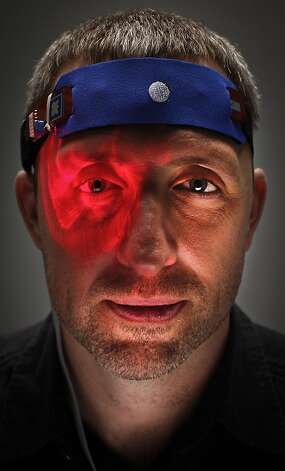
          Bill Andrews Photograph by John B. Carnett, illustration by Alberto Seveso

          Bill Andrews’s feet are so large, he tells me, that back when he was 20 he was able to break the Southern California barefoot-waterskiing distance record the first time he put skin to water. Then he got ambitious and went for the world speed record. When the towrope broke at 80 mph, he says, “they pulled me out of the water on a stretcher.”

          The soles of the size-15 New Balances that today shelter those impressive feet strike a steady clap-clap on the macadam as Andrews and I lope down a path along the Truckee River that takes us away from the clutter of cut-rate casino hotels, strip malls and highway exit ramps that is downtown Reno, Nevada. Andrews, 59, is a lean 6-foot-3 and wears a close-cropped salt-and-pepper Vandyke and, for today’s outing, a silver running jacket, nicely completing a package that suggests a Right Stuff–era astronaut. He is in fact one of the better ultramarathoners in America. I am an out-of-shape former occasional runner, so it gives me pause to listen as Andrews describes his racing exploits. “I can run 100 miles, finish, turn around, and meet friends of mine on the course who are still coming in,” he says. “I’ve been in many races where I’m stepping over bodies of people who have collapsed, and I’m feeling great.”

          “I want to cure my aging, my friends’ and family’s aging, my investors’ aging, and I want to make a ton of money,” Andrews says. His return to running after a middle-aged break was, he says, inspired by a revelation he had at a time when he and a small team of scientists at his biotech start-up, Sierra Sciences, had been working 14 to 18 hours a day in the lab for five years, rather obsessively pursuing a particular breakthrough. Finally, his doctor told him he was headed for an early grave. “I thought, god, I don’t want to cure aging and then drop dead,” Andrews says.

          That would indeed be ironic. Because Andrews does intend to cure aging. This stated ambition induces in some listeners the suspicion that Andrews might suffer from delusions of grandeur, but he has a scientific pedigree that insists he be taken seriously. Unlike his friend Aubrey de Grey, the University of Cambridge longevity theorist who relentlessly generates media attention with speculations that straddle the border between science and science fiction, Andrews is an actual research scientist, a top-drawer molecular biologist.

          In the 1990s, as the director of molecular biology at the Bay Area biotech firm Geron, Andrews helped lead a team of researchers that, in alliance with a lab at the University of Colorado, just barely beat out the Massachusetts Institute of Technology in a furious, near-decade-long race to identify the human telomerase gene. That this basic science took on the trappings of a frenzied Great Race is a testament to the biological preciousness of telomerase, an enzyme that maintains the ends of our cells’ chromosomes, called telomeres. Telomeres get shorter each time a cell divides, and when they get too short the cell can no longer make fresh copies of itself. If we live long enough, the tissues and organ systems that depend on continued cell replication begin to falter: The skin sags, the internal organs grow slack, the immune-system response weakens such that the next chest cold could be our last. But what if we could induce our bodies to express more telomerase? We’ll see, because that is what Andrews intends to do.

          Andrews had scheduled this afternoon’s run as an 18-miler, but he graciously downscaled those ambitions on my behalf long before we set out from the parking lot of the Grand Sierra Resort Hotel. Four miles in, he’s hardly winded—and I’m out of gas. As we make our way back to his car, he consults his training watch and informs me that our pace was an almost respectable 8:40, excepting the latter stretches when I walked, pushing our average up to 10 minutes a mile.

          The embrace of fitness has for Andrews a telomeric logic. Make poor lifestyle choices, and you’re likely to die of heart disease or cancer or something well before your telomeres would otherwise become life-threateningly short. But for the aerobicized Andrews, for anyone who takes reasonable care of himself, a drug that activates telomerase might slow down the baseline rate at which the body falls apart. Andrews likens the underlying causes of aging, free radicals and the rest, to sticks of dynamite, with truncated telomeres being the stick with the shortest fuse. “I believe there’s a really good chance that if we defuse that stick,” he says, “and the person doesn’t smoke and doesn’t get obese, it wouldn’t be surprising if they lived to be 150 years old. That means they’re going to have 50 more years to be around when somebody solves the other aging problems.”

          But in his race to cure aging, Andrews may himself be running out of time. The stock-market crash of 2008 nearly wiped out two investors who had until then been his primary funders. Without the money to continue refining the nearly 40 telomerase-activating chemicals he and his team had already discovered, Andrews made the decision last September to cut a deal with John W. Anderson, the founder of Isagenix, an Arizona-based “network marketing” supplement company. This month, Isagenix will launch an anti-aging product containing several natural compounds that Sierra Sciences has verified to have “telomere-supporting” properties. It’s not the powerful drug Andrews originally envisioned, but he says he believes it will promote “health and well-being” and just possibly generate enough cash to underwrite the expensive “medicinal chemistry” required to come up with a more fully developed anti-aging compound—one attractive enough to bring in a billionaire or a Big Pharma partner with pockets deep enough to take a drug candidate through the FDA’s time-consuming and fabulously expensive approval process.

          “I want to cure my aging,” Andrews tells me, “my friends’ and family’s aging, my investors’ aging, their friends’ and families’ aging, and make a ton of money. And I want to cure everybody else’s aging too—I put that probably equal to making a ton of money.”

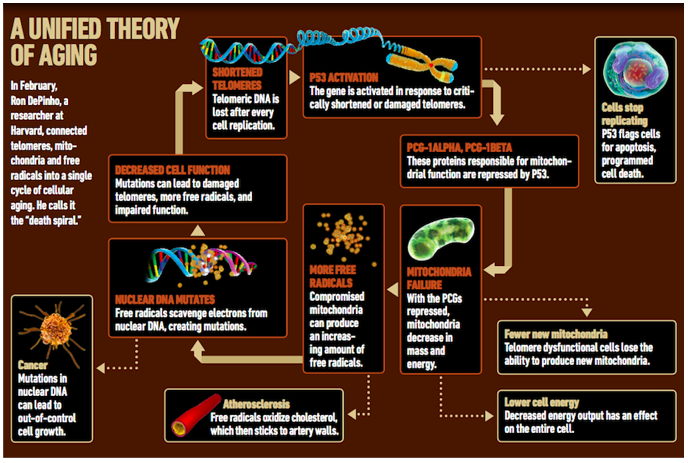
          Doctors tend to look at bodily decline through the prism of so-called diseases of aging, our increasing susceptibility over time to killers like cancer and heart disease. But in the 1950s, research biologists began to view aging itself as the disease. When free radicals scavenge electrons from their neighbors, they set in motion some ugly chain reactions. Cholesterol molecules become oxidized and begin to interact with the artery walls to form atherosclerosis-causing plaque, for instance, or the DNA in the cell nucleus suffers mutations, laying the groundwork for cancer. Later refinements of this theory emphasize the role of the mitochondria, the cellular power plants that help convert glucose into energy. As the mitochondria age, they spew out increasing amounts of the free radicals that hamper energy production and damage the entire cell, accelerating our all-systems decline.

          Among cell biologists, these mechanisms remain to this day the most accepted ways of explaining what’s happening to that face reflecting back at us in our bathroom mirror. But telomere science has opened up the possibility of drilling even deeper into the molecular bedrock of aging. The fledgling field was energized in 1984, when biochemist Elizabeth Blackburn of the University of California at Berkeley and her then-grad student Carol Greider discovered the telomerase enzyme in a pond-scum protozoan, an achievement that won them a Nobel Prize. Since then, our picture of human telomeres and telomerase has sharpened considerably.

          “A magic pill?” says Nobel Prize winner Elizabeth Blackburn. “I think we’ve been there about a million times before.”Telomeres are made of repeating sequences of six DNA bases—two thymine, one adenine, three guanine (TTAGGG)—that serve to “cap” chromosomes, preventing potentially cancerous breaks; the analogy usually trotted out is the plastic aglet that prevents a shoelace from fraying at the ends. Telomeres also assist cell division. Every time a cell splits, the ends of its chromosomes fail to get fully copied in the two new daughter cells, and a bit of telomeric DNA gets lost. No harm is done to the rest of the chromosome, but in cells that divide frequently, the telomeres shorten with each replication. Telomerase’s job is to synthesize new DNA to add to the shrinking telomeres, slowing down the decline.

          Human life, it turns out, is a losing effort to hang on to our telomeres. At conception, telomeres have roughly 15,000 DNA base pairs. Because telomerase can’t keep up with rapid cell division in utero, they shrink to about 10,000 base pairs at birth. At that point, the telomerase gene is mostly turned off. Without the enzyme, we continue to lose telomeric DNA—once we’re out of our teens, usually at a rate of 50 base pairs a year. By the time some of our telomeres drop below about 5,000 base pairs, typically well into our “golden” years, our cells may have lost the ability to divide. They become senescent, bad at doing the work they were designed to do but good at doing things like releasing inflammatory chemicals that harm their neighbors. Or they may be targeted for cell death.

          Andrews sounds almost giddy when he describes the “aha” moment 20 years ago when he first heard his soon-to-be boss at Geron, pioneering telomere biologist Calvin Harley, lecture about telomeres as a “mitotic clock,” in which the steady shortening of the telomeres serves as the tick-tock of the aging cell. “I was floored,” Andrews says. He found the lockstep precision suggested by the metaphor irresistible.

          Cultured in the lab, cells can divide just 50 to 70 times before packing it in (this is known as the Hayflick Limit, after longevity-research eminence Leonard Hayflick, who discovered the phenomenon). The human body is significantly more complex than a petri dish, but some similar limit must be enforced there, Andrews says, to account for the fact that the maximum human life span is so tightly regulated, with the longest-lived humans making it to 100 and, to the best of our knowledge, nobody surviving past 125. If free-radical damage were really the primary driver of aging, he says, people’s rate of bodily decline would vary widely based on the amount of environmental damage they had absorbed, a major contributor to the free-radical load, and therefore so would their maximum life span. “But you can look at a person and have a 95 percent chance of guessing their age within five years,” he says. “There has to be some kind of internal clock ticking inside of us.”

          Biologists continue to debate the extent to which aging at the cell level determines the aging of the whole organism. Most have argued that short or damaged telomeres aren’t as big a deal as Andrews, or even the more measured Harley, make them out to be. Tissues and organ systems that depend on cell division have a fair amount of reserve capacity, and the cells that seem to play the biggest role in our decline, neurons and heart-muscle cells, hardly replicate at all.

          But over the past few years, the case for telomeres as a major player in aging, possibly even the prime mover, has grown stronger. Heart health, telomere biologists point out, depends heavily on the endothelial cells that line the blood vessels, and brain health on the glial and schwann cells that make the myelin that protects neurons, all of which are cell types that hear the ticking of the mitotic clock. And last year, Harvard University researcher Ron DePinho published two studies in the journal Nature that have reframed the debate about telomerase activation. DePinho created an ingenious model whereby he could turn telomerase off in a mouse and then restore it, simply by administering, or withholding, a synthetic estrogen drug. In the first study, the mice with turned-off telomerase exhibited signs and symptoms of decrepitude akin to what we might endure at the age of 80 or 90: wrinkled skin, sluggish intestines, shrunken brain. When telomerase production was turned back on, the tissues rejuvenated within a month.

          “We treated these animals that were the equivalent of your grandmother,” DePinho says, “and they became like young adults.” He says he had expected to be able to stop or slow down the rate of aging. What he found was the proof-of-concept that living tissue could actually go back in time. (When Andrews talks about the possibility of running a seven-minute mile at the age of 130, he’s got the Harvard mice for backup.)

          The second Nature paper was DePinho’s attempt at developing a unified theory of late-life aging, “the death spiral,” as he calls it, that can transform a spry, alert 80-year-old into a shell of herself at 90 or 100 even in the absence of diagnosable disease. His mice data suggest that the major aging processes—free-radical damage, mitochondrial dysfunction, and short or damaged telomeres—interrelate and that the telomeres can instigate decline, acting as the first domino that sets in motion the rest. If the telomeres can be preserved, the entire system may be granted at least a temporary reprieve.

          DePinho says he envisions more animal-model research leading to human clinical trials leading—years or, more likely, decades down the road—to FDA-approved drugs. The high-speed, low-rent workaround of a telomerase-activating supplement beyond the reach of the FDA doesn’t please him. “Even if you did get telomerase activity,” he says, “you sure as hell would want to know where and when to turn it on. Telomerase can be deleterious as well.” Elizabeth Blackburn, now at the University of California at San Francisco, has reservations about a good-for-what-ails-you supplement. “A magic pill?” she says. “I think we’ve been there about a million times before in human history.”

          Sierra Sciences operates out of a small, dun-colored office park near downtown Reno. From the outside, it could be mistaken for a Sun Belt Staples, but inside are touches that speak to Andrews’s specific history and sense of mission. He walks me into a conference room decorated with plaques commemorating U.S. patents issued, and a whiteboard with an “Aging Sucks” bumper sticker plastered on it. “Dad sent that,” Andrews says, identifying the handiwork of Ralph Andrews, a retired Los Angeles game-show producer (his biggest hit was You Don’t Say!, which ruled the daytime airwaves in the 1960s). For reasons Andrews can’t adequately explain, his father, still hale at 84, has always been dead set against aging, and once suggested to his preteen son that he might want to take a shot at solving the problem. “My dad probably told me to do a lot of things, but this just struck a chord,” he says. “I never thought aging was inevitable. I just thought nobody had figured it out yet.”

          In the late ’90s, Andrews came to feel that Geron had lost the true telomerase-activating religion, having redirected most of its resources into stem-cell therapies. He left Geron, crossed the Sierras, and in 1999 gathered around him in the Nevada desert a small circle of researchers who believed almost as ardently as he that it might be possible to engineer a “small molecule” drug that would flip the telomerase gene’s “on” switch inside a living human body. Since then, the company has gone through two distinct phases, pre-crash and post-crash. In the first era, two especially beneficent investors unquestioningly underwrote his efforts to crack the telomerase code. (Start-ups working on an actual product in development attract venture capitalists. More-speculative ventures like Sierra Sciences typically draw individual “angels”—in the anti-aging field, often older, wealthy men willing to risk losing money in the hopes that somebody will come up with a way to extend their fruitful lives.)

          During this first phase, Andrews and his team deployed an elegant recombinant DNA approach, arguably better suited to an academic lab than a start-up that needed marketable results. They would painstakingly alter one or two DNA bases out of the thousands that make up the telomerase gene, cycling through thousands of slight variations in an effort to find one that the regulatory molecule that normally keeps the gene turned off, the “repressor,” would no longer recognize. This would reveal the molecular identity of the repressor, and the team could then create a drug to neutralize it—repressing the repressor and switching the telomerase gene back on.

          By 2006, after seven years of effort and one excruciatingly close miss (they found “a” repressor but apparently not “the” repressor), Andrews finally shifted strategies. If developing a telomerase-activating drug with recombinant-DNA methods was a bit like trying to find a needle in the haystack by analyzing the haystack molecule by molecule, the new approach was brute force: Grab a pitchfork and start digging. The company bought libraries of several hundred thousand chemical compounds and tested each one to see if it would activate telomerase in cultured human cells.

          The cells Andrews chose were fibroblasts, which are found in skin and connective tissue and which are relatively cheap and easy to culture. They also have little ability to express telomerase in a lab setting. When Andrews first started the company, he ran into skepticism from some of his high-profile scientific advisers, who doubted his overall strategy of trying to turn on telomerase. “They were even laughing at it,” he says. Now at this later stage of the game, a few of his paid consultants questioned his decision to use fibroblasts. “Bill is the most persistent guy I’ve ever met,” says Bryant Villepointeau, a Geron alum and a former Sierra Sciences consultant. “Sometimes if he’s committed to something, he will go beyond the point where it’s wise.”

          But Andrews had his reasons—the fibroblasts behave themselves in the lab and don’t change into other cell types, unlike stem cells, which can be moving targets. And after a year and a half of testing for telomerase activation, running compound after compound through a screening assay, he finally caught a break. On the 57,684th run, the team got a chemical hit. C0057684 was too toxic to be easily transformed into a drug prospect, but it gave the company a positive control. In other words, they could use it to tune their detection tests to recognize fainter and fainter levels of telomerase activation, which is essential when you’re working with stodgy, underperforming fibroblasts.

          By then, however, the market crash of 2008 had clipped the wings of the company’s two angels, radically altering Andrews’s job description. Rather than spending his days and nights in the lab, he became a telomerase-activation evangelist, crisscrossing the country in search of funding. “Where’s Bill?” became a regular link on the company’s website. His doleful SOS bounced around the life-extension blogosphere: “The bottom line is that Sierra Sciences needs $200,000 per month as soon as possible.”

          The worst part for Andrews was leaving the day-to-day responsibilities of the lab and retreating to his office, where he works the phones and e-mail trying to pilot the company out of financial peril. The long hours and personal austerity required by the new mission are by now second nature and, this afternoon, become grist for an enthusiastic show-and-tell. The office fridge: “For breakfast, I have a protein shake, and every two weeks I go to Trader Joe’s or Whole Foods and buy a whole bunch of frozen foods that I heat up for dinners.” The low-slung chest of drawers with the cushion on top where he spends many of his nights, cutting down on the commute in from his ranch 25 miles outside of town: “My legs overhang the edge, but that’s OK. If I bend my knees, my legs are on the cushion.” (The last bed I saw with such awkward dimensions belonged to Father Junipero Serra, the 18th-century founder of the California Franciscan missions—his attempt to mortify the flesh presented a resonant contrast to Andrews’s efforts to make it something closer to immortal.)

          “Unequivocally, he’s paid a price with his scientific peers,” Federico Gaeta says. “How big, I don’t know. But Bill’s not going to break.”For all the monastic devotion he brings to the cause, Andrews is a pure gene jock. It’s a sign of our nutraceutical-besotted times that such a scientist has made a marriage of convenience with a supplement industry often equated with hippie herb lovers and cynical marketers looking to exploit the next pseudoscience fad. Gone are the bulk shipments of synthetic chemicals to be assayed, replaced by a small weekly delivery of ingredients derived mostly from traditional Chinese and Indian medicinal herbs that John W. Anderson prepares in his five-man Arizona lab. To Andrews’s surprise (and considerable relief), at least three of these compounds have tested positive for telomerase activation in the lab, even though many of the source materials are readily available in health-food stores. Have longtime devotees of traditional Chinese and Indian medicinal herbs been activating their telomerase without knowing it? Anderson, a self-described nutraceutical research scientist and medicine hunter, demurs, saying only that his nonchemical extraction and refining process concentrates and enhances any healing properties they may have previously exhibited. As Jon Cornell, Andrews’s administrative lieutenant at Sierra Sciences, says, if herbs and roots naturally had the level of telomerase-inducing activity that Andrews and his team are really looking for, “we’d probably already have immortal people.”

          Andrews leads me through a succession of compact lab rooms, each of which contains more equipment than people to run it. (Since 2008, he has cut the number of staff scientists from 34 to eight.) The center of the complex is a single cramped room where a couple of cell biologists and lab techs tend to plastic flasks holding millions of human fibroblast cells. The cells will be transferred to tiny plastic vials, frozen in liquid nitrogen, and then, when their number is called, thawed and bathed for 24 hours in one of Anderson’s natural ingredients. Then they’re whisked across the hall, where another small group of scientists and techs run a production line that sends plates of the treated cells through a LightCycler analyzer, which amplifies what’s going on at the molecular level using PCR (polymerase chain reaction, better known as the perp-catching technology on CSI). Telomerase is made up of two components—the RNA, which serves as a template to be used by the second part, a catalytic protein that synthesizes the DNA added back to telomeres. The LightCycler scans for RNA activity suggestive of telomerase expression. Promising compounds are then run through a slower, by-hand assay to look for hard evidence of the protein at work. “It’s cherry picking,” Andrews says. “The machine selects the reddest cherries.”

          The analogy sounds so delightful that it’s jarring to remember that the measuring rod, the “standard control” the lab uses to evaluate telomerase activity in test compounds, is cancer—specifically the HeLa cancer cells that were the first cell line to achieve immortality. Back when Andrews was working with the more potent synthetic chemicals that he says were, in theory, capable of putting the brakes on aging, his team was able to get one compound up to a 16. That would be 16 percent of the telomerase required to make the HeLa cells live forever. “What we really want to do is to get it to 100 percent and above,” he says.

          Telomerase, as Blackburn once noted, is a Dr. Jekyll and Mr. Hyde proposition. Though it will not cause a cell to turn cancerous by itself, telomerase in its uncivilized Mr. Hyde mode does fuel the unregulated growth of most cancers. By activating the enzyme, Calvin Harley says, “there is a risk, a small probability, that it could cause a premalignant cell to divide enough times to become malignant.” But both Harley and Andrews say they believe that any increased cancer risk is outweighed by the potential rewards. Telomerase can also be a benign Dr. Jekyll that protects against the chromosomal breakage and re-fusion that can lead to cancer, and it can help drive the proliferation of immune-system cells whose job it is to fight cancer.

          A study in the July 7, 2010, Journal of the American Medical Association highlighted the correlation between cancer and short telomeres: People with shorter-than-average telomeres had three times the risk of developing cancer and 11 times the risk of dying from it. Andrews is not shy about talking with cancer patients—seemingly the group most vulnerable to the Mr. Hyde risks of runaway telomerase—about the potential health advantages of telomerase activation. “I’m always careful to qualify that I’m not an M.D., I’m not able to provide medical advice,” he says. “I do say that if I had cancer, I’d be taking as much telomerase activator as I could get my hands on.”

          As it happens, he already is. In 2002, a New York City entrepreneur and former appliance manufacturer, Noel Thomas Patton, licensed the rights to Geron’s research on a telomerase-activating compound found in the Chinese medicinal herb astragalus, for supplement use only. (Geron is finalizing a plan to send an astragalus-based telomerase-activating drug candidate through clinical trials.) Three years ago, Patton’s TA Sciences test-launched its TA-65 supplement with 100 clients, each willing to pay $25,000 a year to be anti-aging guinea pigs. Paying patient number one: Bill Andrews.

          TA Sciences has this year ramped up production and dropped the stratospheric price tag, although so far the most impressive effects remain anecdotal—more energy, greater mental clarity, a sexual boost, even improved vision. Andrews says his ultramarathon times dropped when he started taking TA-65. An observational study co-authored by Harley, who helped discover the original molecule at Geron, found improvements in the immune system of those first 100 clients. Andrews was hoping for a more pronounced effect. As he describes what it was like to take that first dose of the supplement in 2008, I can hear the voice of a kid who hasn’t entirely grown up, anti-aging as a never-ending Hardy Boys adventure: “I remember Noel and I sitting having dinner, and we were wondering, What are we going to look like two weeks from now? We talked on the phone practically every day, and we were both disappointed that we didn’t look any younger right away.”

          Andrews’s tendency to let his enthusiasms take him out on a limb, especially when he’s trying to attract investors, makes him a polarizing figure in the research community. To some academics, his standard pitch-cum-sound-bite, “We age because our telomeres shorten,” is a crude oversimplification. Even Andrews seems to suspect that Sierra Sciences’s company motto, “Cure Aging or Die Trying,” isn’t winning him many friends among people who possess advanced biology degrees. “Some people like it and other people say it’s embarrassing,” he says. “So I don’t know what to do.”

          “I can’t be happy unless I’m working on this,” Andrews says. “The mission won’t die unless I die.”I later ask Federico Gaeta, Geron’s former head of chemistry and a current Sierra Sciences consultant, whether Andrews’s reputation has suffered for his damn-the-nuance pursuit of longevity. “Unequivocally, he’s paid a price with his scientific peers,” he says. “How big a price, I don’t know, but there is an excellent chance that he will ultimately be vindicated.” Now, Gaeta says, “he’s in a position where he has to show that he’s done something.” The years of angels with blank checks are over, and the pressure to produce—and to raise the money to buy the time to produce—is tremendous. “He’s not going to break,” Gaeta says. “I know that about him. Bill’s not going to break.”

          By 5 P.M., midwinter darkness is beginning to fall, and the skeleton crew at Sierra Sciences is mostly gone, though Andrews is looking at another long night that will probably end on his makeshift bed. The last employee to leave is Randy Lee, the IT guy, an old Southern California prep-school buddy of Andrews’s. He’s been hanging around because he has some bad news to deliver. Lee has the unenviable job of reconfiguring the lab’s now inadequate computer system. Today he lost a cache of valuable data when the system crashed. When he delivers the news, Andrews visibly compresses, as if another 10 pounds has been added to the weight already on his shoulders. Then he collects himself. “I told people we’re either going to never move forward with our system or we’re going to take the chance of losing things,” he says. “Well, try to get a good night’s sleep. I’m sorry for your sake that it happened.”

          After Lee heads for home, I ask Andrews to consider a hypothetical. If I wrote him a check for $10 million, would that be enough to send him back to the lab to find that home-run telomerase-activating chemical? “No,” he says, “but that would increase our chances of getting a really good natural product that nobody could compete with. To do the pharmaceutical, we’d need $30 million.” I toss out a flip rejoinder—“Sorry, Bill, I can only do the $10 million”—and Andrews freezes for a half-second, then slumps back in his chair. “I’ve got business plans that have all that budgeted,” he says. “What the money would be used for.”

          I ask Andrews what the worst-case scenario would be for Sierra Sciences. “The worst-case scenario,” he says, “is that we put out a telomerase activator and everybody who takes it dies right away.”

          “No,” I clarify, “the worst-case financial scenario?”

          Andrews, his voice phlegmy with fatigue, tries again. “The company folds. I find another job, but I still work on trying to find more investors to resurrect it. I can’t be happy unless I’m working on this. The mission won’t die unless I die.”

          Me: This was the same article I had read almost 2 years ago and I honestly don’t know how Sierra Sciences is coming along. I know that Bill Andrews is still on his mission to succeed in his mission to cure agin.

          The main thing Andrews has been trying to do is to find a compound that can activate the telomerase in our body to a high enough level to slow down the shortening of telomeres.


          Body Hack III: Quantified Self Movement And Biohackers

          There is another underground group of individuals these days who have developed a methodical approach to tracking and measuring nearly everything they do. These are the Biohackers, who have developed the name “quantified self movement”. For them, the objective is to find out ways to manipulate and get the body and the mind to be at its optimum state using what science and the data states.

          The article of the San Francisco Gate  is below. Again, I will highlight the parts which I felt is important or relevant to what we are doing with this site.


          ‘Biohackers’ mining their own bodies’ data

          Glen Martin
          Updated 12:09 p.m., Thursday, June 28, 2012
          • Dave Asprey, seen on Wednesday, June 6, 2012 in San Francisco, Calif., is considered a guru of the biohacking movement.  Asprey has helped develop a prototype HEG (Hemoencephalography ) neurofeedback device that helps train the brain, and he also uses a soliton laser which helps with healing. Photo: Russell Yip, The Chronicle / SF
            Dave Asprey, seen on Wednesday, June 6, 2012 in San Francisco, Calif., is considered a guru of the biohacking movement. Asprey has helped develop a prototype HEG (Hemoencephalography ) neurofeedback device that helps train the brain, and he also uses a soliton laser which helps with healing. Photo: Russell Yip, The Chronicle / SF

          (06-28) 12:07 PDT SAN FRANCISCO — Dave Asprey’s morning regimen will seem deeply unfamiliar to anyone accustomed to starting the day with a cup of sludge from the Mr. Coffee, a Pop-Tart and a self-administered slap across the face in the bathroom mirror.

          The first thing Asprey does is check his Zeo, a small biometric device that monitors sleep patterns. He’s looking for a balance between REM sleep and deep sleep: REM sleep, Asprey says, rejuvenates the brain, while deep sleep revives the body.

          “What I don’t want to see is a lot of light sleep or waking episodes,” he says. “That would require adjustments to my schedule.”

          After that, he gulps some compounds: L-tyrosine, an amino acid that Asprey says improves mood and thyroid function; vitamin D3, which proponents claim tunes the immune system and promotes bone density; vitamin K1, considered a toner for the cardiovascular system; and piracetam, a “smart” drug purported to raise oxygen levels in the brain.

          Then it’s off to the kitchen for a cup of coffee. Not just any old mud, though. Asprey drinks a special decoction that has been purged of mycotoxins. And he mixes it with big dollops of coconut oil and butter from grass-fed cows.

          “That’s my entire breakfast,” says Asprey. “It puts my body in full burn mode – if necessary, I have enough energy to go for eight hours.”

          Certainly, Asprey needs that energy. The 42-year-old former Bay Area resident sleeps only five hours nightly, devoting his abundant waking time to book and Web projects, whirlwind speaking tours, regular travels to Silicon Valley and helping his wife raise their two young kids.

          After his morning routine, he recharges his body with a refined “Paleo” diet that includes large quantities of grass-fed meat, some veggies “and a ton of butter.” Every 10 days, he exercises 15 minutes with special barbells on a vibrating plate that jerks up and down 30 times a second.

          “That tells your body, ‘It’s time to grow’ ” muscle, he says. When he feels stressed, he consults his emWave2, a device that allows him to monitor and consciously change his heart rate via biofeedback.

          For Asprey, life isn’t something to accommodate, negotiate or endure. He’s out to optimize it.

          Nothing new in that, of course: In the past six decades, self-help gurus from Jack LaLanne to Werner Erhardt and Tony Robbins have coached, cajoled or bullied us into being more fit, successful and well-adjusted. But their approaches have focused on mere exercise or attitude. Asprey and a growing number of like-minded peers are taking things down to the molecular level. They’re trying to “biohack” the human body – tweak its biological processes to make it run at optimum efficiency.

          The Quantified Self movement, as it’s called, incorporates various approaches; diet is an element, as are exercise, sleeping habits and the ingestion of arcane supplements. But the bedrock factors are meticulous measurement and data collection. Devotees use biometric devices to monitor brain activity, respiration rates, bloodstream oxygen levels, heart rate and blood pressure, physical activity – even blood flow to the brain.

          Collection data

          Periodically, they submit to blood tests – not just for the lipids and fasting glucose standard for most health checkups, but for expanded panels that examine up to 100 variables. All these data are archived – often on mobile apps – and quantified, as it were, to provide finely textured metabolic portraits.

          “We’re now capturing more data on what it means to be a human being than at any time in history,” says Asprey, “and what we’re learning isn’t just telling is what we are. It’s telling us what we can be.”

          The Quantified Self movement is just starting to come up on the scope of the medical community, and few physicians have written or spoken on it; none at UCSF Medical Center, for example, would comment for this piece. One of the few medical authorities who have addressed the trend is Dr. Ravi Bhatia, a professor of hematology and the director of the stem cell and leukemia program at the City of Hope National Medical Center in Duarte (Los Angeles County).

          Bhatia says the detailed data collected by a given Quantified Selfer may be of genuine medical utility – but only for that specific individual.

          In order to draw broad conclusions, it’s essential to conduct studies and collect and verify data in a clinical setting,” says Bhatia. “Only then can you scientifically analyze the data and – ultimately – reach consensus for treatment. I’m not saying there’s no individual benefit to this monitoring. I’m just advocating clinical trials.”

          The supplements

          Bhatia also sees some risk in the Quantified Self community’s advocacy of exotic supplements.

          “If someone is on a course of medical treatment, there’s always the risk of undesirable interactions,” he says. “(The supplements) can activate pathways that affect how prescribed medications are metabolized. On the whole, I understand the motivation. But it’s like everything else. It’s best to avoid dogmatism – to be reasonable and avoid extremes.”

          Asprey, for his part, feels he is more of what he can be than he used to be. As a prime mover of Quantified Self, he has been hacking his body for several years. He claims to have jacked up his IQ by 40 points and supercharged his health.

          “It’s a lot like making a map, and then using the map to determine where you want to go,” he observes. “For example, we’re using a little prototype unit that measures cerebral blood flow – it has a headband that shows how much blood is getting to the front of the brain, the prefrontal cortex.

          “The headband shines infrared light into the skull. Red blood cells bounce the light back, and you can use that to monitor blood flow on a screen. Then you use standard biofeedback techniques to maximize the flow. You thus increase your ability to rationally analyze data and situations because the prefrontal cortex is where intellectual processes occur.”

          If the rigorous diets, the plethora of gizmos and the constant monitoring of bodily functions sound like a lot of work, Asprey acknowledges it is.

          “Self-motivation, obviously, is hard,” he says. “One way around that is to tweak the way you collect data. We’re working on apps that embed gaming techniques into the monitoring process. If it seems like fun, it’s easier for people to stick with it.”

          The reasons underlying Quantified Self participation are varied. A desire for longevity is certainly a motivation for many, but so is the cutthroat economic climate – particularly in Northern California, the cradle of biohacking. Middle-aged IT professionals feel vulnerable, says Asprey.

          “Silicon Valley chews people up young and spits them out,” he observes. “But lots of people feel they still want to contribute – and they’re looking for ways to compete with younger workers. Quantified Self helps them stay in the game.”

          Primary motivator

          The primary motivator, however, may be the simple desire to exercise control – exquisite, exact control – over one’s own body. Quantified Self isn’t a precisely scientific method, but it embeds science into the human potential realm to an unprecedented degree, says Brian Kerr, an adherent who went from being an unhappy, obese teen to a trim, successful marketing consultant through self-monitoring and a Paleo-style diet.

          “A lot of people involved in this have endured a great deal of pain in terms of self-image,” Kerr observes. “Being seriously overweight deeply affects your outlook. So when you find something that works, that allows you to permanently drop the weight, that makes you feel healthy and aware and engaged, it’s a fantastic feeling. It’s something you want to share.”

          And share Quantified Selfers do, with a vengeance. They blithely swap intimate medical data with one another in their quest for the ideal biohack.

          There may be a certain inevitability to the biohacking urge, says Gaymon Bennett, a bioethicist with Center for Theology and the Natural Sciences in Berkeley.

          The hacking of digital technology has become a common skill, he says.

          There is this expectation that the biohack – monitoring metabolic processes and influencing them through diet, supplement consumption and other practices – will yield results similar to a computer hack. You get this sense of a hunger to accelerate, a feeling that if (biohackers) could truly bioengineer the human organism, they would.”

          More information on Quantified Self

          — quantifiedself.com.

          — www.quantifiedscience.com.

          — www.bulletproofexec.com.

          Quantified Self is not a protocol recognized by the medical community. Concerns have been raised about the way some users apply the data that is collected and shared:


          Me: Ok, so I realize I am being a little biased posting this article about Asprey again but I am very impressed and interested in the movement of biohackers. In the previous Body Hack post, I was talking about these groups of researchers who are doing synthetic biology, which is where people literally are building living organisms using individual components and parts. With the “Quantified Self Movement”, people are now trying to hack their bodies so that the body can be at its optimum. The are monitoring and checking for as many variable as possible to see what type of leverage they can get. The different types of supplements they take and the odd instruments the strap onto their bodies are all used to learn more about how their own bodies operate. Overall, if you want find out how to have a healthier body and mind, you should consider joining the movement. 


          Body Hack II: Do-It-Yourself, DIY Genetic Engineering

          There is a small underground group of people these days who are trying to do with biology and genetics what the computer hackers did 20 years ago. They are trying to figure out cool ways to hack biology and genetics. I personally think that this new field of synthetic biology is going to be a completely new area of study that will grow far bigger in the future.

          This is a post I found from HPlusMagazine.com which talks about the DIY Biology movement going on.


           DIY Bio: A Growing Movmeent Take On Aging

          Parijata Mackey
          January 22, 2010

          A movement is growing quietly, steadily, and with great speed. In basements, attics, garages, and living rooms, amateurs and professionals alike are moving steadily towards disparate though unified goals. They come home from work or school and transform into biologists: do-it-yourself biologists, to be exact.

          DIYbiology (“DIYbio”) is a homegrown synthesis of software, hardware, and wetware. In the tradition of homebrew computing and in the spirit of the Make space (best typified by o‘Reilly‘s Make Magazine), these DIYers hack much more than software and electronics. These biohackers build their own laboratory equipment, write their own code (computer and genetic) and design their own biological systems. They engineer tissue, purify proteins, extract nucleic acids and alter the genome itself. Whereas typical laboratory experiments can run from tens-of-thousands to millions of dollars, many DIYers knowledge of these fields is so complete that the best among them design and conduct their own experiments at stunningly low costs. With adequate knowledge and ingenuity, DIYbiologists can build equipment and run experiments on a hobbyist‘s budget. As the movement evolves, cooperatives are also springing up where hobbyists are pooling resources and creating “hacker spaces” and clubs to further reduce costs, share knowledge and boost morale.

          This movement, still embryonic, could become a monster — a proper rival to industry, government, and academic labs. The expertise needed to make serious breakthroughs on a regular basis at home hasn‘t yet reached a critical mass, but there are good reasons to believe that this day will soon come.

          Software

          DIYbio software has been around for a long time. Folding@home, which came out of Professor vinjay Pande‘s group at Stanford Chemistry Department in 2000, is designed to perform computationally intensive simulations of protein folding and other molecular dynamics. FAH, as it‘s known, is now considered the most powerful distributed computing cluster in the world. Open source software for bioinformatics, computational neuroscience, and computational biology is plentiful and continues to grow. On their own time, students, professors, entrepreneurs, and curious amateurs contribute to open source work that captures their interests. BioPerl and BioPython have hundreds of contributors and tens of thousands of users. Programs like GENESIS and NEURON have been downloaded by computational neuroscientists for over twenty years.

          The software part is easy. The FOSS/OSS machine is well established, and has been successful for a long time. As the shift to open source software continues, computational biology will become even more accessible, and even more powerful. (Red Hat has recently asked the US Supreme Court to bar all software patents, submitting an amicus brief to the Supreme Court in the “Bilski case.” See Resources.)

          Hardware

          Biological research is expensive. Microscopes, pipetmen, PCR machines, polyacrylamide gels, synthesizers — basics for any molecular biology lab — run from hundreds to thousands of dollars apiece. Traditional experiments cost hundreds-of-thousands to millions of dollars to conduct. How can the hobbyist afford this equipment? Unless “Joe (or Jill) the DIYBiologist” is extremely wealthy, they can‘t. So instead of purchasing brand new equipment, DIYers like to find good deals at auction sites like eBay or Dovebid, refurbish discarded equipment from labs or biotech companies, or — more and more frequently — build it themselves.

          Hardware hacking has a rich history, filled with geek heroes, and these skills are being turned towards the creation of biotech equipment. On the bleeding edge of it all, some DIYbiologists are applying their skills to h+ technologies. SENS researchers John Schloendorn, Tim Webb, and Kent Kemmish are conducting life-extension research for the SENS Foundation, building equipment for longevity research, saving thousands of dollars doing it themselves.

          Stem cell extraction and manipulation, DIY prosthetics, DIY neural prosthetics, sensory enhancements, immune system testing, general tweaking of whatever system strikes the hobbyist‘s fancy.

          The DIY SENS lab is headed by PhD candidate John Schloendorn. John is a last- year PhD student at Arizona State University. He volunteers full time for the SENS Foundation. Entering his lab was a mind-blowing experience. The ceilings were high, the lab itself was spacious and well-lit. It smelled of sawdust, the product of constructing the furniture on site. The equipment was handmade, but brilliantly so. Elegance and function were clear priorities. When a panel could be replaced with a tinted membrane, it was. When metal could be replaced by sanded wood, it was. The on-site laser was modified from a tattoo-removal system. Costs were down, but the technical skill involved in manufacturing was top notch.

          In addition to his own experiments, Schloendorn is building an incubator (no pun intended) for DIYbio engineers who work on fighting death.

          Schloendorn tells me that working by ourselves might only take us so far, but thinks it‘s a great place to start (many successful discoveries and businesses were founded in someone‘s garage). He believes that being a DIYer doesn‘t mean you must “go it alone,” but can include cooperation and teamwork. He cautions that since time and effort are limited, DIYers must choose carefully what they‘re going to work on and do that which is most important for them. His personal priority is to solve parts of the aging question, and he‘d obviously like many other DIYers to take up this challenge. “I wanted to make a dent in the suffering and death caused by aging. It seemed like the SENS people were the smartest, most resourceful and best organized among those ambitious enough. Of course, there are also DIYers with no ambitions to save the world, who are content to ‘make yogurt glow‘ in the basement for their own personal satisfaction.”

          The DIYbio community has a high-traffic mailing list, where projects are discussed, designs shared, and questions asked or answered. The community has worked on dozens of DIY designs: gel electrophoresis techniques, PCR machines, alternative dyes and gels, light microscopes, and DNA extraction techniques. All of them focus on enabling cheap and effective science.

          Wetware

          The most popular conception of wetware is the genome — the language of life, the ultimate hackable code. Genetic engineering and (more recently) synthetic biology are the hallmarks of this effort. Synthetic biology takes genetic engineering and builds it into a scalable engineering framework. It is the synthesis of complex, biologically-based (or inspired) systems that display functions that do not exist in nature. In synthetic biology, genetic code is abstracted into chunks, colloquially known as biological “parts.” These parts allow us to build increasingly complex systems: putting several parts together creates a “device” that is regulated by start codons, stop codons, restriction sites, and similar coding regions known as “features.” (Visit MIT‘s Standard Registry of Biological Parts for more detailed information, and tutorials on how to make your own biological part.)

          These parts are primarily designed by undergraduates competing in the International Genetically Engineered Machine (iGEM) competition, the largest student synthetic biology symposium. At the beginning of the summer, student teams are given a kit of biological parts from the Registry of Standard Biological Parts. Working at their own schools over the summer, they use these parts, and new parts of their own design, to build biological systems and operate them in living cells.

          Randy Rettberg, director of the iGEM competition, says that iGEM is addressing the question: “Can simple biological systems be built from standard, interchangeable parts and operated in living cells? Or is biology just too complicated to be engineered in this way?” The broader goals of iGEM include enabling the systematic engineering of biology, promoting the open and transparent development of tools for engineering biology, and helping to construct a society that can productively apply biological technology.

          If this sounds suspiciously like a front for DIYbio, that‘s probably because it is. In addition to attracting the brightest young minds to the critical field of molecular biology, many of the founders of iGEM, including Drew Endy at Stanford, Tom Knight at MIT, and DIYbio-rep Mac Cowell are heavily involved in or supportive of the DIYbio community. The recent introduction of iGEM teams unaffiliated with universities (“DIYgem”) is a step towards an inclusive community, allowing anyone with the brain and the drive to participate at the level of academics.

          So many seeking, Around lampposts of today, Change is on the wind. — Unknown

          Mainstream science is increasingly friendly to DIYbio. DIYbiologist Jason Bobe works on George Church‘s Personal Genome Project (PGP), which shares and supports DIYbio‘s drive to make human genome data available for anyone to use.

          How to get involved

          Join the DIYbio mailing list (see Resources). Anyone can join and it‘s the best way to begin your involvement with DIYbio. You‘ll want to check out their DIYbio forums, which are growing rapidly. You can also find a local group there and connect with like-minded DIYers. Have a look around the DIYbio.org site, which lists some of the current projects:

          BioWeatherMaps: “Self-Assembly Required” 
          Flash mobs meet consumer-generated science in the new DIYbio initiative Flashlabs, where they‘ll be pulling-off a new large-scale collaborative science project annually for amateurs and enthusiasts worldwide. Case in point — the BioWeatherMap initiative is a “global, grassroots, distributed environmental sensing effort aimed at answering some very basic questions about the geographic and temporal distribution patterns of microbial life.”

          SKDB: “Apt-Get for Real Stuff (Hardware)” 
          Skdb is a free and open source hardware package management system. The idea is to let the user “make” a project by using all of the packaged hardware out on the web, so that the wheel isn‘t reinvented every time a new project is started. The package includes milling machines, gel boxes, semiconductor manufacturing processes, fabratories, robot armies, wetlab protocols… everything. At the moment, they‘re working on OpenCASCADE integration. Package maintainers from the DIYbio and open manufacturing communities assist others in bringing in projects into the system.

          Smartlab: “Taking the Work out of Benchwork” 
          Project Smartlab is aiming to build hardware to augment the benchtop science experience. This includes automatic data logging instruments with painless electronic lab book integration, video streaming with “instant replay” features for those “did-I-just-pipette-that-into-the-wrong-tube” moments, and interactive protocol libraries that guide new scientists and the scientifically enthusiastic alike through tricky protocols.

          The Pearl Gel Box: “A Built-In Transilluminator and Casting Box for $199!” 
          Want to get a jump start in DIYbio? The gel electrophoresis box is a basic tool for any DIYbiologist — and they‘re making kits so you can build your own. The Pearl Gel Box is cutting edge, open-source, and cheap. The participants in this project have created a professional grade gel box, available fully assembled or as free design documents. Plus, they want you to design new features like a built-in light filter or a mount for your digital cam.

          This is a mere glimpse into the vast undertaking that is DIYbio. Most DIYers work independently on projects that have significant personal meaning. Tyson Anderson, a specialist in the US Army, was struck by the lack of technological infrastructure during his time in Afghanistan. Anderson, a transhumanist as well as a DIYbiologist, was trying to discuss the implications of the Singularity with the friends he had made there. He realized it was difficult to conceive of a technological paradise in a world with limited electricity. He looked to DIYbio to make a difference, and is now engineering bioluminescent yeast to construct sugar-powered lamps for his friends in Afghanistan.

          Because there is much overlap between the DIYbio and transhumanist communities, it‘s not surprising that many emerging projects focus on both. DIY-SENS is only the tip of the iceberg. DIYh+ is a fusion of DIYbio and h+, coordinating projects that allow willing individuals to experiment with practical human enhancement. Example projects include supplement/ exercise regimens, DIY-tDCS, DIY-EEG, and the personal harvesting of stem cells. From the group description: “This group is a friendly cross between DIYbio and Open Source Medicine, with a dash of the ImmInst (Immortality Institute) forums [see Resources]. It‘s the slightly edgier half of OSM. The community, ideally, should strive to foster an open and safe way for responsible adults to learn about do-it-yourself human enhancement. We do not believe in limiting the use of medical technology to therapy.”

          It‘s not just enhancement technology that can benefit from DIYbiology. As the popular distrust of doctors grows, people will want to understand and monitor their own body. Likewise, as personalized medicine becomes a reality, we will probably see a rise in the number of hobbyists who treat their own bodies as machines to be worked on — like a radio or a car — branching out from personalized genomics to things like DIY stem cell extraction and manipulation, DIY prosthetics, DIY neural prosthetics and sensory enhancements (infrared vision, anyone?), immune system testing, and general tweaking of whatever system strikes the hobbyist‘s fancy. This hacker‘s paradise has not yet come to pass, but it is, perhaps, our exciting future.

          The road to true DIYbiology will not be easy. It‘s not a magic bullet. It will probably not produce the next Bill Gates, at least not for a long time. Biology is hard, messy, and failure is more common than success. The knowledge required takes time and effort to acquire, and even then, so-called textbook knowledge is being revised almost daily. Many are attracted by the glamour of it all. They‘re drawn to the romance of being a wetware hacker — the existential thrill of tweaking life itself. They tend to become quickly disappointed by the slow, tedious, difficult path they face.

          Hobbyist biology is still in its infancy, and it will take a great deal of work before it reaches its potential. Few are more skeptical than DIYbiologists themselves. But many see no choice. Squabbles over sponsorship, intellectual property, and cumbersome regulations often prevent progress along more conventional lines. An anonymous DIYbiologist puts it this way: “universities charge far more than the experiments really cost, and bureaucratic rules constantly retard real progress.” Questions of IP and ownership can hamstring innovation in industry, while concerns for national security prevent real information sharing in government science. Large, unwieldy bureaucracies and regulatory agencies find it difficult to keep pace with the breakneck speed of technological progress. Thought-monopolies make it unwise to promote new ideas while waiting for tenure, despite the fact that many central dogmas of biology change. Individuals willing to intelligently circumvent convention may find themselves stumbling into uncharted areas of biology where they may make new discoveries.

          Indeed, it is only in the last century that biology has become an unreachable part of the academic-corporate-government machine. History‘s naturalists, from Darwin to Mendel, are the true fathers of DIYbiology. They shared the spirit of discovery and scientific ingenuity and the drive to “figure it out yourself.” No one told Isaac Newton to discover the laws of classical mechanics, and you can bet he was never given calculus homework. Einstein‘s life would have been respectable if he hadn‘t spent a silent decade questioning the nature of spacetime. They were driven by the simple need to know, and they would not be stopped by the incidental truth that no one had figured it out before. DIYbiology is perhaps a reemergence of this basic curiosity, applied to the study of life.

          As technologyl advances, let us study the workings of the cell the same way Newton may have studied the effects of gravity. Who wouldn‘t want to know? Who can resist a peek at the mechanisms of our own existence? DIYbio may be young, but it is a symptom of our species‘ unbreakable curiosity. We will know these secrets too, someday.

          “For me, chemistry represented an indefinite cloud of future potentialities which enveloped my life to come in black volutes torn by fiery flashes, like those which had hidden Mount Sinai. Like Moses, from that cloud I expected my law, the principle of order in me, around me, and in the world. I would watch the buds swell in spring, the mica glint in the granite, my own hands, and I would say to myself: I will understand this, too, I will understand everything.” —Primo Levi

          Without a lab supervisor to guide them, DIYbiologists must take a carefully disciplined (and perhaps more genuine) approach to science. DIYbio has the potential to revive a noble tradition of pure scientific curiosity, with a modern, engineering twist. If you want to get something done, some day it really will be possible to do it yourself.

          Parijata Mackey is the Chief Science Officer of Humanity + and a senior at the University of Chicago, interested in applying synthetic biology, stem cell therapies, computational neuroscience, and DIYbio to life-extension and increased healthspan.


          I didn’t write this article but I wanted to post it here to let other people know what is being build in around the world today. From the NY Times, the story of these group of people unfolds…

          Do-It-Yourself Genetic Engineering

          Douglas Adesko for The New York Times

          From left, City College of San Francisco’s Leeza Sergeeva, Bowen Hunter, Angela Brock, Bertram Lee, Colby Sandate and Dirk VandePol.

          By JON MOLAR
          Published: February 10, 2010

          IT ALL STARTED with a brawny, tattooed building contractor with a passion for exotic animals. He was taking biology classes at City College of San Francisco, a two-year community college, and when students started meeting informally early last year to think up a project for a coming science competition, he told them that he thought it would be cool if they re-engineered cells from electric eels into a source of alternative energy. Eventually the students scaled down that idea into something more feasible, though you would be forgiven if it still sounded like science fiction to you: they would build an electrical battery powered by bacteria. This also entailed building the bacteria itself — redesigning a living organism, using the tools of a radical new realm of genetic engineering called synthetic biology

          Douglas Adesko for The New York Times

          THINK TANK At the iGEM Jamboree at M.I.T., the audience awaits the awarding of the grand-prize trophy, a huge aluminum Lego that is kept by the winning team for one year, like the Stanley Cup.

          Douglas Adesko for The New York Times

          IT’S ALIVE! Team C.C.S.F. set out to create a battery powered by bacteria.

          A City College team worked on the project all summer. Then in October, five students flew to Cambridge, Mass., to present it at M.I.T. and compete against more than 1,000 other students from 100 schools, including many top-flight institutions like Stanford and Harvard. City College offers courses in everything from linear algebra to an introduction to chairside assisting (for aspiring dental hygienists), all for an affordable $26 a credit. Its students were extreme but unrelenting underdogs in the annual weekend-long synthetic-biology showdown. The competition is called iGEM: International Genetically Engineered Machine Competition.

          The team’s faculty adviser, Dirk VandePol, went to City College as a teenager. He is 41, with glasses, hair that flops over his forehead and, frequently, the body language of a man who knows he has left something important somewhere but can’t remember where or what. While the advisers to some iGEM teams rank among synthetic biology’s leading researchers, VandePol doesn’t even teach genetic engineering. He teaches introductory human biology — “the skeletal system and stuff,” he explained — and signed on to the team for the same reason that his students did: the promise of this burgeoning field thrills him, and he wanted a chance to be a part of it. “Synthetic biology is the coolest thing in the universe,” VandePol told me, with complete earnestness, when I visited the team last summer.

          The first thing to understand about the new science of synthetic biology is that it’s not really a new science; it’s a brazen call to conduct an existing one much more ambitiously. For almost 40 years, genetic engineers have been decoding DNA and transplanting individual genes from one organism into another. (One company, for example, famously experimented with putting a gene from an arctic flounder into tomatoes to make a variety of frost-resistant tomatoes.) But synthetic biologists want to break out of this cut-and-paste paradigm altogether. They want to write brand-new genetic code, pulling together specific genes or portions of genes plucked from a wide range of organisms — or even constructed from scratch in a lab — and methodically lacing them into a single set of genetic instructions. Implant that new code into an organism, and you should be able to make its cells do and produce things that nothing in nature has ever done or produced before.

          As commercial applications for this kind of science materialize and venture capitalists cut checks, the hope is that synthetic biologists can engineer new, living tools to address our most pressing problems. Already, for example, one of the field’s leading start-ups, a Bay Area company called LS9, has remade the inner workings of a sugar-eating bacterium so that its cells secrete a chemical compound that is almost identical to diesel fuel. The company calls it a “renewable petroleum.” Another firm, Amyris Biotechnologies, has similarly tricked out yeast to produce an antimalarial drug. (LS9, backed by Chevron, aims to bring its product to market in the next couple of years. Amyris’s drug could be available by the end of this year, through a partnership with Sanofi-Aventis.) Stephen Davies, a synthetic biologist and venture capitalist who served as a judge at iGEM, compares the buzz around the field to the advent of steam power during the Victorian era. “Right now,” he says, “synthetic biology feels like it might be able to power everything. People are trying things; kettles are exploding. Everyone’s attempting magic right and left.”

          Genetic engineers have looked at nature as a set of finished products to tweak and improve — a tomato that could be made into a slightly better tomato. But synthetic biologists imagine nature as a manufacturing platform: all living things are just crates of genetic cogs; we should be able to spill all those cogs out on the floor and rig them into whatever new machinery we want. It’s a jarring shift, making the ways humankind has changed nature until now seem superficial. If you want to build a bookcase, you can find a nice tree, chop it down, mill it, sand the wood and hammer in some nails. “Or,” says Drew Endy, an iGEM founder and one of synthetic biology’s foremost visionaries, “you could program the DNA in the tree so that it grows into a bookshelf.”

          Endy is part of a group of synthetic biologists that is focused on building up basic tools to make this process faster, cheaper and less research intensive, so that even the most sophisticated custom-built life forms can be assembled from a catalog of standardized parts: namely, connectable pieces of DNA called BioBrick parts, which snap together like Legos. Ideally you wouldn’t even need to know anything about DNA to manipulate it, just as a 5-year-old doesn’t need to understand the chemical composition of the plastic in his Legos to build a fortress on the living-room carpet.

          With the field still in its infancy, and with such monstrously ambitious work ahead of it, you never really hear the word “failure” at iGEM. Some teams do manage genuine breakthroughs. (One of the most successful teams in 2009, drawn from two universities in Valencia, Spain, engineered a synthetic yeast that lights up in response to electricity, with which they might construct a computer screen made of yeast cells instead of digital pixels — a living LCD.) But students aren’t necessarily expected to build a perfectly functioning living machine in one summer. More important at this stage are the tools and the techniques they generate in the process of trying.

          Over the past five years, iGEM teams have been collaboratively amassing a centralized, open-source genetic library of more than 5,000 BioBricks, called the Registry of Standard Biological Parts. Each year teams use these pieces of DNA to build their projects and also contribute new BioBricks as needed. BioBricks in the registry range from those that kill cells to one that makes cells smell like bananas. The composition and function of each DNA fragment is cataloged in an online wiki, which iGEM’s director calls “the Williams-Sonoma catalog of synthetic biology.” Copies of the actual DNA are stored in a freezer at M.I.T., and BioBricks are mailed to teams as red smudges of dehydrated DNA. Endy showed me a set stuck to paper, like candy dots.

          Still, the real legacy of iGEM may end up being the future synthetic biologists it is inspiring. There was an irrepressibly playful atmosphere around the weekend-long iGEM Jamboree at M.I.T. — students strode around in team T-shirts or dressed up as bacterial mascots — and each year the winning team flies home with the BioBrick grand-prize trophy, a large aluminum Lego, which is passed from champion to champion like the Stanley Cup. IGEM has been grooming an entire generation of the world’s brightest scientific minds to embrace synthetic biology’s vision — without anyone really noticing, before the public debates and regulations that typically place checks on such risky and ethically controversial new technologies have even started.

          City College, the first two-year college to enter a team at iGEM, is not the place to go if you want to see synthetic biology’s cutting edge. But it turns out to be an ideal place to understand the can-do fervor propelling the science forward. The question was never whether Team City College would win this year’s iGEM. It would absolutely not win. The question was how it managed to get there at all.

          Of all the City College students, Colby Sandate seemed the most enthralled with synthetic biology; he often drove around the Bay Area to attend talks by its leading researchers and provocateurs or to visit start-ups. He hoped to make a career in the field, he told me, and felt lucky to be a part of the generation that would get in on its ground floor. “It’s a chance to be part of something bigger than ourselves,” he said. “A real modern scientific movement.”

          Sandate, who is 21, is half indigenous Mexican, half Italian. He was working 20 hours a week selling Kiehl’s skin-care products to women in upscale Pacific Heights, but even so he emerged as the de facto leader of the City College team, shouldering a lot of the bureaucratic responsibilities and always projecting a low-key confidence in the lab. “His temperament is just indestructible,” VandePol told me one morning.

          It was the first week in September, and the team was reconvening after a two-week break. City College closed its building for most of August, exiling the members of the synthetic-biology team from the unoccupied basement classroom they had commandeered as a lab (the school is not a research institution — there are no real laboratories). The school had been facing escalating financial trouble all year, and now with the fall semester starting and classrooms filling up, all it could offer the team members was a run-down greenhouse on the top floor of the science building. It was filled with plants, flies and compost tubs and smelled of mildew and loam: not the sterile environment their work required. So they began squatting in whatever classroom happened to be open on a given day, wheeling their materials around the halls on carts.

          Teams at most schools pay students to work on their projects; some have budgets as high as $90,000. At the iGEM Jamboree, the backs of some team shirts overflowed, Nascarlike, with their sponsors’ logos, including those of a few multinationals like Monsanto and Merck. The City College team had rustled up a budget of $18,000. (A school administrator knew someone who knew the widow of a Berkeley scientist and Levi-Strauss heir.) Almost everything the team had was either donated or borrowed. An educational nonprofit lent it some equipment, and the students took frequent trips to a depot an hour south, where biotech start-ups ditch their old glassware. There were no stipends, and the students were balancing their work on the battery with jobs and their regular coursework. It made for an unpredictable, rotating cast.

          But by early fall the core group that would travel to M.I.T. established itself. In addition to Sandate, there was the team’s founder, Leeza Sergeeva, a deadpan 19-year-old from Moscow; Angela Brock, 34, with a bleached, punk haircut, who came back to school to study electrical engineering after dropping out 10 years ago; and Bertram Lee, 47, a high-spirited man who wore his pants high on the waist and short at the ankles. Lee spent a decade designing databases in the financial sector, then took up science somewhat spontaneously after his parents passed away. Finally there was Bowen Hunter, a plucky 27-year-old certified massage therapist who went to a Southern Baptist high school in Texas that taught creationism instead of evolution and now wanted to get a master’s and teach in City College’s biotech track.

          From a technical standpoint, the design of the team’s battery was relatively straightforward compared with other iGEM projects, but it turned out to be ambitious in its own way. Two glass containers, the size of cider jugs, would be connected by a glass tube. Each contained a different species of bacteria, living in a liquid medium. The bacteria on the right side, R. Palustris, are photosynthetic, converting sunlight into sugar, which they need to survive. The other bacteria also subsist on sugar but can’t generate their own; they use sugar as energy to create a small electric charge. Both types of bacteria exist, as is, in nature; the team spent a lot of time researching online for the best-suited species and ones they could easily obtain. VandePol fetched a particularly good strain of R. Palustris from a lab at M.I.T. when he flew there for an iGEM teachers’ training last spring, and the team bought the other bacteria, first discovered at the bottom of a bay in Virginia, for $240 through the mail.

          The idea was to build a bacteria-based battery that could be powered entirely by the sun. To do that, the team would redesign the photosynthetic R. Palustris so that it released some of the sugar it made and sent it through the tube to fuel the electricity generation of the bacteria on the other side. The students would need to re-engineer R. Palustris to give up its food — something that in nature would be totally nonsensical. They had a long list of tasks, but this was the pivotal one: give R. Palustris a leak.

          The story of iGEM and, to some degree, the vision of synthetic biology that it champions, begins not with biologists but with engineers. From the beginning, the approach was rooted less in the biologist’s methods of patient observation than in the engineer’s childlike love of building cool stuff and hyperrational expectations about the way things ought to work.

          Drew Endy came to M.I.T. as a bioengineering fellow in 2002 at the age of 32. He now teaches at Stanford and is probably the field’s most voluble and charismatic spokesman. “I sort of Facebook-stalk him,” I overheard a student say at the jamboree. (Last month, the National Science Foundation financed the creation of a full-scale BioBrick part factory in the Bay Area, called the Biofab; Endy is a founding director.) At M.I.T., Endy found a group of colleagues — like him, all originally engineers by training — who were disappointed with how unmethodical a field that was termed “genetic engineering” appeared to still be: its major successes were more like imaginative, one-off works of art than systematic engineering projects. As Endy told me, “I grew up in a world where you can go into a hardware store and buy nuts and bolts, put them together and they work.” Just as you tell a computer to add 2 and 2 and know you’ll get 4, Endy said, you should be able to give a cell simple commands and have it reliably execute them — and explaining this, he still managed to sound honestly flummoxed that something so absolutely logical wasn’t actually true; his approach to the living world is astonishingly Spock-like. “Biology is the most interesting and powerful technology platform anyone’s ever seen,” he said. “It’s already taken over the world with reproducing machines. You can kind of imagine that you should be able to program it with DNA.”

          Arguably this has been an implicit dream of genetic engineering all along. But starting in the mid-’90s, synthetic biologists concluded that we had amassed enough knowledge about how genomes work and developed enough tools for manipulating them that it was time to actively pursue it. In 2003, Endy formed a partnership with three other like-minded engineers at M.I.T., Gerald Sussman, Randy Rettberg and Tom Knight. Rettberg, who now directs iGEM, had absolutely no background in biology until, after retiring as a chief technology officer at Sun Microsystems in 2001, he started reading textbooks and hanging around Knight’s lab; the two friends worked early in their careers on designing computers. Knight had already developed the concept of BioBrick parts and a method for connecting them.

          The four men decided that rather than spend decades figuring out how to turn life into the predictable machinery they wanted it to be and then teaching that to their students, they would enlist the students to help. They taught a monthlong course challenging teams of students to design E. coli that “blinked” — that is, generated fluorescent light at regular intervals. That first experimental class rapidly evolved, by 2006, into an iGEM Jamboree involving 35 schools. And from there, Endy told me, “this thing goes international fast.”

          It’s easy to understand what makes synthetic biology alluring to undergrads. For biology students, iGEM is a chance to creatively design the kind of powerful biological systems inside organisms they’ve spent so many years studying. For engineers, it’s a chance to work with the most awesome material around: life. It’s also a rare opportunity for students to direct their own research. Experiments done for science classes are usually predetermined to work. Here, as Bowen Hunter put it, “You’re not just following instructions; you’re paving a way.” Consequently, many schools’ iGEM teams are initiated by students, almost as extracurricular clubs for the summer, not by professors or provosts. Endy told me, “We have now, in a bottom-up, grass-roots fashion, de facto installed a genetic-engineering curriculum for the future of our field in 120 schools worldwide.”

          By now, many schools have taken a proactive approach, developing “iGEM boot camp” courses and smaller, intramural iGEM jamborees in advance of the competition. A public high school in San Francisco teams seniors with mentors from the University of California, San Francisco to compete. “I’ve just never seen an idea that galvanizes the excitement of young students as much as this,” says Wendell Lim, the team’s adviser. At Imperial College London, strong showings at the iGEM Jamboree have contributed to the growth of a full-fledged synthetic-biology institute. Or consider the case of the Slovenian iGEM team, the most intimidating squad coming into last fall’s jamboree and also the hardest to miss, having forgone mere team T-shirts for severe, blue athletic jerseys that made the dozen young Slovenians seem capable of sprinting 200 meters or throwing a discus at a moment’s notice. “I think the last two years, we have 100 percent, beyond doubt, the best shirts,” the team’s adviser, Roman Jerala, told me.

          Slovenia had won the BioBrick trophy in two of the past three iGEMs, including the previous fall, when it produced a possible vaccine for a bacteria that causes stomach ulcers, presenting promising data in mice. The team is covered consistently by the Slovenian media, and Jerala had recently lectured about synthetic biology to the Slovenian National Assembly. A television network named him one of Slovenia’s seven most influential people.

          The students at City College splurged. One day last summer, they ordered a brand-new $600 voltage meter, so that if they got the battery up and running, they could measure the electricity it generated. Their prototype might only light an LED, but by scaling up the two chambers of bacteria you could, in theory, build a credible tool for solving the world’s energy crisis — at lower cost than conventional solar panels. Sergeeva envisioned a smaller version to power space probes.

          The voltage meter was the team’s only piece of new equipment, and its arrival one day last September was stirring. Though the team was woefully behind schedule, morale was high, and VandePol clearly wanted to keep it that way. “Isn’t this a little honey?” he said, slipping the yellow machine out of its box. “Let’s measure the voltage of something!”

          He had Sandate hold the meter’s leads in each hand. Then he grabbed the lid of the Styrofoam cooler in which they kept their vials of DNA and started rubbing it against Sandate’s sweater, trying to get some static going. The meter didn’t move. Sandate looked at the soles of his sneakers. “Maybe if I’m not grounded,” he said. He stood on a chair. VandePol kept rubbing. Still nothing.

          This was about how things were going for Team City College. Across the room, Bowen Hunter was, as usual, toiling away in front of the P.C.R. machine, a desktop appliance that looked like some 1970s conception of a futuristic food processor. P.C.R., or polymerase chain reaction, has been a key tool in genetic engineering since the late 1980s — a way to copy, rearrange or stitch together particular sequences of DNA by alternately heating and cooling the DNA to break and reform its chemical bonds. Hunter was carefully pipetting various fragments of other DNA, called primers, into the top of the machine. The team had been painstakingly experimenting with the right combinations of primers, as if perfecting a recipe, to copy a particular gene. Hunter had to add the contents of more than 100 different pipettes before she could run the machine, initiating a number of various reactions, and she sat there in her lab coat and goggles for hours, ripping open sterile pipette tips, chucking each used one into a plastic hazmat bin in front of her.

          The team had done some more research and discovered that there are species of bacteria that already have holes in their cell membranes through which sugar passes; those bacteria all use the holes to let food in, but they could, theoretically, be made to do the reverse. It was exactly the design feature that Team City College needed to give its R. Palustris. They had already made multiple attempts to first pull that particular gene out of one bacterium and tweak it in a specific way to turn it into an easily connectable BioBrick part. Then they would try to insert that into R. Palustris.

          Most iGEM teams’ designs involve many more manipulations of DNA; some teams create a dozen new BioBricks during the summer, but this hole-maker would be City College’s sole contribution to the registry. Even if the battery never worked, another synthetic biologist, 50 years from now, might stumble upon this custom-made part, take it off the shelf and put it to a totally different use in an organism he or she was designing. That is, if the City College students ever managed to actually create the BioBrick. If they didn’t design the primers correctly, a reaction would fail. If Hunter’s arm wasn’t totally steady as she deposited those chemicals into the machine, a reaction would fail. If flecks of her skin or her hair — or any other stray DNA in the room, for that matter — fell into the machine, a reaction would fail. And reactions were failing — again and again, for most of August and into the fall.

          This work is not nearly as big a stumbling block for more typical iGEM teams. In fact, some better-financed teams outsource the job to professional gene-synthesis companies with superior, industrial-scale equipment. The cost of synthesizing genes has dropped tremendously in the last five years. (DNA is essentially an intricate chain of four different chemical compounds, each represented by a letter; a gene can be thousands of letters long. You can now send a sequence of those letters to companies like Blue Heron Biotechnology, outside Seattle, and get the actual gene back in the mail for a dollar, or less, per letter.) Across the bay from City College, a University of California, Berkeley iGEM team was building a piece of computer software that allowed it to design genetic parts by dragging and dropping DNA sequences together on the screen. Then, with the click of a button, the software fed instructions to a liquid-handling robot in their lab that executed various reactions and assembled each genetic part they needed. It was like when you line up songs on iTunes and burn the playlist on a CD. “We’re making way more DNA’s than we ever have before, and we couldn’t have done it without the robot,” the Berkeley team’s adviser told me.

          City College didn’t have a robot. They had Hunter. And what astounded me as I continued to visit the team was how persistent she and everyone else remained despite the fact that — by any objective measure — their battery remained a failure. With only a few weeks to go, at 4 o’clock on a sunny Friday afternoon, the week before midterms, I found them pounding away at all dimensions of the project. Hunter was now working with the P.C.R. machine for hours at a time in a storage closet, the only space she could consistently find available.

          Even if the battery wasn’t working, iGEM itself was. With the limits of what’s possible still totally unclear in synthetic biology, what the field may need most of all — what will move it forward faster — is a global mob of young people slogging away in their labs to construct stuff plucked from the edges of their imaginations. A new field needs failures to analyze and successes to build on. Moreover, if the goal is to make life easier to manipulate — requiring less time, money and, ultimately, expertise — “the fact that a community college can participate,” Drew Endy noted, “is a sign that we are succeeding.”

          The rise of synthetic biology only intensifies ethical and environmental concerns raised by earlier forms of genetic engineering, many of which remain unsettled. Given synthetic biology’s open-source ethic, critics cite the possibility of bioterror: the malicious use of DNA sequences posted on the Internet to engineer a new virus or more devastating biological weapons. ETC Group, an international watchdog that has raised complicated questions about synthetic biology since its earliest days, also warns of the potential for “bio-error”: what unintended and unimaginable consequences might result from deploying all these freely reproducing, totally novel organisms into the world? What if those living machines don’t work exactly as planned? “In a way, you don’t have to have a working product to sell it,” says Jim Thomas, a senior researcher at ETC Group. “You just have to have a product that seems to work long enough to get into the open market.” And, Thomas adds, as corporations continue to invest in organisms that turn biomass into fuel or plastics, otherwise unlucrative crops will suddenly be commoditized as feedstock for those synthetic organisms — requiring more land to be cultivated and potentially displacing food crops or people.

          “This absolutely requires a public and political discussion,” Thomas told me. “It’s going to change the alignments between very large corporations. It’s going to change the ownership and patenting of life forms. The field is growing at such a speed and industrial money is flowing into it at such a speed — and here you have very excited, smart, clever young people becoming wedded to these techniques. The worry is, there’s not a lot of space left for reflection.”

          Most students I met at iGEM said they were attracted to synthetic biology because of the immense good it might accomplish and had spent their summers engineering very altruistic microbes: ones that generate cheap alternative energy, attack tumors or deliver pharmaceuticals within the body, detect fertilizer runoff in drinking water, reveal the location of land mines or, in the case of Stanford’s team, wipe out irritable-bowel syndrome. iGEM has begun to require students to consider any ethical or safety questions their projects raise, and Endy seems particularly intent on making sure that these issues, as they pertain to the field in general, are discussed publicly.

          Still, the spirit of the competition is geared toward exuberance, not introspection. At the closing ceremonies, iGEM’s director, Randy Rettberg, told everyone that he was counting on them to “spread synthetic biology everywhere.” He invoked, as he does constantly, his role in pioneering the Internet 40 years ago and explained, “I think that over the next 40 years synthetic biology will grow in a similar way and become at least as important as the Internet is now and that you will be the leaders, that you will form the companies, that you will own the private jets and that you will invite me for rides.”

          After Rettberg’s speech, the 2009 BioBrick trophy was ceremoniously awarded to the Cambridge University team, developer of “E. Chromi”: E. coli that is programmable to turn one of five colors when it detects a certain concentration of an environmental toxin. After the announcement, the Cambridge squad strode out onto the lawn in front of the auditorium, formed a human pyramid and posed for photos around the big silver Lego.

          Team City College stood a few yards behind them with understated pride, reveling in the intellectual contact high and collegiality of the entire weekend — even though, in the end, the team never managed to produce a functioning BioBrick for the registry and was thus disqualified for the most basic form of commendation, an iGEM bronze medal. “That was sad,” one judge, a Harvard Ph.D. candidate named Christina Agapakis, later told me. “I really wanted to give them a medal. They were so excited and so motivated despite all the challenges they faced. I really liked them. I was definitely rooting for them as underdogs.”

          In fact, the students from City College heard this from people, spontaneously, throughout the weekend: as one man who approached Colby Sandate put it, they embodied the audacity and the grit that iGEM is supposed to be about. The competition, after all, is itself a machine, engineered to absorb enthusiastic young people and produce synthetic biologists. “I was like, ‘Really?’ ” Sandate told me. “Nobody’s ever complimented us that much before.” He had chosen to genuinely embrace Team City College’s status as the Bad News Bears of synthetic biology. Like the head of a small start-up, he was already lining up equipment, lab space and seed money for the next year.

          Jon Mooallem is a contributing writer for the magazine.

          This article has been revised to reflect the following correction:

          Correction: February 14, 2010
          An article on Page 40 this weekend about synthetic biology misstates the cause of stomach ulcers for which a possible vaccine is being produced by a team of Slovenian students. The vaccine would treat ulcers caused by bacteria, not by a virus.