Category Archives: Uncategorized

Body Hack XIX: Changing Eye Color From Brown To Blue Permanently Using Quick Laser Treatment Without Surgery

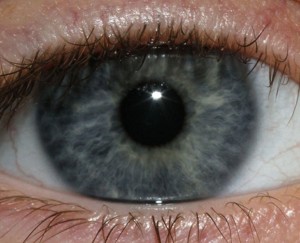
6a00d8341bf67c53ef015392e527f7970b-800wiI was reading through the science articles recently when I came through an article which talks about innovative medical innovations on the science of the eye. The BBC, Discovery Magazine, Washington Post, and other sources all have been able to pick up this story of the fact that a optic physician from California, a Dr. Gregg Homer, says that he has managed to create a type of laser that  can in only 20 seconds remove the pigmentation from a person’s iris.

From our high school biology books, we remember that the pigmentation from our eyes comes from some type of compound or protein called melanin. The melanin is what gives over 50% of the human world the color brown in their iris. Apparently only a small percentage of the world has what is traditionally blue eyes. However the blue hue or color in the iris is really just behind the brown pigment. All that the laser he has developed does is zap away the outer brown coloring to reveal the blue color underneath.

All the articles I have found say that the procedure will take either 20 seconds or 1 minute. The procedure is supposed to be painless, and the transformation from brown to blue eyes takes about 2-3 weeks, after the brown pigment is blasted away and degenerated. The blue color will apparently naturally remove the pigment. The cost of this cosmetic procedure will take about $5000 for each person. Currently, there is only one such process, from brown to blue. For black, green, hazel, and other colors of the eyes, there is no treatment found yet.

The article I decided to copy and post below is from the Discovery Magazine link…

New Procedure Would Turn Your Brown Eyes Blue

NOV 8, 2011 11:03 AM ET // BY MARIANNE ENGLISH

If you had the option to change your eye color — would you?

Now think about the question again, this time under two conditions: you’d have to pay $5,000 and undergo brief laser surgery. Would you still do it?

It’s obvious many people’s answer would flip. But one doctor thinks his method will attract a following. Gregg Homer, a California doctor, says he’s worked 10 years to perfect a laser treatment that can irreversibly turn brown eyes blue.

Homer believes that the eyes are the “window to the soul,” with blue being a preferred hue that looks less opaque than darker colors. In essence, he says, blue eyes allow others to look more deeply into them.

Here’s how the “20-second long” laser procedure works: A computer scans the iris and uses a laser to disrupt the brown pigment on the surface of the eye. Since blue pigment lies beneath the brown pigment, removing the outer layer of melanin can reveal a bluer look behind it. Since the brown pigment is damaged and will not regenerate, Homer says, the eye removes it naturally, according to one BBC article. Between two and three weeks later, the pigment lightens up, eventually transforming brown eyes to blue.

While addressing questions about the risks associated with the procedure, Homer told KTLA, a news station in Los Angeles, that he uses 15 “sophisticated” tests to ensure that no tissues are damaged. But in the very next sentence, he says, “Is it possible that something comes down the road? It’s possible.”

Unless the video was edited completely out of context, the previous statement suggests that Homer does not know the long-term effects of his laser treatment — a glaring problem other doctors point out in one ABC News article.

One NYU eye specialist, Robert Cykiert, told ABC News that the procedure is “probably risky.” He also said:

“When you burn the brown pigment away with a laser, the debris that is created in the front of the eye — think of it as ashes resulting from burning anything — is likely to clog up the microscopic channels in the front of the eye, known as trabecular meshwork,” said Cykiert. “ is very likely to cause a high pressure in the eye, known as glaucoma.”

Ironically, one of the treatments for glaucoma is more surgery.

So far, Homer says he has worked on the technique in animals, cadavers and human participants in Mexico. The method, called Lumineyes has been launched under Homer’s business, Stroma Medical Corporation (as of November 2011, neither site lists anything other than an email address).

He estimates the procedure will be available outside the United States in as few as 18 months, while it may take longer to gain approval in the states.

Also, it appears the technology only works to change from brown to blue, not other colors. Homer writes in one of his first patents that color eye contacts as well as implants aren’t permanent enough for people desiring pretty blues.

Photo by Dottie Mae/Flickr.com

The Connection Between The Wnt Beta Catenin Signaling Pathway And Growth, Part I

For the longest time I have been hearing from other height increase researchers talk about the Wnt/Beta-Catenin Signaling Pathway and how it effects so many different protein signaling pathways so I wanted to try to explain in my own words in this post what I have come to understand from reading from PubMed articles, Wikipedia articles, Medical journals, and other scientific and biological resources why this pathway is so important and how it is involved in the process of human growth and height.

Since my degree was in chemistry and engineering, I never formally took a class on molecular biology or on genetics before so this will be a slow process. The one class I ever took for Biochemistry I remember almost nothing from it so this study on the Wnt/Beta-Catenin Signaling Pathway will be absolutely necessary for any serious researcher on protein pathways and intracellular and extracellular pathways.

Here is what I remember from high school and college courses.

  • The purpose of all genes is to create proteins.
  • Genes are found either in the nucleus or the mitochondria of a cell.
  • A gene is a molecular unit of heredity of a living organism. It is a name given to some stretches of DNA and RNA that code for a polypeptide or for an RNA chain that has a function in the organism. (Wikipedia)

Since I remember that a lot of biology, biochemistry, and molecular biology, was about remembering names and terms, I think it was important to make a few terms and the terminology clear.

The definitions were mainly taken from the Wikipedia articles on these terms.


  • Intracellular – In cell biology, molecular biology and related fields, the word intracellular means “inside the cell”. It is used in contrast to extracellular (outside the cell)….This terms also means existing within the cells.
  • Extracellular – In cell biology, molecular biology and related fields, the word extracellular (or sometimes extracellular space) means “outside the cell”. This space is usually taken to be outside the plasma membranes, and occupied by fluid. The term is used in contrast to intracellular (inside the cell).
  • Ligand – In biochemistry and pharmacology, a ligand (from the Latin ligandumbinding) is a substance (usually a small molecule), that forms a complex with a biomolecule to serve a biological purpose. In a narrower sense, it is a signal triggering molecule, binding to a site on a target protein.
  • Receptor – In the field of biochemistry, a receptor is a molecule most often found on the surface of a cell, which receives chemical signals originating externally from the cell. Through binding to a receptor, these signals direct a cell to do something—for example to divide or die, or to allow certain molecules to enter or exit.Receptors are protein molecules, embedded in either the plasma membrane (cell surface receptors) or the cytoplasm or nucleus (nuclear receptors) of a cell, to which one or more specific kinds of signaling molecules may attach. A molecule which binds (attaches) to a receptor is called a ligand, and may be a peptide (short protein) or other small molecule, such as a neurotransmitter, a hormone, a pharmaceutical drug, or a toxin.
  • Cell surface receptors ( aka membrane receptors or transmembrane receptors) – are specialized integral membrane proteins that take part in communication between the cell and the outside world. Extracellular signaling molecules (usually hormones, neurotransmitters, cytokines, growth factors or cell recognition molecules) attach to the receptor, triggering changes in the function of the cell. This process is called signal transduction: The binding initiates a chemical change on the intracellular side of the membrane. In this way the receptors play a unique and important role in cellular communications and signal transduction.
  • Kinase – In biochemistry, a kinase is a type of enzyme that transfers phosphate groups from high-energy donor molecules, such as ATP,[2] to specific substrates, a process referred to as phosphorylation.
  • Protein – are large biological molecules consisting of one or more chains of amino acids. Proteins perform a vast array of functions within living organisms, including catalyzing metabolic reactions, replicating DNA, responding to stimuli, and transporting molecules from one location to another. Proteins differ from one another primarily in their sequence of amino acids, which is dictated by the nucleotide sequence of their genes, and which usually results infolding of the protein into a specific three-dimensional structure that determines its activity
  • Like other biological macromolecules such as polysaccharides and nucleic acids, proteins are essential parts of organisms and participate in virtually every process within cells. Many proteins are enzymes that catalyze biochemical reactions and are vital to metabolism. Proteins also have structural or mechanical functions, such as actin and myosin in muscle and the proteins in the cytoskeleton, which form a system of scaffolding that maintains cell shape. Other proteins are important in cell signaling, immune responses, cell adhesion, and the cell cycle.
  • Protein Kinase – is a kinase enzyme that modifies other proteins by chemically adding phosphate groups to them (phosphorylation). Phosphorylation usually results in a functional change of the target protein (substrate) by changing enzyme activity, cellular location, or association with other proteins. The human genome contains about 500 protein kinase genes and they constitute about 2% of all human genes.[1] Protein kinases are also found in bacteria and plants. Up to 30% of all human proteins may be modified by kinase activity, and kinases are known to regulate the majority of cellular pathways, especially those involved in signal transduction.
  • Phosphorylation – is the addition of a phosphate (PO43-) group to a protein or other organic molecule. Phosphorylation turns many protein enzymes on and off, thereby altering their function and activity. Protein phosphorylation is one type of post-translational modification.
  • Signaling Molecule – is a chemical involved in transmitting information between cells. Such molecules are released from the cell sending the signal, cross over the gap between cells by diffusion, and interact with specific receptors in another cell, triggering a response in that cell by activating a series of enzyme controlled reactions which lead to changes inside the cell.
  • Signaling Pathway (aka Signal transduction) – occurs when an extracellular signaling molecule activates a cell surface receptor. In turn, this receptor alters intracellular molecules creating a response. There are two stages in this process:
    1. A signaling molecule activates a specific receptor protein on the cell membrane.
    2. A second messenger transmits the signal into the cell, eliciting a physiological response.

    In either step, the signal can be amplified. Thus, one signalling molecule can cause many responses. A signal transduction functions much like a switch.

  • Target gene – (A personal definition) – the gene that a particular protein signal pathway will eventually have an affect on. The pathway’s main or secondary goal was to affect this one type of gene specifically.
  • Transcription – Transcription is the first step of gene expression, in which a particular segment of DNA is copied into RNA by the enzyme RNA polymerase. Both RNA and DNA are nucleic acids, which use base pairs of nucleotides as a complementary language that can be converted back and forth from DNA to RNA by the action of the correct enzymes. During transcription, a DNA sequence is read by anRNA polymerase, which produces a complementary, antiparallel RNA strand.

From the Wikipedia article on the Wnt Signaling Pathway


Mechanism

  • The Wnt pathway involves a large number of proteins that can regulate the production of Wnt signaling molecules, their interactions with receptors on target cells and the physiological responses of target cells that result from the exposure of cells to the extracellular Wnt ligands.
  • The canonical Wnt pathway describes a series of events that occur when Wnt proteins bind to cell-surface receptors of the Frizzled family, causing the receptors to activate Dishevelled family proteins and ultimately resulting in a change in the amount of β-catenin that reaches the nucleus

From the Wikipedia article on Beta-Catenin


Beta-catenin (or β-catenin) is a protein that in humans is encoded by the CTNNB1 gene. In Drosophila, the homologous protein is called armadillo. β-catenin is a subunit of the cadherin protein complex and acts as an intracellular signal transducer in the Wnt signaling pathway.

Function

β-Catenin is part of a complex of proteins that constitute adherens junctions (AJs). AJs are necessary for the creation and maintenance of epithelial cell layers by regulating cell growth and adhesion between cells. β-Catenin also anchors the actin cytoskeleton and may be responsible for transmitting the contact inhibition signal that causes cells to stop dividing once the epithelial sheet is complete.[6]

Recent evidence suggests that β-catenin plays an important role in various aspects of liver biology including liver development (both embryonic and postnatal), liver regeneration following partial hepatectomy, HGF-induced hepatomegaly, liver zonation, and pathogenesis of liver cancer.[7]

Role in the Wnt signaling pathway

When Wnt is not present, GSK-3 (a kinase) constitutively phosphorylates the β-catenin protein. β-catenin is associated with axin (scaffolding protein) complexed with GSK3 and APC (adenomatous polyposis coli). The creation of said complex acts to substantially increase the phosphorylation of β-catenin by facilitating the action of GSK3. When β-catenin is phosphorylated, it is degraded and, thus, will not build up in the cell to a significant level. When Wnt binds to frizzled (Fz), its receptor, dishevelled (Dsh) is recruited to the membrane. GSK3 is inhibited by the activation of Dsh by Fz. Because of this, β-catenin is permitted to build up in the cytosol and can be subsequently translocated into the nucleus to perform a variety of functions. It can act in conjunction with TCF and LEF to activate specific target genes involved in different processes

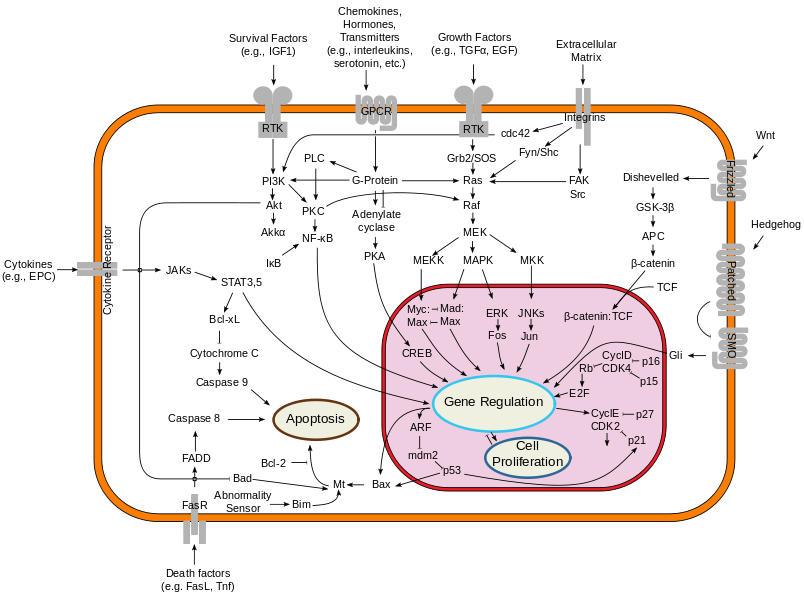
The picture below represents a the overview of the major signal transduction pathways. It is taken from the Wikipedia article for signal tranduction pathway .

Note: The post is continued below the picture of the signal transduction pathway diagram. Yes, there is more. Much, MUCH more in this post for me to study and learn. Hope you guys are reading and learning too.
Screen Shot 2013-01-22 at 8.45.20 PM


What we are seeing is that the Wnt/Beta-Catenin Signaling Pathway is one of the major signal transduction pathways which goes from the extracellular layer and area through the cell outer membrance inward, into the intracellular area, and then into the Nucleus, through the nuclear membrance.

The first question I would be asking myself is…’What is Wnt? What does the term refer to?

From what I can gather from the Wikipedia artilce on the word “Wnt” itself, it seems that the term “Wnt” is the combined word and meaning from two words and terms, Int and Wg.

Wg represents Wingless.

Int represents Integrated.

From PubMed study “Wnt signal transduction pathways“…”The name Wnt is resultant from a fusion of the name of the Drosophila segment polarity gene wingless and the name of the vertebrate homolog, integrated or int-1.”

The term Wnt is used in two cases. It refers to both the genes that make a certain type of protein, and the proteins that are made. So there are….

  • Wnt genes – The wnt genes make the wnt proteins. (I know, confusing). There is more than one type of Wnt gene, but an entire group (or family) of these genes.
  • Wnt proteins – these proteins act almost exclusively as signal transduction proteins, which give signals as a form of communication between individual cells.

From Wikipedia….

  • The Wnt proteins are a group of secreted lipid-modified (palmitoylation) signaling proteins of 350-400 amino acids in length
  • The WNT gene family consists of structurally related genes that encode secreted signaling proteins. These proteins have been implicated in oncogenesis and in several developmental processes, including regulation of cell fate and patterning during embryogenesis.
  • Wnt proteins are a major class of secreted morphogenic ligands of profound importance in establishing the pattern of development in the bodies of all multicellular organisms studied.

From looking at the diagram above, we can assume that the names used in the Wnt/Beta-Catenin Pathway are the key players. There is…

  1. Wnt – 
  2. Frizzled
  3. Dihevelled
  4. GSK-3Beta
  5. APC
  6. Beta-Catenin
  7. TCF

It would be difficult for me to explain the pathway well right now so I take a paragraph from a page from Stanford

Wnt proteins form a family of highly conserved secreted signaling molecules that regulate cell-to-cell interactions during embryogenesis. Insights into the mechanisms of Wnt action have emerged from several systems: genetics in Drosophila and Caenorhabditis elegans; biochemistry in cell culture and ectopic gene expression in Xenopus embryos. Mutations in Wnt genes or Wnt pathway components lead to specific developmental defects, while various human diseases, including cancer, are caused by abnormal Wnt signaling. As currently understood, Wnt proteins bind to receptors of the Frizzled and LRP families on the cell surface. Through several cytoplasmic relay components, the signal is transduced to beta-catenin, which enters the nucleus and forms a complex with TCF to activate transcription of Wnt target genes

Me: From the Stanford website, there is 19 documented Wnt genes from the mice genome. The reason why we can say that the study of mice to find elementary protein pathways and that information can be eventually applied to humans is because of this. It would appear that the Wnt pathway is a type of signal transduction, extracellularly pathway that almost all animals seem to have, derived from some billion years ago evolved process. If there is 19 currently found Wnt genes, we could be reasonably confident in saying that there is probably 19 Wnt genes for humans as well, and that the genes for humans have the same function as the genes in the mice.

From the looks fo the diagram, it seems that the Wnt gene will create a Wnt protein, which is and acts as a signal transduction from one cell to another cell. It is also a ligand. When it reaches the outer surface of the cell, it interacts with a certain type of receptor. This process is a where the Wnt ligand/protein and attaches itself to a specific type of protein, known as the target protein. The surface of animal cells is called the plasma membrane.

From a first glance, it would seem that the Wnt protein first interacts with something called a Frizzled, which is a type of protein already on the plasma membrane. This send a signal to something called a Dihevelled.

From the webpage from Stanford….

  1. Wnt – 
  2. Frizzled – Frizzled proteins are seven-transmembrane receptors. There is biochemical and genetic evidence that Frizzleds act as receptors for Wnt proteins, in particular in the case of Frizzled and Dfrizzeld2 interacting with Wingless in Drosophila. Wnts can bind the the CRD (cysteine-rich domain) of Frizzled, an extracellular part of the receptor. The structure of the CRD has been solved by Dann (2001) FRP/FrzB molecules consist of the CRD only and can act as secreted antagonists of Wnt signaling. Little is known about the mechanism of Frizzled signaling. Some but not all Frizzleds stimulate Ca release and PKC activity.
  3. Dihevelled – Dishevelled is one of the multi-module proteins working in the Wnt pathway. The DIX domain in Axin is similar to a domain in Dishevelled, and may promote interacions between these two domains. The protein has been found at multiple locations in cells, including the nucleus
  4. GSK-3 – GSK-3 (zw3 or shaggy in Drosophila) is a key enzyme in Wnt signaling. It phosphorylates b-catenin leading to the subsequent degradation of this molecule. The phosphorylation is primed by CK1alpha.
  5. APC – APC is an enormous protein that has muliple roles in the cell. In the Wnt pathway, it binds to b-catenin and is necessary for its down-regulation. APC also interacts directly with Axin.
  6. Beta-Catenin – β-catenin (armadillo in Drosophila) is the key mediator of the Wnt signal. In cells not exposed to the signal, β-catenin levels are kept low through interactions with the protein kinase zw3/GSK-3, CK1a, APC and Axin. β-catenin is degraded, after phosphorylation by GSK-3 and CK1 alpha, through the ubiquitin pathway.
  7. TCF – In the nucleus, in the absence of the Wnt signal,TCF acts as a repressor of Wnt/Wg target genes. TCF can form a complex with Groucho. The repressing effect of Groucho is mediated by interactions with Histone Deacetylases. b-catenin can convert TCF into a transcriptional activator of the same genes that are repressed by TCF alone

Axin – Axin associates directly with β-catenin, GSK-3β and APC and is implicated in down- regulating Wnt signaling. A gene related to Axin, called Conductin or Axil was cloned by virtue of interacting with β-catenin. Overexpressed Axin or Conductin destabilize β-catenin

So the pathway from the diagram goes Wnt –> Frizzled –> Dihevelled –> GSK-3Beta –> APC –> Beta-Catenin –> TCF –> Gene regulation.

From the information I have gathered through Wikipedia and Stanford, this is what I can piece together at this point on the entire pathway.

  • The Frizzled is a big receptor that goes across the lipid bilayer which is the plasma membrane. It is big, long, and has ends sticking out to the outside and side the cell. The Frizzeled act as a receptor for the Wnt proteins.
  • The GSK-3 is an enzyme in the pathway. It adds a phosphate group to beta-catenin which causes the beta-catenin to degrade. Before it can add the phosphate group, there is another element called CK1alpha which needs to do something on the GSK-3.
  • The APC seems to have multiple roles in the cell. For the Wnt pathway, it binds to the beta-catenin to down regulate the beta-catenin. It also interacts directly with Axin.
  • The Beta-Catenin itself does not directly interact with the Wnt signal from the beginning of the pathway. The levels of this element is kept low from binding and interacting with other elementts, the GSK-3 (aka zw3), the CK1a, the APC, and the Axin. The Beta will be phosphorylated by the GSK-3 and the Ck1 alpha which will cause it to degrade.
  • For the TCF, its function is to repress Wnt/Wg target genes if there is to Wnt signal.
  • The Axin is used to down-regulate Wnt signaling.

From this quick analysis on why the Wnt/Beta-Catenin signaling pathway is important for growth and overall height, it would seem that the pathway is one of the most important in controlling the life cycle of cells during embryo formation.

From PubMed study “Wnt signal transduction pathways“…

“The extra-cellular Wnt signal stimulates several intra-cellular signal transduction cascades, including the canonical or Wnt/β-catenin dependent pathway and the non-canonical or β-catenin-independent pathway which can be divided into the Planar Cell Polarity pathway and the Wnt/Ca2+ pathway”

Interpretation: This sentence implies that there Wnt/Beta-Catenin signal pathway is one of several pathways all started by the extracellular Wnt signal. The canonical version has the Beta-Catenin and the non-canonical does not have the beta-catenin. The study would go on to explain why the Wnt family of genes and protein and the pathway named after them are so important in growth and development of the human body….

Conclusion: I wanted to end this post here due to the fact that the Wnt/Beta-Catenin signaling pathway is one of most important and most studied intracellular signaling pathways. There is much more to learn about this pathway than what I have learn here and I think that I should come back to the learning of this pathways in another time. There are quite a few PubMed studies and articles which show how the target genes and the eventually expressed (or not expressed) proteins result in regulating some part of a the chondrocyte proliferation and/or chondrocyte differentiation processes. As for now, there is clear connections on how the Wnt/Beta-Catenin signaling pathways effects growth, but I just haven’t had the chance or have more time to go further into studying and researchers its effects.
Increase Height And Grow Taller Using Microfracture Surgery, Part III

So far we have looked at the idea of using microfractures surgery principles and techniques as a starting point for ideas to cause potential height increase. In the first post, we looked at where the origin of the idea came from. The 2nd post was to go explain what is the knee microfracture surgery is, which is a arthroscopy procedure.

This last post is to see whether we can from an integration of the ideas behind the micrafracture surgery can come up with something real.

Analysis And Interpretation:

The reason why I thought we might be able to use the ideas of microfracture surgery to develop an height increase minimal surgical method was because of how minimally invasive the approach was, and how easily cartilage can be formed, at least for articular cartilage repair or decreased degeneration and damage. Microfractures have been mentioned extensively within this community and this medical procedure, specifically on the knee and leg region seemed to have some similar and maybe even applicable ideas.

The main issue that the Wikipedia source seems to reveal is that the cartilage that is formed from the bone marrow stem cell clots is that it is fibrocartilage, not hyaline cartilage. From the Wikipedia article on cartilage, we find out that there is apparently 3 types of cartilage. (I had stated before that there was only 2, so I was wrong about that point.) From the article…

Cartilage is composed of specialized cells called chondroblasts that produce a large amount of extracellular matrix composed of collagen fibers, abundant ground substance rich in proteoglycan, and elastin fibers. Cartilage is classified in three types, elastic cartilage, hyaline cartilage and fibrocartilage, which differ in the relative amounts of these three main components. Chondroblasts that get caught in the matrix are called chondrocytes. They lie in spaces called lacunae with up to eight chondrocytes per lacuna.

So they say that the difference between the hyaline cartilage and the fibrocartilage is the relative amounts of the 3 main components…

  1. collagen fibers
  2. ground substance composed highly of proteoglycans
  3. elastin fibers.

I remember when I was doing research that the chondrocytes do leave a type of waste, that the waste is two main components that make up the cartilage extracellular matrix, the collagen type II, and the proteoglycans.

Continued….

Unlike other connective tissues, cartilage does not contain blood vessels. The chondrocytes are supplied by diffusion, helped by the pumping action generated by compression of the articular cartilage or flexion of the elastic cartilage. Thus, compared to other connective tissues, cartilage grows and repairs more slowly.

We do remember that the perichondrium, which is a layer of cells that surrounds cartilage that is in DEVELOPING bones. This makes me wonder whether after the bones have stopped growing, is the perichondrium still there, at least in the articular cartilage layer? From it’s Wiki page…

The perichondrium is a layer of dense irregular connective tissue which surrounds the cartilage of developing bone. It consists of two separate layers: an outer fibrous layer and inner chondrogenic layer. The fibrous layer contains fibroblasts, which produce collagenous fibers. The chondrogenic layer remains undifferentiated and can form chondroblasts or chondrocytes. Perichondrium can be found around the perimeter of elastic cartilage and hyaline cartilage. Fibrocartilage and articular cartilage both lack perichondrium

Perichondrium is a type of Irregular Collagenous Ordinary Connective Tissue, and also functions in the growth and repair of cartilage

Once vascularized, the perichondrium becomes the periosteum.

So when we combine the two wiki articles together, we get a better image of how the development of cartilage to bone and cartilage and bone separately work. Cartilage seems to always have some tendency to turn into bone. The cartilage does not contain blood vessels, but get their food or energy by the process of diffusion. In the developing bone at least, when there is still an epiphyseal plate to talk about, the growth plate cartilage has a surrounding perichondrium. There is two layers, an outer fibrous layer (which I would guess has the function of structure and protection) and an inner chondrogenic layer (for proliferation and acts as a source for new chondrocyte formation). The chondrogenic layer doesn’t get differentiated but can change into either the chondorcytes or chondroblasts.

One of the most most important phrases in the wiki article on perichondrium is this “Once vascularized, the perichondrium becomes the periosteum.I remember from other studies on the periosteum that the periosteum around the long bones also have two layers like their predecessor, the perichondrium. The outer layer of the periosteum is something I haven’t looked at extensively but I did write a post looking at the possible idea for using the inner layer of the periosteum as a way to increase height before.

From the Wikipedia article on cartilage continued….

Repair

Cartilage has limited repair capabilities: Because chondrocytes are bound in lacunae, they cannot migrate to damaged areas. Therefore cartilage damage is difficult to heal. Also, because hyaline cartilage does not have a blood supply, the deposition of new matrix is slow. Damaged hyaline cartilage is usually replaced by fibrocartilage scar tissue. Over the last years, surgeons and scientists have elaborated a series of cartilage repair procedures that help to postpone the need for joint replacement.

Bioengineering techniques are being developed to generate new cartilage, using a cellular “scaffolding” material and cultured cells to grow artificial cartilage.

This shows the same issues that is talked about in the microfracture surgery issue, which is that hyaline cartilage is replaced with fibrocartilage.

From source (McGrawHill)…

Hyaline Cartilage

The type of protein fiber embedded within the matrix of cartilage determines the cartilage type.  In hyaline cartilage protein fibers are large and predominantly collagen.  The optical density of these fibers is the same as the ground substance surrounding them and as a result, they are not visible within the extracellular matrix.  Hyaline cartilage subsequently appears as a very uniform, glossy type tissue with evenly dispersed chondrocytes in lacunae.  Typically, perichondreum is found around hyaline cartilage.

  • Chondroblasts would be found as flattened, elongate cells between the perichondreum and cartilage.

Elastic Cartilage

Elastic cartilage has a preponderance of dark-staining elastic fibers embedded in ground substance.  These fibers are clearly visible and this trait is the single, best identifier to be used for differentiating elastic cartilage from hyaline.  Perichondreum is also typically found around elastic cartilage.  Elastic cartilage is found in the pharyngotympanic(eusatachian) tubes, epiglottis, and ear lobes where needs dictate supportive tissues possess elasticity.

Fibrocartilage

Fibrocartilage(fibrous) is a type of cartilage that contains fine collagen fibers arranged in layered arrays.  In contrast to the very uniform appearance of hyaline cartilage, fibrocartilage possesses a more open or spongey architecture with gaps between lacunae and collagen fiber bundles.  It is this open spongey structure that makes fibrocartilage a good shock-absorbing material in the pubic symphysis and intervertebral disks.  It can appear quite different in these two locales.  Most textbooks show images of fibrocartilage from the intervertebral disks where it is very open and loose.  In the pubic symphysis, it can be much tighter in construction, appearing like a dense connective tissue with lacunae.  

What we are seeing for the difference between the fibrocartilage and the hyaline cartilage is that the collagen fibers are arranged differently. The hyaline cartilage is a very uniform, glossy type tissue. The fibrocartilage is different because it has a more open and spongey architecture of the gaps between the lacunae and collagen fiber bundles. The hyaline cartilage in contrast has a uniform, evenly dispersed chondrocytes in lacunae.

Implications for Height Increase:

If we decided to try to drill microfractures into the long bone ends, what would happen is that the stem cells that seeps out would be disorganized and not be distributed in uniform which would be what determines hyaline cartilage from the other types. Fibrocartilage formation from the clotting process would be a given. It might be possible that through adding a type of scaffold that the cartilage type can be changed to be hyaline. What could work is that if a series of microfractures in a specific distribution design is created from drills on the side of the epiphysis to completely go around the bone in a closed path. This means that after a few days, the path of drilled microfractures would fill up with stem cells which will eventually turn into fibrocartilage. The fibrocartilage will not be that strong, but before they calcify into bone from vascularization, it would be possible to drill another set of microfractures around the same path to fill up the remaining bone bridges. The idea that we are using is to get a punctured hole to the subchondral, subcortical bone layer so that the stem cells inside would come out and turn into cartilage.

Increase Height And Grow Taller Using Microfracture Surgery, Part II

Screen Shot 2013-01-22 at 3.53.04 PMIn the previous post, I wanted to establish the basis for the origin of the idea for this question to see if we can somehow use the microfracture surgery technology to increase height. From a post, Tyler had said…

Scientists have utilized the power of microscopic fractures in stem cells with knee microfracture surgery to stimulate cartilage growth.  You can also cause microscopic fractures in the ends of the long bones to release these powerful red bone marrow stem cells.  Laterally pressing against the ends of your bones also increases fluid flow within the bone.  This increase in fluid flow sends the stem cells to your now opened growth plate!

The idea is theoretically sound and might work from a quick analysis. I would do a little more research on microfracture surgery. Let’s first see what Wikipedia says with it’s article on Microfracture Surgery. From Wikipedia…


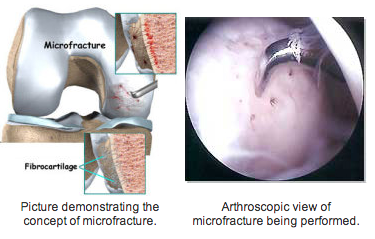
Microfracture surgery is an articular cartilage repair surgical technique that works by creating tiny fractures in the underlying bone. This causes new cartilage to develop from a so-called super-clot. Microfracture surgery has gained popularity in sports in recent years; numerous professional athletes including …. have undergone the procedure.

The surgery is quick (typically lasting between 30-90 minutes), minimally invasive, and can have a significantly shorter recovery time than an arthroplasty (knee replacement).

Background

Chronic articular cartilage defects do not heal spontaneously. However, acute traumatic osteochondral lesions or surgically created lesions extending into subchondral bone, e.g. by Pridie drilling, spongialization abrasion or microfracture causing the release of pluripotent mesenchymal stem cells from the bone marrow, may heal with repair tissue consisting of fibrous tissue, fibrocartilage or hyaline-like cartilage. The quality of the repair tissue after these “bone marrow stimulating techniques” depends on various factors including the species and age of the individual, the size and localization of the articular cartilage defect, the surgical technique, e.g., how the subchondral bone plate is treated, and the postoperative rehabilitation protocol.

Procedure

The surgery is performed by arthroscopy, after the joint is cleaned of calcified cartilage. Through use of an awl, the surgeon creates tiny fractures in the subchondral bone plate. Blood and bone marrow (which contains stem cells) seep out of the fractures, creating a blood clot that releases cartilage-building cells. The microfractures are treated as an injury by the body, which is why the surgery results in new, replacement cartilage. The procedure is less effective in treating older patients, overweight patients, or a cartilage lesion larger than 2.5 cm. Further on, chances are high that after only 1 or 2 years of the surgery symptoms start to return as the fibrocartilage wears away, forcing the patient to reengage in articular cartilage repair.

The effectiveness of cartilage growth after microfracture surgery is thought to be dependent on the patient’s bone marrow stem cell population and some think increasing the number of stem cells increases the chances of success. A couple of physicians are promoting an alternative treatment implanting autologous mesenchymal stem cells directly into the cartilage defect, without having to penetrate the subchondral bone.

Microfracture Reports

Studies have shown that microfracture techniques do not fill in the chondral defect fully, forming fibrocartilage rather than hyaline cartilage. Fibrocartilage is not as mechanically sound as hyaline cartilage; it is much denser and unable to withstand the demands of everyday activities as well as the original cartilage and is thus at higher risk of breaking down. The blood clot is very delicate after surgery and needs to be protected. In terms of time, the clot takes about 8 weeks to 15 weeks convert to fibrous tissue and is usually fibrocartilage by about four months post surgery, holding implications for the rehabilitation.

Chondrocyte Implantation procedures (CCI), a cell based articular cartilage repair procedure that aims to provide complete hyaline repair tissues for articular cartilage repair, have been posed by some as an alternative to microfracture surgery. In February 2008, Saris et. al published a large-scale study claiming that CCI results in better structural repair for symptomatic cartilage defects of the knee than microfracture surgery. According to the study, one year after treatment, the tissue regenerate associated with CCI is of better quality than that of microfracture surgery.


So we know a few things just from a Wikipedia article. This idea of purposely creating microfractures in the knee subchondral bone plate area in the shape of small circular holes will cause blood and bone marrow to flow out, cause some clotting, which will cause cartilage formation. It seems that the clotting action of the bone marrow with the stem cells inside which seeps out is what causes cartilage formation. The problem seems to be that the cartilage formed is fibrocartilage, NOT hyaline cartilage. We must remember that there are different kinds of cartilage. The growth plates and the articular cartilage are hyaline cartilage, which is what we are looking for and to create. However the idea of making very small microfractures and punctures through the bone into the subchondral layer is enticing. Cartilage is formed so that is a start.

From a section of the website for the US National Library of Medicine, National Institutes of Health


Knee microfracture surgery

Knee microfracture surgery is a common procedure used to repair damaged knee cartilage. Cartilage is the material that helps cushion and cover the area where bones meet in the joints.

Description

Three different types of anesthesia may be used for knee arthroscopy surgery:

  • Medicine to relax you, and numbing the knee using shots of pain killers
  • Spinal (regional) anesthesia
  • General anesthesia, where you will be asleep and pain-free.

The surgeon will make a 1/4-inch surgical cut (incision) on your knee.

  • A long, thin device called an arthroscope is placed through this cut. It is like a camera. It is attached to a video monitor in the operating room. This tool allows the surgeon to look inside your knee area and work directly on the joint. See also: Knee arthroscopy
  • The surgeon makes another surgical cut and passes tools through this opening. A small pointed tool called an awl is used to make very small holes, called microfractures (tiny breaks), in the bone near the damaged cartilage.
  • These holes release cells in your bones that build new cartilage. Your body will build new cartilage to replace the damaged cartilage.

Why the Procedure is Performed
Your doctor may recommend this procedure if you have some damage to the cartilage in the knee joint and on the underside of the kneecap.

The goal of this surgery is to prevent or slow further damage to the cartilage, preventing knee arthritis. It can help you avoid the need for a partial or total knee replacement.

This procedure is also used to treat knee pain due to cartilage injuries.

Another surgery, autologous chondrocyte implantation, is done for similar reasons.


What we see from this resource is overall a repeat of the same information. From the website for the London Knee Clinic, it would seem that the procedure is similar in effect as the Autologous Chondrocyte Implantation (aka Transplantation). It says that in the beginning, there will be 1/4th of an inch in cut on the articular cartilage surface area. There is a 2nd cut and surgical tools are passed through this opening. Something called an awl (sharp pointy device??) is used to make the small holes, which is what the microfractures are. The hole are big enough to release the cells from inside the bones to the outside where the cartilage covering is but small enough that bone healing from the clotting effect will be easy and will be relatively simple and noninvasive.

This is Part II in a 3 post series where I look at the potential idea on using the techniques and theories from microfracture surgery to possibly find a way to increase height.

Increase Height And Grow Taller Using Microfracture Surgery, Part I

In the previous post I mentioned that an old post entitled “Grow Taller Basics” from HeightQuest.com made me realize that from something as simple as head and feet rubbing can possibly lead to height increase. Something else that caught my eye from the post was this segment he added in…

“Scientists have utilized the power of microscopic fractures in stem cells with knee microfracture surgery to stimulate cartilage growth.  You can also cause microscopic fractures in the ends of the long bones to release these powerful red bone marrow stem cells.  Laterally pressing against the ends of your bones also increases fluid flow within the bone.  This increase in fluid flow sends the stem cells to your now opened growth plate!”

I recently been looking at the idea of possibly using the current microfracture surgery technology to increase height after I went back to an old post about the Shinbone routine and using Microfractures to grow taller to add to these old posts which I edited and upgraded. The idea on growing taller using induced microfractures has been around a long time and there were even groups and teams of people who tried out their own created routines to see if the idea would work.

Tyler’s idea is interesting and has some points with…”Their is a myth that the growth plates completely fuse after puberty but that is untrue.  Their is actually a thin growth plate line that is simply inactive.

I would actually have to disagree with this idea, because I have read from sources that the epiphyseal line itself will also eventually go away. At this point, I can’t find those sources which state that the line itself will also at one point disappear too.

From WiseGeek.com“The epiphyseal line the part of the bone that replaces the epiphyseal growth plate in long bones once a person has reached their full adult height. An epiphyseal line is visible on a standard x-ray. It looks like a thin dark streak that stretches horizontally across the rounded ends of the bone.”

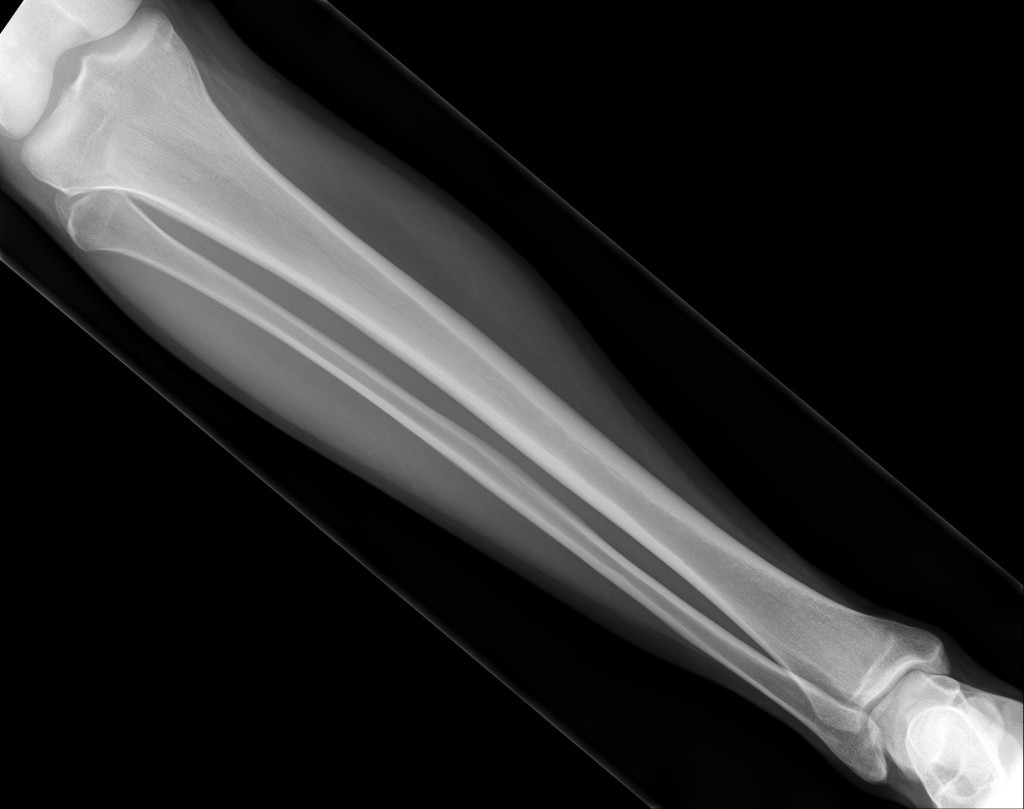
I would have to validate this type of claim from an pic of 1 X-Ray (out of 3 provided) of a tibia I received in the website email today I got where a person asked me whether I can see if their growth plates are fully closed and how to reopen them again. A guy named Felipe (last name not revealed over privacy issues) would give me this message…

“…here there are some pictures of my tibia distal and proximal growth plates,i had been using mens routine for 2 years and i hadnt any result, Actually i will be turning 20 in 2 months more,and i need a way to open my growth plates.”

[Note: As always, if this picture breaks any type of privacy or medical confidentiality laws, and I am informed by the person who gave me this picture that I am doing something wrong, I will of course take this picture down for privacy and legal reasons.]

Of the 3 X-rays he provided, this picture is probably the clearest. We can see that even a young 19 year old male already no longer has even an epiphyseal line. My claim is that the line also eventually goes away. There is a slight hint of some type of indention on the ends at the epiphysis but they are not where the epiphyseal plates are supposed to end up when they finally die out and calcify completely. I would guess that the line like indention is an indication of where the articular cartilage covering of the ends end off. If we use WiseGeek’s advice, I can’t find where the dark think streak is. Do you?

This is Part I of a 3 part series of posts where I look at whether we can use microfractures to cause some type of height increase.

18395516-0-RX DE PIERNA DERECHA-img0

Increase Height And Grow Taller From Head And Feet Rubbing And Tapping, A Simple Idea With High Feasibility

urlAs I was scouring through the usual sites that deals with height increase, I somehow came across a post on the GrowTallInfo.com website which made me realize that there may be a VERY easy and simple idea on how to possibly cause some bit of height increase. From the thread entitled “Grow Taller Basics” I realized that the thread was actually an old post that Tyler Made on HeightQuest.com HERE. After reading over the post, I was rather shocked to realize that a very simple and easy method for some height increase was possible that I completely forgot about which has a really good chance to work.

The post that was on HeightQuest.com mentions the fact that there are other types of bones in the human skeleton, not just the long bones. The skull for example is a clear example of a non-long bone but an irregular bone. The top of the skull is irregular in shape with a flat surface. As he states…

“The same tissue that is present on the width of long bones is present at the top bone of the skull.  Therefore, since you can increase the width of this tissue height increase after puberty is possible.”

“Now how do you increase the width of this outer sheet?  You rub against it.  Since it is the outer covering of the bone, you only need to target the surface of the bone.  So, a vigorous head massage may be one of the ways to get taller!”

When I thought over this simple and easy to do idea, I was very surprised at how simple it could be. All that one really has to do is do some vigorous top of head rubbing or massage. When I was little I would hear old wive’s tale that for a balding or bald man to regrow hair, he should just rub a raw potato on the top or back of his head, where the bald stop is. Maybe head and skull rubbing may cause more than just hair regeneration, but also some additional height that will come from the flat surface on the top of the head.

I remember looking over the idea of a dynamic bone loading method to widen the shoulder bones which I wrote a post about at “Review Of Claim To Widen Shoulder Bone, Lengthen Forearms, And Lengthen Lower Legs” and I had stated that the idea for shoulder widening really could work since the shoulder bone is irregular. Any possible loading on the surface of the shoulder could cause the bone sides to increase in width, thus leading to wider shoulder. The same idea is for the top skull flat bone.

I would maybe even suggest that instead of rubbing the head, it might be better to tap the entire upper head area, but get the loading to be of equal pressure distribution. If the tapping on the top of the head leads to just one small sized lump, like what we see in the cartoons when an anvil falls on a person’s head. However

If we remember, the way that real height is measure is from the top most point of a person’s top of head to their feet when they are standing completely erect and straight. The bump could mean that any bumps formed from appositional growth and bone remodeling from certain loading can lead to maybe a little bit of skull flat bone width increase and height increase.

Gray290As for the feet…

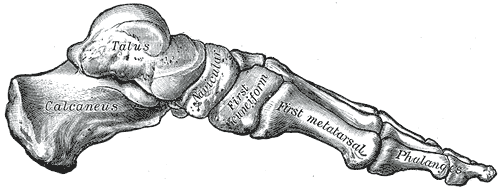
Tyler would state…”There is also a bone in your feet.  Your heel bone.  This bone is completely covered with the sheet that can increase in width.  If you can increase the width of this bony sheath it will act sort of as height increasing shoes and you will be taller!

What he is referring to is known as the Calcaneus. From Wikipedia, “In humans, the calcaneus (from the Latin calcaneum, meaning heel[1]) or heel bone is a bone of the tarsus of the foot which constitute the heel. In some other animals, it is the point of the hock.”

Theoretically I would guess that the calcaneus may have the same bone remodeling effects as the flat surface of the top of the head, although I would suspect that in real life, the results would not be positive. We have to remember that in terms of the amount of weight and load any of the bones in the body gets most exerted on them, the heel bone probably has the most load on it. When a 200 lb human being jumps up, when they land back down, the heel bone and the ankles are the area of the body which gets the greatest amount of force per area and shock. Even if a person did manage to put enough load over the sheet of the heel bone, I would guess that the incredible load that the human body from the gravitational force exerted on it would experience would negate any real bone width increasing, but it might be possible to get 1-2 mm of height increase from applying pressure on the heel bone. I would rather suggest that it might be smarter to use a hammer or a 50-75 lb dumbbell for a stronger enough load on the bone.