Thoughts From One Of The Female Readers On Why She Wants To Be Taller

Thoughts From One Of The Female Readers On Why She Wants To Be Taller

Since the website started, I’ve gotten messages from dozens of people who have written their entire life story on how they dealt with the insecurity of feeling smaller than others. Most of them have been from young teenager men, who compare themselves to their school peers and wish to be more attractive to the female gender. However, there are also a few females who have messaged me.

This message was left by a person who calls herself “Z**” months ago.

Submitted on 2014/03/08 at 9:24 am

This was an interesting post. i can relate to the retired man who never gave up on his quest to be taller. Though I am a female, 30, i too never gave up. My obsession with being taller began around 15 or 16 when i wanted to be a model. I had been wearing about 2.5″ lifts from that age until I was about 22 until my foot started to hurt and wearing lifts were so inconvenient. They were hard to walk on and I could never go to someone’s home or do anythign that required me to take my shoes off or it would “expose” me. People who knew me then that i havent seen still think that I am really 5’7″.

For some girls, they move on and get over it, but i was really obssessed and never stopped wanting to be a model even now, when I am well past the age of when typical models are “discovered”. Ive also wanted to be taller because I think taller makes you stand out. I stand at 5’4, if i stand super straight then maybe about an extra half inch. I wear one inch lifts out, and to be honest, I dont feel that i am very short. I usually feel on the small side to average side however i think now, though i have not fully accepted my height still, i am also much more comfortabel with it. Anytimne i meet other people , i size them up by their height and see how much taller or shorter i am in comparison. I never leave the house without about an inch to one and a half inch in lifts, which is honestly hardly a difference when you take your shoes off. I think it is more of a mental thing where it just makes me feel better. Well, basically my point is, yes there are people who have never been able to let go of this, and after 15 years, i still search that there is hope that i can gain a few more inches.

My reply

Z**,

I wanted to ask this question to a female, since height issues effect mainly men. How or why did this issue manifest for you? Was it from some insecurity issue from a younger age or something? Being 5′ 4″ is actually quite average for height. 

(Notice how she mentions that she is 5′ 4″ which is actually quite average for american females.)

Her Next Message to Me…

Hello,

I just noticed your email today! Sure, I’d love to give you a response to your questions.

How or why did this issue manifest for me?

I think it started when I was around 14, I just had this obsession of wanting to be a model, and models are tall (5’8 +). I remember in high school admiring all the tall girls and thinking how I wished I could be just like them. I also associated being tall with just being better than others for some reason. i thought that you stand out more, you are prettier, glamorous etc. I never stopped wanting to be a model, even now when it is quite unattainable at my age. I think this has caused an insecurity that just never left me, and I am 30 now. I started wearing lifts in high school and by the time I was in college my lifts were as high as 2.5″-3″. No one has ever known that I wore lifts. It affected all aspects of my life, from being in social situations to personal relationships to doing any activities and figuring out which shoes to wear going through airport security is always a nightmare haha. As a result, I think I became even more introverted as i would have to avoid certain situations that required shoes to be taken off. I previously traveled and lived in T***** recently and was there for 4 years. During this time, I started to wear lower lifts because it just became impractical with all the walking and traveling. I think this helped me too to accept my height a little more. I was quite surprised by the height disparity there.

Tall girls (around 5’7) are just as common as very short girls( under 5’2 or so). In fact, I found people around the 5’4-5’5 range to be less common.

Thank you for saying that 5’4 is actually quite average for a girl’s height, but I do feel like a shrimp often, especially I notice caucasion women are often a bit taller. Well, sometimes I also notice that I am taller than most of the other girls in a room. Like i said in my previous email as well, I have somewhat accepted my height, somewhat. At least, I am more comfortable with my height, though I never leave the door without at least 1″ lifts, which is sometimes ridiculous as I don’t think it makes much of a difference, but I think it just makes me feel better knowing that there is something in my shoes.

I also know it is rare that height complexes usually affect men not women. It has greatly affected me and caused me to be super insecure and I missed out on many opportunities throughout life. Ive obsessed about it since the age I was 14. I had tried many experiments to see if I could gain a few inches including hanging upside down and sitting with weights. All failed. Again, it is much better now, though I still care and probably always will try and do anything to gain even an extra inch. I wish I could tell other people to not obsess about their height, it is just not worth it. Just go live your life to its fullest, but I suppose it is a mental thing and  it is easier said than done.

Please let me know if you have any other questions, I am happy to share my experience especially if it can help others!

Regards,

Z**

I asked her for permission to publish her messages and she agreed, on the condition that I change her name and the names of places she has visited. I complied on that wish.

Based on the way she compared herself to “caucasian” women I would assume maybe she is not caucasian, and maybe african american or east asian or south asian or hispanic in race/ethnicity. Race does play a difference in how she views herself. Based on averages of different sub-set of human groups, if she is a hispanic or asian female, being 5′ 4″ would definitely make her NOT short.

She seems to have lived abroad in another country for a few years and the differences of the height in the two countries might have given her another perspective, and maybe even made her feel more accepting of how tall she is. She admits that now she doesn’t try to wear shoes with too high of a heel.

We are very happy that she has managed to get her internal demons exorcised a little bit. If she still feels like she will always need that extra 1 inch of height to give her a little more confidence in social situations, then more power to her. As long as she is not hurting anyone else or herself from her habits and behavior, we will always support her on what she does.
Have Bodybuilders Already Done All Our Research For Us?

Have Bodybuilders Already Done All Our Research For Us?

This has been a really big issue for me for the longest time and I think I need to address a concern which maybe many of the intermediate height increase researchers might have been thinking about and worrying about for at least the last half decade.

Ever since the creation of the internet and the uploading of so many academic scientific studies to various databases to the internet, bodybuilders have been scouring the academic papers like PubMed.com and Google Scholar to find articles which have already done the tedious laboratory work to help give the bodybuilders new ideas.

When I start searching for the link between bone growth or cartilage regeneration with compounds I have never done research on or have never heard before like CJC-1295 and Isoparelin, what shows up in the Google search results are the bodybuilding forums, like AnabolicMinds.com, The Steroid Forums, SimplyShredded.com, MatterofSize.com, ProfessionalMuscle.com, SteroidWorld.com, and BodyBuilding.com. (Note: Yes, I am aware that the Matter of Size forum is not for bodybuilding but used for men hoping to increase their genitalia)

What shows up are threads written by some guy around the ages of 18-22 who wants to maybe get another growth spurt and the repliers calling him a “manlet” (I have no idea where this stupid term came from) and him being ostracized for such a crazy desire.

However, when there is a more technical response, the knowledge that the posters shows is extremely technical and high level. I am always very surprised and impressed at how much the other men have figured out and read, at least in terms of reading the Abstract on PubMed studies. These guys probably don’t read the entire 20+ page PDF for a study unless it is extremely relevant and reveals new information but most likely glances and reads the Abstract. Well, that is what I do.

I knew that the bodybuilders have always been very knowledgeable on the limits of what science and technology has revealed. They really do keep up to date on the latest information and are at the forefront/leading edge on what is possible.

I have watched a few YouTube videos of Arnold Schwarzeneggeer (spel??) talking about his training and why he did certain weight lifting techniques when he was younger and his explanations reveal that Arnold was very knowledgeable on the physiology of the body. His understanding how the body reacts and changes from weight lifting and taking supplements is really at a high-level. Since he was the person who really brought bodybuilding in the mass media starting in the 70-80s, the bodybuilders after him probably took his lead and also educated themselves extensively on supplements, steroids, human physiology, anatomy, etc.

When I talk to my physical therapist or even the local gym trainer with maybe just a BS/MS from some state school in Kinesiology or Sports Medicine, they are really knowledgeable on the human body and can discuss even the most complicated aspects of human biology.

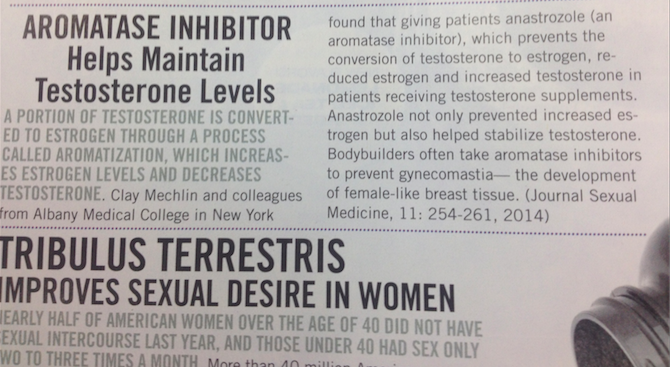
I was recently at the local supermarket leafing through a Men’s Health Magazine and on one of the pages, there was an excerpt on research being done at some research lab in some university. I took a picture of the article and have put it below. It is about the Aromatase Inhibitors, and how they can prevent the testosterone from converting too quickly into estrogen.

Aromatase Inhibitors

Anastrozole is mentioned and we all know that Hakker/Thomas and his forum reached the same conclusion more than 5 years ago. Since the internet is now at the fingertips of anyone and the PubMed database is free to access, anyone who wanted to do even a slight bit of research to maybe find a way to make themselves taller would have figured out the AI technique.

Every single serious height increase researcher have realized it from the last half decade. The GrowTallForum.com people all knew about it. In the 5th Podcast I did with Hakker, he revealed that he did give pills to forum members to try out. There were results, but the results were only for people with open growth plates. He revealed to me that one of the 4 pills he often gave in a set was Letrozole, the other really well known Aromatase Inhibitor.

The PubMed database is close to being completely mined out of any new or fresh ideas. Tyler already did all that work. In his old website HeightQuest.com he probably has listed maybe 80+ possible chemical compounds which have at least a small chance of increasing height at least a little bit. In terms of what is easily found on the internet from only looking at studies in university databases, we are almost at the final point.

The Brazilian researcher Mateus knew much more than me and he told me about a year ago that he would find a way to regrow the growth plates using all these studies. So far, he never came back or revealed anything. So my guess is, he didn’t succeed. Who can blame him anyway, right?

Interestingly, in the 2nd Podcast Tyler revealed to me that he was also a former bodybuilder who mentioned a story on how the talk about Mariusz Pudzianowski being 6 feet tall was considered small in the World’s Strongest Men competition. These anecdotal stories and similar personal life experiences in some many people who want to grow taller and actively do serious research suggests to me that probably hundreds, if not thousands of bodybuilders have already come before me and mined through all the studies looking for the same thing I am doing and Tyler has been doing.

So have those bodybuilders already done al of our research for us?

I am willing to bet that there has been at least a few crazy guys who were as obsessed with growing taller as me and Tyler and did the same type of research for years maybe. I know that the Joey or Tim guy who runs the AdultHeightIncrease.Blogspot.com website has been researching for a oral supplement which would work on adults for at least 12 years. He has been creating many different types of powder for people to take for years, doing his formulations.

The next questions are going to be the most important

  • So if these bodybuilders already did the research, did they find something?
  • Did they find the solution or an answer, our “Holy Grail”?

I am guessing they never found the “Holy Grail”. If they did, they would have marketed it or promoted it and used that platform to make themselves a billionaire or even trillionaire. The financial rewards for such a solution would be immense, beyond anything the world would believe.

Plus, if any researcher in any public university lab in the world figured out the answer, they would have probably promoted it or created a company around the idea. The solution is just too attractive and seductive an idea, in my opinion.

There is the possibility that some research in a secret government or military lab or private company (think Google’s Calico project which is trying to cure aging) which did figure it out, but they would not release that type of information out into the general public. Based on a few articles I’ve found, I am quite positive that the Chinese Military Hospitals have figured out a Limb Lengthening Alternative. Refer to the older posts China Military Hospital Research Clinics Have Already Engineered Functional Epiphyseal Growth Plates (Breakthrough) and China Is Most Likely Trying To Engineer Taller Humans Currently As Well As Geniuses (Important!). I remember reading this excerpt from a quite credible source about this South Korean male who went to some Chinese Hospital to get his height increased by a full 12 inches about a year ago but I can’t find the source right now.

However, any government or military lab would NEVER reveal what they have found. (As an example, I know at least 1 MIT mathematician who about 15 years ago did secret contract work with the company BAE Systems who specializes in USA Navy Technology. That person even in 30 years will never be able to reveal the type of work they did without being prosecuted by the American government).

The nice thing about the government and the military keeping what they discover secret is that even if you are the 2nd organization, like a public fully transparent company, who discovers it, you can get the credit for it since the government or military can never reveal that they were the 1st people to figure out a new technological innovation.

So far, I have never been able to find in the Google Patent database many patents claimed by just the USA Government. Since the patent is not on the database, you can file for the right to be the originator of the idea, even though you were not the 1st.

Getting back to the original point before getting sidetracked and into a tangent…

Hundred of bodybuilders before me already did the research. I am almost 100% certain that they did not find the holy grail solution. If they did, they would have promoted it.

So that obvious next question is “What can we do if the bodybuilders already looked at everything like the steroids, supplements, stacking, growth hormones, etc.?”

What is our approach, if the bodybuilders already did maybe 98% of all of our research?

My guess is that the focus with the bodybuilders may have always been on hormones, HGH, steroids, and endocrinology.

My focus is on orthopedics, how the mechanism in the bones and cartilage work. My focus is looking at how the various external stimuli effect the structure of bones and cartilage. That is something which I don’t believe the bodybuilders focus on. While they are focused on what type of chemical they can swallow or inject using a needle, they probably have not been considering other ideas, like using magnetic forces, dynamic electrical signals, or unique ultrasonic technologies and combining all of these biomedical techniques together. That is what I think my research i able to do, being able to really make a big contribution. That is something I don’t think many people have done extensively. That is where I am differentiating myself from the bodybuilders who do research for the same end goal, which is to find a way to increase in height. They have their general approach, based on endocrinology. I have my approach, using tissue engineering, stem cells, orthopedics, and really new biomedical ideas which may not even be clinically available for decades to come.

NEWS: If you have read this far, I have some good news for the regulars and reader. I have recently found something which may be as close to a real solution as I have ever found. It seems to be a game changer.

Calcium Enriched Foods Like Milk Do Seem To Make Young Kids Taller

Calcium Enriched Foods Like Milk Do Seem To Make Young Kids Taller

There has been so much debate over whether high calcium level or calcium enriched foods like milk actually makes kids grow taller. We went back and forth on this issue maybe 3-4 times before, and we had concluded that the most likely answer is that common food items like milk seems to have a positive, but small correlation to increased statural height increases in developing children.

We also previously looked at other common long held beliefs on children growth and lifestyle choices. We looked at the effects of coffee consumption and stunted growth, smoking and stunted growth, and even masturbation and stunted growth. Our conclusions for each are 1. No, 2. Most definitely, 3. No, respectively.

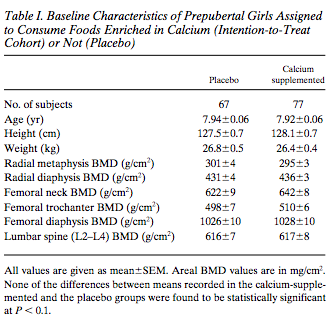
Here is a study I found which seems to finally put the nail in the coffin on the debate on milk and calcium. There are of course always some caveats.

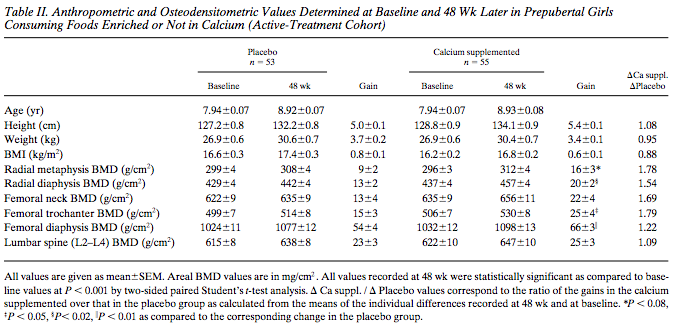
1. The study was performed on girls who did not reach menarche yet.

Calcium-enriched foods and bone mass growth in prepubertal girls: a randomized, double-blind, placebo-controlled trial.

Make Young Kids TallerNotice the difference is around 0.6 cms, which may not seem like a lot but statistical analysis shows that the difference can NOT be just due to random chance but is starting to become statistically significant.

Now, the results seem to go directly against other scientific studies, like the one below

Lactose Intolerance: Lack of Evidence for Short Stature or Vitamin D Deficiency in Prepubertal Children

Of course, both of the studies were done on pre-pubertal kids. That is probably the key factor which explains why there is discrepancies.

Here is something important to take away: Multiple studies show that the human body can only retain about 1200-1500 mg of Calcium per day before any more increase in Ca has no effect.

For at least girls that are 7-9 years old, getting even an extra 800-900 mg of Ca per day is not enough to have the right effect for bone mass increases. When the increased Ca intake reaches the 1100-1200 mg per day mark, then the effect starts to show, but it is somewhat mild.

Calcium Enriched Foods

Note that fact that the greatest differences was in the experimental subgroup of test subjects who were given what is known as spontaneous low-calcium enriched foods. (Personally, I am not sure that that even suggests. Haven’t slept well last night.)

The researchers state two interesting facts.

The spontaneous low-calcium sub-group seemed to get most of their height in the appendicular skeleton aka bones in the torso but NOT in the axial skeletal region (which are the bones in the limbs, like leg and arms). The exact region where the bones grew larger was in the lumbar region, the L2-L4 area.

The sub-group who got the most results also had X-Rays done to show that the middle region of their femur became wider too. At this point, I can’t make any significant connections between the metaphyseal region of the femur increasing in width and the mid-lumbar vertebral bones increasing. There seems to very little difference between the placebo group and the calcium intake group on the proximal end of the femur.

It might also be useful to also look up the study Double Blind Controlled Calcium Supplementation and Bone Mineral Accretion in Children Accustomed to a Low Calcium Diet by Lee and Leung

Important Note: Since the beginning of the research on the website, I have had proposed a theory that our dietary intake and habits can change our height only in the appendicular skeletal region aka torso, but won’t do much for our leg length. The length of our legs/arms seems to be much more determined by our genetics, and not by childhood dietary habits.

This was due to my analysis on the body shape of the swimmer Michael Phelps, who has a disproportionally long torso to leg length and used to consume large amounts of food as a teenager. When we compare the body proportions of a Michael Phelps to a Wilt Chamberlain or Shaquille O’Neal, we notice that for the latter two, all of their height seems to be coming from their legs, specifically femurs. Shaq is genetically pre-disposed to tall stature, since both his mother and grandfather on his mother’s side was huge. Wilt, I don’t know. He was a true genetic freak and a most likely a statistical anomaly, just like Angus MacAskill, coming along once every billion people.

This study seems to kind of validate my theory, in a sort of tangental way.

Your Backpack and Demanding School Curriculum Is Making You Shorter

Your Backpack and Demanding School Curriculum Is Making You Shorter

Demanding School CurriculumI remember back when I was in elementary and middle school how the teachers would give us these really thick, heavy textbooks to learn from. It was often neccesary to carry all those books around for convenience reasons so that we don’t become late to a class due to going back to a locker to pick up the books.

The fear in the 4th grade for many people was that they would develop scoliosis and a hunched back from putting so many books in their backpacks. There was always the motherly concern that their son or daughter would have stunted growth from carrying such a heavy backpack in school. Of course those old “wive’s tales” could never be proven to be true.

Well I found evidence that apparently putting such a high load on a growing kids’s back does indeed stunt their growth. As an adult, the same type of load will also make them shorter.

Backpacks


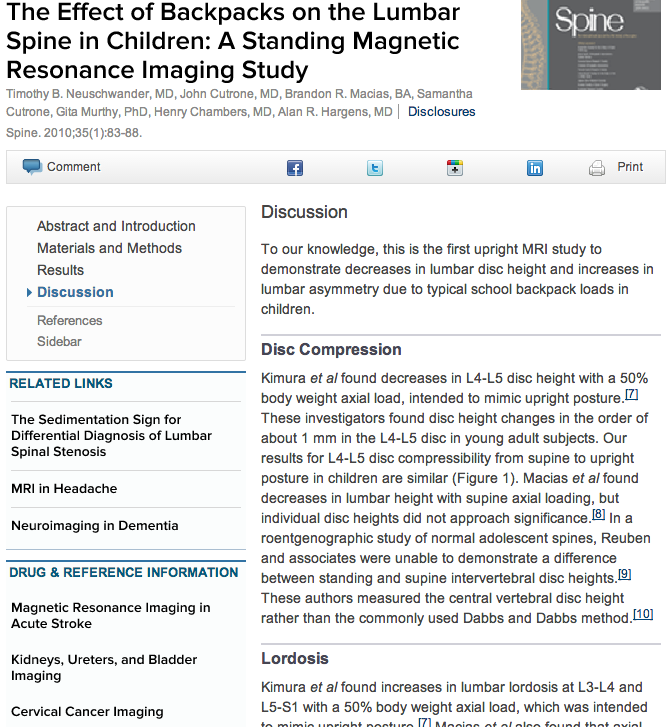
Now I admit that the study showed the children putting a load that was upwards of 50% of their total body weight and the decrease was just 1-2 millimeters, but the effects was that the IVD in the L4-L5 region was consistently squeezed.

That may not be much, but the effects can result in lower back problems later in life which will manifest when the children grow up to their 40s and even as early as 30s. The L4-L5 IVD is the one which is the most commonly ruptured disc when we did research on herniated discs, and bulging discs.

Thank god that the younger kids are moving away from the crazy heavy backpacks and towards tablets and ultra-books which are much easier on the back.

Of course, there is always a net downside. With the increase in kids using more and more computers for learning and less need to use paper books, they may not be developing back problems and become shorter, but their eyes are becoming more and more strained with more problems with mental health due to computer addiction.

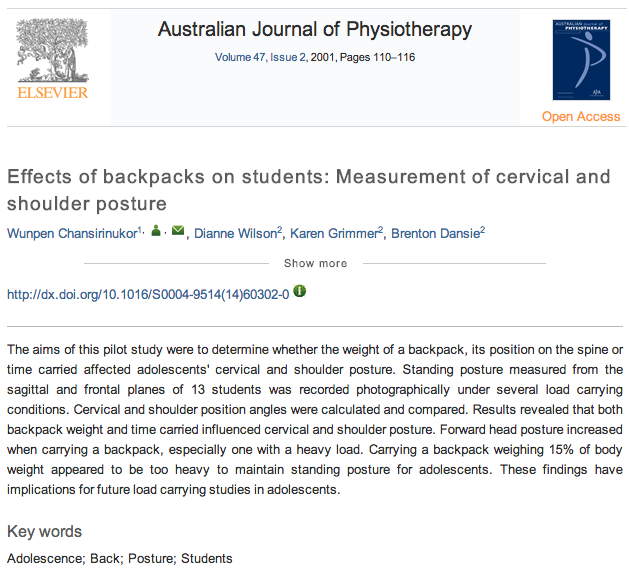
Effects of backpacks on students cervical and shoulder posture

LSJL update-Another finger angle and wingspan

Call to action: In the comments section, post anecdotal evidence of people increasing bone length due to tensile strain(stretching).  Example exercises would be inversion(If legs are stretched), hanging, or gripping weights.  Normal stretching would not be sufficient as that would put most of the load on the muscle and not the bone.

Also, please post suggestions on how to do a before and after finger(or toe) experiment that does not require expensive x-rays.  Preferably, a suggestion that only requires easy to take pictures.

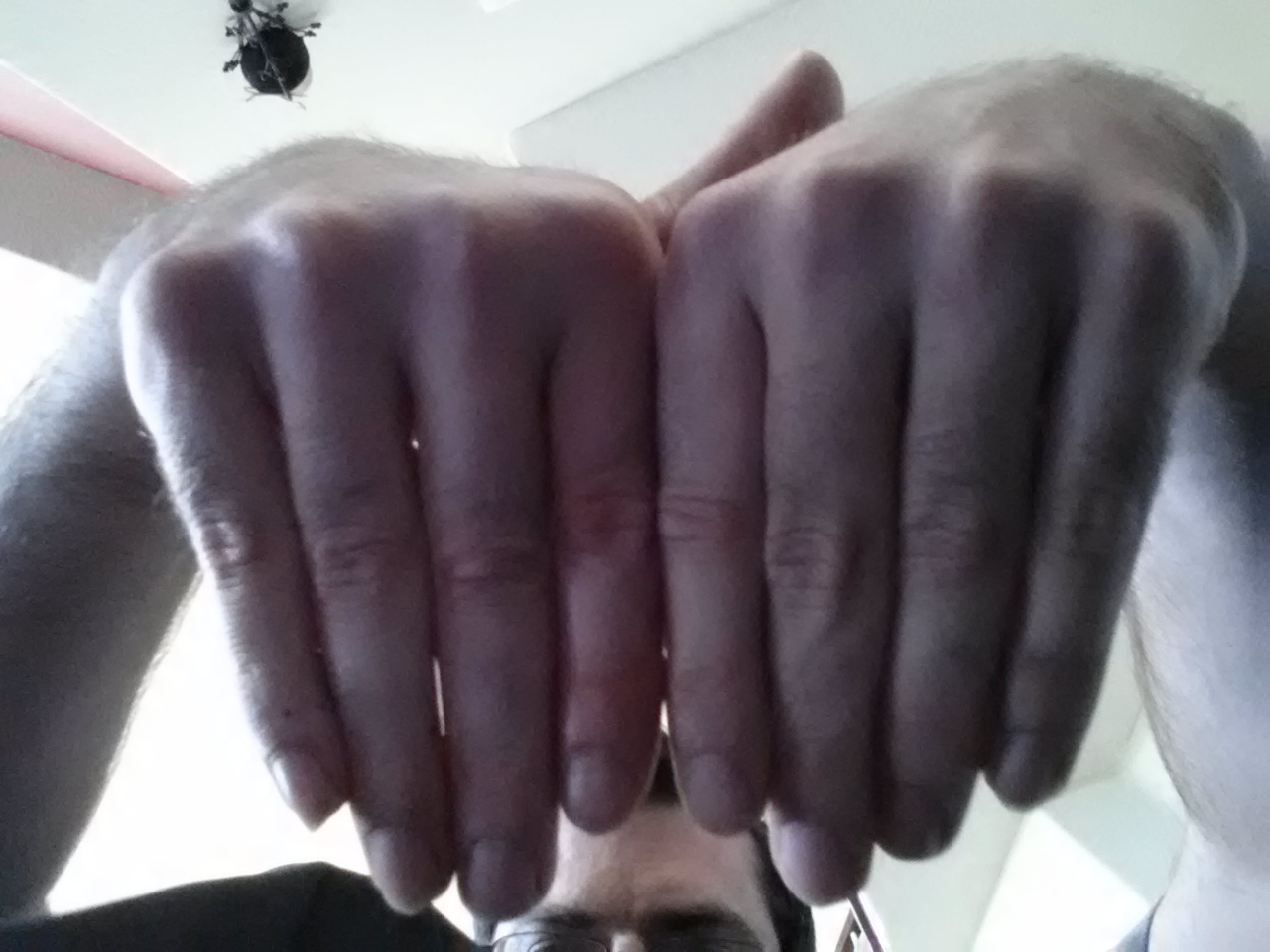
Here’s a picture that proves that my right finger is now longer:

20140521_124303You can definately see that the right index finger is longer as it is aligned at the tips and yet the knuckle sticks out higher.  Also, the left thumb seems to be bigger too which I have also been loading with LSJL.

If you haven’t already click on the last post on the finger progress here.

Here’s another image very similar to one of the images on that page:

20140519_122107

This image may look similar to the image in the other but the other image was aligned at the knuckles with the right hand being slightly higher so that I can’t be accused of knuckle manipulation.  This picture is aligned by the tip of the finger tips.  You can see in this image that the right handed knuckle is above the left handled knuckle.  Meaning that the right finger(the one I’ve been performing LSJL on) is longer.

Also, I hadn’t measured my wingspan in a while and previous wingspan measurement was 72.5″(I like a lot of people have a longer wingspan than my height).  This was about 5 years ago.

Recently, I measured my wingspan again and it was 189cm or about 74.4″.  I haven’t really been measuring the wingspan as I didn’t have faith in the methodology of LSJL on the arms.  I use the irwin quick grip to clamp the elbows but the bone structure there is clunky.  I can get a good solid clamp on my wrists though.

This has given me faith that LSJL doesn’t need the extreme force that you can generate on your fingers.  However, unlike the legs it is much easier to generate tensile strain on the bones of the arms(although you can generate tensile strain on the legs via inversion).  Although, we’ve pretty much ruled out axial loading as a method to increase height we haven’t quite ruled out tensile loading.  So it’s possible that the increase is due to hanging or holding onto dumbells or barbells which would place a bit of a stretching force on the bone.

An increase in wingspan at adult age due to farmer’s walk or hanging is less likely to be reported than an increase in height and I don’t know for sure how many people did inversion for their legs and to what extremes.  So I can’t say for certain that the gain was due to LSJL and not tensile loading.

And I don’t have before pictures aside from just me standing but this does give me faith that LSJL can generate height at less extreme forces than one can generate on the finger.  Although 1 inch per arm over five years is pretty slow.

This Researcher Succeeded In 3D-Printing Spinal Discs Allowing Adults With Closed Growth Plates To Grow Taller If They Desired – Big Breakthrough

This Researcher Succeeded In 3D-Printing Spinal Discs Allowing Adults With Closed Growth Plates To Grow Taller If They Desired – Big Breakthrough

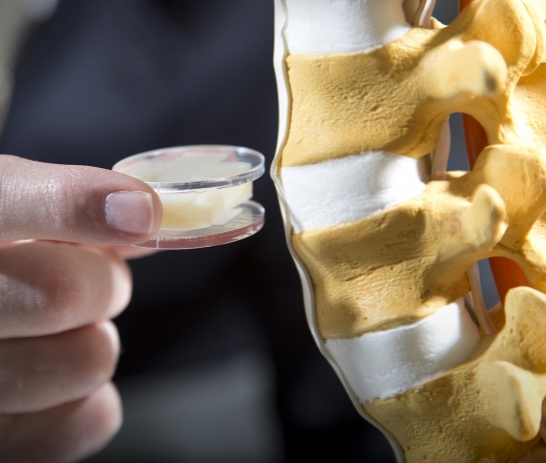
3D Printing Spinal DiscsMy claims and estimates that the technology to find an alternative to limb lengthening surgery would take at least 2 decades, if not 4 decades, may have to be drastically reduced. In my recent post about the nature of how Kurzweil’s Law of Accelerating Return shows an acceleration of technological breakthroughs, it may be that we have already reached the inflection point and things are already accelerating much faster than even I would have anticipated.

The old idea that so many people have suggested of increasing the torso or spine in some way to achieve the goal of increasing their height even as adults with closed growth plates is indeed already here. “How is that possible?” the reader might ask.

The technology has finally arrived, but the biomedical researchers which have succeeded might not even realize just how they can use their new technology in lateral thinking unique and potentially extremely financially rewarding applications.

Update: May 16, 2014: I finally realize now that Dr. Bonassar’s research group had made a very similar ear cartilage tissue like the group from Wake Forest University, which I had referenced twice already on this website. Interestingly he was recently promoted to the rank of Full Professorship back in January of this year, 2014. I guess doing breakthrough research that gets the media and the rest of the world talking definitely helps move one’s academic career much faster. He has quite an impressive Curriculum Vitae, having a BS and MS from MIT in MSE (Material Science & Engineering) and finished his graduate work at JHU (John’s Hopkins University) with his Ph. D in BME (Biomedical Engineering). After getting his Ph.D, he did fellowship work at the Orthopedic Research Lab at Massachusetts General Hospital and then another fellowship at the Center of Biomedical Engineering at his Alma Mater MIT. Before coming to Cornell, he had spent 5 years at the Center for Tissue Engineering at UMass in the Medical School.

So he knows what the hell he is doing and understands tissue engineering and cell culturing and cartilage regeneration much better than me.

I had written quite a few posts talking about how we can use 3D-Printing, and even 4D-Printing of “smart materials” for our endeavor and used his research as an example already. (I also referenced Dr. Valenti’s work on regrowing ear tissue on the sides of lab mice.) The posts were “How 4-D Printing Can Synthesize Biological Tissues And Organs Which Grow Themselves” and “Increase Height And Grow Taller Through Bioprinting And Electrospinning” and “Programmable 3D Printers Creating New Epiphyseal Growth Plate Cartilage As Interchangeable Body Parts“.

Interchangeable-Body-PartsThe group from Wake Forest University were the ones who managed to successfully regrow human ears. Remember the picture above??

Even NPR did a short piece on them back in Feb of 2013 on the research going on in Bonassar’s Lab at Cornell (Available Here). Back then, he was still an Associate Professor in BME. Their paper is entitled High-Fidelity Tissue Engineering of Patient-Specific Auricles for Reconstruction of Pediatric Microtia and Other Auricular Deformities“.

This researcher with his team in some lab at Cornell University has been able to validate and prove a concept which had been another huge block in our progress. You can click below to get the webpage for the Bonassar Research Group, whose goals are focused on regeneration of the musculoskeletal tissue.

I am referring to the viral post which was written on the website DVice.com entitled “3D printing right into your spine could make you whole again”. I am surprised that neither I or any of the readers of the website ever mentioned it or did not see it written. It proved the validity of an idea which I did not think was reasonable for at least another 10-15 years. However, the whole advent and spread of 3-D Printing technology has made me reconsider so much of what is possible.

So how can we make such a leap in theory from the achievement of regrowing an ENTIRE Spinal Disc, and achieving the goal of increasing our heights as adults?

It turns out that I was wrong before (I admit it. I made a anatomical mistake which led to a bad judgement call, which I will correct right now). Before, I said that there is no way that we should ever touch the spinal disc since we could cause the person in operation to become paralyzed if the spinal cord, which I thought was inside the disc, was nicked or sliced in some way.

Thinking back on it, I realize now that anatomically speaking, it made no sense to assume that the Spinal Cord with the CSF (cerebral spinal fluid) would be in the core of the disc. I was off by around 2 inches at least.

I was reminded of the horrible case of the former Superman actor Christopher Reeves and what he had to go through for over 20 years suffering in a wheelchair after suffering a fall from a horse ride. At the time, I felt that no one should ever be stupid enough to ever choose to go through such an invasive surgery as spinal disc replacement or similar since the risk of paralysis and turning into a paraplegic was just too high, just to gain extra height. If someone did actually go through a surgery like that and risk becoming a paraplegic for just a few centimeters into their torso, they should have their mental state checked out and get major psychiatric help.

Getting back to the question which I still haven’t answered before yet… “So how can we make such a leap in theory from the achievement of regrowing an ENTIRE Spinal Disc, and achieving the goal of increasing our heights as adults?”

So here is what I am going to outline in only semi-technical fashion to show the readers that we already have the technology and the technical know how to achieve this goal.

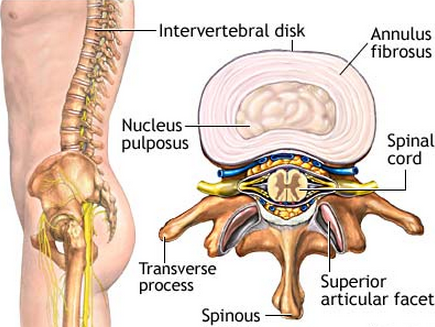
IVDWhen we actually look at the positioning of the intervertebral disc relative to where the spinal cord is, it seems that they are in different areas of the dorsal region.

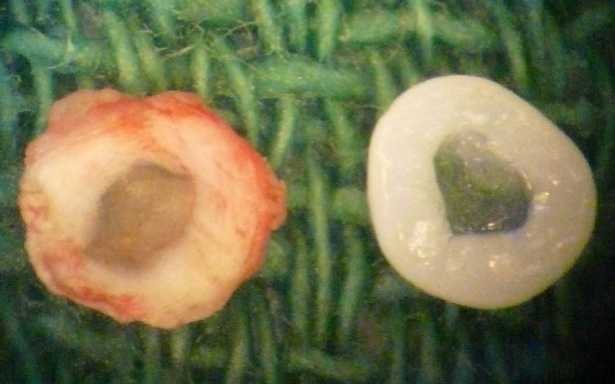
The group of researchers was able to using electro-spinning techniques in a Bio-3D Printer to recreate the entire disc, getting the material strength and properties of the nucleus pulposus and annulus fibrosis correct.

Remember that the composition of the NP and the AF are just slight varying percentages of a combination of proteoglycans, collagen, and water.

There is a nice picture that was available on the DVice.com article which I clipped below

Disc regeneration

This is going to be a 2-Part process which will be combined together in the end for implantation..The steps to do this are the following….

Part 1: For the hyaline cartilage layers…

  1. Get a sample of the person’s marrow through a bone marrow biopsy. This one is going to hurt quite a bit!
  2. Take some of the patients own MSCs from their bone marrow through centrifuging and filtration processes.
  3. Differentiate the MSCs into the chondrogenic linage using growth factory combinations.
  4. Culture the chondrocytes into cell colonies using a culture medium to increase the cell density
  5. Take the chondrocytes and using a 3-D Printer layer them into the shape of a thin disc shape. Note that since we are using the 3D Printer to extrude layers upon layer, we can precisely program the alignment of the chondrocytes. With a simple script, we can have the chondrocytes stacked on top of each other like the column-like fashion of the growth plates.
  6. Don’t forget to also inject the right IHH and PTHrP combination to get the cartilage to expand on its own.

Part 2: For the collagen disc layer…

This is what has been achieved by Bonassar and his research group. They got the structural alignment correct, with the right tissue material properties.

This was one of the other technical problem which I realized we had to figure out, which was shown to have been solved.

Part 3: Re-implantation

  • You just layer the cartilage on top and bottom of the collagen disc layer. It turns into a sandwiched multi-layer. This can be implanted into the backs of the patients.
  • Since the discs are themselves in the back of the spinal cord, this surgery will be relatively safe from the possibility of cutting the spinal cord.

Part 4: Growth Factor Injections

  • After the surgery, the person is recommended to take about 1 week to let the implant to fuse to the vertebrate bones.
  • Due to the fact that the printed cartilage sides had the chondrocytes specifically positioned in columnar structures, the cartilage would act like any growth plate and expand in thickness, aka make you grow taller.
  • Of course, we recommend increasing the rate of cartilage growth with some carefully positioned growth factor injections, like PTHrP and IHH which I had mentioned before as well as OP-1 (aka BMP-7) which had been proven successful in increasing the disc height of lab rabbits.
  • It might even be as simple as using a growth factor patch, where you stick it on your back to let the growth factors diffuse into your back, like the smoking patches you see quitters use.

On The Issue of The Facet Joints Between the Irregular Vertebrate Bones…

  • Anatomically, we also have to take into consideration the fact that not only are the irregular vertebrate bones attached to each other through the discs, they are also attached to each other in in the area known as the facet joints, which are areas on the sides where it is ligaments or cartilage.
  • I have not done any research on the facet joints, however the joints can be easily be stretched out using injections of a certain type of chemical.
  • If the facet joints were mainly ligaments, an injection of the compound relaxin would make the facet joints looser, and easier to stretch out. (The use of relaxin to increase the torso and/or the pelvic girdle bone was the proposed theory me and Tyler gave on why a minority of the female population who went through pregnancy seems to end up taller too.) Even just a few days ago, we had this message to the website where another woman claimed that she increase in height by 2 inches over a span of 2 pregnancies around the age of 33!. (It could be a lie though since we can’t validate all these pregnancy claims, but we wanted to post it here anyway.)

Pregnancy Height Increase

  • If the facet joints were mainly elastic or fibrocartilage, a small inject of growth hormone would make the area go into hypertrophy.

The Stretching of the Spinal Cord

This was the other big technical problems we would need to consider. The question is, “If we started to stretch out the torso/back again, would the spinal cord also be stretched out?”

Or is the spinal cord like a piece of string which goes through the vertebrate bone acting like a needle hole?

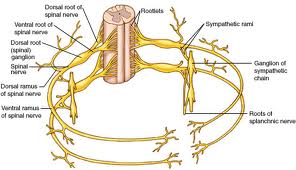
Ventral Dorsal Root Spinal CordIt seems that even a slight bruising of the spinal cord can cause paralysis so we have to be very careful here. It might be that the spinal cord can NOT stretch out or increase in length at the speed of the increasing of the back. If not, the ventral and dorsal roots that laterally comes out of the spinal cord might be pulled out or snapped off, like the branches on a tree.

My personal belief on the elastic nature of the spinal cord says that due to the slow, but noticeable changes in the volumetric size of the irregular vertebrae bones, the spinal cord should not have any difficulty in slowly increasing in small incremental length along with the bone surrounding it.

To all the people who said that Limb Lengthening Surgery is the only way to increase in height, I believe I might have proven you guys wrong, at least in theory. Based on the following steps I have outlined above, there will be some biomedical researcher or company with the funds to take every single step I have outlined above, execute on them, and become a future billionaire.