So You Are A Basketball Player and You Wish To Become Taller…

So You Are A Basketball Player and You Wish To Become Taller…

Wish To Become TallerI’ve said in the past before that for a long time, I was a huge basketball fan. Growing up in the 90s and watching what is probably one of the most transcendent figures in professional sports establish his immortality gave me personal ideas on becoming a professional athlete. After years of practice and drills in the basketball courts of North Carolina, I realized that I couldn’t jump or be fast enough laterally. Now I live in Seattle. Being from Seattle and the Pacific Northwest, it was sort of sad that the Supersonics decided to leave to be in Oklahoma City.

Just yesterday my friend told me that the Seattle Seahawks had won the Superbowl from the Denver Broncos this year and how the streets of downtown Seattle was littered with hundreds of thousands of people. I had no idea since I don’t keep up with any other sports except basketball. That shows just how out of the loop I am with almost every other sport. Maybe that is why I’ve always had a unique fascination over height, or maybe just length in general. When a person is a basketball fanatic, they care about how big people are.

In basketball, one’s identity can be primarily defined by one’s size. In no other sport is innate god-given genetic luck more important than in basketball. With almost any other sport, one can be quite successful if they put all their effort into it. Even football can be something one can succeed in, since speed and bulk mass is important. For the wide receivers, being smaller can be a good thing since their center of gravity is lower, and speed and the ability to dodge players is critical. We can work on speed and muscle bulk. There is no way to work on making our bones longer or larger.

I don’t know many sports where a person can be drafted and given a multi-million dollar contract based on just “potential” alone. I’ve seen too many guys drafted and defined as “raw” or as “a project” because they are 7 feet tall and decided to start playing basketball only maybe a couple of years ago. To be drafted into professional basketball requires mainly three qualities…

  1. Length – It turns out that height is not everything. The draft scouts now realize that you have to consider the wingspan of the players, and their maximum standing reach as well.
  2. Jumping ability – combined with a person’s maximum vertical reach with their feet still on the ground, this shows what is the real maximum vertical jumping reach of a player.
  3. Coordination – most people over a certain size have a really low coordination ability. I’ve known plenty of people who couldn’t even dribble a basketball properly or get their brain to process a normal jump shot.

Beyond these three qualities, there are obviously a few more qualities which are not as fundamental as those but if you have plenty of natural resources in the fundamentals, the basketball scouts will take a chance with you and just call you a “project”.

This is why in basketball, the main requirement to be considered is size of the player. If you are big enough, there will always be people who want to mold you into a basketball player.

So wishing to become taller is probably one of the most common desires in developing basketball players. Gaining even 2 extra inches can change one’s athletic career forever.

The first thing to realize is that probably 98% of all basketball players have at some point expressed the desire to be even bigger than where they are now. Even if they are already in the long tail/upper reaches of the height distribution curve, it is still not enough for them. Gaining more height and length only helps their game.

Is there something a person can do as a basketball player to get more size?

It depends mostly on how old a person is. If the player is 17 or younger, they still have a chance to grow more, on average. If the player is 18 or older, then there is probably very little chance they would ever again experience a natural growth spurt. While 1-2 inches in possible, a 19 year old basketball player should not expect that their height is going to explode upwards in one year.

In the few well known cases like David Robinson, Anthony Davis, or Dennis Rodman, their unique growth progression is something that happens to very few people. They are the 1 in a million case which no one who has even an average intelligence should expect for themselves. I have always said that one should not count on dumb luck and chance for god or randomness to do something nice for them. That is why I am willing to start a website like this one.

The best thing to do for any High School or Middle School player (male or female) who has dreams to become a professional basketball player, it is absolutely critical that they asses their own unique situation, and be practical in their choices. So let’s take a look at the most popular basketball player in the game today…

What Can Lebron James Tell Us About How To Grow Taller?

It turns out that there is not a lot that the basketball prodigy can tell us since he had no control over it when he was going through adolescence and puberty. Like most young guys in middle school and high school playing organized basketball, one of the key desires is to become bigger (taller and longer) so that they can be better at playing the game. Height is an attribute that is extremely valued in the particular sport where the general rule is “the more the better”. I remember Lebron once saying that his idol when he was growing up was Michael Jordan. He wanted to be tall like Mike and also wanted to get MJ”s shoes. Coming from a low class family, and being raised by a single mother, it was not possible at the time for him to afford the Air Jordan sneakers. However, the other desire was achieved. He did eventually reach 6′ 6″ like his idol but it seemed that nature (or maybe god?) gave him even more, and he outgrew his idol. The realization one day that he was even bigger than his basketball idol was probably something he did not expect.

Was he happy about that? He might have surpassed MJ in stature but will he surpass MJ in accomplishments and rings in his playing career? 

We could guess that his height was due to genetics, but there doesn’t seem to be that much information about James’ father, only mother.  From the interviews and talks with the mother, I suspect that she is of average height (5′ 4″-5′ 6″). The father who I have found very little information about we might guess could have been a good athlete at a young age too, and might have been just above average in height (6′ 1″-6′ 3″). Using those types of values, even at the upper limit, James’ height calculated using the standard formulae would have been around 6′ 2″, maybe. Based on the SD of height, he is at least 2 SD away from what is predicted of his height by the calculate values of his parents

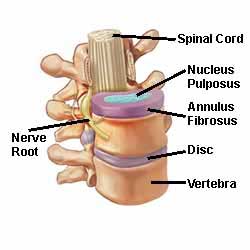
So his height is listed at 6′ 8″ with a wingspan of 7′ 2″. Many people point out that his predraft measurements say that he is actually 6′ 7.25″ without shoes but after examining his pictures compared to other professional basketball players and standard height doors, we have enough confidence to say that Lebron James’ height is more likely 6′ 7.75″ for most of the day standing upwards. Based on the normal way height changes from diurnal variations of the intervertebral discs, his height after being decompressed from lying horizontally for a long time (aka sleep) would most likely exceed 6′ 8″. I personally suspect that him ending up so much bigger than what was expected of him from just the math shows how random and unique case he is.

If we look at the body shape of this “basketball player” we notice that he is much wider/ thicker than the average professional basketball player. He is described by sports analysts of having a NFL Linebacker type of body. Where most of the other players have an ectomorphic body type, his is a mesomorphic type. People with mesomorphic body types are not supposed to become too tall, because of the amount of weight that the growth plates would be subjected to. If there is too much weight on the cartilage, they will go through faster senescence. His listing of weight at 260 lbs says that he weighs more than many NBA centers, who are much taller than him. He supposedly can put on 20 lbs of pure muscle from doing almost nothing and eating just lean chicken.

We look at his strength next. This guy is strong. Unlike Kevin Durant, who has rather thin shoulders, skinny, but long, Lebron has slightly larger than proportion shoulders and a wider mid-section/core. Where Kevin Durant couldn’t even do 1 bench press  of 185 lb in the predraft, Lebron is one of the only NBA players who have ever broken a backboard.

In terms of strength and weight, his body and natural abilities is much higher than the prototypical NBA player. How can we explain this phenomena? We suspect that what has happened to Lebron is the same as what happened to MJ, Michael Jordan. These basketball superstars who are supposed to be genetic freaks were never supposed to be as tall and long as they were supposed to be. Sure, we can say that all professional basketball players are supposed to be much shorter than they are supposed to be, since they are so many standard deviations away from what their genetics predicted, but the unique body shape of Lebron is a very extreme example. He has the strength and thickness of someone who is much shorter but just became taller from random chance.

The same can be said about MJ. MJ’s family genetic history shows no one that tall. His sister is just 5′ 5″ and his father is 6′ 0″. His brother Larry is around 5′ 9″. Michael’s height should have been just 5′ 11″-6′ 1″. His height as his late James Jordan said was maybe a sign from god that Michael would have to be an athlete or he would have starved due to lack of focus and good work ethic when he was younger. When we look at MJ’s sons, they are both closer to the average, at around 6’1″ – 6′ 2″. Michael was an anomaly in his size since no one in his family was that big. He has the strength and width of someone who is much shorter (he is also one of the only other people to ever break a backboard) but somehow through chance became much taller than what his genes had predetermined.

Looking at the numbers

There are supposed to be 370,000,000 people in the USA today. Guessing, out of those, maybe 2-3 mil of those people have played basketball in an organized fashion. Out of those people, about 1.5-2 mil are young enough between the ages of 12-18 to still have intact growth plates. Most of these kids, white, black, asian, hispanic, probably harbor some dream of becoming taller and playing basketball professionally for a career.

So you have the intent, and the desire, as well as some drive to get better at the game, which means these young middle school and high school kids practice drill in the basketball courts 5 times a week in their school basketball teams. The mental aspect is all there. That probably makes up half or more of those kids, or about 1 million secondary school basketball players.

Then the only thing that is really required is the physical. The main requirement would be size. Is the kid big enough to be selected by a team at the next level? For the majority of them, they are not.

Most of those kids trying to get into the NBA (or even college basketball) will never be taller than 6′ 3″, which I believe is the current established cutoff point, where a kid goes from “average” size to “worth the scout to consider” size. For example, Anthony Davis was a completely passed over average skilled  6′ 3″ point guard until he grew 7 inches which pushed him into the national spot light. A 6′ 10″ PF/4 with point guard handling skills is something which is very hard to come by. On average, most kids have already grown to 98% of their expected final adult height by 15-17. A 7 inch growth spurt within a 1 year time is something to definitely take notice to which changes almost everything in the basketball world. When you are too short/small, the scouts at the next level will not look at you, unless one has tremendous skills.

The problem there, is that those others “skills” are also sort of an innate talent which a person can’t really work on. The ability to jump high, go for an explosive first step to drive pass the defender, the “handles” and lateral quickness are something which is mostly innate talent which can not be learned. Sure, one “can’t teach height”, but the basketball monday morning QBs also forget to mention that you can’t teach athleticism either. Some people just have more fast trigger muscles which allow them to jump higher, no matter how much jumping practice the other person competing against them does. One might be able to get the drills in the gym every day to get faster, but the limitation will come down to the thickness of the nerve bundles running down their limbs and the number of neurons in the brain, which gives the hard working kid the ability to be coordinated, explosive, and/or be able to read the signals during the game correctly and instantly. Those anatomical traits are set at birth.

When our team and research goes away, the kids are left to the forces of chance and pure dumb luck. Of course, every one of those kids who messages us claims that they will make it, and will work hard everyday. We are sure they will, but there will also be a million other kids just like them going through the exact same drills, the same exercises, the same routines and strategies. What is going to make them unique and differentiate themselves from the million other kids in the exact same position?

There is no way to really get around it either. There is no cheat code one can use. This is not like a college admission test where being a legacy, having parents throwing money, or knowing someone is going to give them a shortcut way to be admitted into that exclusive club thousands of others are trying to get in. You can’t scam your way into becoming a professional athlete, since that is based on scouts looking at the raw skills of a person. Maybe 20-30 years ago a real talent might have been missed and they never got their shot in the NBA trials, but these days with the internet, it is almost impossible for the basketball scouts to miss out on what many people call a “touch diamond”. Big guys who have some type of coordination are often sent to basketball camps to be worked on as a “project” because they are too “raw”.

We often get bombarded by teenagers telling us that they are basketball players wanting to become taller. What can they do?

There are many things they can do, but we haven’t written any type of guide yet for them.

However, what we can suggest can only give them at most 2 inches and those are for the most extreme cases. We try to be very realistic on what we can control and have any type of affect on. If these kids are hoping for something to give them 4-5 inches, I can only tell them to pray that they are that lucky and be that 1 out of 100,000 kid who gets the mega-growth spurt. I would of course tell them to not put all their hopes into something so random and improbable and focus instead of looking for something that has better odds for success. Hedge their dreams of playing professional ball and stay in school to learn a useful skill to take with them.

The life of a professional athlete is short since the human body will eventually wear down. You have to have some type of backup plan after one’s playing days are over.

In the world, we only hear about the success stories and the winners, the people who got lucky. (Sure, they were focused, worked hard, focused on learning, and were persistent but there are plenty of examples I know of people who still did not reach the success they hoped for due to bad luck in some area of life, which they had no control over or could have predicted earlier in life.) We never hear about the losers, the ones who never made it, who were not big enough or talented enough. This tendency of people to constantly use as case study the few minority cases where the person had a happy ending is known as survivorship bias. We like to trick ourselves in believing that our life and case is somehow special. Not everyone can become a MJ or Lebron. .

In the long term, our physical accomplishments are most likely going to become surpassed by someone else. Like all the Olympic records, the newer generation of kids will shatter the older generation of athletic records. People thought MJ was the greatest 20 years ago but now it is supposed to be Lebron, which might be surpassed by KD in another 10 years. Who is next, who will be so physically imposing and dominant who will make Lebron, Shaq, and Dwight H. look weak and small in comparison?

The people in our generation seems to be so fixated on the size, and strength of Lebron, DH, and KD, because we don’t have footage showing how well Bird, Magic, and MJ played which was 20 years ago. The older generations knows full well the accomplishments of Wilt Chamberlain but we don’t know that. They talk about his strength and dominance but we think of Shaq when we think of overwhelming size and dominance. We just didn’t experience what they experienced. That is their reference point. We all are using our own reference point, our current time line and say that the person in our current time is the best of all time, when they are only the best of our particular time or generation.

However, our mental and intellectual accomplishments will stand for much longer. As long as something we created or discovered is shared with the world and the world fully accepts and acknowledges our contribution and effort, people will always remember our life’s work.

In the words of the late Los Alamos physicist Richard Feynman

“From a long view of the history of mankind, seen from, say, ten thousand years from now, there can be little doubt that the most significant event of the 19th century will be judged as Maxwell’s discovery of the laws of electrodynamics. The American Civil War will pale into provincial insignificance in comparison with this important scientific event of the same decade.”
This Non-Available Prodrug Taken Orally Helps Older Adults Become Taller

This Non-Available Prodrug Taken Orally Helps Older Adults Become Taller

Older Adults Become TallerI am very happy with the results of the former post  This Non-Prescription Supplement Has Been Scientifically Proven To Make You Grow Taller Even With Closed Growth Plates. The reaction that it received was what I was sort of hoping for and so far, it has had over 50,000+ views already. Since that post was so popular, I wanted to do a 2nd post which shows them another compound which we have found which have a similar ability.

This compound is known as a prodrug, which I am not sure how to obtain, taken orally has been shown only on a theoretical basis to increase height in the lab animals. In rats, their body lengths increased in the ways which we desire. From what I personally have read about it, I have about a 60% confidence in its ability to increase height in people who can ever get it. It would work best on adults, those people who are in theirs 30s and beyond. This suggests that this compound would indeed work for people with closed growth plates, or even specifically intended for people with completely ossified epiphyseal cartilage tissue.

So what is 2nd chemical compound which has this ability?

It is called CPA-926.

I first was informed of this particular drug in an article I had cited in one of my previous posts. This particular compound is mentioned in both the books Dynamic Reconstruction of the Spine (by Daniel H. Kim & Frank P Cammisa on pg 384) and Nonfusion Technologies in Spine Surgery. (edited by Marek Szpalsk on pg 53). I will also be referencing the medical reference “Therapeutic Strategies for Modulating the Inflammatory Diseases” edited by Barry M. Weichman but not as much as the other two.

There was also a few articles I had to glance over (notice I used the word glance, and not study) which validated this idea that the prodrug could indeed work.

It seems that this compound is both anti-tumorogenic and anti-inflammatory, which are always positives for almost any compounds we ever intend to swallow.

The most important study is the one done by Okuma.

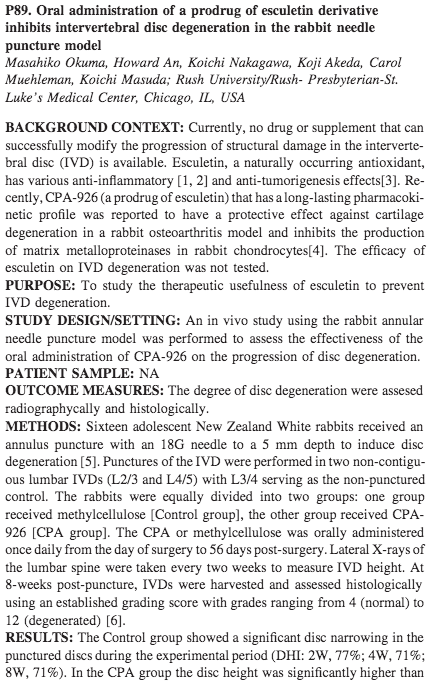
Esculetin CPA-926Okuma M, An HS, Nakagawa K, Akeda K, Muehleman C, Masuda K (2005) Oral administration of esculetin prodrug inhibits intervertebral disc degeneration in the rabbit annular needle puncture model. Orthopaedic research society meeting, (p 370)

This particular article was published in The Spine Journal back in Sept 10, 2004 (volume 4 or 5).

We are not sure if there is a PubMed study link to it but the title of the study is located and scattered around Google just from a quick search.

From a quick look, it seems that even one patent referenced this method on how to treat discs that are degenerating.

For more proof that this idea of inhibiting the loss of disc, we refer to the patent Method for inhibiting fibrocartilage degradation (WO 2005091960 A2) by Koichi Masuda, a director of Orthopaedic Surgery. (His Curriculum VItae is Available Here). I never did look over the patent extensively but did glance over the document to mine a few interesting facts about CPA-926.

  1. The compound is provided by Kureha Chemical Ind., Co. Ltd., Tokyo Japan or Kureha Chemical Corp
  2. Following the lateral X-rays of the lumbar spine, the vertebral body height and disc height of the IVDs were measured
  3. Oral administration of CPA-926 preserved disc height and the histological analyses of these tissues show that CPA- 926 protects against disc degenerative chances in a rabbit model

At this point, it might not be possible to call up the sales people at Kureha and get them to ship a few grams of this cartilage regenerative chemical compound. I haven’t tried it but is only providing evidence of its efficacy.

In terms of how effective this chemical compound could be, it could be similar to Harpagoside, which I wrote about in the old post Increase Height and Grow Taller Using Harpagoside

So does this mean that every single compound which has inhibitory effects on compounds which have catabolic effects on cartilage (aka treats osteoarthritis) is good?

If we were to be completely general, I would give a tentative yes to that question. While there is probably a few dozen compounds the drug synthesize makers know of which have abilities to treat diseases associated with articular cartilage degeneration, very few of them have shown the characteristic of doing more than just preventing degradation, but also anabolic effects, where cartilage is regrown back. This prodrug of the chemical compound 6,7-dihydroxycoumarin suggests that it has those anabolic effects besides just the usual inhibition of catabolic processes in the IVDs.

Is it however better than just popping Glucosamine Sulfate?

We are not sure about the comparison but it is obviously harder.

Is it safe to take orally?

From the 3-4 main studies that have talked about this compound, it has been found to be safe on the lab rats and lab rabbits it was tested on.

So we buy this from somewhere?

I have not searched to see whether the Keruha Chemical Corp in Tokyo sells this stuff.

The Inhibitory Effects Of CPA-926 On The MMPs

On multiple posts written by Tyler over the years, he mentions over and over again how the MMPs (aka Matrix Metalloproteinases) are not good for height increase, specifically MMP-9 and MMP-13. My own research supports this opinion. The study by Yamada and even Watanabe (Esculetin suppresses proteoglycan metabolism by inhibiting the production of matrix metalloproteinases in rabbit chondrocytes.) suggests that for esculetin at least and whatever derivatives that is made from it (or a precursor to the compound) shows that the main way these compounds work is by targeting the pathways of the MMPs.

For the Future

I am also looking into three other compounds called RO 32-3555 (aka Trocade), SKI 306X and KHBJ-9B, which seems to have similar properties in being anti-inflammatory and great for prevention of cartilage degeneration. Those reports will be delivered on another day.

Study shows feasability of micro-growth plates

The idea of LSJL is to create microgrowth plates via fluid shear strain on the mesenchymal stem cells in the bone marrow.  This study shows that microgrowth plates can exist:

Growth Plate Regeneration Using Polymer-Based Scaffolds Releasing Growth Factor

“Depending on the type of growth plate fracture and the severity it can lead to stunted bone growth or bone growth deformation. The current treatment options for growth plate fracture are removal of the bony bar and replacing it with a filler substance, such as, bone cement or fat, but still yield poor results 60% of the time. In previous work, poly(lactic-co-glycolic acid) (PLGA) scaffolds were developed and studied in vivo for the purpose of growth plate regenerationDepending on the type of growth plate fracture and the severity it can lead to stunted bone growth or bone growth deformation. The current treatment options for growth plate fracture are removal of the bony bar and replacing it with a filler substance, such as, bone cement or fat, but still yield poor results 60% of the time. In previous work, poly(lactic-co-glycolic acid) (PLGA) scaffolds were developed and studied in vivo for the purpose of growth plate regeneration”

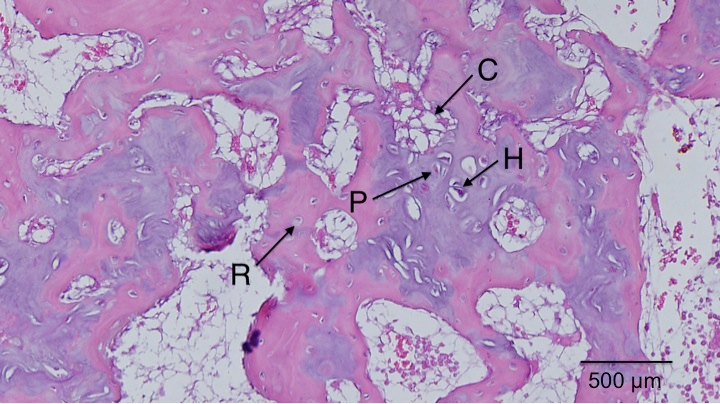
micro growth platemicrogrowthplate

“Figure 6.7. Fat implant showed thin, continual line of cells across medial side that contained reserve (R), proliferative (P), hypertrophic (H) cartilage cells and calcification zones (C).”

Another micro growth plate:

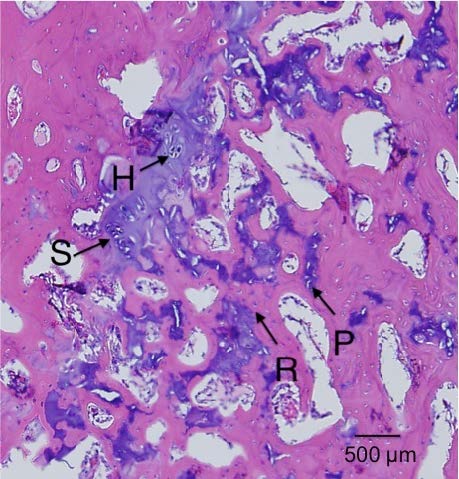
microgrowth plate2

“Blank scaffold on (A) the lateral side with columnar structure and (B) the medial side with the appearance of stacked (S), reserve (R), proliferative (P), and hypertrophic (H) cartilage cells.”

Here’s a growth plate but loaded with IGF-1 so it’s much more sophisticated:

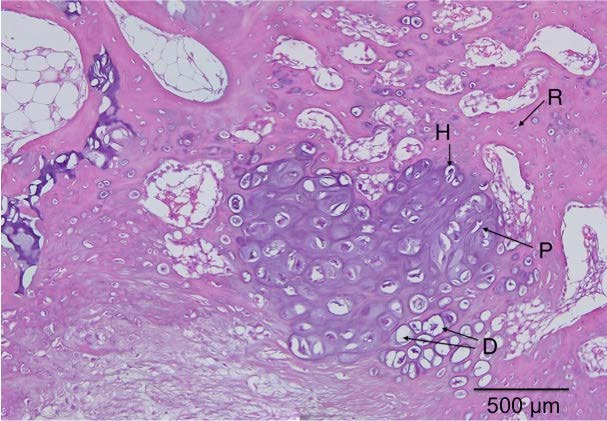
igf1 microgrowthplate

“IGF-I loaded scaffold showed dispersed pockets of cartilage cells throughout the medial side with the appearance of reserve (R), proliferative (P), hypertrophic (H), and degenerative zones (D).”

“In this study, the attempt to regenerate the growth plate did not result in columnar structure to the degree that the native growth plate has, regardless of the treatment type. It appeared that the fat implant allowed for some cartilage regeneration, but it was only a cell wide at most points and most of the chondrocytes were in the calcification zone. The tissue surrounding the cartilage areas was woven bone, which has been known to appear after fractures{But would this still result in a longer bone?}. The blank scaffold treatment resulted in tissue having a similar structure to that for the fat implants with a couple exceptions. First, there were a few areas where blank scaffolds had been placed with some cellular stacking, and secondly, the lateral side retained more structure, resembling that of the native growth plate, compared to defects treated with fat graft. The blank scaffolds gave the epiphyseal region more structural support, preventing further collapse of the lateral growth plate, while the fat graft implant had a thinner growth plate region across the whole tibia.”

“The defects treated with IGF-I-loaded scaffolds, both with or without seeded cells, showed a similar appearance on the lateral side as that of the blank scaffold group, however the medial sides were quite different. Without cells, the IGF-I-loaded scaffold resulted in pockets of chondrocytes throughout the medial side along the epiphyseal line that contained cells in all zones of cartilage development. The addition of cells created a large vertical pocket (~3 mm long) of chondrocytes located in the upper epiphyseal region. Interpretation of the IGF-I loaded samples was limited because only one sample could be used for observation so it is difficult to say if this cellular organization would occur again. The cells were mostly in the hypertrophic state and had no columnar organization. Both types of IGF-I loaded scaffolds (with and without cells seeding) increased the density of hypertrophic chondrocytes compared to the fat, blank, and hybrid scaffolds. Cells seeded on scaffolds containing IGF-I created the largest population of chondrocytes”

“Though the results did not show total growth plate regeneration, the necessary cell types were present”

It should be noted the mesenchymal stem cells used in this study were harvested from the diaphysis thus providing evidence that MSCs needed to create growth plates do not necessarily have to be from the Zone of Ranvier.

The study did not display changes in length due to the various scaffolds.  The fat scaffold and IGF-1 seeded scaffold did reduce the angular measurement resulting from part of the growth plate being damaged.  The blank scaffold altered the angular measurement disparity but increased it in the tibia and decreased it in the femur.  We can be fairly certain that microgrowth plates can alter longitudinal bone growth as the angular measurement is dependent on how tall one side of the bone grows versus the other.

Even though this study involves scaffolds and LSJL does not.  The information about microgrowth plates altering height growth can be extrapolated to LSJL as MSCs could migrate to the epiphyseal region and use bone as a natural scaffold.

This study provides evidence that you don’t need to create a whole growth plate to increase height.

Can rest intervals make LSJL more effective?

Enabling bone formation in the aged skeleton via rest-inserted mechanical loading.

“The mild and moderate physical activity most successfully implemented in the elderly has proven ineffective in augmenting bone mass. We have recently reported that inserting 10 s of unloaded rest between load cycles transformed low-magnitude loading into a potent osteogenic regimen{but is it a chondrogenic regimen?} for both adolescent and adult animals. Here, we extended our observations and hypothesized that inserting rest between load cycles will initiate and enhance bone formation in the aged skeleton. Aged female C57BL/6 mice (21.5 months) were subject to 2-week mechanical loading protocols utilizing the noninvasive murine tibia loading device. We tested our hypothesis by examining whether (a) inserting 10 s of rest between low-magnitude load cycles can initiate bone formation in aged mice and (b) whether bone formation response in aged animals can be further enhanced by doubling strain magnitudes, inserting rest between these load cycles, and increasing the number of high-magnitude rest-inserted load cycles. We found that 50 cycles/day of low-magnitude cyclic loading (1200 microepsilon peak strain) did not influence bone formation rates in aged animals. In contrast, inserting 10 s of rest between each of these low-magnitude load cycles was sufficient to initiate and significantly increase periosteal bone formation (fivefold versus intact controls and twofold versus low-magnitude loading){we’re not looking for periosteal bone formation, we’re looking for neo-growth plate formation but the principles may be the same}. However, otherwise potent strategies of doubling induced strain magnitude (to 2400 microepsilon) and inserting rest (10 s, 20 s) and, lastly, utilizing fivefold the number of high-magnitude rest-inserted load cycles (2400 microepsilon, 250 cycles/day) were not effective in enhancing bone formation beyond that initiated via low-magnitude rest-inserted loading. We conclude that while rest-inserted loading was significantly more osteogenic in aged animals than the corresponding low-magnitude cyclic loading regimen, age-related osteoblastic deficits most likely diminished the ability to optimize this stimulus.”

“While the inability to perceive mild and moderate loading events as stimulatory may reflect potential deficits in numbers and/or viability of mechanosensory (e.g., osteocytic) cells, the inability to initiate and, especially, sustain bone formation more likely reflects potential for deficits in the numbers and/or function of osteoblastic cells. Additionally, the declining availability of biomolecules involved in coordinating and enhancing osteoblastic response to mechanical stimuli (e.g., TGF-β, IGF-1){these biomolecules are involved in chondrogenesis too so it’s important to monitor changes in these biomolecules due to aging} potentially compromises the ability of bone cells in aged tissue to perceive low and moderate magnitude loading events as being stimulatory. Last, the age-related decrease in the surface to volume ratio of bone mineral matrix and increased viscosity of interstitial fluids could decrease biophysical stimuli delivered to bone cells via standard exercise regimens{this could affect neo-growth plate formation too as the degree of biophysical stimuli delivered to cells would affect the ability to form new growth plates}

“A total of 49 aged female C57BL/6 mice (mean ± SE; 21.5 ± 0.16 months)”

“The device fixes the proximal tibia (at the tuberosity) against motion and applies controlled loads to the distal tibia, thereby placing the tibia diaphysis under “cantilever” bending in the medial–lateral direction.”<-not quite like LSJL.

“a strain versus load calibration curve was determined and yielded peak strains in the range of 800–2400 με at the periosteal surface (and 600 to 1800 με peak strains at the endocortical surface) for loads of 0.4–1.2 N, respectively.”

“rest-inserted loading (particularly at low magnitudes) enhances rates of bone formation by primarily increasing mineral apposition rates compared to cyclic protocols”

“attempts at further enhancing the bone formation response to rest-inserted loading by doubling strain magnitude, inserting rest-intervals, and subjecting animals to five-fold the number of high-magnitude rest-inserted loading cycles were all ineffective in the aged skeleton.”

Chondrodiatasis Is Tensile Loading The Epiphyseal Growth Plate Cartilage Longitudinally Without Fractures

Chondrodiatasis Is Tensile Loading The Epiphyseal Growth Plate Cartilage Longitudinally Without Fractures

ChondrodiatasisFor a long time I’ve wondered whether it was possible to do more than just stretch out the bone tissue to make the overall bones longer, and it seems that there have been a few recent articles which came out showing that it is indeed possible to stretch out cartilage (epiphyseal growth plate) tissue. More than just stretching the cartilage, it seems that it would not even result in any type of fractures.

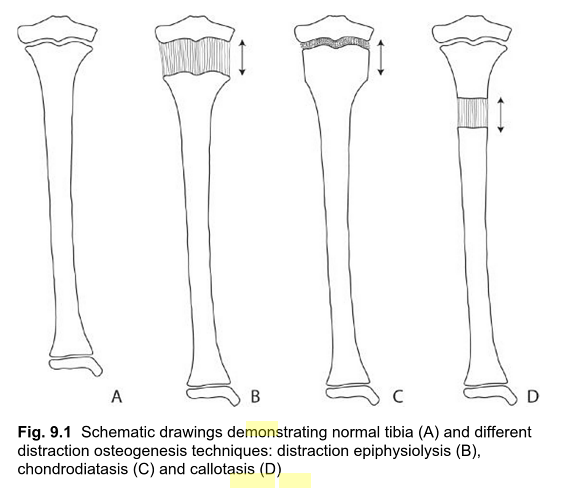
This medical technique is known as chondrodiatasis. It seems that it is so rare and so uncommon that there is almost no information on it except in a few sources from Google. Even orthopedic surgeons are not that too familiar with this idea. (There is a 2nd type of physeal distraction called distraction epiphysiolysis which is much faster but does result in fractures and the cartilage ossifying by the trabecular bone tissue).

In the medical reference book Musculoskeletal Tissue Regeneration: Biological Materials and Methods by Vacanti and Pietrzak there is a small section dedicated to alternative ways to distract bones which is much less step intensive.

There are two types. You have…

1. Distraction Epiphysiolysis – This method is the distraction of the growth plate at a fast rate of 1-1.5 mm per day. The fast rate of separation between the epiphysis and metaphysis results in the cartilage developing fractures, which also leads to the physeal cartilage to turn into trabecular bone. The experiment done by Zavialov and Plaskin back in 1967 showed the change of the cartilage into bone. We won’t focus on this type of physeal distraction technique too much because of the fact that the cartilage is almost immediately converted into bone through advanced levels of osteogenesis.

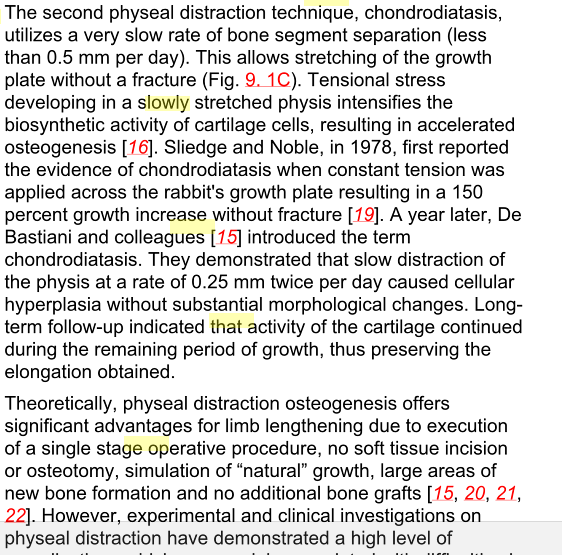
2. Chondrodiatasis – This is the type of physeal distraction that would be worth our time to look at. It is very slow in fact, usually less than 0.5 mm a day. It seems that tension stress causes the chondrocytes to increase in activity. This technique also increases the level of osteogenesis but there is no evidence (yet) that the cartilage will convert into bone tissue.

Sliedge and Noble back in 1978 showed that they could increase the thickness of lab rabbit’s growth plates by 150% without the presence of fractures. De Bastiani distracted it at just 0.25 mm a day and the chondrocytes cells went through hyperplasia but the overall form of the cells did not seem to change. When the rate of longitudinal growth after physeal distraction was checked, there was no decrease in bone longitudinal growth seen.

Remember however that for any type of bone or cartilage distraction, the surgeons would still drill two pin holes into the bone to pull. It seems that there is no way to get away from having an external fixator used.

However, there will always be complications associated…

Surgical Complication #1: Because we are talking about the growth plates, which are often already so thin, to distract them by only 0.25 mm a day would be very hard to perform.

Surgical Complication #2: The physis would actually get damaged.

Surgical Complication #3: This is the major issue, which seems to be many incidences where growth of the bones seemed to completely stop, which is slightly concerning.

Out of the three ways that you can distract a bone, both of the ways to distract cartilage has proven to be not that effective. That is why the surgeons have almost always just focused on callotasis, instead of these two other types of surgical techniques.

Surgical Complications

Looking through the PubMed archives, there were probably only a dozen studies which ever mention this term “Chondrodiatasis“. We picked the ones which are worth looking over and linked them below…

  1. Chondrodiatasis-controlled symmetrical distraction of the epiphyseal plate. Limb lengthening in children.
  2. Early physeal closure after femoral chondrodiatasis
  3. A large-deformation, finite-element study of chondrodiatasis in the canine distal femoral epiphyseal plate

We will also make a medical reference to the text “Physeal Injury Other Than Fracture” By Hamlet A. Peterson.

While the initial studies showed us that maybe it is possible to lengthen a bone by distracting the epiphyseal cartilage, which would mean no osteotomy necessary, these later studies showed that maybe it is not such a good idea.

The first study gave us hopes and showed that the surgical technique might be viable. There was no visible lesions, infections, or loss in vascularization.

It is the 2nd study which showed that this technique did have its own share of problems. It seemed that when the bone lengthening was done, almost immediately after the surgery was over, the cartilage ossified over. The end result was that the lengthen bone actually shrank. The end result was that this type of surgery was not recommended for children who are too young or have just a small limb length discrepancy.

The last study done on the femoral growth plates of lab dogs was not as informative as I hoped. All it showed that was if you are going to be pulling the bone, the cortical bone and the area where the cartilage and the bone touch will experience a high level of stress.

Conclusion

These procedures known as Chondrodiatasis and Distraction Epiphysiolysis are not well known because they are probably almost never done anymore. It seems that the amount of complications where the cartilage will ossify to prematurely was the reason most orthopedic surgeons will not try to length bones by doing distraction on the cartilage. Distracting the bone tissue seems to be much less complicated and more straight forward, with much more surgical evidence and examples.

Triptorelin Can Increase Adult Height For People Developing Precocious Puberty

Triptorelin Can Increase Adult Height For People Developing Precocious Puberty

Someone recently messaged me information about the existence of a type of drug called Triptorelin which is used by endocrinologists to help young children develop taller adult height. It did trigger my interest so I did only a little bit of research on this drug and these are 5 sources which had the most relevance to the effects of triptorelin on growth.

  1. Final height after long-term treatment with triptorelin slow release for central precocious puberty: importance of statural growth after interruption of treatment. French study group of Decapeptyl in Precocious Puberty
  2. Final height and timing of menarche after treatment for idiopathic central precocious puberty (CPP)
  3. My daughter & Triptorelin (Decapeptyl 3.75mg)?
  4. Three-month sustained-release triptorelin (11.25 mg) in the treatment of central precocious puberty
  5. Effect of GnRH Analogs Leuprolide-Acetate and Triptorelin on Bone Mineral Density in Girls with Central Precocious Puberty

The basic idea is that for a minority of females, they will experience something known as central precocious puberty aka CPP. The gonads will start releasing their steroids about 2-3 years earlier than was they are supposed to. The ultimate result is that the girls will end up with shorter than average final adult height. To inhibit the gonads of the female, the egg, from releasing too much of the steroid, which I believe is just estrogen, the medical researchers used this compound called Triptorelin.

We learn from the 2nd PubMed study that two groups were made, the control group and the group with the girls that were given the treatment. The dosage and timing was every 4 weeks at a dose of 3.75 mg. It was shown that the triptorelin could hold back the initiation of menarche by almost 1.4 years, when the experimental and control groups were compared. What is surprising with the 2nd study is that the average heights of the two groups tested had only about a 2.3 cm difference, which the researchers felt was statistically insignificant.

As for the 1st study, it was probably more insightful. The study was tested on both girls and boys. The Final Height aka FH was compared to control groups and what the predicted final adult height of the control groups would be. For the girls, the average difference was around 4.8 cm but the range of the differences was extremely large (even over 10 cm for certain subjects in the group). For the boys, the increase in height was even more noticeable. Of course, they were compared to the group of kids who did not get any type of GnRH Agonist treatment. Compared to the the predicted height before treatment, the actual increase in height was on average exactly where the predict height was calculated to be.

What is probably most interesting is that apparently triptorelin can actually have a detrimental effect if the treatment is given after a certain age, specifically about at age 11 for the girls. 

Beyond these few studies, there are commercial viability in the drug for children who are noticeably shorter but have not gone through puberty yet. The company called Debiopharm Group has been working on the drug. The website for Debiopharm Group which showed that…

January 13, 2014 – Debiopharm Group™ (Debiopharm), a Swiss-based global biopharmaceutical group of companies with a focus on the development of prescription drugs that target unmet medical needs and companion diagnostics, announces that it has completed the recruitment of patients for its Phase III clinical study in Central Precocious Puberty (CPP) with triptorelin 22.5 mg.

My personal opinion is that while triptorelin may be useful, we maybe should look into the dozen other compounds we have already found which is probably more effective in inhibiting the stunted growth in children. Triptorelin is not the best compound to use since its effects is very depend on the age of the kid for when they start getting the treatment.

For us, as adults, this type of synthetic compound, which is a type of GnHR agonist, is not useful. If it is going to be successful in some type of effect, you want to start on it as early as possible, and quit using it around the age of 12.0-12.5 years of bone age. The source of this info was from the study “Analysis of the factors affecting auxological response to GnRH agonist treatment and final height outcome in girls with idiopathic central precocious puberty