The coloration of regions of an area in an xray reflect their density. If a region of bone is grayer than normal that bone is less dense. If a bone is less dense that could mean that it is a region of new growth or that the bone is naturally less dense. But even though some regions of less density are natural, if these regions of decreased density are expanded it is very possible that this could be indicative of increased growth. If this expansion occurs in the longitudinal direction then it is indicative of longitudinal bone growth. If you compare my right and left lateral finger xrays below you can see that my right bone has much greater expansion of these gray regions than the left and the regions extend into the longitudinal direction thus being indicative of longitudinal bone growth.
I need your help to confirm or deny this theory.
I statement I found on white versus black regions in x=rays: “On x-ray, bone and dense materials such as barium are white. Black would be air (lungs or air in the GI tract). Other tissues are in shades of gray. You can see the outline or shadow of the kidneys or certain muscles, for example. But you cannot see these things in detail. X-ray does not show the difference between normal vs. “dead” tissue. A CT scan, or even better, a MRI would be better suited for that type of diagnosis. ”
The darker regions of the bones are more likely to be less dense or possibly new grown bone. Some bones are naturally less dense than others. So we have to compare the bones also to standard bones. If there are more gray areas than normal then it’s likely that there was new bone growth.
Here’s one lateral index finger view:
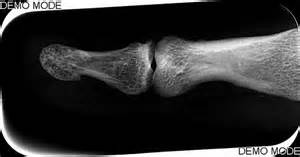
Which my finger looks more like. Here’s one that my left finger looks more like(this is also a right index finger):
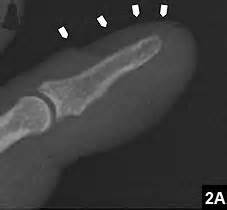
Have to compare color intensity of areas of right versus left bone.
Here’s a finger with some gray areas. There is a large gray region on the tip of the proximal finger and some on the bottom part of the distal region of the medial index finger. Note this is a fractured finger so we’d expect there to be some anabolic growth.
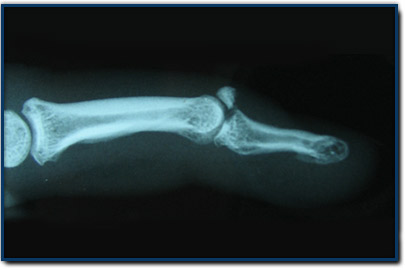
So, it’s normal to have those regions of darker bone.
There are other potential reasons why one part of the bone can be much darker than the other but one strong possibility is that it is new LSJL induced bone growth. Since LSJL involves lateral loading it makes sense that much of the growth can be better observed than a lateral angle(the differences in coloration can not be seen as well from an overhead view). From the overhead view the right index finger looks to be whiter than the left index finger infact. Click on the images below to enlarge them.
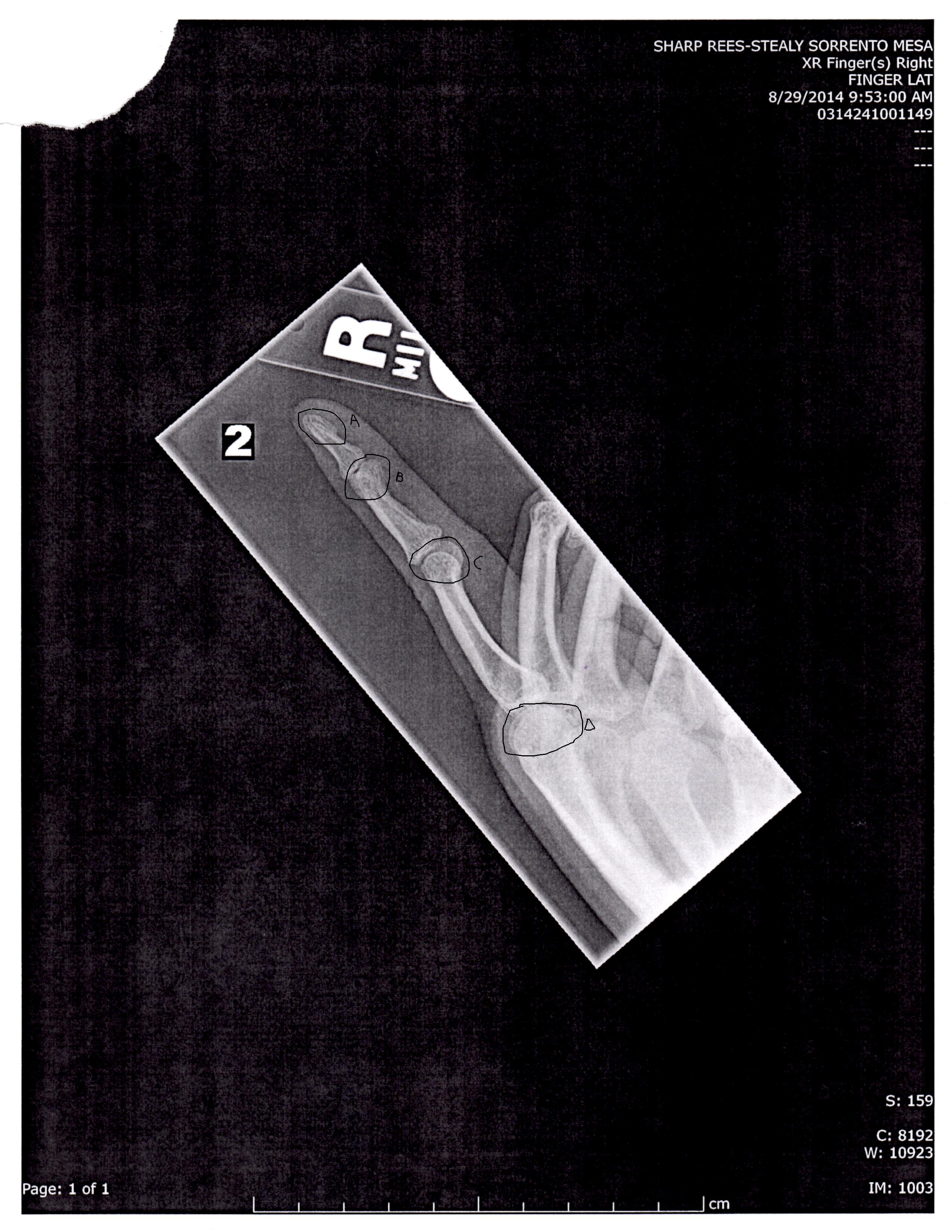
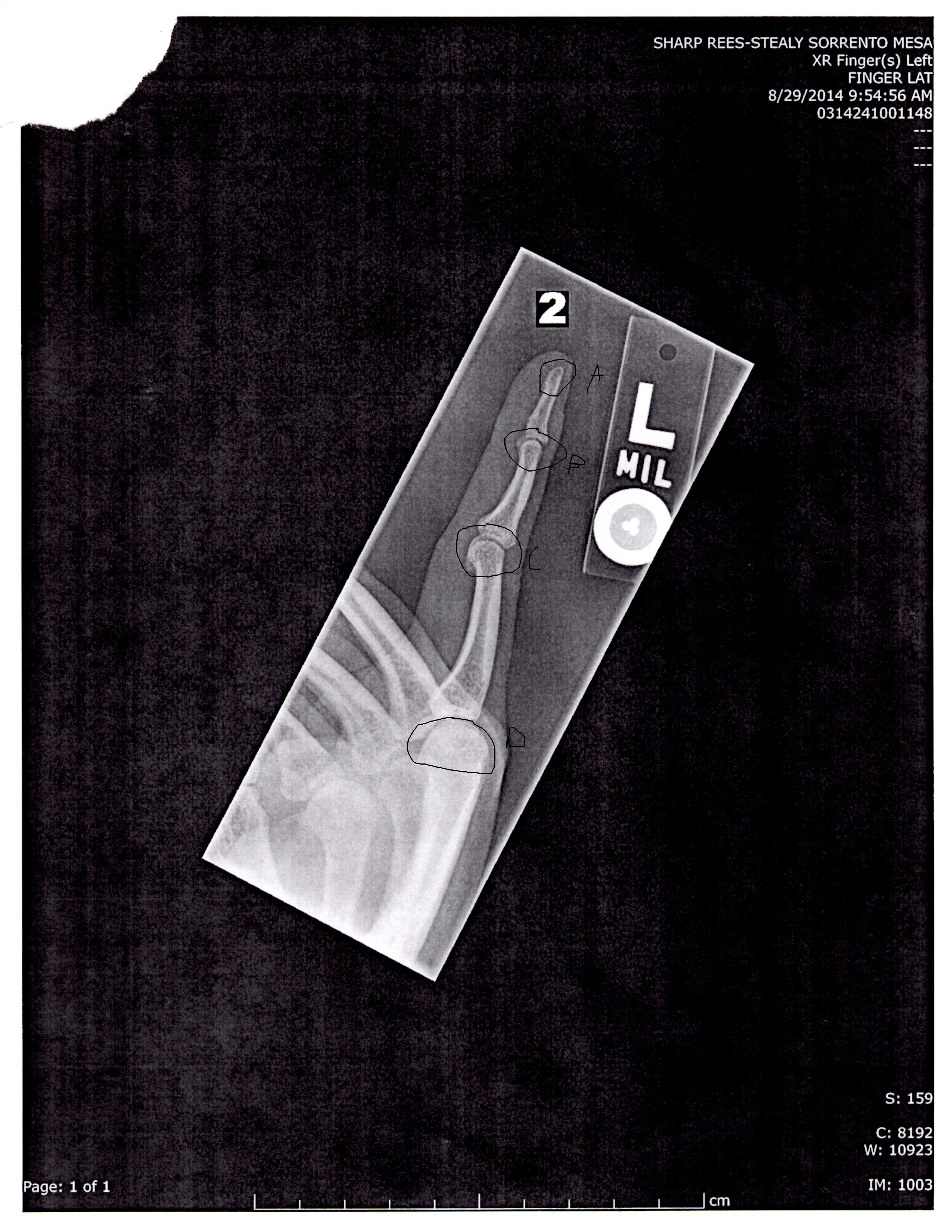 Each of the circled points A-D represents a region of bone that is much lighter than the other. On the left side these regions are present but the are much lighter. At point A it seems to blend better with the whiter region of the bone in contrast to the right side where it is more a bulbous head. The bone at B looks totally different. C and D are similar but the right(LSJL loaded side the darker region of the bone is much bigger).
Percentage growth based on darker area versus lighter area:
Proximal Head(Tip of dark region to tip of light): 23.4 pixels
(bottom of proximal index finger bone to top of light region): 170.4 pixels
13.7% growth.
However, I’d guess that my left bones are about 1% longer than my right. If my right finger did grow longer than 10% my right proximal finger would measure longer than my left which is not the case. You can see from the above images of other images that the normal finger has these darker regions, those regions are just expanded above normal. So maybe the the proximal finger bone didn’t grow the entire gray region but the gray region just expanded in response to the stimulus. In fact a study has shown that the finger bones naturally grow into adulthood. So these darker regions of bone could be a sign of adult finger growth. The same study stated that metacarpals tend to decrease in length so the fact that my right metacarpal grew longer is a good sign that this growth could extend to other bones.
What’s a bit unfortunate is that the growth plates are on the proximal(bottom) end of the finger bones and the gray regions are on the distal(top) ends of the finger bones. However, the distal regions of my right finger bones do seem to be a bit more gray than the left bones so it is possible that the growth plate region was stimulated by LSJL.
Below is some more information about x-rays.
Here’s something I found describing xrays:
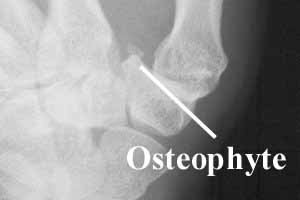
” The bone along the joint is usually whiter (called “sclerosis”) and may have little points of bone growing out (called “osteophytes”). There may be holes in the bone ( called “cysts”) and the bones may be starting to slide out of alignment (called “subluxation”).”<-None of these images quite explains the growth in LSJL.
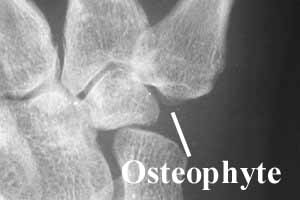
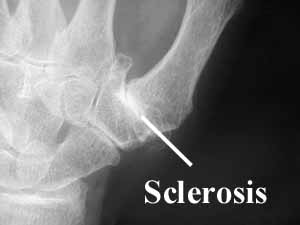
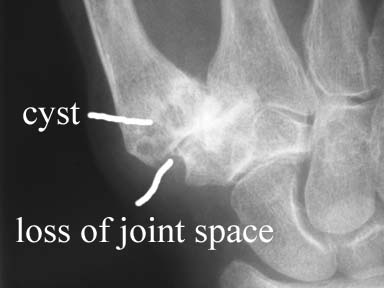
Here’s a comment I found from Yahoo! Answers:
“Bones always appear as white images in regular xrays. However they arent really white because the film is clear, the plastic on the view box is white. But on xray film it is coated with a metalic layer. The xrays make the metalic layer stick to the film. So the black part of the film is where all the xrays reach the film. If the area on the xray is gray, then that means that some of the xrays are getting through implying that the structure is more dense than the black part. Soft tissue appears gray. The bone is a very dense structure allowing minimal to no xrays getting through. The film is then put through the processor and the film runs through chemicals that make the picture “stay” on the film. It is then rinsed and dried. Since the xrays make the metalic layer stick, none stick to the area of the bone because no radiation got through and the layer was washed off during processing. This is why bones appear white, they are the densest structure.”
Here’s another response from Yahoo! Answers regarding why one part of the bone is darker than the other:
“When a bone X-ray is taken, radiation is momentarily irradiated on the area being examined. X-rays pass through the body to produce an image on film. Structures like bone that are dense and have a high atomic number absorb a lot of X-rays, so less X-rays reach the film and the bone appears white on the film. Muscle, fat, tumour, and fluid absorb less X-ray than bone, and appear darker than bone on the film. Air distributed in various pockets within the body (usually due to an abnormality) has a low atomic number and density, and consequently appears black, because most X-rays pass through without being absorbed. You would be advised to consult the doctor or radiologist dealing with this matter and enquire as to the suspected cause of the description that you describe. You may find that further tests/examinations will result from the X-Ray result which will determine or assist the diagnosis.
The information provided here should not be used during any medical emergency or for the diagnosis or treatment of any medical condition. A licensed physician should be consulted for diagnosis and treatment of any and all medical conditions. “<-I don’t think air pockets could explain the larger gray area on the right side bone.
On this page is an image of tissue types in regard to whiteness: http://radiologymasterclass.co.uk/tutorials/physics/x-ray_physics_densities.html#top_first_img. The coloration is consistent with soft tissue.
Here’s an image of a periosteal chondroma:
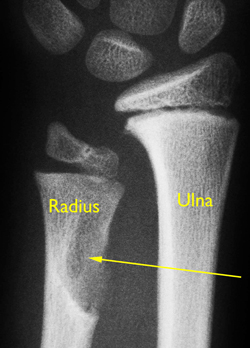 “In this x-ray of the wrist, the saucer-like hollow in the radius bone is a classic indication of a periosteal chondroma. “<-That’s not really consistant with what’s going on in my bone.
As for my ganglion cysts according to here, they are usually caused by myxoid(mucous) degeneration of collagen and usually lined with flattened mesothelium.
I can’t really find any adequate explanation as to the brighter regions of my finger.
Update by Michael:
From what I remember from being in some medical derivative courses back in my university days, I do remember the idea of X-rays penetrating into human tissue. White light means that the X-rays did not completely go through the tissue, while the black color is an indicator that the X-rays went through less dense tissue, like fat and tendons.
I don’t have the enlarged X-rays pictures with me anymore but I don’t remember the left or right index fingers having any major differences in color. I think the important thing to remember is that we are looking for bone length differences, not bone density variations.
Now it is theoretically accurate to say that if we can show that LSJl caused bone density changes, causing the X-ray to cause a darker band on a metatarsal bone then LSJL might lead to bone longitudinal growth. However, on a much more practical level, even if the BMD is lowered, that doesn’t seem to translate to bone length increases, even after half a decade of doing joint loading on a consistent basis. I don’t think that it is worth trying to validate the LSJL theory based on a slight difference in color/density from comparing the left and right X-rays of the index fingers. That is too much of a stretch even for me.
As for the fingers growing longer, that actually makes a lot of sense. The human nose gets longer over time, the human ears droop lower and lower, and even the human mandibular joint area grows longitudinally if you have a pituitary problem.
For the old time regular readers, remember my study on why deer antlers can fall off, and regrow back in length every season? It is because of the occurrence of a laceration/osteonomy at the beginning, causing an open wound. A blastema develops in that region. That blastema eventually grows into a pseudo “growth plate”. The top part of the horn is where the mesenchyme is, and it is covered by a layer of perichondrium, NOT periosteum. That means that the top roof surface that is encapsulating the “rest zone’ type cells in the mesenchyme is flexible. It is only being pushed down by air and gravity, not an entire body, like the grow plates in the tibia of an adult human, which can be over 200 lbs of weight. Similarly, the human fingers have the same type of structure, a human anatomical peninsula, like the human tibia-knee area, which is more like an isthmus.
What I am trying to say is that fingers is similar to the horns on the deer. I have already shown a few times that some stem cell powder can regrow fingers. It is not that a big of a stretch to then conclude that human fingers, like noses, and ears, and pregnant female’s feet can grow throughout one’s life.