Category Archives: Uncategorized

A Honest Guide On How To Possibly Increase Height And Grow Taller, For The Person With Closed Epiphyseal Growth Plates

Not available at this time – Earliest release date: June 1, 2014

A Honest Guide On How To Possibly Increase Height And Grow Taller, For The Person With Closed Epiphyseal Growth Plates

An guide on Honest, non-BS, logical, scientifically validated ideas to possibly increase the growth rate of height increase during the years when the growth plates are completely closed.

Price Of This Product: Not sure yet

  • Length Of Product: over 200 pages. – this will be similar in volume like a thesis application for Doctoral degree
  • Number Of Actual Proposed Ideas, Methods, and Techniques You Can Implement: unknown at this time.

The “book” will be quite expensive. There is no doubt about it. If you want one of the regular E-Books that some Internet Marketer who uses Clickbank to go to the – Free Stuff – or The Library section. Those E-Books and E-Products have the regular type of information which you would find in most books. This


Note #1: Unlike the other product which is for open growth plate, there is indeed a Refund for this product. A 30 days FULL refund for this product.

The reason why this product has a refund and the other product doesn’t is because of two main reasons.

  1. The price for this product is going to be very high. Many who do want this may not be able psychologically part with this type of cash, if not most people would not be willing to give up that time of time for such an endeavor.
  2. The fact is that this whole venture to try to find a real non-limb lengthening surgerical way to increase height is INSANELY DIFFICULT. There are multiple channels and avenues of research I have tried to look into and most of them seem to have little real chance of working. This is little guarantee that the methods I will put in the book will even be able to give 1 cm of height increase.

The refund policy is my way of giving the buyer a way to get out of lossing $300 if they realize they can’t do the steps in the method since there is a high probability and chance of failure and the idea not working.


The Truth: All the information you will find in the book, you can find at some point on the website. At some point I have talked about one of the main ideas already. What I have done is take all the most useful and applicable content from the last 1000 posts and placed them in one place.

At some point I realized that the Supplement Guide and the Exercise Program Guide was not enough. The section I put up for FAQs to help slow down the onset of dozens of emails I get each day still did not stop the emails. This is the way I can put a full stop to the emails. This “book” is the best advice that I can give at this stage in my research.

I will NEVER lie or try to deceive the readers and the visitors to this website/blog. Everything I am showing you is the best content and “secrets” that I have found. There is NO Magic Pill.

Warning: Do not purchase this product on the spur of the moment. I will just say it right now. Do not purchase this product on the spur of the moment. Before you buy this product, ask yourself…

How badly do I really want it? How much do I really want to increase my height? What am I willing to give up and sacrifice to gain the amount of height increase that I am hoping for?

I wrote in a post about this exact issue because I understand the psychological resistance there is with this type of purchase. You have been tricked before. The scam artists are many and this entire niche is a cesspool of scams and frauds. I have looked at the past work of the other height increase researchers and seekers before me. I have read everything I could about the research Sky (from EasyHeight.com and LimbCenter.org), Tyler (from HeightQuest.com), Hakker (from GrowTallForum.com), the GrowTallerForum.com (the other small less popular forum), the GrowTallInfo.com forum, Alkoclar, XCrunner211, Bababooey, GiantScientific.com, the people on the MakeMakeTaller.org forum, and any other resources I have been able to find on the internet.

If you are going to put your (or your parents’, siblings’, friends’) credit card information in, I hope you are really ready to make the type of commitment to say that you are really goig to buy the neccesary equipment, make a true commitment, and section off a portion in the day for time to implement the idea out.


Final Message For Right Now 1/26/2013:

If you have managed to read this far down to the post/message, I’ll say truthfully that this book/E-Product has not been written. It will be the 1st edition. Over the next 3-5 years, I will be editing and revising this book to be more up-to-date with any new breakthroughs, ideas, and news I hear. It will also have less spelling and grammatical mistakes.

There is a very good reason for this. It is because I haven’t found any methods or results which really do seem to have a high chance of working for the person who has closed growth plates.

I have decided that even if I get over my own height insecurities and my own issues on how tall I am, I will not stop in my research. This is my calling. I am here to help the world and hopefully make a real difference and make other people’s lives a little better.

So please put your full name and personal email information below to make a reservation for the option to buy the book when it finally is finished. I promise that when the book is finally finished, I will give you a email notice/message that the book is ready for you to easily buy and download for use. There is also a very good chance that I will upload the book to Amazon.com as a Kindle E-Reader file.

A Honest Guide On How To Possibly Increase Height And Grow Taller, For The Person With Open Epiphyseal Growth Plates

Not available at this time – Earliest release date: July 1, 2013

A Honest Guide On How To Possibly Increase Height And Grow Taller, For People With OPEN Epiphyseal Growth Plates

A guide on Honest, non-BS, logical, scientifically validated ideas to possibly increase the growth rate of height increase during the years when the growth plates are still open.

Warning #1: Do not purchase this product on the spur of the moment. I will just say it right now. There is NO REFUND. Please read that last part again.

Price Of This Product: Not Sure Yet

  • Length Of Product: over 100 pages for sure. – at this point it is still being developed and in the infancy stages of being finished (ie. 4-5 pages finished)
  • Number Of Actual Proposed Ideas, Methods, and Techniques You Can Implement: over 10 techniques, ideas and things which have been documented by real researchers and medical professionals have proven through experimentation in the laboratory to work.

First thing first, the most obvious thing about the book – This book is going to be quite expensive

There is no doubt about it. If you want one of the regular E-Books that some Internet Marketer who uses Clickbank to sell a weak content based book, go to the – Free Stuff – or The Library section. Those E-Books and E-Products have the regular type of information which you would find in most books. This book is real and detailed of only technical information. However that technical information is only used to validate and show definite proof from sources, citations, and references that scientific professionals in the past have seen the same type of results and phenomena.

In this book I will be giving specific step by step directions on what to do. The book is a guide and an instruction manual. Sure, I can spend the next 40 minutes giving as many fluffy reasons on why you should buy this book to justify the of price but I can’t. I am going to let the content and the information built its own reputation.

The Truth: All the information you will find in the book, you can find at some point on the website. At some point I have talked about one of the 4 main ideas already. What I have done is take all the most useful and applicable content from the last 1000 posts and placed them in one place.

At some point I realized that the Supplement Guide and the Exercise Program Guide was not enough. The section I put up for FAQS to help slow down the onset of dozens of emails I get each day still did not stop the emails. This is the way I can put a full stop to the emails. This “book” is the best advice that I can give at this stage in my research.

I will NEVER lie or try to deceive the readers and the visitors to this website/blog. Everything I am showing you is the best content and “secrets” that I have found. There is NO Magic Pill.

Warning #2: Do not purchase this product on the spur of the moment. I will just say it right now. There is NO REFUND. Please read this again. Think rationally about this choice and ask yourself whether you are really going to put the energy, effort, and time to implement the suggestions and steps given.

The reason There is no refund is because I am around 80-85% confident that the methods described in the book will work in increasing the rate of longitudinal growth in the long bones of the person who is still developing with OPEN growth plates. I don’t have 100% confidence because that would be arrogant of me to think I would know all the answers.

The whole endeavor of trying to increase one’s height is a very tricky and sensitive subject.

The most important question you probably should ask yourself is….

How badly do I really want it? How much do I really want to increase my height? What am I willing to give up and sacrifice to gain the amount of height increase that I am hoping for?

I wrote in a post about this exact issue because I understand the psychological resistance there is with this type of purchase. You have been tricked before. The scam artists are many and this ENTIRE niche is a cesspool of scams and frauds. I have looked at the past work of the other height increase researchers and seekers before me. I have read everything I could about the research Sky (from EasyHeight.com and LimbCenter.org), Tyler (from HeightQuest.com), Hakker (from GrowTallForum.com), the GrowTallerForum.com (which is not related to the more popular forum), the GrowTallerInfo.com forum, Alkoclar, XCrunner211, Bababooey, GiantScientific.com, the people on the MakeMakeTaller.org forum, and whatever else I have been able to find.

If you are going to put your (or your parents’, siblings’, friends’) credit card information in, I hope you are really ready to make the type of commitment to say that you are willing to actually go through with the stuff that the book talks about.

I don’t intend for this book to make a lot of money. I know very few people would accept the idea of paying $100 for a book. and that is perfectly okay. If I sell not one copy in its existence I will still be okay. This is a book which I am writing for my future children, which I will use on my own children in time since I have confidence in the ideas I propose. This book is my legacy.

I don’t intend to take down this website for a long time, at least until the internet changes so much that this type of format can no longer function. Sky from EasyHeight.com and LimbCenter.org had those sites up for over 6 years. Hakker had his website up for around 4-5 years. If you would like to see what was on those websites you can use the Wayback Machine that archives old, dead websites from the entire internet.

This website/blog is not going away, since I know for a fact that I am making a difference in this world by doing more research on this subject.

[Disclaimer: As always I am not a medical professional but just an obsessive amateur researcher on auxology and height increase, so taking any type of advice from me is at your own risk. I can not and will not be held responsible legally or financially for any injuries or adverse affects that might happen to the individual who does indeed choose to go through the procedures I talk about. I have a high level of  confidence in my own product and my research can indeed stand up to close scrutiny, scientific scepticism, and criticism by people from the medical establishment.]

Before you click on that link below to buy this book, read this final message very clearly!

This book is for people with OPEN EPIPHYSEAL GROWTH PLATES. If you are still at the age or stage in your life where natural normal growth is still possible since your growth plates are around, then this book is okay to buy. –

– If however your epiphyseal growth plates aka physis is CLOSED, gone, ossified, etc. whatever you want to call it, then do not buy this book. It will NOT help you. Buy the CLOSED EPIPHYSEAL PLATE BOOK instead, assuming that I ever do manage to finish that book and find real viable ideas and techniques.  –

So please put your full name and personal email information below to make a reservation for the option to buy the book when it finally is finished. I promise that when the book is finally finished, I will give you a email notice/message that the book is ready for you to easily buy and download for use. There is also a very good chance that I will upload the book to Amazon.com as a Kindle E-Reader file.
What Are The Chances For Me To Go Through A Late Teenage Years Or Late Life Growth Spurt?

One of the more common questions posed by people who email to the website email is them asking the question which is a variation or derivative of “What Are The Chances For Me To Go Through A Late Teenage Years Or Late Life Growth Spurt?

This is a really common question that I see on all of the height increase and grow taller boards. For these people they are only in the very early stages of learning about this endeavors.

I have thought about putting this question in the FAQ section of the website.

If felt that the entire question can be almost completely answered by reading the two posts below

Hi, I’m ENTER YOUR AGE years old. Am I Still Growing? Can I Still Grow Taller?

What Is The Most Height Gain One Can Achieve Through Exercises And Stretching After Puberty And Growth Plate Closure?

While the question posted for this post implies that the person asking the question is hoping that a miracle will happen to them which will let them do nothing but be passive in their achievement of height increase, the question and post I linked above implies that the person who wishes to be taller is willing to do more than just hope and may be more active and assertive in their approach for height increase.

To answer the question more directly is is worth pointing out the medically defined age range for most males and females for when they stop the natural growth process.

For males, they stop growing around the 17-19 age range – This is basically exactly the end of the teenage ages since the technical definition of the end of being a teenager is around 18 years old.

For females, the stop growing around the 15-17 age range – This is basically a little below the end of the teenage years. However we do note that females in general even in their development years mature faster than males, in terms of bone maturity and also emotional and mental maturity too.

If the person asking is hoping for a late teenage years growth spurt, then they would have to be more exact on how old they are exactly. There is a major different between 17.6 years old and 18 years old for men. There are enough cases seen where the male manages to continue to add 1-2 extra inches after even the 18 years point. This is due to maybe from the late closure of the male growth plates and also the longer, bigger tail of the bell curve of the distribution of height tabulated for men. The standard deviation magnitude for the male population is large than the standard deviation magnitude for the height bell curve distribution of females.

In all honestly, I would tell the individual that their chances are very low, maybe around 0.1-0.5% if they are anywhere past the age of 17 for a female and 19 for a male. There are many people who might try to counter-argue this assessment by telling me and recounting a story of how their relative, themselves, or one of their friends beat the age range and was the exception but the numbers don’t lie.

Most people who do contact this website are already in their 20s so their odds are severely reduced. I am talking about it to mean that in terms of percentages they might have a 0.001% chance that they would even be able to get 1 inch. However this does not mean that they can’t get some real height increase by focusing on stretching out their vertebrate and realigning their posture. A large percentage of people in a given population has the potential to gain upwards (or sometimes slightly more) of 1 inch in height increase through stretching and posture correction int their 20s. However what they are doing is more like body remodeling or modification, which is NOT a growth spurt.

Growth Spurts imply that the bones in their body went through further the process of endochondral ossification and the height they did achieve is permanent, which is something that won’t go away if they stop doing the stretching.

Maybe the person who messages me might think that they are somehow special, unique, or have a situation which means that they are excluded from the majority but fit that very, very small minority of people who can still grow, but that is always assuming that they think that their growth plates are still open. I would not want to wager that the person has their growth plates still around, but are gone. If a person doesn’t have their growth plates anymore in their limbs, they still have some cartilage in their vertebrate which might still be around which will contribute to the person’s overall height through appositional growth but if those vertebrate growth plates disappear, then growth spurts are almost impossible.

There is one unique case where it is suggested that growth spurts might still be able to occur that was with with the now passed Tanya Angus. Her biography showed that she apparently stopped increasing in height when she was in her teens but her growth was reactivated when she was around 18, which is the age when most females would have complete closure of their cartilage. Of course Angus had the most severe case of Acromegaly that has ever been documented. Where most pituitary gland tumours which cause human gigantism are benign in nature, Tanya Angus had one which seemed to more malignant, at least in terms of the fact that her tumour seemed to grow bigger. If we can prove that Angu’s plates were in deed gone before her pituitary gland was activated, this might prove the idea that even with all the growth plate closed, growth spurts still might be able to happen where the body is enlarged in every single way, not just in terms of height.

So at this point, hope for the best but expect the worst. Be prepared to accept the idea that maybe you are not going to get any growth spurt but be grateful if it does happen. Sometimes the growing does happen, like what happened with Dennis Rodman with his crazy 10 inch of growth at the age of 20, but those cases are very, very rare.

If A Person Has Open Growth Plates, How Much Are They Going To Grow Each Year On Average?

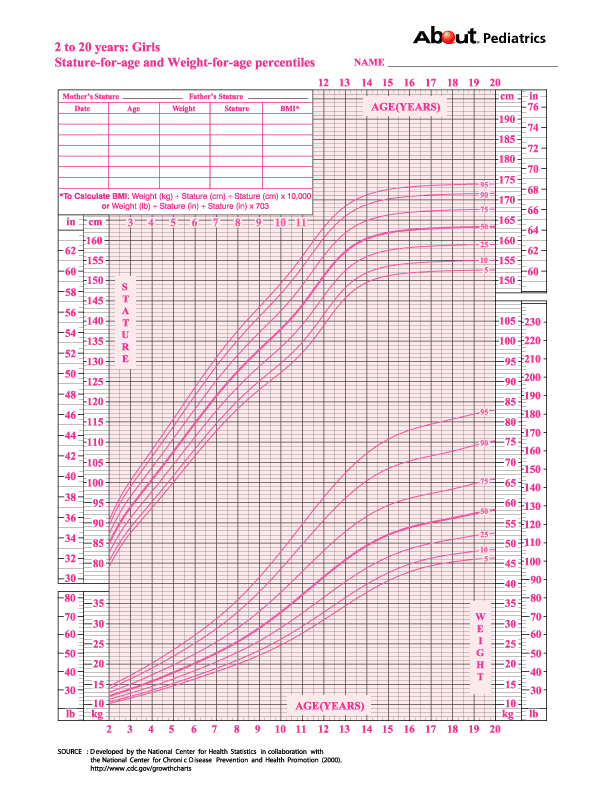
chartThis post is really for the concerned and worried parents out there who might be interested in knowing just how fast their son or daughter should be growing at the age that they are at.

Note: This post is also a key post which will be used to show that if I propose a technique or method for increasing the growth rate of a person who still has open epiphyseal growth plates, for the serious, sceptical, cynical person to see that there is a high reasonable percentage of a chance that the technique probably did do what I had said it would.

All that would need to be done is to compare the average rate of height increase for the time period of a person from say a medical textbook chart to the increases seen from implementing a technique or idea I propose.

First, I would like to cite the Wikipedia article on “Growth Chart” which has a link to the World Health Organization websiteThere is a link to a PDF entitled “WHO Child Growth Standards” from the www.who.int/ website. This massive book is over 300 pages long so I clearly will not try to read the entire PDF.

Analysis #1: For the WHO child growth standards

I would like to refer the reader to pages to 3 main sections of the PDF

  1. pages 32-33 which talks about the growth of boys
  2. pages 59-60 which talks about the growth of girls
  3. pages 74-77 which compare the growth of girls to boys.

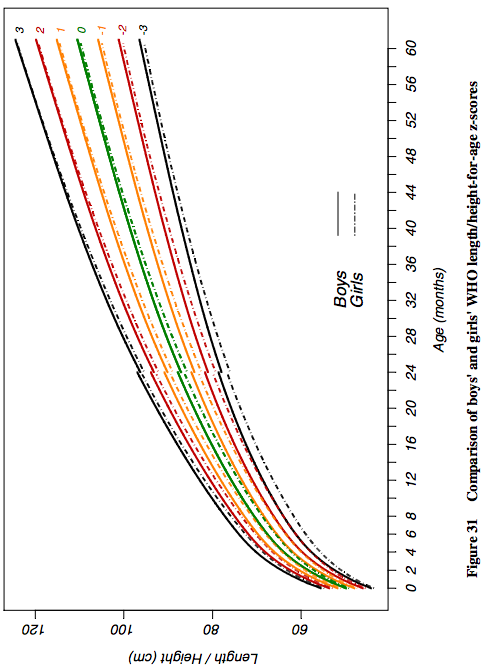
whochartThere are charts for all of the three sections. what is interesting is that in this World Health Organization PDF they are comparing the numbers and measurements of the WHO to also the CDC and the NCHS. The study only is looking at the growth rate of very young kids. between the 0-60 months years old group. As we can see from the chart pic on the left there is a non-linear growth pattern for young children between the ages of 0-5 years old. If we look at another picture looking at the growth rate progression of people in general from ages 0 until the ends of puberty, ages 0-22, we see that the entire growth progression chart is also nonlinear.

The graphs like the one (taken from the section 74-77) to the left all show for a y->x axis chart looking at measured height to determined age, in units of cm to months. For the page section comparing the growth of girls to boys, you can see that the heights are all slightly lower for girls compared to boys. This is expected since humans when comparing the sex have a sort of dimorphic distribution of height where the girls and boy height are always diverged apart from each other, but don’t seem to ever converge in the middle.

Note #1: As it is well known, for each different demographic, ethnic group, or nation the growth rate and final adult height of a subset of the entire human population will be different from another. This means that the final numbers or the chart that might be posted at the end of this post will almost always be slightly off from what a real parent would see. What the growth/ height increase progression rate of a child will be different in Vietnam compared to say the Netherlands.

So what does the small chart I have copy and pasted from page 75 actually show about the growth progression in young children from young age, specifically ages 0-5 years old?

If we take a ruler and tried to measure the magnitude of the difference of the y axis versus each year we see that for the first year of life, the growth is the strongest (months 0-12) with going about 40-> 75 cms, a 25 cms increase, which is exactly 1 entire feet in growth. For the 2nd year for average (50 percentile) boys they go from 75 –>90 cm, which is a 15 increase, or 6 inches. For the 3rd year they increase from 90–>97 cm, or a 3 inch increase. This continuation in decrease of growth rate is seen in the 4th and 5th year too. For the issue with girls, they seem to start at about 5 cm shorter than boys at birth and but have a similar growth pattern trend, if not a little less steep growth trend in the first 2-3 years. Since the graph does not continue on for ages 6-18, I had to resort to another graph and other resources to find out just how much a child should grow in later years when their epiphyseal plates are still open.

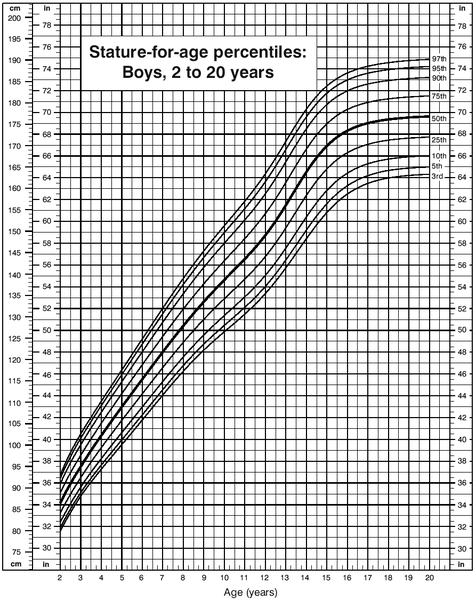
When I try to type in the phrase “growth progression chart” into google what I mostly get are charts for very young children, babies and infants in the 0-5 year range. Most of the image results reveal the two charts (for boys and girls) belows

Male_Growth_Chart

girlstwoyears

Before we look at the charts for the average height growth progression I would like to cite a few PubMed articles.

The first is “Evaluation of growth rate in height over periods of less than one year

Abstract

The stature of 260 well-nourished children aged between 7 and 10 years was measured at intervals of approximately 1 month over 13 months. The growth rate of each child was calculated over periods of 3 months and 6 months ending in each month of the year. Children who missed one or more measurements, due to absence from school, were excluded from the calculations

Centiles of growth rate for these periods are presented. A growth rate of 3-4 cm/yr is well within normal limits for a period of 3 or 6 months ending in December or January, but is below the 10th centile for periods ending between March and June.

Most children reach their maximal 3-monthly rates in the periods of either 3 or 6 months ending between March and July, and their slowest in the periods ending between September and February.

A child’s growth rate over the 3 months of fastest growth is most frequently 2 to 3 times his slowest rate, but may be 7 or more times the slowest if the latter was very low. There may be no measurable growth during a single period of 3 months in a normal child, but maximal rates of up to 10 cm/yr are not necessarily abnormal. An individual’s maximal 6-monthly rate may be up to 3 times his minimal.

A satisfactory assessment of a child’s growth cannot be made over a period of less than one year.

The 2nd study cited is “[WHO growth standards for infants and young children].” which was written in 2009 in French

Abstract

The growth pattern of healthy breastfed infants deviates to a significant extent from the NCHS/WHO international reference. In particular, this reference is inadequate because it is based on predominantly formula-fed infants, as are most national growth charts in use today. The WHO multicentre growth reference study (MGRS), aimed at describing the growth of healthy breastfed infants living in good hygiene conditions, was conducted between 1997 and 2003 in 6 countries from diverse geographical regions: Brazil, Ghana, India, Norway, Oman and the United States. The study combined a longitudinal follow-up of 882 infants from birth to 24 months with a cross-sectional component of 6669 children aged 18-71 months. In the longitudinal follow-up study, mothers and newborns were enrolled at birth and visited at home a total of 21 times at weeks 1, 2, 4 and 6; monthly from 2-12 months; and bimonthly in the 2nd year. The study populations lived in socioeconomic conditions favorable to growth. The individual inclusion criteria for the longitudinal component were: no known health or environmental constraints to growth, mothers willing to follow MGRS feeding recommendations (i.e., exclusive or predominant breastfeeding for at least 4 months, introduction of complementary foods by 6 months of age and continued breastfeeding to at least 12 months of age), no maternal smoking before and after delivery, single-term birth and absence of significant morbidity. Term low-birth-weight infants were not excluded. The eligibility criteria for the cross-sectional component were the same as those for the longitudinal component with the exception of infant feeding practices. A minimum of 3 months of any breastfeeding was required for participants in the study’s cross-sectional component. Weight-for-age, length/height-for-age, weight-for-length/height and body mass index-for-age percentile and Z-score values were generated for boys and girls aged 0-60 months. The full set of tables and charts is presented on the WHO website (www.who.int/childgrowth/en), together with tools such as software and training materials that facilitate their application. The WHO child growth standards were derived from children who were raised in environments that minimized constraints to growth, such as poor diets and infection. In addition, their mothers followed healthy practices such as breastfeeding their children and not smoking during and after pregnancy. The standards depict normal human growth under optimal environmental conditions and can be used to assess children everywhere, regardless of ethnicity, socioeconomic status and type of feeding. The standards explicitly identify breastfeeding as the biological norm and establish the breastfed child as the normative model for growth and development. They have the potential to significantly strengthen health policies and public support for breastfeeding. The pooled sample from the 6 participating countries allowed the development of a truly international reference that underscores the fact that child populations grow similarly across the world’s major regions when their health and care needs are met. It also provides a tool that is timely and appropriate for the ethnic diversity seen within countries and the evolution toward increasingly multiracial societies in the Americas and Europe as elsewhere in the world. The WHO standards provide a better tool to monitor the rapid and changing rate of growth in early infancy. They also demonstrate that healthy children from around the world who are raised in healthy environments and follow recommended feeding practices have strikingly similar patterns of growth.

The 3rd PubMed article cited is “New growth standards for the 21st century: a prescriptive approach.”

Abstract

Breast-fed babies have been shown to grow at a substantially different rate from the current international reference curves, with greater growth rates in height but with smaller body weight increases and substantially less variability in the growth patterns of a group. On this basis, the World Health Organization concluded that there was a need to undertake new studies to establish on a global basis the appropriate growth curves for exclusively breast-fed babies, their growth curves then being potentially seen as optimum standard curves rather than an arbitrary set of reference charts. The Multi-Country Growth Reference Study was therefore carried out from July 1997 to December 2003 as a population-based study covering the cities of Davis, California, USA; Muscat, Oman; Oslo, Norway; and Pelotas, Brazil, together with selected affluent neighborhoods of Accra, Ghana and South Delhi, India. These centers were considered conducive to a study of babies and children under optimum breast-feeding and weaning and early feeding conditions. These studies, to be reported shortly, confirm previous observations on breast-fed children, but also show that the greatest differences are within each population group rather than being international differences.

The last study or article I would like to cite is written by Dr. Robert H. Shmerling entitledCan We Predict Height?“. A part of the article he wrote is copy and pasted below…

What Determines Height?

One’s ultimate height is determined by a complex interaction of many factors including nutrition, genes, and overall health. Growth rates vary over a lifetime:

  • From infancy, when average length is 20 inches, to age 2 there is initially rapid growth, then slowing, with about 14 inches in height added.
  • From age 2 to puberty there is slow, steady growth at about 2½ inches per year.
  • As one enters puberty, a growth spurt of 3 to 5 inches in a year is common.
  • By ages 40 to 50, height actually may begin slowly to decline, even in healthy adults.

Final Conclusion & Analysis Made By Me

So what do the charts and numbers say about the growth rates in children or adolescent who still have open growth plates?

From the first pubmed studies we learn that for children at least in the age range of 7-12, their growth rate is far higher between the months of March and july than the other half of the year.  The growth rate during the fastest 3 months can be as high as 7 times as fast as during their slowest time but is on average 3 times as fast as the slow months between december and february. Growth is usually 3-4 cm/year if one was only accounting the time of growth during the bad time range but can be as high as up to 10 cm/year

The 2nd pubmed study shows that if mothers decided to breastfeed their babies exclusively or more than just usual formula very quickly in the babies development, their height growth progression would be far more different. The modern nations have mothers feeding their babies formula much more now that this causes the World Health Organization height progression charts to be very off from what might be more “natural”. For the study, all the other factors which might make the issue of comparing breastfeeding vs formula to height progression was removed where the mothers were advised to continue to breatfeed beyond a certain month and to refrain from smoking and many other behavior to negate other factors which might make the data useless.

The 3rd pubmed study is written by the same authors so basically only validates the 2nd study. The growth charts for breast feed babies are very different from formula feed babies. The growth rate for the babies show higher height increase in terms of relative to the gain of weight. This implies that if the health organizations like WHO are hoping to get a far more natural and most accurate reference growth chart of babies from around the world, they need to put the babies on a breastfeeding diet for much more than their mothers might be doing currently.

The last resource I cited is from a doctor He states that from ages 0-2, the baby gains about 14-15 inches in height, which is about what the other chart indicated. For the age range of 2-13, or whenever puberty starts, the growth rate is about 2.5 inches per year. Puberty causes the growth rate to increase up to 3-5 inches per year.

So from all the resources I have found, but especially the WHO, CDC, and NCHS the amount of height increase is sort of like this

Age range

  • 0-1 – 12 inches
  • 1-2 – 5-6 inches
  • 2-3 – 3 inches
  • 3-4 – 2.5-3 inches
  • 4-11 – 2.5 inches
  • 11-13 – 3-5 inches
  • 13-17 – 1.5-2 inches
  • 17-18 – 1-1.5 inches

So the number values are based on averages but can still be used to compare one’s children’s growth rate to other kids their age to see if they are growing property and within the aceptable growth rate percentile.

Is Using Microscopic Engineered Nano-Bots To Increase Height And Grow Taller Even Reasonable Or Possible?

On the idea of using microscopic engineered nanobots to increase height and grow taller

urlThere have been a few people who have contacted me through email to ask over this idea. They talked about building and releasing nanobots which can swim around our bodies through the blood streams and be able to focus on the old growth plate areas to somehow regrow the growth plates again. They of course never go into detail on how they would be able to convert the nonliving organic hard calcium phosphate and hydroyapatite into the collagenous fibers or how to take into consideration the fact that the human structure can break apart if too much of the hard element which forms bones is removed.

The main problem is that to be able to recreate something similar to what we found in our younger days would require at least 4 step process to do that.

  1. The first thing is to remove the inorganic hard calcium reinforced matrix that makes up the bone on the inside, the trabecular bone.
  2. The 2nd thing is to remove the inorganic hard material that makes the even harder material, the cortical bone.
  3. The 3rd is to be able to direct the blood vessels and marrow in the empty cavities of the long bone long enough for step 3.
  4. The last step is in creating the actual epiphyseal hyaline growth plate. This in itself is already hard enough to do, due to the fact that the chondrocytes in the growth plate are stacked in columns, which are not seen in any other type of tissue found in the human body.

Overall, when I hear this type of idea I start to roll my eyes and can not believe that since it seems either too fantastic to believe or too far into the future to make it even remotely realistic for people like us who are in our teens or 20s, maybe 30s to use in our lifetime. It is hard enough for computer scientists today to build robots which have any type of Artificial Intelligence capabilities currently and to extrapolate the technology we have currently to make them microscopic for biomedical or cosmetic reasons seems very fantastic.

The current level of robotics we see today are being advanced further and further in many top universities, military bases, and possibly secret large corporation locations which do insane research and truly crazy breakthroughs. However these research will never reach the eyes of the general public.

I would propose that for any type of nano (or micro) sized robots or mechanical entities to be able to do all the steps I propose above, they would probably have to have at least three main qualities.

1. Safety – The bots will be safe and not hurt the formation process of other systems but especially the nervous and circulatory system.

2. Biodegradable or Can be expelled from the body without hurting the host – meaning that the bots will eventually disintegrate from the human body’s natural immune response. If they can’t be removed without hurting the person then they must be removed in another way, say through the urine or feces. However that means that the robots have to have the 2nd trait, intelligence.

3. Intelligent – It has to follow at at least 4 steps. From what I’ve seen, it might need to learn how to form 3-dimensional shapes or forms to create a pseudo-tissue in the 3rd step since redirecting blood vessels, blood, and bone marrow may be impossible from my known area of understanding of how science can work.

Problems with Safety – We know that if we ever do even find a way to create the nanobot we want for medical application, they have to be safe for the person who has the bots injected into them. This means that when the microbots are swimming through and around the blood vessel system of the body, or sometimes getting into extracellular fluid, they have to be relatively harmless to the tissue in the human body, especially the nervous system cells ,the neurons, and the blood vessels. We must remember that the human brain uses around 20% of all the oxygen the human inhales so a lot of blood will be going to the brain. The brain has a blood vessel impermeable membrane barrier that prevents foreign elements from reaching the brain causing serious problems. If we build bots, they have to be small enough to not cause problems when they are the blood vessels in the brain.

Problems with Biodegradability – If the nanobots do manage to do their job, how will they eventually leave the subject’s body? I don’t think that most safety conscious humans would like the idea of nanobots being left in their body but would rather that the engineers and researchers who created the nanobots have already thought up a way for the bots to leave the human body. This probably means that the bots will have to be passed through body by urine, the digestive system through bowel movements, or maybe even through the pores of the skin. If the nanobots can’t be flushed out, then they have to degrade in the body after a certain amount of time. This could be accomplished from the white T cells in the body which have the function to attack any strange foreign objects that reach the body.

Problems with Intelligence – The most “intelligent” computer that I know at this moment was the IBM “Watson” which beat in the TV Show Jeopardy its human contenders. However that doesn’t mean that many computer research facilities and design locations around the world haven’t already built even smarter computers. The computers are indeed becoming smarter and smarter with using smaller transistors and with better written algorithms, however when you want to create nano-bots, you limit the number of transistors that can go into the nano-bot meaning that the complexity of the bot (and maybe also the intelligence) will be limited.

With the multi step process for the proposed growth plate regeneration, the robots will have to be reasonable big to hold the part needed to be able to implement the steps a software engineer might try to program into the microprocessors of the nanobot, which would have to increase in size.

It might be possible for a nano-bot to have a receiver to a micro integrated circuit like the microprocessors which AMD and Intel make these days. However it would also have a part which would allow it to move in a directed direction since we should not just let the human bodies natural fluid movements distate where the bots should be and how fast they should be moving.

Conclusion – I just can’t see how nanobots can be created for medical application or cosmetic reasons for increasing height any time soon and with the number of technical issues I have raised in the post, I don’t think nanobots will be created to the level of safety, biodegradability, and intelligence which be needed to do something like regeneration of the growth plates at least for many decades to come.


What Type Of Non-Invasive Or Minimal Invasive Surgical And Medical Techniques Are Currently Available?

I think this question is something that has to be addressed at some point if we are really serious about looking for a way to grow taller without cutting open say our leg or skin too much. I think it is time to look at whether this desire to have a really non-invasive approach is even feasible from the type of technology we have to work with in the modern medical technology.

From my searching on the boards and forums around the internet from people who want to grow taller, they almost all say that they only want to go the non-invasive approach and would not do any type of surgery for it. What most people still are hoping for is some type of supplement, vitamin, or Miracle Pill that would do all the work for them without them needing to put any type of effort, will, or work into it.

However this type of mentality is so prevalent that we can see the sam type of people who might wish to loss weight. If some company right now could create some type of Miracle Pill to be able to make them instantly shed the 10 lbs that they so desperately want without any type of negative side-effects and requires nothing like strenuous exercise, they would be making a lot of money.

However from what I have seen that doesn’t seen reasonable, for weight loss and definitely not for height increase. At least for people with closed growth plates.

At the current stage of technology we are at right now, there area very few options to change tissue in vivo without cutting into it.

Here is what I know can be done for bones…

1. You can increase bone growth but only in terms of bone weight density (BWD) using pill form like Statin. The company Zymogenetics about a decade ago did have a pill made from statin derivative which does grow bones, but don’t actually change their overall shape and volume. A post was written about this at “The Bone Growth Pill From Zymogenetics“. The pill was created to be used for people with osteoporosis, which is where the bone density of a person, usually older females decrease a lot causing them to become more susceptible to bone fractures, joint problems, and similar pathologies.

2. You can increase the bone density again from mechanical loading, like what is done with Lateral Synovial Joint Loading.

3. You can increase bone density from vigorous exercise and being taking up a sport to play, as seen from many PubMed  studies, whether they are for tennis, soccer, or football. I refer the reader to the article “Enhanced bone mass and physical fitness in prepubescent footballers

4. You can increase bone width or thickness from short bursts of dynamic mechanical loading. This type of idea and method was used for the idea over shoulder bone widening, which I wrote about in the post “Review Of Claim To Widen Shoulder Bone, Lengthen Forearms, And Lengthen Lower Legs

5.  You can increase the cortical bone layer thickness in long bone by consistent vigorous exercise and/or training. This is seen in studies like “THE ROLE OF PHYSICAL ACTIVITY ON BONE DENSITY AND BONE GEOMETRY IN MEN”

6. You can increase bone length with growth plates using growth hormone injections or growth hormone-releasing hormone injections.

7. You can increase bone length with growth plates by using aromatizing inhibitors like Anavar and Letrozole.

The problem starts when there is no cartilage layer that transversely cuts across the long bone left. The ossification and calcification caused cartilage to turn into bone. With a long tubular bone with very high tensile and compressive strength in the range of something like stainless steel, is there something that current modern medicine or biomedical engineering technology which can stretch those long bones.

Note: Here we are not going to look at the overall height contribution dur to the vertebrate column but focus only on the long bones like the femur and tibia.

Tyler from HeightQuest.com had shown from an old post that the hard, strong characteristic of the bones, made of hydroxyapatite was the limiting factor. Bone is what is preventing people from increasing their height. This is sort of common sense. Bones are hard and you can’t really stretch them out.

I had proposed that the real limiting factor may actually be the skin, ligaments, blood vessels, and whatever other non-bone tissue that surrounds the actual bone is the limiting factor. The element which I think is the real problem is that people are not willing to accept that idea that maybe we should look into a surgical alternative to the limb lengthening surgery.

However if we really wanted to find a relatively simple way for non-invasiveness, we may have to first realize what is possible for noninvasive techniques.

So…”What Type Of Non-Invasive Or Minimal Invasive Surgical And Medical Techniques Are Currently Available?

From this page HERE found from Charles Sturt University 

Medical technology – Bionics – Non-invasive medical techniques

  • Non-invasive surgery refers to the performing of a surgical technique without making an incision in the skin at all. The removal of gallstones using laser treatment is an example of a non-invasive technique currently in use.
  • Non-invasive diagnostic techniques include ultrasound, x-rays, thermography and magnetic resonance imaging.
  • Minimally invasive refers to techniques that are performed by making the smallest practical incision in the skin

For Non-Invasive Surgical techniques…

  1. Laser 
  2. High Intensity Focused Ultrasound (HIFUS or FUS)
  3. Extracorporeal Shockwaves (ESW) 

For Non-Invasive Diagnostic techniques…

  1. X-rays -are used mostly for producing images of bones and joints
  2. ultrasound – a technique in which high-pitched (ultra) sound waves are projected onto tissues under examination. The waves are reflected, captured and registered electronically as an image we can see
  3. thermography – Thermography, or digital infra-red thermal imaging (DITI), is a diagnostic technique which allows the examiner to map and quantify changes in skin surface temperature.
  4. magnetic resonance imaging. – Magnetic resonance imaging is a technique of scanning the body. It is based on the fact that living tissues give off their own special electromagnetic signals, depending on the water content of the tissue. If the tissue is subjected to a large external magnetic field, the small electromagnetic signals may be detected and built up to form a 3D image. MRI is a popular diagnostic technique, as it ignores bones (as they contain little water), concentrating on soft tissue. In this respect, MRI is the opposite of x-rays, which tend to concentrate mainly on the bones.

For minimally invasive techniques…

  1. keyhole surgery – is a recently developed form of minimally invasive surgery. A small incision is made in the skin, and specially designed surgical tools are inserted through the incision to perform the required tasks. A small camera is also inserted into the hole so the surgeon can see what to do.
  2. endoscopy – 
  3. microsurgery –

We can see that these are all the devices and technology we have right now to treat pathologies in medicine or use for cosmetic body remodeling. I would recently write up about the possibility of using Magnetic Resonance Imaging Guided High Intensity Focused Ultrasound Surgery in the post “Increase Height And Grow Taller Using Magnetic Resonance Image, MRI Guided High Intensity Focused Ultrasound Surgery, FUS (Big Breakthrough!)

this idea posed was unique in that it allowed for the ability to cut and do surgery on the inside of the body without touching the tissue on the outside covering it. The MRIgFSU idea was the most promising of all the non-invasive ideas, although I have looked into Extracorporeal Shockwave Therapy (ESW aka ESWT) as well as microfracture surgery as a way to eventually lead to a procedure on height increase.

When I think about why so many people are looking for a non-invasive approach, I wonder whether it could be because they want to do the techniques or exercises in the comfort and privacy of their own homes, without other people like doctors and medical professional from knowing about it. It might not be a fear of the needle, the knife, or going on the surgery table for height increase they are not interested in, but more of the social pressure and aspect on using a technique which will take the skills of a qualified physician.

This means that even if I create the perfectly theoretical sound invasive procedure for height increase after growth plate closure, it will still have two big hurdles to overcome.

1. First ,the entire medical community and establishment will attack, analyze, and criticize the technique until a large enough group of surgeons are willing to take up the risk and perform the surgery to prove the idea does work.

2. Second, it would require the person who wants a non-invasive way to gain height in their home with them individually doing it to accept the idea that they will need to pay thousands of dollars to a group of medical professionals to cut open their body. People want the easy, fast, simple way to do something and maybe this endeavor just does not have the easy, non-invasive path.