Category Archives: Uncategorized

Local Growth Factor Injections In Aged Periosteum Result In Increased Cambium Proliferation And Cartilage Formation (Breakthrough)

This study shows that the 2nd step in what we had proposed in previous posts about how to induce cartilage regrowth has already been tested, experimented, and being shown to be successful. From PubMed study “Rejuvenation of periosteal chondrogenesis using local growth factor injection.

Analysis And Interpretation: There are two studies we will be looking at here. First we must remember that for the overall thickness of a outer cortical bone layer of a long bone to stay constant after physical maturity, the rate at which the inner layer of the bone to dissolve and get absorbed into the marrow must equal the rate at which the layer of the outer of the bone, next to the periosteum must be the same. If not, the long bone with either get thicker or thinner. We remember that there is constant appositional growth of the periosteal layer of the bone even in adulthood.

For the 1st article…

This shows that if we take the growth factors TGF-Beta1 and IGF-1 and injected them into the subperiosteal layer of the periosteum even in aged mammales, it would result in the periosteum restoring its chondrogenetic abilities like when it was younger. The cambium cells in the lower layer of the periosteum which is what really divides and forms new bone thickness increased in number and in proliferation ability. This is in vitro but I can’t see why the same results would not occur in vivo.

All I can say is to read the really short summary/abstract and you will see that this experiment shows what may be the first easy to implement way to increase chondrocytes in the right area. This would be a way to explain the occasional results we find in people who do the LSJL method. Maybe the dynamic loading laterally manages to cause the cambium layer to form more growth factors, speficially the TGF-1 and cause it to increase in thickness on the top edges of the epiphysis which leads to overall height increase.

For the 2nd article…

The researchers state very clearly that ” The findings of this study indicate that exposure to TGF-beta1 has a stimulatory effect on periosteal chondrogenesis“. As for the correct dosage for maximum increase in cartilage formation and chondrocyte cell numbers, the researchers stated it was at 100 ng/mL of TGF-beta1 for thirty minutes. So if you inject a high level of TGF-beta 1 at short bursts of time, it causes the periosteal cambium cells to go through chondroogenesis. Not only cartilage, but the Type II collagen content and sulfate incorporation ability increased as well.


Osteoarthritis Cartilage. 2009 Jun;17(6):723-34. doi: 10.1016/j.joca.2008.10.011. Epub 2008 Nov 6.

Rejuvenation of periosteal chondrogenesis using local growth factor injection.

Reinholz GG, Fitzsimmons JS, Casper ME, Ruesink TJ, Chung HW, Schagemann JC, O’Driscoll SW.

Source

Department of Orthopedic Surgery, Cartilage and Connective Tissue Research Laboratory, Mayo Clinic, 200 First St SW, Rochester, MN 55905, USA. gregory.reinholz@mayo.edu

Abstract

OBJECTIVE:

To examine the potential for rejuvenation of aged periosteum by local injection of transforming growth factor-beta1 (TGF-beta1) and insulin-like growth factor-1 (IGF-1) alone or in combination to induce cambium cell proliferation and enhance in vitro periosteal cartilage formation.

METHODS:

A total of 367 New Zealand white rabbits (6, 12, and 24+ month-old) received subperiosteal injections of TGF-beta1 and/or IGF-1 percutaneously. After 1, 3, 5, or 7 days, the rabbits were sacrificed and cambium cellularity or in vitro cartilage forming capacity was determined.

RESULTS:

A significant increase in cambium cellularity and thickness, and in vitro cartilage formation was observed after injection of TGF-beta1 alone or in combination with IGF-1. In 12 month-old rabbits, mean cambium cellularity increased 5-fold from 49 to 237 cells/mm and in vitro cartilage production increased 12-fold from 0.8 to 9.7 mg 7 days after TGF-beta1 (200 ng) injection compared to vehicle controls (P<0.0001). A correlation was observed between cambium cellularity and in vitro cartilage production (R2=0.98). An added benefit of IGF-1 plus TGF-beta1 on in vitro cartilage production compared to TGF-beta1 alone was observed in the 2 year-old rabbits. IGF-1 alone generally had no effect on either cambium cellularity or in vitro cartilage production in any of the age groups.

CONCLUSIONS:

These results clearly demonstrate that it is possible to increase cambium cellularity and in vitro cartilage production in aged rabbit periosteum, to levels comparable to younger rabbits, using local injection of TGF-beta1 alone or in combination with IGF-1, thereby rejuvenating aged periosteum.

PMID: 19064326 [PubMed – indexed for MEDLINE]


For the 2nd study from PubMed “Brief exposure to high-dose transforming growth factor-beta1 enhances periosteal chondrogenesis in vitro: a preliminary report.

J Bone Joint Surg Am. 2002 May;84-A(5):793-9.

Brief exposure to high-dose transforming growth factor-beta1 enhances periosteal chondrogenesis in vitro: a preliminary report.

Miura Y, Parvizi J, Fitzsimmons JS, O’Driscoll SW.

Source

The Cartilage and Connective Tissue Research Laboratory, Mayo Clinic, Rochester, Minnesota 55905, USA.

Abstract

BACKGROUND:

Articular cartilage has limited potential for repair. There have been various attempts aimed at improving the repair process in articular cartilage. Transforming growth factor-beta1 (TGF-beta1) has a stimulatory effect on chondrogenesis in periosteal explants. The purpose of the present study was to determine the effect of brief exposures (i.e., thirty and sixty minutes) of high concentrations of TGF-beta1 on periosteal chondrogenesis.

METHODS:

Five hundred and seventy-three periosteal explants were harvested from forty-six two-month-old male New Zealand White rabbits. Explants were exposed to 50 or 100 ng/mL of TGF-beta1 for thirty or sixty minutes. The amount of cartilage formed was then determined with use of a standardized six-week agarose culture assay.

RESULTS:

There was a significant increase in the amount of cartilage formation (p < 0.01), Type-II collagen content (p < 0.05), and sulfate incorporation (p < 0.0001) in explants treated with TGF-beta1. Maximal stimulation occurred following exposure to 100 ng/mL of TGF-beta1 for thirty minutes. There was also an increase in chondrocyte proliferation as measured by [ (3) H-] thymidine incorporation on day 5 of culture (p < 0.049). Conclusions: The findings of this study indicate that exposure to TGF-beta1 has a stimulatory effect on periosteal chondrogenesis. This stimulatory effect is observed even with a very brief exposure time of thirty minutes. Clinical Relevance: A possible clinical application of these findings is exposure of periosteal grafts that are currently utilized clinically to resurface articular defects to TGF-beta1 during the short time between graft procurement and implantation into the joint. This may obviate the need for intra-articular administration of TGF-beta1 and may enhance the ultimate graft incorporation and quality of cartilage repair.

PMID: 12004023  [PubMed – indexed for MEDLINE]

Women With Wider Hips Result In Bigger And Taller Children, A Personal Theory

koreanI was recently in a conversation with my gf and we got into a discussion about the cultural relativity in how people in different cultures and societies views beauty and the subject of the size of a woman’s hips was raised. She showed that in Korean society, the attractive female is one who has a slim waist, and skinny, long legs. I guess the best example is with the picture to the right.

Of course she also added that being tall is also very important. So it seems like the Korean ideal for attractiveness is height and skinniness, something which most other Western countries and their modeling and fashion industries also agree with.

However, I felt that there was something critical missing in the argument. In general, we know that to be skinny, most young girls actually sacrifice a lot of potential height from going on diets, not eating properly, and having some form of eating disorder, whether bulimia or anorexia.

I have always believed that to be skinny and stay skinny, it has to be a habitual lifestyle, since I have found that most people when asked love food and have an incredible desire for food. This would imply that for a person to be that skinny in their adult years, the habits which would lead to this type of body type had to have been developed when they were younger, probably during the years when they still had their open growth plates. If this was the case, any type of intentional restriction of food and nutrition would lead to height growth stunting.

So I showed that it may not be possible to ask for both height and skinniness. The smart person would instead choose to focus on eating as much nutritious and high protein food as possible while they were still growing into physical maturity. Once they have reached the maximum natural height after growth plate closure, they can then start focusing on food restriction diets to decrease the width size. Like I will always say, you can change a person’s weight a lot easier than changing their height. Focus on getting the maximum height first, and then focus on trying to skinny up.

While I was making this first main point I thought about another idea which I wanted to propose, similar to a very old post I did about Michael Phelp’s torso to leg lengths, which are disproportional, entitled “Torso Length To Leg Length , A Personal Theory“. This is the theory…

Women with wider hips can give birth to and result in bigger and taller children, which will thus lead to bigger and taller adults. 

We must remember that on average, European and North A merican Caucasian females have wider hips than East Asian females due to lifestyle choices, eating and diet habits, etc. in the modern world. The “white” women you would find from the rural towns of Iowa or Nebraska I would guess has a larger and wider hips than the urban “asian” girls you might find in Asian cities like Hong Kong, Tokyo, Singapore, etc. I would next propose that the height of these “white” women from Iowa and Nebraska may be around 1-2 inches taller than the women you find in rural asian countries.

If the hips of a women are bigger, by the law of a proportional body, we can say that the uterus of the female should be also bigger.  As a correlary, we can thus infer that the bigger uterus can carry a bigger baby inside it before it is time for the final gestation process, ie. giving birth.

The best example I can think of is the case of Yao Ming. Yao was born to a mother who was either 6′ 2″ or 6′ 3″ and to a father who was around 6′ 7″-6′ 9″. Obviously he had the genes for height working for him from the beginning. I remember reading an anecdotal story about the fact that Yao’s grandfather was supposedly the tallest man in all of Shanghai during a certain early 20th century period. If we use the law of proportion, we can say Yao’s mother had great height, so she had a larger waist hip, which resulted in a larger uterus, so she had the capacity to carry a bigger baby.

I have been finding studies which show the endochondral ossification of long bones process in both prenatal (before birth) and neonatal (after birth) are different. It is well known that the human embryo into fully functioning human grows the fastest while is it still in it’s mother’s womb, the prenatal stage. Once the baby comes out of the mother’s uterus, womb, the growth rate drops as it goes through the younger years, until the growth rate increases slightly during the puberty years. This would suggest then that for women who have the bigger uterus/womb, they will be able to hold their baby slightly longer, giving them a slightly higher chance to grow more before birth. From Yao Ming’s  unofficial biography, “Operation Yao Ming” we find out that Yao came out as a very large baby, at  11 lbs and in the corridors of Shanghai No. 6 Hospital on the evening of Sept. 12, 1980. It was shortly after 7 p.m. (source) Yao weighed more than twice as much as the average Chinese newborn. When we look at the growth rate of Yao, we can see that overall, his growth rate was not really higher than other kids or abnormally higher. it is just that Yao came out a lot bigger than other babies. So, the raw initial amount of mass and cell # was far more to work with. This would be the product of either the fact that his mother’s body and womb is bigger than other Chinese females, or the fact that his mother and father’s height genes are at work, or both.

The next example would be the case of Karan Singh, who we looked at before in the post entitled “Tallest Toddler In the World – Karan Singh“. Karan just “happened” to be born to one of the tallest females in the world. His mother is Shweatlana Singh, who has been billed as Asia’s tallest woman. However that fact comes into contention because on the website The Tallest Man she is listed and measured before at “only” 6’8″. His father is also tall at 6′ 7″. As for Shweatlana, she claims that she is around 7′ 2″. She states about her boy…’He was born big and is already half as tall as me, so I believe he will outgrow me soon,’ said ShweatlanaKaran, who was twice the size of normal babies at birth – 13lb and 2ft – never fitted baby clothes and now wears clothes designed for children three or four times his age. (source)

What we see is that Karan was born to a women who is taller and probably has bigger and wider hips that Yao Ming’s mother. Karan was born at a weight more than Yao Ming and his growth rate is also high. I would guess that Karan would end up taller than Yao in 10 years. His mother who has billed herself as the tallest women in Asia showed us that Karan was born big, and that his growth rate is not from a higher growth rate after birth. It seems to be the same case as Yao Ming.

The last example I can give would be from the Giantess Anna Haining Swan, or Bates, who was around the 7′ 5″ range. Her husband was equally big at maybe around 7′ 3″. They had one baby would was recorded at the highest baby birth weight ever at over 23 lbs and over 30 inches tall but the baby did not survive. If the baby had survived, we would have seen a possible 9 feet tall human being.

There is a rule of thumb in medicine that says that the height of a the baby at the age of 2 would be approximately half the height of its ultimate adult height. Using this rule of thumb, we can say that an individual’s final adult height is a function or dependent on it’s height at age 2 ~ FH=f(H2)~FH=2*H2

This would suggest that overall, every human being goes through an overall normal growing process, with very few people, even true giants being given higher rates of height increase. The fact remains that they just were born bigger, with more cells to replicate. If we then use inverse logic, we can say that the reason the babies were born bigger and had more cells to replicate is because their mother’s had larger wombs and could carry a bigger baby. Since taller women in general have bigger wombs due to proportion, we can make a rather common sense argument that taller females give birth to bigger babies.

However, I feel that the critical step or element is that the final height of an individual is determined at its original cause to be the fact that the mother had wider hips, which allowed for a bigger, wider womb.

Why Are We So Afraid To Reveal Our Identity For This Endeavor?

Recently I have noticed that even with the newly created Frequently Asked Questions sections uploaded which I hope would reduce most of the emails the website email has been getting, the emails still have increased in number. Overall, I would say that creating the FAQs section was still a good idea but one pattern I have noticed a lot in just the last few weeks or so was that as people start to email me multiple times, they start to become really concerned over their identity and state either in the first or last sentence of their message that they wish that I would not divulge to the other readers and visitors of the website who they really are, whether it would be email, country of origin, name, or even comment name.

Now, I could be wrong about this and it could be that some people just don’t want their name posted on the internet or desire any type of fame or notoriety, even for good things like success or high accomplishment. I have known many people and have read many instances where extremely brilliant people are nominated for medals, awards, and honors and when they choose to refuse the prize that they are awarded, it leads to the opposite intended effect, causing them to be even more thrown into the limelight and have people see who they are. However, I could be completely wrong and there is no valid theory behind this reasoning theory.

Here is what I think is the primary reason almost no one wants their name to be published on a height increase research website…

Here is what I am guessing is the real reason why no one wants to be associated with the project or endeavor, or at least have their real names and identity used.

They are afraid to be associated with failure, which would in some way through inference imply that they are also a failure. 

AnonymityI am quite positive that if we somehow came up with something that was shown to consistently give amazing results, most of the people who emailed me would prefer to get their names out. If this website ultimately succeeds in its original intention, it would completely change the way humans will live, behave, and act.

The truth is that in life, most people don’t care about what happens in the rest of the world, and only choose to focus and care about what is going on in their own life. If a person is choosing to take any form of initiative to do some form of action, it is done because they hope to gain something from doing it.

Failure can be described as a psychological “slap in the face” for trying to accomplish a task which would result in a person gaining something they desire.

Most people would not be willing to take the lead in a large group for fear that they would do something wrong, or decide to choice to take a path that leads to ruin or failure. They would instead play the game in a defensive way, waiting for another person who is willing to take the initiave, form a cause or manifestor, and follow them. It is almost automatically assumed that whoeve is the first to take a stance on something, or go down a path, they probably know more or is smarter than the other people who are waiting for a signal from everyone else. This way, even if the endeavor ends in failure, at least they don’t have to feel bad about themselves since they can always rationalize away their wrong choices by saying that everyone else was doing it and that they were just following the crowd.

In most of life, people are very risk averse. In general, females are even more risk averse. They learn better from bad experiences and almost completely stop trying a specific endeavor if the first time they tried the experience it resulted in high levels of pain. For most people in life, they are only willing to do the minimum amount of work and give just enough effort to get by in life and just survive to the next day. It really does take a large amount of mental and emotional energy and effort to be better and further than one’s peers and contemporaries.

Our real reason for not revealing our identity is that we know that our desired out come has a high chance of failure. Success is something which will not come quickly, but can only be found after years and years of dedicated research, testing, and errors.

If instead you were commenting or discussing your idea on a website devoted to weight loss, one would probably be far more comfortable with giving and using one’s real name and usernames. Weight loss is relatively easy, well defined, easy to perform and get results, and is a overall socially promoted and accepted idea. When people decide to write out their New Year’s resolutions, one of the most common resolutions is to loss weight. This means that they probably at one point in time went on a health, fitness, and nutrition website and read a few articles on how to get fit, get strong, and loss weight. Weight loss is possible, since the adipose tissues are malleable, easy to contort and push around. Weight loss is even automatic, if one decided to follow certain diet rules with discipline. A person can quite easily call themselves a fitness and weight loss expert if they can show some results themselves and they would be willing to put their names on their method, system, or technique since weight loss has been consistently shown to work and have results.

Height increase, but especially for people after physical maturity, is an endeavor that is extremely difficult, if not impossible for most people. Whatever stories or results we do find online in those websites or forums are almost never reproducible by other people. The results and successes are also sporatic, random, and unpredictable. The methods and proposed ideas are many but few get any results. What results that are seen are often just temporary. This means that for our desire to grow taller, it is not likely, it is more likely to fail than succeed, and very difficult to achieve, not matter how much we desire for it with our minds and hearts, since some things in world just can’t be changed without insane amounts of power and force to even alter the way things are even a slight bit.

So…Why Are We So Afraid To Reveal Our Identity For This Endeavor?

  • A Personal Answer: Because we are afraid that we would become associated with an endeavor that would not lead to any solution, failure.


Harald From Biomedical Growth Research Initiative, BGRI Answers Questions

About two months ago I got into exchanging emails with Harald Oberleander about whether he would be interested in coming on to the podcast and record an episode. Due to his desire to not reveal his voice and preserve his anonymity, he preferred that he would answer the questions I proposed to him in word doc format. This is the result of him working on the questions and getting us his answers. I hope any people who can help him and his organization will be able to help him and the cause out.

These are the 26 questions I asked him and the answers he gave to them.

Interview questions with Harald Oberländer, founding member of the „Biomedical Growth Research Initiative” (BGRI)

http://www.growth-research.org

Part I

Question 1: So what is your story? What makes you decide to take up this cause?

  • Answer: I am a short statured German teacher, who has always been interested in the progress of biomedical research. I have always been sure, that biomedicine has the potential to revolutionize the therapy of unwanted short stature. But unfortunately there is currently worldwide nearly no specific research concerning the development of an innovative height increase therapy (for adults). That was the reason why I founded the “Biomedical Growth Research Initiative” together with some other short statured people from around the world.

Question 2: How tall are you? Do you feel a sense of insecurity over your size/stature?

  • Answer: I am 1,67 m. Yes, I have always felt insecure because of my short stature.

Question 3: What got you interested in the subject of height increase or auxology?

  • Answer: The problems resulting from my short stature and my interest in (bio-)medical research.

Question 4: Before you found this website, what other resources were you using in your

research?

Question 5: … And how did you find about the website?

  • Answer: I found it with a google search result.

Question 6: Now do you want to talk about your experiences with interacting with people on the other boards and forums?

  • Answer: There has always been some interest concerning our support for serious height increase research. But unfortunately very few people want to support the development of such a therapy actively.

Question 7: Why has it been so hard to deal with those people on the internet forums and boards?

  • Answer: As I already said: Most people don´t want to invest time and efforts in order to support the development of a safe and effective height increase therapy.

So we have been quite ineffective during the last few years, as we only have few active members.

Question 8: So how much money in initial funding are you looking for?

Answer: We have received three detailed research proposals from research teams at universities in the USA, Canada and Hong Kong. Lately we were also contacted by a young German researcher, who has some very interesting ideas, but not a formal research proposal yet. At least 250.000 dollars are needed to start one of these projects. This money would be given directly to the researchers, not to the BGRI. Of course every seriously interested donator or investor will receive the official research proposals after signing a standard confidentiality agreement and he/she will be able to visit the researchers personally at their universities before making a final funding decision.

Question 9: How long has the organization existed?

  • Answer: We started with some first steps concerning the “Biomedical Growth Research Initiative” in 2003.

Question 10: Why is the address of the organization based in Israel?

  • Answer: Our former webmaster lives in Israel and he also created the P.O. Box address for us. Unfortunately he is no longer active. So we are currently looking for a new webmaster in order to update our homepage from time to time.

Interview questions with Harald Oberländer, founding member of the „Biomedical Growth Research Initiative”

(http://www.growth-research.org)

Part II

Question 11: Why do you think it has been so difficult in finding even one investor into the research?

  • Answer: We have contacted several venture capital companies. But unfortunately it is not so easy, as you may think. First of all: Short stature is only in extreme cases (like e.g. achondroplasia) an accepted medical disease and nobody has ever really tried to develop a safe and effective biomedical height increase therapy for short statured adults. Additionally most biotech investors prefer to invest into late stage products, that are already in human clinical trials. There is a significant fear to loose money, if you invest too early in a biotech therapy. You have to know, that even established biotech companies (like e.g. Advances Tissue Sciences, Valigen, Kimeragen and many others) with promissing product candidates have run out of money during the last few years. To sum up: At least during the starting phase a donator or an angel investor with a significant personal interest would be the ideal answer. As soon as human clinical trials have started, it will be much easier to attract large institutional investors. But without personal contacts it is really hard to find serious wealthy short statured donators or investors. In the past we have had three contacts with individual investors, but in the end they couldn´t fulfill their promises. So we need every help we can get in order to find a serious donator or investor (ideally with a personal interest in height increase research).

Question 12: What types of research have you personally been doing?

  • Answer: I am not a researcher, I am a short statured person. The BGRI is some kind of international support group. We are “only” in contact with (bio-)medical researchers around the world.

Question 13: What areas of research or ideas do you think are the most promising?

  • Answer: Tissue engineering, growth factors, gene therapy, stem cells and maybe LIPUS offer interesting perspectives. But only specific height increase research projects could tell, which way will be successful. So I can´t answer your question without further scientific research results.

Question 14: Which countries are actually looking at this scientific endeavour seriously?

  • Answer: As I already wrote: we have been in contact with researchers working at universities in the USA, Canada, Hong Kong and Germany.

Question 15: Have you ever thought about going through with the limb lengthening surgery?

  • Answer: Yes, I have thought about that. But I still hope for better options in the foreseeable future.

Question 16: Are you familiar with Tyler´s method Lateral Synovial Joint Loading? What is your opinion on his proposed technique?

  • Answer: I have read about it. My opinion concerning Tylers´s method is: maybe it will have some little effect (like e.g. regular stretching exercises) of about some centimetres in the best case. But I don´t know any published human clinical studies concerning this program. So there is no scientific prove, that it will work.

Question 17: Can you go into a little more detail in explaining how you think the theory actually works out?

  • Answer: I had to sign very strict confidentiality agreements with the involved universities. So I am not allowed to reveal more information in a public interview. If an interested donator or investor wants to have more detailed information, he/she will be very welcome to contact me personally at any time.

Question 18: Have you found anything recently?

  • Answer: Our most recent contact has been the ideas of the young German researcher.

Question 19: Now, this next question is to sort of play Devil´s Advocate. What makes you believe that the ability to increase our height after growth plate closure is even possible?

Question 20: Can you give some evidence in terms of recent studies or published papers which show that there are some researchers and groups that are really making headway into the search?

  • Answer: Unfortunately there is currently worldwide nearly no specific research concerning an innovative height increase therapy for adults. Nevertheless some research results for other indications (e.g. growth plate injuries, bone healing, limb regeneration) would surely have relevance for developing a safe and effective biomedical height increase therapy. You will find some very interesting studies on pubmed by searching for e.g. “bone tissue engineering”, “growth plate regeneration” or “limb lengthening growth factors”.

Question 21: In your professional opinion, What is the area of study me and other seekers out there should probably be focusing on? Stem cells, gene therapy, bone loading techniques, growth plate regeneration?

  • Answer: In my opinion all these approaches could lead to innovative therapy options.

Question 22: Within 20 years, do you think we will have an alternative to limb lengthening surgery?

  • Answer: As far as I can see this is mainly a question of the invested money and resources concerning specific height increase research. From the scientific point of view this would be more than realistic, I think.
  • With adequate support a much shorter timeframe should be possible.

Question 23: Beside height increase, what other interests and field of studies are you doing research in?

  • Answer: I am not a researcher, but a short statured support group member. So I am not doing research myself.

Question 24: Now do you have any suggestions on how the website can be improved on?

  • Answer: A discussion forum would be great, so that your readers could connect with each other.

Question 25: Do you have your own blog or website?

Question 26: Now if we wanted to find out more about your research, how can the readers reach you?

  • Answer: You can contact my by e-mail at harald_oberlaender@hotmail.com

Generation Of Cartilage From Periosteum In Vivo, A Clear Clue How To Start Epiphyseal Cartilage Regrowth Using Minimal Invasive Techniques (Breakthrough)

When I wrote ideas on how to possibly create or implant replacement epiphyseal plates for adult height increase, I had talked extensively about the idea on possibly using the articular cartilage layer or the cortical bone proliferation cell layer underneath the periosteum as a initial starting area to regenerate some form of columnar structured growth plate again.

What we see from these next articles is the first example of how it may be possible to regenerate new cartilage from the periosteum itself.

From PubMed, a study entitled “In vivo generation of cartilage from periosteum“… (There is no full text file unless you pay for it)

Tissue Eng. 2005 Mar-Apr;11(3-4):369-77.

In vivo generation of cartilage from periosteum.

Emans PJ, Surtel DA, Frings EJ, Bulstra SK, Kuijer R.

Source

Department of Orthopedic Surgery, University Hospital Maastricht, The Netherlands. pj.emans@orthop.unimaas.nl

Abstract

Periosteum has chondrogenic and osteogenic potential and plays an important role in fracture healing. The purpose of this study was to evaluate the reactive tissue formed after damaging the periosteum. Damaging the periosteum may be a way to generate ectopic cartilage or bone, which may be useful for the repair of articular cartilage and bone defects. Periosteum was bilaterally dissected from the proximal medial tibia of New Zealand White rabbits. Reactive periosteal tissue was harvested 10, 20, and 40 days postsurgery and analyzed for expression of collagen types I, II, and X, aggrecan, osteopontin, and osteonectin (by reverse transcription-polymerase chain reaction) and collagen types I and II (by immunohistochemistry). Reactive tissue was present in 93% of cases. Histologically, this tissue consisted of hyaline cartilage at follow-up days 10 and 20. Expression of collagen type II and aggrecan was present at 10 and 20 days postsurgery. Highest expression was at 10 days. Expression of collagen type X increased up to 20 days. No significant changes in the mRNA expression of osteopontin or osteonectin were observed. Immunohistochemistry confirmed the presence of cartilage, which was positive for collagen types I and II at 10 days and only for collagen type II at 20 days. At 20 days postsurgery the onset of bone formation was also observed. At 40 days postsurgery, the reactive tissue had almost completely turned into bone. The quality and amount of cartilage formed 10 days postsurgery make this technique potentially useful to fill large cartilage and bone defects. Also, periosteal callus formation, providing possible useful information for tissue engineering techniques, can be studied with this model.

Personal Analysis, Interpretation & Implication:

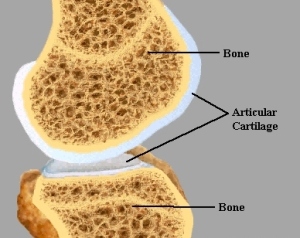
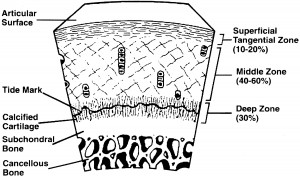
articular-cartilage-diagramWhat we are seeing is that the researchers state quite explicitly that “damaging the periosteum may be a way to generate ectopic cartilage or bone”. If we now remember, one of the central ideas on why Tyler thinks the LSJL technique works is because it leads to ectopic (not in the normal impacted location) microfractures which can result in mini growth plates. In the experiment the researchers cut into the bone on the proximal medial tibia side, beyond past the periosteum and got to the layer of proliferative cells right underneath the periosteum which is what really leads the bones to develop width based appositional periosteal growth leading to an overall constant thickness in the outer bone area/volume.

The periosteal tissue is taken at certain days after the cut made past the periosteum into the harvest tissue layer (day 10, 20, and 30). When these tissue is tested looking at the types of cells that develop after a few days, the researchers noticed that the periosteal tissue first turns into cartilage. This is confirmed from an immunohistochemical measurement where the fact that Collagen type I and type II are both expressed from the tissue the most around the 10 days postsurgery point. After a few more days however, the cartilage appear to change into bone cells from noticing the increased mRNA expression of collagen type X.

This indicates that it might be possible through delaying or suspending the inner cambium layer of the periosteum to cause a layer of cartilage to form and that can be converted into a chondrocyte stack leading to longitudinal legnthening.

F3.large

We can see from other PubMed articles like “Articular cartilage regeneration using periosteum.” and “The role of periosteum in cartilage repair.” that this technology has already been proposed and being utilized. Their abstracts are below…

Clin Orthop Relat Res. 1999 Oct;(367 Suppl):S186-203.

Articular cartilage regeneration using periosteum.

O’Driscoll SW.

Source

Department of Orthopedic Surgery, Mayo Clinic, Mayo Foundation, Rochester, MN 55905, USA.

Abstract

Periosteum has chondrogenic potential that makes it possible to repair or regenerate cartilage in damaged joints. Whole periosteal explants also can be cultured in vitro for the purpose of studying chondrogenesis. This chondrogenic potential arises because the cambium layer of periosteum contains chondrocyte precursor cells that form cartilage during limb development and growth in utero, and does so once again during fracture healing. The advantages of whole tissue periosteal transplants for cartilage repair include the fact that this tissue meets the three primary requirements for tissue engineering: a source of cells, a scaffold for delivering and retaining them, and a source of local growth factors. Data from in vivo studies show that periosteum transplanted into osteochondral articular defects produce cartilage that can restore the articular cartilage and be replaced by bone in the subchondral region. This capacity is determined by surgical factors such as the orientation of the cambium layer, postoperative factors such as the use of continuous passive motion, and the age and maturity of the experimental animal. In vitro studies have shown that the chondrogenic potential of periosteal explants is determined by culture, donor conditions, and technical factors. Chondrogenesis is optimized by suspension of the explants in agarose under aerobic conditions, with supplementation of the media using fetal calf serum and growth factors, particularly transforming growth factor-beta 1. The role of physical factors currently is being investigated, but studies show that the mechanical environment is important. Donor factors that are important include the harvest site, the size of the periosteal explant, and most importantly the age of the donor. Periosteal chondrogenesis follows a specific time course of events, with proliferation preceding differentiation. The current challenge is to clarify the process of periosteal chondrogenesis and its regulation at the cellular and molecular levels, so that it can be controlled intelligently and optimized for the purpose of cartilage repair and regeneration.

{Here’s an article I found-Tyler

Elucidating multiscale periosteal mechanobiology: a key to unlocking the smart properties and regenerative capacity of the periosteum?

“The periosteum, a thin, fibrous tissue layer covering most bones, resides in a dynamic, mechanically loaded environment. The periosteum also provides a niche for mesenchymal stem cells. Periosteum exhibits stress-state-dependent mechanical and material properties, hallmarks of a smart material.”

” In absence of graft, infilling occurs from the periosteum, toward the surface of the implant, which stabilizes the femur and fills the medullary cavity.  Biophysical and chemical environment of PDCs egressing from the periosteum into the critical-sized defect modulates tissue genesis (chondro- as well as osteogenesis).”

“the cytoskeleton is akin to a living bridge that restructures its architecture to minimize areas of stress concentration in high wind or traffic situations. Similarly, at the length scale of a tissue, the periosteum serves as bone’s bounding membrane and harnesses endogenous biophysical cues to modulate environmental conditions on either side (within and outside of bone).”

“Periosteum is highly vascularized and provides at least 1/3 of the blood supply to cortical bone, with the remaining supply coming from the intramedullary niche.”

“The periosteum is anchored to the bone by Sharpey’s fibers, strong fibers with a high collagen content. Sharpey’s fibers serve as a link between the exterior musculature and the interior skeleton and allow the periosteum to remain intact and attached to the bone, even after severe trauma occurs. In certain bones, Sharpey’s fibers anchor tendons and ligaments to the bone. Periosteum is absent at sites of tendon attachments. As tendon and ligament attachments vary by bone, periosteum morphology is highly variable between bones and even within bones.”

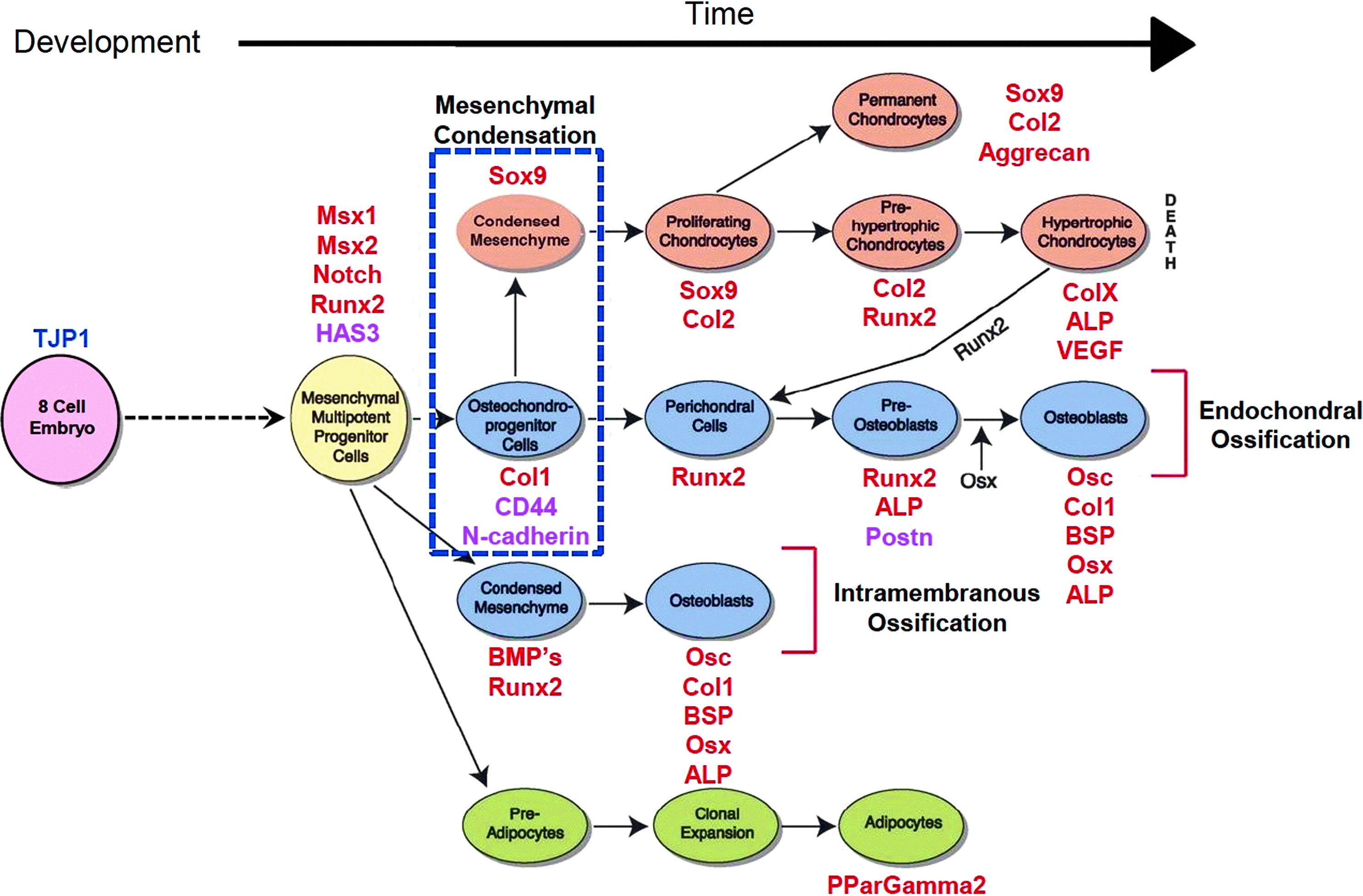
mesenchymal condensation genes“PDCs[Periosteum Derived Stem Cells] and BMSCs have been shown to differentiate along different lineages when cultured on the same roughened titanium surface, suggesting different pathways or mechanisms for mechanotransduction for MSCs from different niches.”

“The native environment of PDCs is mechanically regulated by a combination of tension and shear (given that the periosteum itself exhibits different moduli of elasticity in the longitudinal and circumferential directions). The intracellular tension PDCs experience is suggested to regulate long bone growth.”

“PDCs’ capacity to carry intracellular tension through their active microfilament network has been postulated to regulate a signaling cascade which, in turn, is responsible for the expression of soluble factors that modulate cartilage growth. The stiffness of the culture surface determines the magnitude of intracellular tension placed on the actin microfilament network.”

“mechanical signaling alone can cause PDCs to differentiate”

“PDC proliferation during periosteal chondrogenesis can be stimulated by DFP[Dynamic Fluid Pressure].”}

PMID: 10546647 [PubMed – indexed for MEDLINE
Analysis and Interpretation: The abstract shows that the cambium layer of periosteum has the precursor to chondrogenic type cells. These pregenitor cells are what form the cartilage in limb development in growth. They are also what caused the callus formation from fracture healing. Apparently the scientists have already been using this type of cell for tissue transplants for at least articular cartilage repair since it satisfies all three requirement, being a source of cells acting also as a scaffold and also hace local growth factors. It seems that the ability for transplanted and implanted periosteal tissue is determined by the culture, the donor conditions, and technical factors. However, we note that all of these factors can be manipulated in the laboratory until the optimum conditions for the three factors are found. The researchers in turn understand very well which factors are critical and which factors will need to be tested to see they are at the optimum conditions. The ending of the abstract shows that the technology for using periosteum derived pre-cursor chondrocytes is under way. they state “The current challenge is to clarify the process of periosteal chondrogenesis and its regulation at the cellular and molecular levels, so that it can be controlled intelligently and optimized for the purpose of cartilage repair and regeneration.”

The role of periosteum in cartilage repair. 

Clin Orthop Relat Res. 2001 Oct;(391 Suppl):S190-207.

The role of periosteum in cartilage repair.

O’Driscoll SW, Fitzsimmons JS.

Source

Department of Orthopedic Surgery, Mayo Clinic, Mayo Foundation, Rochester, MN 55905, USA.

Abstract

Periosteum, which can be grown in cell and whole tissue cultures, may meet one or more of the three prerequisites for tissue engineered cartilage repair. Periosteum contains pluripotential mesenchymal stem cells with the potential to form either cartilage or bone. Because it can be transplanted as a whole tissue, it can serve as its own scaffold or a matrix onto which other cells and/or growth factors can be adhered. Finally, it produces bioactive factors that are known to be chondrogenic. The chondrocyte precursor cells reside in the cambium layer. These vary in total density and volume with age and in different donor sites. The advantages of whole tissue periosteal transplants for cartilage repair include the fact that this tissue meets the three primary requirements for tissue engineering: a source of cells, a scaffold for delivering and retaining them, and a source of local growth factors. Many growth factors that regulate chondrocytes and cartilage development are synthesized by periosteum in conditions conducive to chondrogenesis. These include transforming growth factor-beta 1, insulinlike growth factor-1, growth and differentiation factor-5, bone morphogenetic protein-2, integrins, and the receptors for these molecules. By additional study of the molecular events in periosteal chondrogenesis, it may be possible to optimize its capacity for articular cartilage repair.

Analysis and Interpretation: This abstract is a sort of review of the technology to use periosteum in cartilage repair. It has one or more of the three primary factors to make tissue engineered cartilage repait possible. It has the pluripotent mesenchymal stem cells, it has the scaffold or matrix which the cells and growth factors can adhere to. It also produces within itself (locally) the type of growth factors need to lead the MSCs to cartilage cells. The growth factor the periosteum can manufacturer and release for cartilage formation are TGF-beta 1, IGF-1, GDF-4, BMP-2, integrins, and the receptor for the growth factors. While the writers of this article are imagining and thinking abut how to use this pool of amazing resource for articular cartilage repair, we are thinking about how to use the periosteum in epiphyseal cartilage regeneration.

PMID: 11603704 [PubMed – indexed for MEDLINE]

What Is The Most Height Gain One Can Achieve Through Exercises And Stretching After Puberty And Growth Plate Closure?

So I am going to take some time today to answer this question so that it will go in the Frequently Asked Questions section.

What I am finding is that even though I have created a FAQs Section to the website, I still get around half a dozen emails everyday asking me the same questions.

The two most common variations of questions are (and I have already wrote about it 3 times already).

  • Hi. I am 16-30 years old (in some age in that range). I am this tall. Can I still grow taller?
  • I want to be 4-7 inches Taller. I am 5′ 1″-5’5″ male and I want to be 5′ 10″-6′ 2″. What supplements/ pills can I take to grow taller?

In each of these questions, you realize that both of them are loaded questions.

In the first question, they just are hoping that I will say yes to this question. The truth is that the chances are low and that they probably won’t gain even half a centimeter of height increase if they don’t start taking some form of action immediately, in the form of exercising and stretching.

In the second question, they are hoping that I will tell them some secret, unknown chemical compound supplement which no one has heard before yet which will be essentially a “Magic Pill” which I have already talked about. The truth is that the real answer to this question is that there is no single pill that will no everything.

A common variation to the supplement/pill question is to ask is there a type of pill that the person can take which will have all of the essential, suggested active ingredients. And my answer is a quick no. Again what the question is looking for is a “Magic Pill“, that has all of the height increase benefits, at least one which really does work. Throughout the internet space there are few website which do claim that they have all of the essential ingredients needed to stimulate increased height growth rate in them, but all of them are fake, at least all of the supplements I have looked at. Not one of them have been able to give a theory on why the pills they are selling could possibly work and resolve the issues dealing with the chondrogenesis process and how to get over the hard, strong cortical bone extracellular matrix.

I am going to be completely honest with the questioner right now. Everything I know I have already revealed to the reader at some point in the website. What you know from reading the website is what I know, and that is the limit and extend of my knowledge.

So if the answers to the two most common asked questions to the email are…

Answer to question #1: “Probably not, but you can try by  reading the Exercise Guide Section and buy the supplements in the Supplement Guide Section

Answer to question #2: “There is no pills that will guarantee height increase but you can try out the supplements I suggested in the Supplement Guide Section.”

Since these two most commonly asked question are finally completely and fully answered, I will answer what I think is a third and maybe the real question many questioners are really asking to me, but don’t realize is their real intention…

“What Is The Most Height Gain One Can Achieve Through Exercises And Stretching After Puberty And Growth Plate Closure?”

This question is assuming that the supplements i suggested the questioner and reader try to buy and take is either not used or is being used and having no noticeable effects. The answer is that for most people, the maximum height increase they can get, both temporary and permanent would be around the 1.5″ or 4 cm range. That is what in my professional research opinion is possible for height increase for 99.99% of all people in a large group. 4 cm or 1.5 inches is both lage enough to be noticeable and small enough to not be that dramatic. For most people, they will never go beyond 2 cm of potential height increase due to their posture and vertebrate curvature already inherent in their skeletal structure.

However,we must not remember that extremely tall people can have an even greater amount of height increase, by upwards of 5 cms. A person like Paul Gasol who has been measured at a little over 7 feet tall can have his height show a variation as large as 1.50-2 inches of height difference between the time of him first getting out of bed and right before he goes to bed to decompress his vertebrate. We see from Tyson Chandler’s predraft measurements that he was actually 6′ 11.50″ in height without shoes, 7′ 0.5″ with shoes on, a 7′ 3″ length in wingspan, and a 9′ 2″ reach.  (source) However, we know that he is listed as 7′ 1″ on most of the basketball and NBA website directories. This could also be right which would suggest that a human male that is over 5 standard deviations away from the average height can have a high variation in his height, and at some points of the day really be 7′ 1″ and at other times 1.5″ less. For these super tall humans, the amount of height increase they can get through exercises and stretching can be up to 5 cm in height increase, but however by the time there are already around 7 feet tall, it would really make little sense for them to desire to be any taller for any good practical reasons.

So if you are going to go through with some form of exercise routine or stretching program, the most that almost everyone should expect is about 1.5 inches of height increase.

As a sort of example, let me show my own process. As for myself, I focused on swimming at least 2 hours a day, sleeping without a pillow, doing decompressive stretching while lying after waking up which involved lunges. I also bought an inversion table and used that with twisting of the torso for maybe 10 minutes everyday until my head got dizzy from the blood flow down to my head. I also used yoga posed that focused on bending and stretching my back. I was very consistent in when I would measure my height and even shaved my head to make sure my hair would not cause any height measurement eror. This went on for about 4 months. In the end I gained 0.25 of an inch.