Author Archives: Tyler

new study from LSJL authors

Predicting and Validating the Pathway of Wnt3a-Driven Suppression of Osteoclastogenesis.

“we examined Wnt3a-driven regulation of osteoclast development. Mouse bone marrow-derived cells were incubated with RANKL in the presence and absence of Wnt3a. Using microarray mRNA expression data, we conducted a principal component analysis and predicted transcription factor binding sites (TFBS) that were potentially involved in the responses to RANKL and Wnt3a. The principal component analysis predicted potential Wnt3a responsive regulators that would reverse osteoclast development, and a TFBS prediction algorithm indicated that the AP1 binding site would be linked to Wnt3a-driven suppression. Since c-Fos was upregulated by RANKL and downregulated by Wnt3a in a dose-dependent manner, we examined its role using RNA interference. The partial silencing of c-Fos suppressed RANKL-driven osteoclastogenesis by downregulating NFATc1, a master transcription factor of osteoclast development. Although the involvement of c-Myc was predicted and partial silencing c-Myc slightly reduced the level of TRAP, c-Myc silencing did not alter expression of NFATc1. Collectively, the presented systems-biology approach demonstrates that Wnt3a attenuates RANKL-driven osteoclastogenesis by blocking c-Fos expression and suggests that mechanotransduction of bone alters the development of not only osteoblasts but also osteoclasts through Wnt signaling.”

LSJL upregulates c-Fos.  In all likelihood LSJL alters Wnt3a expression but there wasn’t any evidence in the LSJL gene expression studyFluid flow upregulates Wnt3a and LSJL does involve fluid flow although this was only in osteocytes and we’d want to know the effects on stem cells or chondrocytes for height growth purposes.  No evidence that LSJL alters Nfatc1 expression but it likely does and Salubrinal alters Nfatc1 expression.  According to a diagram, from that study LSJL would increase Nfactc1 expression but it reduces levels of phosphorylated eif2a.

“Wnt5a activates noncanonical Wnt signaling through a receptor tyrosine kinase-like orphan receptor and stimulates osteoclastogenesis. Wnt10b is required for maintenance of mesenchymal progenitors, and its deficiency leads to loss of bone mass. Wnt14 enhances endochondral ossification and accelerates chondrocyte maturation”<-Wnt14 may alter height.  However, Wnt14 does suppress chondrogenic genes and I couldn’t find any studies stating that Wnt14 transgenes or knockout causes overgrowth or undergrowth.  Genetic association study of WNT10B polymorphisms with BMD and adiposity parameters in Danish and Belgian males., says that Wnt10b may have an effect on height but more testing needs to be done.

“Mouse bone marrow cells isolated from long bones (femur and tibia) as well as RAW264.7 mouse pre-osteoclast cells [were used in the study]”.  If mouse bone marrow cells were used it may have ramifications for how stem cells are affected by stimuli and finding the right stimuli is the key for height growth.

“Administration of RANKL to bone marrow cells significantly increased the number of TRAP-positive multi-nucleated cells{osteoclast cells are trap-positive}. In response to 100 or 200 ng/ml of Wnt3a, the number of TRAP-positive cells was reduced in a dose-dependent manner. The observed suppression of osteoclast development by Wnt3a was associated with a decrease in the phosphorylated form of β-catenin (p-β-catenin) as well as NFATc1 ”

“Wnt3a-induced reduction of the relative mRNA expression levels of the genes (NFATc1, TRAP, OSCAR, MMP9, and cathepsin K) linked to osteoclastogenesis on days 1 and 2 in bone marrow cells”<-Note that none of these levels were lower than control(The cells that were not exposed to RANKL) and the reduction was dose dependent until at least 200ng/ml.

Wnt3a downregulates C-Fos and C-Fos may be an important part in LSJL induced growth.

Wnt3a upregulated Egr1, Notch1, and Tgif1 at greater levels than control so excess levels of Wnt3a may have an effect on stimulating on those genes even without altering cells exposed to RANKL.  It downregulated Hmga1, Smad3, Dnmt3a, and Bach1 versus control.  Smad3 is involved in TGF-Beta induced chondrogenesis.  Dnmt3a promotes DNA methylation.

Growth Plate Repair

RECENT RESEARCH ON THE GROWTH PLATE: Mechanisms for growth plate injury repair and potential cell-based therapies for regeneration

“[The growth plate] functions to produce a mineralised cartilaginous scaffold to which new trabecular bone is formed via a tightly controlled two-step process (called endochondral ossification) involving chondrogenesis and osteogenesis ”

“The resting zone has previously been thought to play a very minimal role during endochondral ossification as the pre-chondrocytes/cells within this zone proliferate minimally. However, studies have indicated the importance of the resting zone as it acts as a reservoir of stem cells/pre-chondrocytes for the chondrocytes in the adjacent proliferative zone”

“The proliferative zone is responsible for matrix production (including collagen-2 and aggrecan) and cellular division during endochondral ossification. The height of the proliferative zone directly correlates with the extent of longitudinal growth that can be achieved by the long bone. As regulated by various signalling pathways including parathyroid hormone-related protein, insulin-like growth factor (IGF1), bone morphogenic protein (BMP), Wnt/B-catenin, fibroblast growth factor (FGF) and others , chondrocytes cease to proliferate and become hypertrophic. The hypertrophic chondrocytes produce collagen-10 which is involved with matrix mineralisation. Together with the action of angiogenic factor vascular endothelial growth factor (VEGF) produced by hypertrophic chondrocytes and a low oxygen tension, the lower hypertrophic zone attracts blood vessel invasion from the adjacent metaphyseal bone, which brings along mineralised cartilage-resorptive cells (chondroclasts), bone-forming cells (osteoblasts) and bone-resorptive cells (osteoclasts) to convert the mineralised cartilage scaffold into trabecular bone in metaphysis.”

growth plate injury repair

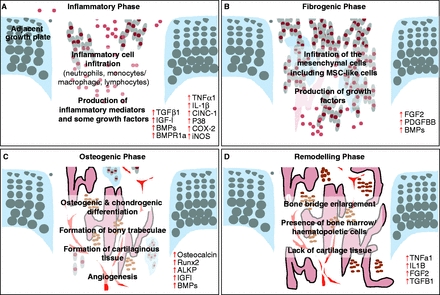
“The initial inflammatory response involves an influx of key inflammatory cells into the growth plate injury site and up-regulation of inflammatory cytokines/mediators and some growth factors (A). The fibrogenic phase involves an influx of fibrogenic and progenitor cells containing MSC-like cells (B). The osteogenic phase involves the osteogenic and chondrogenic differentiation, formation of bony trabeculae together with angiogenesis within the injury site (C). The remodelling phase involves the maturation and active remodelling of the newly formed bony trabeculae as well as disappearance of cartilaginous repair tissue (D).”<-Cinc1 is also known as IL8 or CXCL1{Which is upregulated by LSJL}

“neutrophil-mediated inflammatory response was found to modulate downstream injury repair events. Following the depletion of neutrophils with a neutralising antibody, an increase in the undesirable bony repair tissue [occurred] with increased expression in bone-related genes such as Runx2 and osteocalcin, but decreased expression in cartilage-related genes Sox9 and collagen-2 ”

“Blocking TNFa resulted in a clear delay in the subsequent mesenchymal infiltration response and a reduction of the proliferation of these cells”

“At the growth plate injury site, some of these cells were found to express growth factors including BMPs, platelet-derived growth factor (PDGF) and FGF2 and receptors for BMPs and PDGF. In addition, some of these cells were found to be MSC like as they expressed the stem cell marker alpha-smooth muscle actin{acta2 which is upregulated by LSJL}”

“this influx of mesenchymal cells may contain a myriad of cells including MSC-like cells, osteoprogenitor cells, pre-osteoblasts, and/or pre-chondroblasts (either pre-existing or newly derived from the infiltrated MSCs).”

“significant peak in the mRNA expression of platelet-derived growth factor (Pdgf) and fibroblast growth factor 2 (Fgf2){up} following the initial inflammatory phase, suggesting a potential regulatory role for these two growth factors during this phase”

“In rats with growth plate injury, the inhibition of PDGF signalling caused a significant reduction in the amount of mesenchymal infiltrate, decreased amounts of bony and/or cartilage repair tissues, and thus an overall delay in bony repair 14 days post-injury”

“At the injured growth plate, bone formation has been observed to commence around day 7 with the appearance of bony trabeculae, and bone remodelling has been observed by day 14 with the appearance of bone marrow cells in between bony trabeculae”

“During the osteogenic phase of the growth plate injury repair process, the cells within the fibrogenic infiltrate differentiate into Runx2 and alkaline phosphatase-immunopositive osteoblasts and produce increased levels of bone matrix protein osteocalcin (both mRNA and protein) during days 8–14”

“after a ‘fibrous tissue’ is formed from the infiltrated stromal cells at an injured growth plate, its invasion by new blood vessels is a prerequisite for its osseous transformation”

“the absence of VEGF delayed bone formation by halting the initial soft callus from being converted into hard bony callus. ”

“osterix over-expression can induce bone healing”

“PKD up-regulates osterix and [is] important for osteoblast differentiation. Inhibition of PKD suppressed bony repair but induced more chondrogenic differentiation at the injury site”

“over-expression of osterix in osteochondroprogenitor cells resulted in a decrease in chondrogenic transcription factor Sox9.”

“In a rat tibial drill hole growth plate injury model, levels of Bmp2 mRNA expression were found notably increased in the early part of the fibrogenic phase and then again later during the osteogenic phase”

“synovium-derived MSCs in particular had the greatest capability to enhance the chondrogenic differentiation potential when compared with any other mesenchymal tissue-derived cells. However, other studies have reported that bone marrow-derived MSCs (BMMSCs) are most suitable for cartilage tissue engineering, as they possess higher proliferation rates and higher levels of expression of cartilage-specific genes, when compared with MSCs derived from other tissues”

“MSCs were successfully isolated directly from murine epiphysis.  This novel type of MSCs could potentially be better than BMMSCs as they have shown greater capacities in growth and differentiation potential as well as possessing immunosuppressive and anti-inflammatory properties”

LSJL Studies 3: Lengthening of mouse hindlimbs with joint loading

This is the most significant LSJL study to date.

Three key takeaways from this study:

1) LSJL increases bone length in existing growth plates via traditional mechanisms(chondrocyte hypertrophy)

2) LSJL increases bone length in non-traditional mechanisms as shown by the fact that LSJL also stimulates the reserve zone.  Reserve zone cells being the chondrocyte precursor cells and the ones able to form new growth plates.

3) LSJL dramatically alters the microenvironment of the bone(as shown by the histological slides).  It’s unclear exactly what changed but the decrease in bone trabeculae and the increase in bone marrow means that an LSJL loaded bone is more permissive to growth plate formation.  Osteomy is essential for renewed longitudinal bone growth.  As cartilage is capable of interstitial growth which induces longitudinal bone growth whereas bone is not.

Lengthening of mouse hindlimbs with joint loading

“Loads were applied to the left hindlimb (5-min bouts at 0.5 N[at 5Hz) of C57/BL/6 mice (21 mice, ~8 weeks old). Compared to the contralateral and age-matched control groups, knee loading increased the length of the femur by 2.3 and 3.5%, together with the tibia by 2.3 and 3.7%, respectively. In accordance with the length measurements, knee loading elevated BMD and BMC in both the femur and the tibia. Histological analysis of the proximal tibia revealed that the loaded growth plate elevated its height by 19.5% and the cross-sectional area by 30.7%. Particularly in the hypertrophic zone, knee loading increased the number of chondrocytes as well as their cellular height along the length of the tibia.”

3min/day for 5 days/week for 10 days total was LSJL applied.  Bone was harvested 18 days after the last loading.

“Femoral length was defined as the maximum distance from the distolateral condyle to the
most medial and proximal position on the femoral head. Tibial length was defined from the most proximal position of the tibial plateau to the most distal position of the medial malleolus.”<-this is important as changing where and how femoral length is measured would effect total femur length.  It is hard to tell the ramifications of this length setting for sure without more data though.

“The height of the growth plate (GP) was defined from the apical[apex] border of the reserve zone to the lower border of the mineralized cartilage”<-So the measurement of growth plate height would likely include not just growth plate chondrocytes but chondrocyte progenitor cells.  And you’d need chondrocyte progenitor cells to form new growth plates.

According to Artificial selection sheds light on developmental mechanisms of limb elongation, an increased number of proliferative chondrocytes is likely the cause of increased height.

“the upper boundary of the hypertrophic zone was identified at the margin of the
chondrocytes that increased their size relative to those in the proliferative zone, whereas its lower boundary was at the terminal intact chondrocytes next to the metaphysis”

“At the cellular level, the numbers of proliferative and hypertrophic chondrocytes were counted and the total number of chondrocytes was calculated as their sum. The height of hypertrophic chondrocytes was determined using at least 20 cells in each slice”

“During knee loading, no apparent damage was detected at the site of loading or injection.”

“the longitudinal length of the femur was increased by 2.3% (14.19 ± 0.28 mm in contralateral control; 14.51 ± 0.28 mm in knee loading)”

“the longitudinal length of the tibia was increased by 2.3% (16.68 ± 0.23 mm in contralateral control; 17.06 ± 0.21 mm in knee loading)”<-interesting that the percent increase is so comparable(both 2.3%).

“Compared to the age matched control, knee loading increased the longitudinal length by 3.5% in the femur and by 3.7% in the tibia”<-Also a very similar percentage.

In the elbow loading study, “humerus was elongated by 1.2% compared to the contralateral and age-matched controls, while the ulna had become longer than the contralateral control (1.7%) and the age-match control (3.4%)”.  In 16 week mice(see same link above), the increase in length was 1.6% in the tibia.

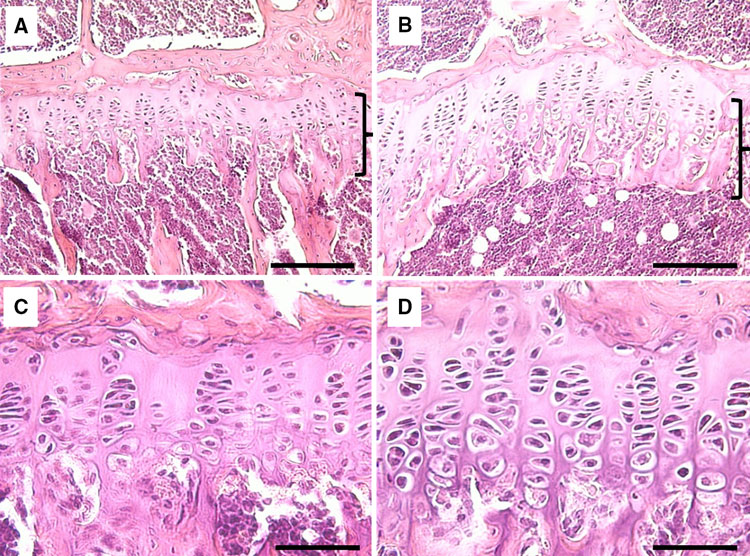
Here is the growth plates under LSJL(I provide a more detailed analysis here):

LSJL growth plates

“H&E-stained sections of the growth plate in the proximal tibia. a Growth plate of the contralateral control. The bracket denotes the growth plate. b Growth plate (bracket)
of the loaded tibia. c Proliferative and hypertrophic zones of the contralateral control. d Proliferative and hypertrophic zones of the loaded tibia. Bars a, b 100 micro-m; c, d 200 micro-m”

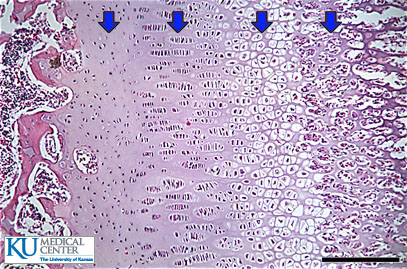
Here’s a baseline growth plate with similar colors:

resting-zone

It’s difficult to say exactly what is going on in the growth plates of the control and LSJL-loaded version but what is clear is that the micro-environment of the two bones is dramatically different.  The LSJL loaded growth plate has much more bone marrow and many more osteoclasts(the white spots; although those spots could also be adipose tissue).  The increase in bone marrow and loss of bone trabeculae would be more enabling for micro-growth plates.  Thus, LSJL could create a more favorable microenvironment for micro-growth plates.

“Histological analysis revealed that knee loading increased the height and the cross-sectional area of the growth plate in the proximal tibia. First, the total growth plate height was increased by 19.5% (175 ± 25.6 micro-m in contralateral control; 210 ± 18.1 micro-m in loading) including the heights of the proliferative zone and the hypertrophic zone. In particular, the height of the hypertrophic zone was extended by 33.6% (48 ± 4.6 micro-m in contralateral control; 65 ± 3.4 micro-m in knee loading). Note that the height ratio of the hypertrophic zone to the growth plate (HZ/GP) was significantly increased, whereas the ratio for the proliferative zone (PZ/GP) was not altered”

“the cross-sectional area of the growth plate was increased by 30.7% (0.263 ± 0.108 mm2 in contralateral control; 0.344 ± 0.095 mm2 in knee loading)”

“At the cellular level, the numbers of chondrocytes were increased in the total growth plate and the hypertrophic zone by 28.5% and 46.3%, respectively. In the proliferative zone, however, no statistically significant difference in the numbers of cells was detected”

“the height of individual chondrocytes in the hypertrophic zone was elevated in the loaded side (16.3 ± 1.67 micro-m) compared to the control side (13.0 ± 1.45 micro-m)”

“oscillatory loads laterally applied to the knee not only induce anabolic responses but also lengthen the femur and the tibia.”<-Interesting that they do not state the necessity of an existing growth plate in this statement although admittedly this is not strong evidence.

The total length increase in the growth plate was more than the sum of the increases in the proliferative and hypertrophic zones, indicating that other regions such as the resting and calcifying zones were also affected“<-This is huge as the resting zone is where chondrocyte progenitor cells are derived.  If LSJL can induce mesenchymal stem cells to become chondrocyte progenitor cells than it can create new growth plates.

“Because the cross-sectional area of the growth plate is significantly increased with knee loading[the growth plate is wider], the data support that the bone-lengthening effects are not limited only to the lateral or medial loading site. At the cellular level, the number of chondrocytes in the hypertrophic zone was increased together with their cellular height. Our results are consistent with the notion that dynamic tensile and compressive loads stimulate and suppress longitudinal growth, respectively”

“In knee loading, the rate of lengthening with 0.5 N loads (peak-to-peak) was 0.1% per bout (femur) and 0.1% per bout (tibia) for 5-min loading per day.”

“both loaded and contralateral hindlimbs increased in length in the tibia.”

LSJL Studies 2: Effect of holes on LSJL

Not a lot on this study relating to longitudinal bone growth.  The important takeaway is evidence that LSJL can cause bone degradation which would be an important part of the process for neo-growth plate formation.

Effects of surgical holes in mouse tibiae on bone formation induced by knee loading.

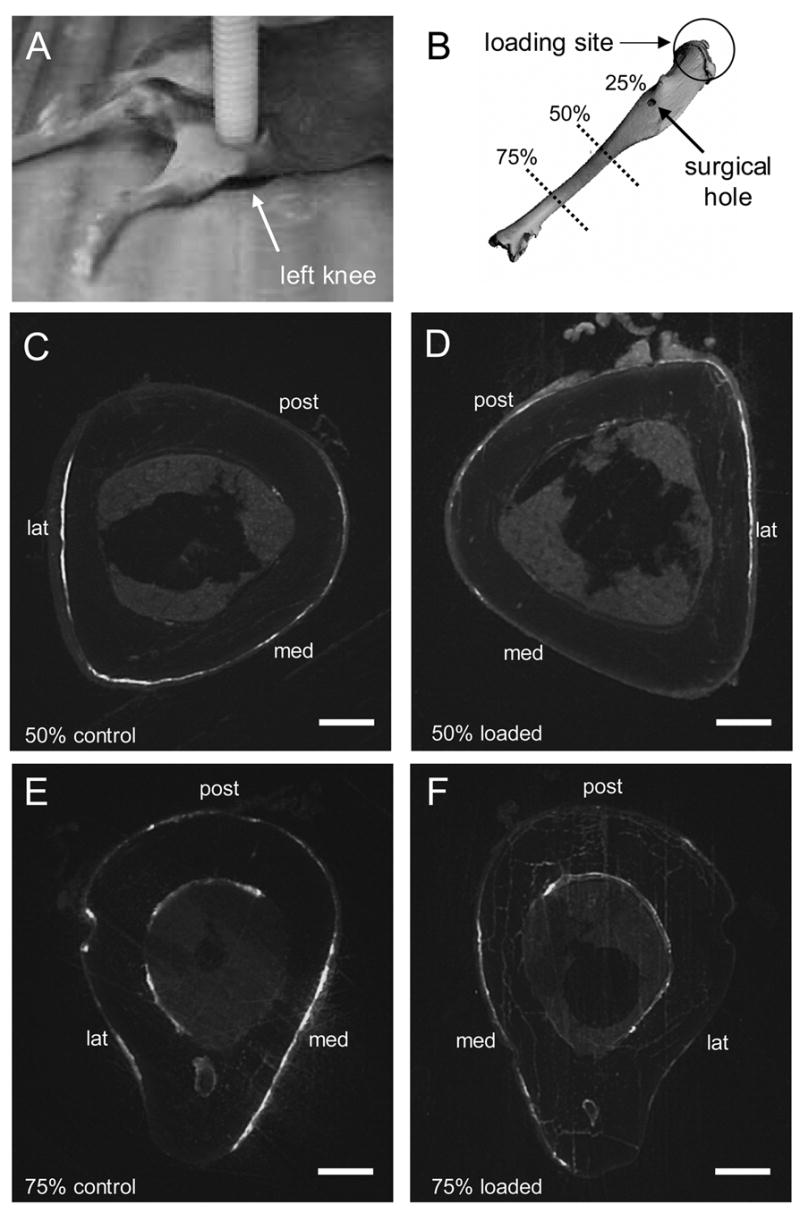
“Loads applied directly to the knee (knee loading) have induce anabolic responses in femoral and tibial cortical bone. In order to examine the potential role of intramedullary pressure in generating those knee loading responses, we investigated the effects of drilling surgical holes that penetrated into the tibial medullary cavity and thereby modulated pressure alteration. Thirty-nine C57/BL/6 female mice in total were used with and without surgical holes, and the surgical holes were monitored. The left knee was loaded for 3 days[at 5Hz at 0.5N for 3 min a day], and the contralateral limb was treated as a sham-loaded control. Mice were sacrificed 2 weeks after the last loading. Although the surgical hole induced bone formation in both loaded and non-loaded tibiae, due to regional and systemic acceleratory phenomenon the anabolic effect of knee loading was substantially diminished. Without the holes, knee loading significantly elevated cross-sectional cortical area, cortical thickness, mineralizing surface, mineral apposition rate, and bone formation rate on the periosteal surface. For example, the rate of bone formation was elevated 2.1 fold (middle diaphysis–50% site from the knee along the length of tibiae) and 2.7 fold ( distal diaphysis–75% site). With the surgical holes  knee loading did not provide significant enhancement either at the 50% or 75% site in any of the histomorphometric measurements. Alteration of intramedullary pressure is necessary for knee loading to induce bone formation in the diaphysis{it may also be necessary to induce longitudinal bone growth} .”

Now they do say however that the drilling of the epiphysis did induce a response of the bone just not the same adaptations as it did without drilling.  Note that drilling was used rather than microfracture.  Although we can’t say for sure how surgical holes would affect LSJL’s effects on longitudinal bone growth.

“On days 2 and 6 after the last loading, the mice were given an intraperitoneal injection of calcein” and the results are shown below.  Calcein is used as a Ca2+ and Mg2+ indicator which are two proteins that are strong components of bone.

Without drilling:

Note that in group D which is the loaded group there is a huge hole in the middle of bone indicating that LSJL may in fact cause bone degradation which would allow for cartilagenous growth plates.  The fluid flow degrades bone and osteomy(removal of bone) may be necessary for new chondrogenesis.  It’s possible that this degradation of bone occurs in the epiphysis as well.  In group F the hole is smaller.  Group F was farther away from the site of loading than group.  Perhaps LSJL induces bone degradation more at sites closer to loading rather than farther away from loading.
  Slides were only taken from above so it’s possible that there would be bone degradation visible if the bone was horizontally sliced.  Bone degradation from a horizontal degradation would be ideal to allow for new growth plate formation for renewed longitudinal bone growth.
With drilling:
In this group both C and D have holes but in group F versus E the hole is much bigger in F.  In D the bone degradation is much more scattered than in C.  So LSJL can increase bone degradation in the body.
Unfortunately this study was performed before Yokota and Zhang realized that Lateral Synovial Joint Loading could be used to increase bone length so they didn’t measure the things that would interest us height seekers like if the tibia and femur had increased in length.

” knee loading induces alteration of intramedullary pressure in the femoral bone cavity and this alteration is synchronous to the loading frequency in Hz”<-The higher the frequency, the greater the intramedullary pressure.  I’m not sure exactly how to alter the frequency via LSJL but I believe that clamping/release from clamping/and then clamping again.

“cyclic deformation of the epiphysis alters pressure in the medullary cavity and the pressure gradient induces fluid flow in the diaphysis “<-Although fluid flow which can increase nutrient supply to chondrocytes, the number of changes induced to the growth plate via LSJL cannot be explained by just an increase in nutrient.

“In the presence of surgical holes, it is expected that the gradient is not adequately established because of incomplete pressure sealing.”

“A pressure gradient, elevated by venous ligation, was shown to increase interstitial fluid flow and this flow-mediated bone adaptation was considered to be independent of mechanical strain ”

“During knee loading no bruising or other damage was detected at the loading site, and after loading mice did not show a weight loss or a diminished food intake.”

“Osteoblast specific factor 2 (periostin) is preferentially expressed on periosteum and considered to play a role in the recruitment and attachment of osteoblast precursors in the periosteum”

“knee loading herein induces approximately 30 μstrain at the site of bone formation and the number of loading cycles per day is 900 for 3 days”

LSJL Studies 1: Osteogenic potentials with joint loading modality

I will be going over all the LSJL studies to see if I missed anything or to find new insights.

Osteogenic potentials with joint-loading modality.

Here’s the paper: osteogenic LSJL study.
“Osteogenic potentials with a novel joint-loading modality were examined, using mouse ulnae as a model system. Load-induced deformation of rigid bone [generates] interstitial fluid flow and stimulate osteogenesis. However, in most of the previous studies, loads were applied to cortical bone. In the current study, we addressed the question of whether deformation of the epiphysis underneath the joint would enhance bone formation in the epiphysis{New bone formation in the epiphysis can increase height if the bone is added at the longitudinal ends} and the diaphysis. We applied lateral loads to a mouse elbow. Compared to the no-loading control, 0.5-N loads, applied to the elbow at 2 Hz for 3 min/day for 3 consecutive days, increased the mineralizing surface (two- to threefold), the rate of mineral apposition (three- to fivefold), and the rate of bone formation (six- to eightfold) in the ulna. Strain measurements indicated that strains of around 30 microstrain{30 microstrain is extremely low according to mechanostat theory}, induced with the joint-loading modality, were under the minimum effective strain of around 1000 microstrain, which is considered necessary to achieve strain-driven bone formation. To evaluate the induction of fluid flow with the joint-loading modality, streaming potentials were measured in separate experiments, using mouse femurs ex vivo. The streaming potentials correlated to the magnitude of the load applied to the epiphysis, as well as the flow speed in the medullary cavity.  Joint-loading [induces] osteogenesis, through a mechanism that involves the induction of fluid flow in cortical bone.”

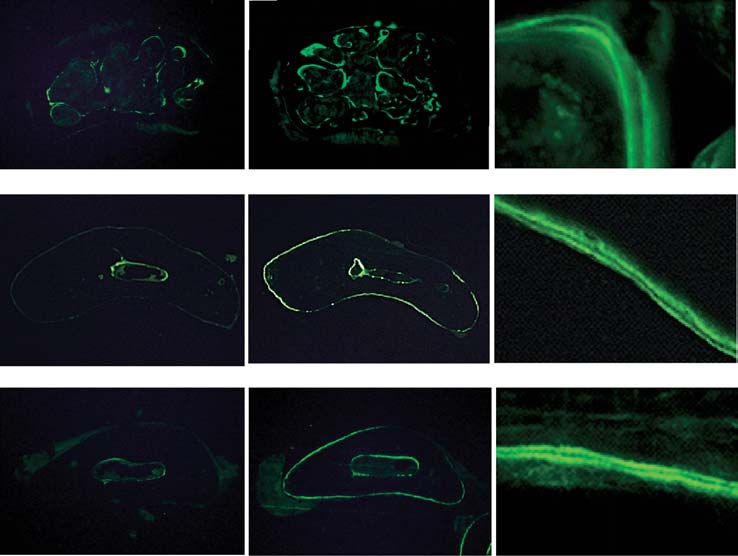
loading versus loaded LSJLColumn 1 is unloaded.  Column 2 and 3 is LSJL loaded.   It’s hard to tell in this pictures if LSJL created any gaps in the bone where new growth plates could form.  The diagrams are not in enough to tell to notice the formation of any microgrowth plates at least in figure 2a.  Calcein staining was used in these studies which detects mostly Ca2+ and Mg+ so it cannot distinguish between potential micro-growth plates and regular bone.

Here’s what the text had to say about the above diagram:

“Cross-sections of the ulnar shafts of control (no loading) and joint-loaded mice. The zoom images on the far right show double calcein staining, where the confined area constituted bone newly formed in 4 days. A Section of the metaphysis (trabecular bone) 1 mm from the loading center. The light staining outside the periosteal surface is collagen autofluorescence in a tendon of the triceps. B Section of the diaphysis (cortical bone) 2.5 mm from the loading center. C Section of the diaphysis (cortical bone) 4.5mm from the loading center”

“Trabecular bone in the epiphysis is less stiff in the lateral direction than in the axial direction and, therefore, lateral loads to the elbow may effectively deform the epiphysis of the ulna.
Deformation of the epiphysis may then induce fluid flow in the ulnar diaphysis in cortical bone, and load-induced fluid flow may enhance bone formation in the epiphysis{and possible stimulations of the epiphysis could be such as to spur new longitudinal bone growth} and the diaphysis.”

14 week old mice were used.  “3min per day for 3 consecutive days. The loading force was sinusoidal, at 2Hz, with a peak-to-peak amplitude of 0.5N.”

“The measured intramedullary streaming potential (f1, in mV) correlated to the magnitude of the applied force, according to the equation: f1 = 7.3 ¥ F (r2 = 0.92)”

“the magnitude of the streaming potential in the medullary cavity is proportional to the lateral load applied to the joint and the speed of fluid flow.”

If you look at figure 1a you can see that the device used is a lot like a C-class clamp with the nylon screw.

“The tip of the loader had a contact area of 4 mm in diameter. In order to avoid local stress concentrations between a joint and the loader, the surface of the loader was covered with a silicon rubber sheet.”

It should be noted by analyzing Table 1 that LSJL increases the bone formation rate of bone near the periosteum than trabecular bone.   Since the periosteum is partially involved in growth plate formation this is not necessarily a bad thing and since trabecular bone is still stimulated it still means that LSJL stimulates all areas of the bone and that LSJL could target any area of the bone that could be required to be targeted for neo-growth plate formation.

“[With axial loading], the force required to elevate the rate of bone formation is reported to be 2.3 N . With the joint loading modality described here, bone formation was enhanced by loads as small as 0.5 N.”<-So LSJL requires about 21% as much load to stimulate the bone as axial loading.  Let’s say hypothetically, that 1000lbs of axial loading could stimulate neo-growth plate formation.  LSJL would only require 210lbs.  Although, the rate of bone formation is irrelevant to what we’re looking for as we’re looking for longitudinal bone formation via neo-growth plates and that may be a result of stimulus that is unique to LSJL that axial loading cannot provide.

“The cross-sectional images of the ulna, together with the data on bone strains, support the notion that enhanced formation of cortical bone was an adaptive response to mechanical stimuli rather than a response associated with wound healing. First, the histological sections clearly showed double-labeled staining on the periosteal surface, with no indication of woven bone, which would frequently be formed in the process of wound healing. Second, unlike the four-point bending modality, where woven bone is formed underneath soft connective tissues, due to bending moment or compressive stress”<-it may be better if LSJL did increase bone formation as a result of wound healing as that could indicate the formation of holes in the bone where neo-growth plates could form.  However, the lack of woven bone could mean that cartilage was formed instead of bone which would be very promising indeed.

“the speed of the intramedullary fluid flow induced by 0.5-N loads, applied to the knee, is estimated as 476micro-m/s.”

This study was published in 2005 whereas lengthening of mouse hindlimbs with joint loading was published in 2010 so they were not yet aware of the lengthening effects.  And the load was only applied for 3 days which is not a lot of time for bone lengthening to occur.

I did email the author to try get length data but I don’t know if he’ll respond.

Osteochondroma’s can grow after skeletal maturity

This can provide benefit to the theory of microgrowth plates.

CASE REPORTS: Enlargement of a Calcaneal Osteochondroma after Skeletal Maturity

“Growth or radiologic modification of an osteochondroma after the epiphyseal plate closes suggests the diagnosis of malignant transformation to a chondrosarcoma. However, extensive growth of an osteochondroma in a skeletally mature patient whose tumor proved benign has been reported. We report a similar case in an adult who had a solitary osteochondroma of the calcaneus. The lesion showed marked growth and was removed. Histologic examination showed no evidence of malignancy, and there was no recurrence during the 4-year followup.”

The man was 36 years old although it’s alluded that the osteochondroma was developed during skeletal development.

” bulky 2-cm thick cartilaginous cap, an irregular and indistinct appearance of the surface of the calcified tissues beneath the cap, scattered calcifications in the soft tissue component of the tumor, radiolucent foci in the lesion, and a large low-density soft tissue mass. However, no destruction of the adjacent bone was visible.”

The images tend to not be informative.  Just a white mass amonst the calcaneus bone.

calcaneusosteochondroma  Looking at that image it seems possible that the growth could provide a height and length increase but seems mostly lateral to the region that would increase foot height and length.

Here’s a normal calcaneus:

normal calcaneusAlthough this foot seems much larger than the normal.

“the cartilaginous cap appeared hyperplastic and had foci of increased cellularity. The chondrocytes were organized in clusters and had no significant atypia.”

“An osteochondroma develops when growth plate tissue is extruded laterally and proliferates into an exostoses. Therefore, an osteochondroma can arise in any bone that undergoes endochondral ossification, and it usually stops growing when the physes close.